It was 6:30 in the morning, and I had barely walked into the textile fabric warehouse storage area when the cutting supervisor blocked my path.
"Chen, that navy batch from yesterday — every piece came out two-toned."
I knew right away. Another dye lot mix-up: same shirt fabric, same order, but the two sleeves on a finished shirt were visibly different shades. The customer rejected the batch, and that day cost us three days of rework plus return freight.
Here is the honest truth: to an outsider, a fabric warehouse is just a place to stack rolls of cloth. To anyone who has run one, the roll ledger is the hardest account in the building. Fabric is not a standard part — it has color, dye batches, and a temper. Put one roll in the wrong place and you have lost a whole order, not just a location.
The Morning the Sleeves Did Not Match
This happened last peak season. We were handling a home-textile order, cotton twill for a four-piece bedding set. The receiving team checked the yardage, weighed the rolls, and put them away. What they did not check was the dye lot number.
The same color had come out of three different dye vats. The lot number sat in small print on the paper core label at each end of the roll. Trying to save time, the crew shelved the rolls with labels facing inward, scanned the product name, and never verified the lot. At picking time, first-in-first-out sent all three lots out mixed in one order.
The cutting room spread the fabric and the problem showed up at once: three vats, three slightly different shades. One roll alone looked fine; sewn into one garment, the sleeves did not match.
After that, I made a rule that has never been bent since: in textile fabric warehouse storage, the dye lot number is the roll's ID card. No lot number, no shelf location.
Dye Lots First: The Rule That Runs the Warehouse
Here is how we do it now.
When fabric arrives, it does not go straight to the shelves. Two inspectors work together: one unrolls the end of the cloth, the other checks product name, color, dye lot number, and yardage against the delivery note. If the lot does not match, the whole delivery waits in quarantine, away from good stock.
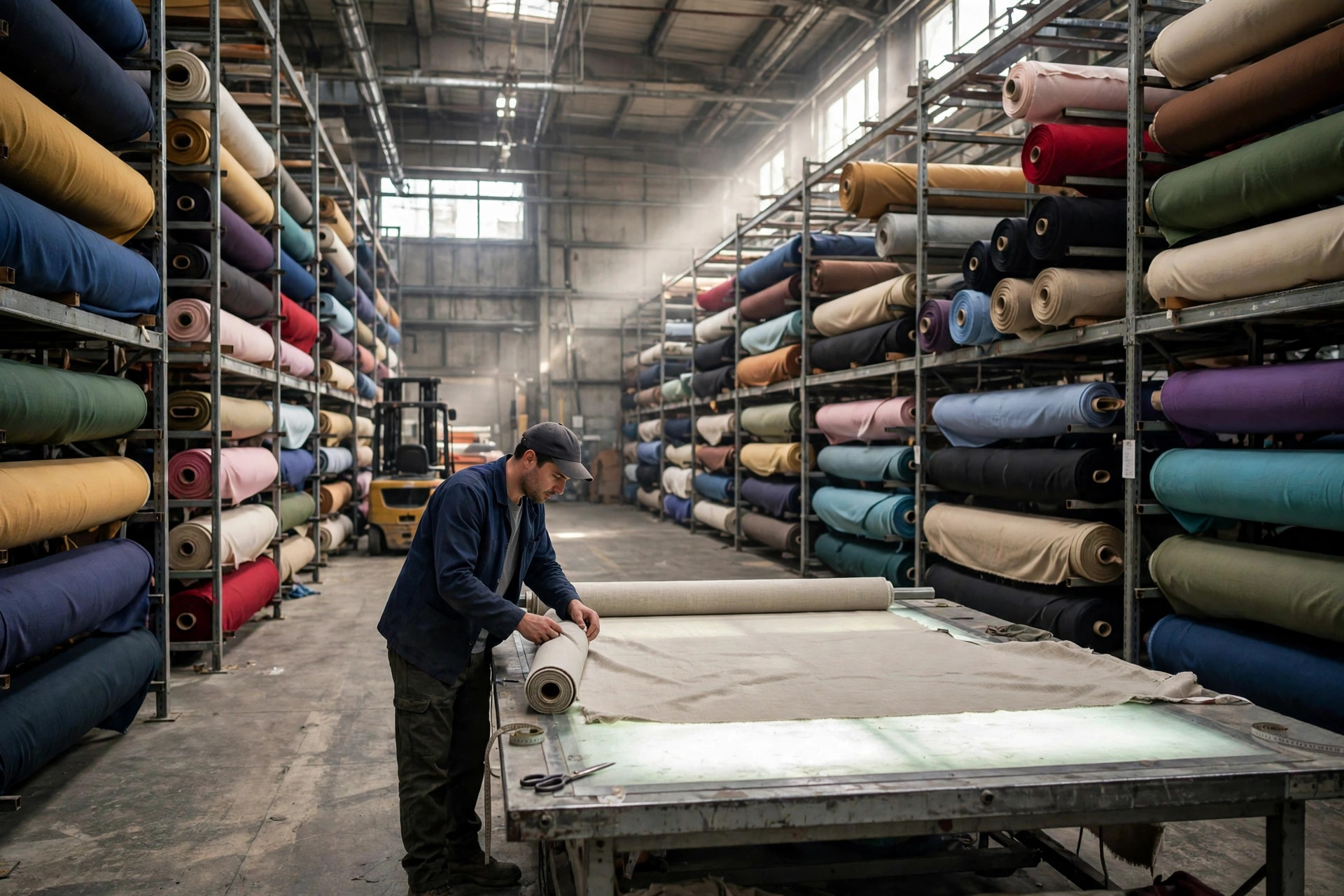
On the shelf, rolls from the same dye lot live in the same bay. The shelf label carries three lines in large print: color, lot number, and remaining yardage. New hires spend three days shadowing an experienced worker before shelving alone.
Picking is stricter still. The pick ticket prints the dye lot number. The picker checks the lot first, then the yardage. If one order can be filled from a single lot, we never split it across two. If the lot runs short, the substitute lot needs a supervisor's signature before anything ships. It is extra work — and it pays for itself in avoided rework.
One detail most warehouses get wrong: label both ends of every roll. Label one end only, and the moment a roll turns around, the label disappears into the rack. Then people pull rolls out hunting for it, the fabric picks up dust, and sooner or later a roll ends up on the floor. Both ends, every roll, photo on file after shelving.
Roll Storage: Hanging Versus Flat Stacking
People ask me all the time whether rolls should hang or lie flat. It depends on the fabric. This is the split we run today, posted on the wall for every new hire.
| Fabric type | Storage method | Limit | Why |
|---|---|---|---|
| Denim, heavy canvas | Flat stacking | Three layers max | Heavy rolls damage cores when hung |
| Chiffon, silk, light cotton | Hanging | One roll per rod | Creases and pressure marks easily |
| Coated fabric, faux leather | Flat, spaced apart | Never stacked | Sticks together and deforms |
| Standard cotton, polyester-cotton | Flat stacking | Three layers max | Durable, saves space |
Heavy fabric goes flat; stack more than three layers and the bottom rolls take permanent pressure marks no washing removes. Light, delicate fabric hangs on a rod through the paper core. Hanging keeps cloth free of pressure and fold lines but eats floor space, so we reserve it for fabrics that truly need it.
Coated fabrics and faux leather are the awkward ones: flat, they stick together; hung, they stretch out of shape. We settled on separate rolls with air gaps and a dust cover on top. It costs an extra rack bay — cheaper than peeling two rolls apart.
That table cost us two crushed rolls of faux leather.
Remnants: Money in the Scrap Bin
Then there is the remnant problem, bigger than most managers admit. After cutting, leftover ends come back: long ones over ten meters, short ones of two or three. Our old habit was a big bin, sold as waste when full. One month I priced that bin at original cost instead of scrap value. It was worth roughly a new forklift.
Now remnants get their own ledger. Anything over five meters gets re-rolled, labeled, and shelved in the remnant area with product name, color, dye lot, and remaining yardage on the tag. Under five meters goes to the sample bin.
The remnant area runs on two rules: first in, first out, and a weekly count. Why weekly? Because remnant records drift faster than any other stock in the building. A tag says eight meters, the roll holds six, and nobody can say where the other two went. Count weekly and you can ask the shift that handled it the same day; count monthly and nobody remembers.
Plenty of managers skip this as fiddly. I ran the numbers: a year of remnant reuse saves enough purchasing to cover two remnant-area workers with room to spare.
Dust and Damp in Fabric Warehouse Storage
Fabric storage has two slow enemies: dust and damp.
Dust first. Cloth on a shelf collects it, and light colors suffer most — dust ground into pale fabric does not wash out. Every roll gets a thin poly bag before shelving, mouth left slightly open for air; an opened roll gets its exposed end wrapped, never left open to the aisle. Forklift lanes get swept at the end of every shift. It looks like housekeeping; it is quality control, because most fabric dust starts as floor dust.
Damp is worse, and here is the counterintuitive part: the most dangerous days are not the rainy ones. On a rainy day, everyone shuts the doors and runs the dehumidifiers. The damage happens when the rain stops, the sun comes out, and someone props all the doors open for fresh air. Humid air rushes in, condensation forms on the rolls, and the cloth suffers more than in the rain. In our warehouse, door opening in the wet season is the shift supervisor's call, not anyone's personal choice — a rule we paid for once.
Our defenses are low-tech on purpose: every roll sits at least fifteen centimeters off the floor and ten centimeters off the wall, nothing on the bottom shelf level, and a humidity gauge hangs by the entrance. Cross our line, and the dehumidifiers go on.
Inspect on Arrival, Not at the Cutting Table
One last thing: inspection. Too many warehouses treat receiving inspection as a formality — open one roll, glance, sign. I do not accept that.
Our rule: three rolls minimum per delivery, ten meters unrolled from each, checking for holes, stains, color streaks, and skewed weave. One defect doubles the sample; a second sends the whole delivery back to the supplier. No hoping it will be fine.
We adopted that rule after a batch of checked fabric passed a one-roll glance and failed at cutting: several middle rolls had a skewed check pattern, and the shirts would not match at the seams. The whole order went back for rework. Since then, only experienced inspectors sign off a delivery.
So if you run a textile fabric warehouse storage operation, here is my advice, and it is short. Keep dye lots separate. Store each fabric the way that fabric needs, not the way that saves the most space. Keep an honest ledger for remnants, because the scrap bin is where profit quietly walks out the door. Systems track the numbers; eyes and hands track the cloth. You need both.
Next time you walk your warehouse, skip the system report for ten minutes and check the racks: which way the labels face, how many layers are stacked, whether opened ends are wrapped. Those ten minutes beat a hundred pages of reports.
By Chen Feng, Warehouse Operations Manager