Bathroom fixtures warehouse storage is not hard because there is a lot of stock. It is hard because every product in the building has a different weakness. Put a toilet on a pallet and nothing happens. Put a bathtub under a load and it slowly goes out of shape. Ship one model with the wrong rough-in distance and the customer cannot install it at all. In this business, the most expensive thing in the building is rarely the rent. It is the truck that comes back loaded with returns and a note that says "wrong model."
Think of it as renting one warehouse to a glassware shop and a gym at the same time. One tenant fears impact, the other fears sustained pressure, and a single set of house rules will fail both of them. You can think of it as sorting by what each product fears, not by product category. Ceramics fear knocks and point loads. Acrylic tubs fear long-term pressure. Vanity cabinets fear moisture. Faucets and small brass parts fear scratches and mixed batches. Once you list the fear, the racking, corner protection, and stacking rules almost write themselves. Skip that list, and no amount of racking will save you.
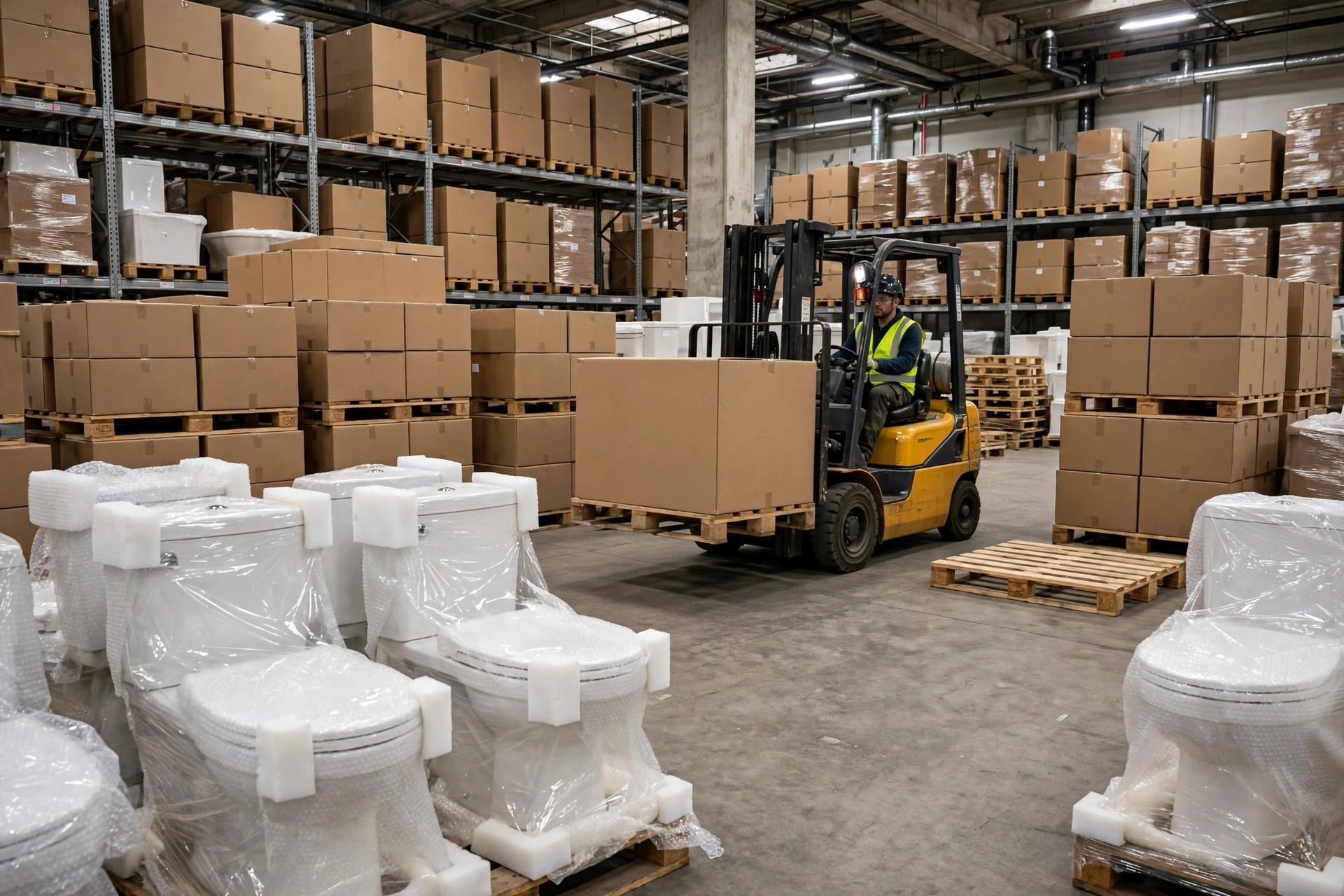
In March 2024, I walked a distributor warehouse in Foshan, Guangdong, that served construction projects. The site was about 6,000 square meters and held more than 800 toilets and bathtubs, with single project orders running to 200 sets. The failure was in toilet stacking. Workers stacked two layers of toilet cartons on wooden pallets to save floor space. The bottom cartons sagged slightly, the glaze rubbed against foam inside the box, and three consecutive project deliveries arrived with damage rates above 4 percent. The fix was unglamorous: one layer per pallet, rigid dividers between cartons, and a hard cap of 800 kilograms per pallet. Two months later the damage rate was under 1 percent. Ceramic damage rarely comes from one big hit. It comes from sustained load plus repeated handling, grinding away a little at a time.
Bathroom Fixtures Warehouse Storage Starts With Physics: Ceramics and Acrylic Fear Different Things
A ceramic toilet or basin usually weighs 30 to 50 kilograms. One person can shift it, two people can carry it safely. Its weak points are the edges and the glaze. A chipped edge is a reject, a scratched glaze is visible the moment the customer opens the box, and neither defect has a "good enough" version. That is why corner protectors matter and why they must sit on all four corners, not just two pieces of foam tossed into the box. A wrap of stretch film around the carton is not about dust. It stops cartons from rubbing against each other during handling.
An acrylic tub is the opposite problem. An empty tub often weighs only 30 to 60 kilograms, so two people can carry it easily, yet it hates pressure. A tub is a hollow shell. Leave weight on it for weeks and the rim and base creep out of shape, and by the time it reaches a bathroom the level is off. Freestanding tubs are the worst case because no cabinet supports the shell; the curve carries the whole load. I have seen a warehouse stand tubs upright against a wall to save space. The rim loaded unevenly, and within three months more than a dozen tubs in one batch showed slight deformation. The return freight cost more than the floor space that was saved. Tubs must lie flat, one layer only, on a level base, with nothing stacked on top, not even a light carton of fittings.
Vanity cabinets bring a third weakness: moisture. Cabinet bodies are board with a veneer or laminate finish, and a ground-floor bay against a damp wall will bubble the finish and warp doors. Faucets and hardware are small, valuable, and easy to mix up. One drawer holding angle valves from three brands is a picking error waiting for an order. List the fear first, then choose the storage. List it wrong, and the warehouse will punish you on every shift.
Bathroom Fixtures Warehouse Storage Has a Clear Dividing Line: Racks Versus Floor
In bathroom fixtures warehouse storage, the dividing line is not product value. It is turnover and bulk. I use three questions, and I do not decide a location until all three are answered: how many times a month does this item ship, does a single unit exceed one standard pallet footprint, and does picking usually take a full pallet?
| Product group | Storage method | Stacking limit | Check before picking |
|---|---|---|---|
| Toilets, basins, and other ceramics | Heavy-duty beam racking or single-layer pallet | One layer per pallet, no carton stacking | Corner protection, glaze, rough-in distance |
| Acrylic and freestanding tubs | Flat floor zone on a level base | One layer, nothing on top | Rim flatness, shell deformation |
| Vanity cabinets | Mid-level racking, off wall and floor | One layer, raised at least 15 centimeters for moisture protection | Door alignment, veneer bubbling |
| Faucets and hardware | Shelving with divided bins | One model per bin, no mixing | Brand, model, connection size |
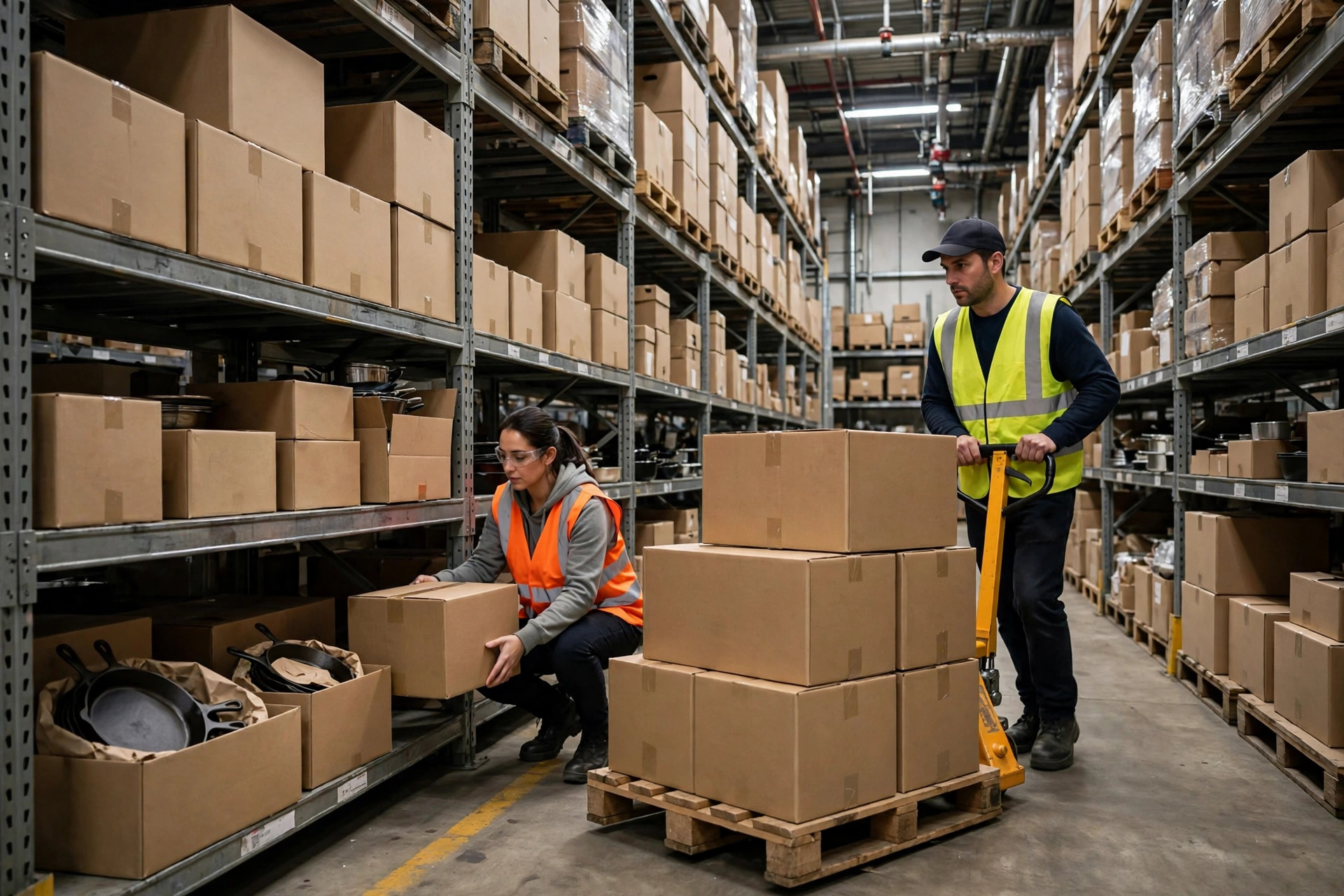
Fast-moving toilets belong on racking, where a forklift can pull a full pallet in one cycle. Slow-moving tubs belong on the floor, where skipping the racking saves money and protects the shell. When someone proposes an automated storage system for this kind of stock, I push back hard. Toilets and tubs are large, slow, and irregular. Automated lanes, forks, and pallet specs are built around standard cartons, and a tub more than 1.7 meters long destroys the space utilization the system was sold on. The money goes in, the throughput does not come out. That is what a fake requirement looks like: automation applied to freight that never needed it.
In September 2025, an online bathroom seller in Hangzhou asked me to review its picking errors. The warehouse was about 3,000 square meters with more than 1,200 SKUs. One toilet series alone split into a dozen models, and cartons for 305-millimeter and 400-millimeter rough-in distances looked almost identical. During the week before a major sale, pickers grabbed cartons by size and color, and the mispick rate ran above 2 percent for three straight days. Customer messages about products that "do not fit" flooded in. The fix was almost embarrassingly simple: one model per location, a large label on each carton showing model plus rough-in distance, and a barcode scan that checks the rough-in field before release. No scan, no shipment. Within two weeks the mispick rate fell below 0.3 percent. A system can hold perfect master data, but one mixed location cancels all of it.
The Maintenance Trap: A Wrong Model Costs More Than a Broken One
In bathroom fixtures warehouse storage, most warehouses count damage and stop there. The bigger bill is mispicking. A damaged unit costs you that unit plus freight. A wrong unit costs you freight both ways, customer service time, trust, and, on a project order, a missed installation window. Here is the rough math I use. A warehouse shipping 5,000 units a month with a 1 percent damage rate loses 50 units. A 1 percent mispick rate is also 50 units, but each mispick costs roughly two to three times as much as each damaged unit because it travels twice and consumes a manual recheck. Cutting mispicks from 1 percent to 0.3 percent removes 35 problem orders a month. That saving alone pays for a full refresh of corner protection across the building, with money left over.
Three maintenance traps show up again and again. The first is worn protection: foam corners that have collapsed get reused for "one more round," which means no protection at all. During patrols, collapsed corners go straight in the bin. The second is creep in the floor zone: today two cartons of fittings, tomorrow a pallet of faucets, and the tub area quietly turns into a general storage area, bringing deformation risk back with it. The third is counting quantity without counting specification. An inventory sheet that says "120 toilets" without rough-in distance and glaze color is not accurate, it is fiction. Cycle counts must go down to model plus the specification that decides whether the product fits.
So is the money worth it? Judge it by one number: damaged plus mispicked units per 10,000 units shipped. Get that number under 50 and every label, corner protector, and scan step has paid for itself. Miss it, and do not talk about automation or expansion yet. Put one model in each location, replace worn protection, and enforce the picking scan. Do those three things properly, and the number will move.
By Da Liu, Automation Engineer