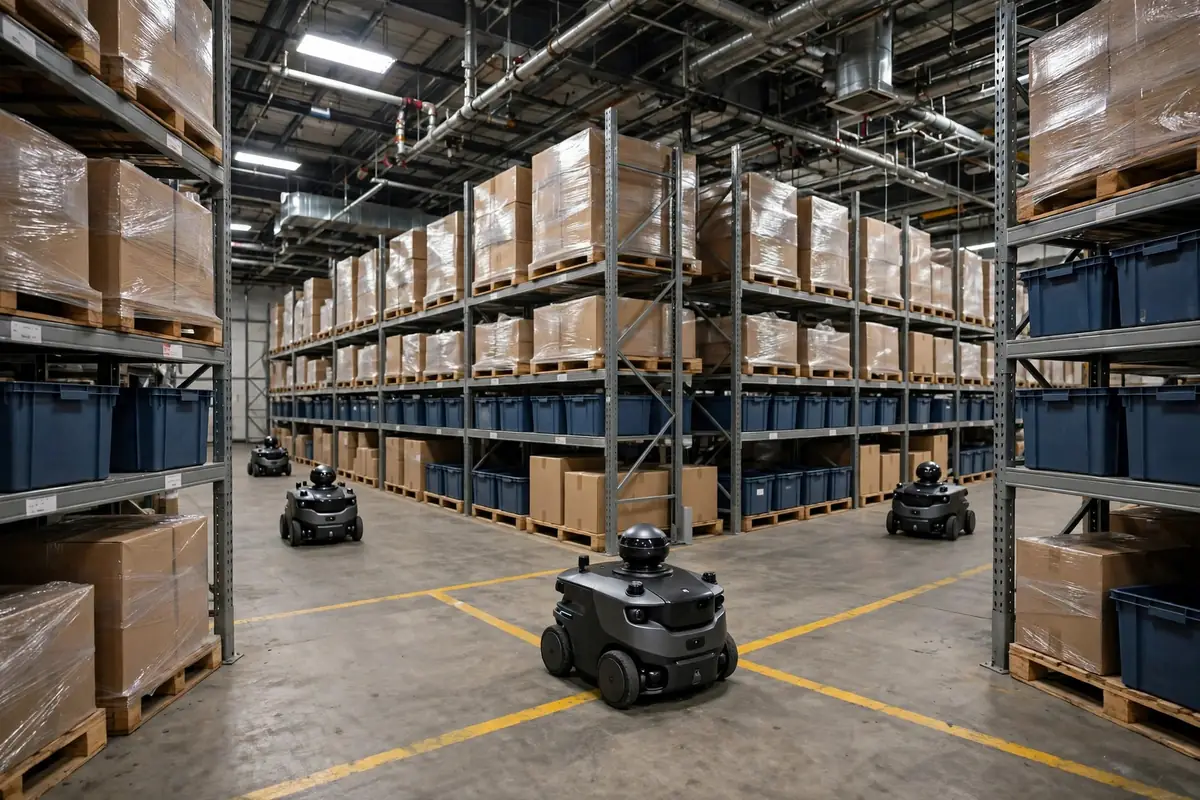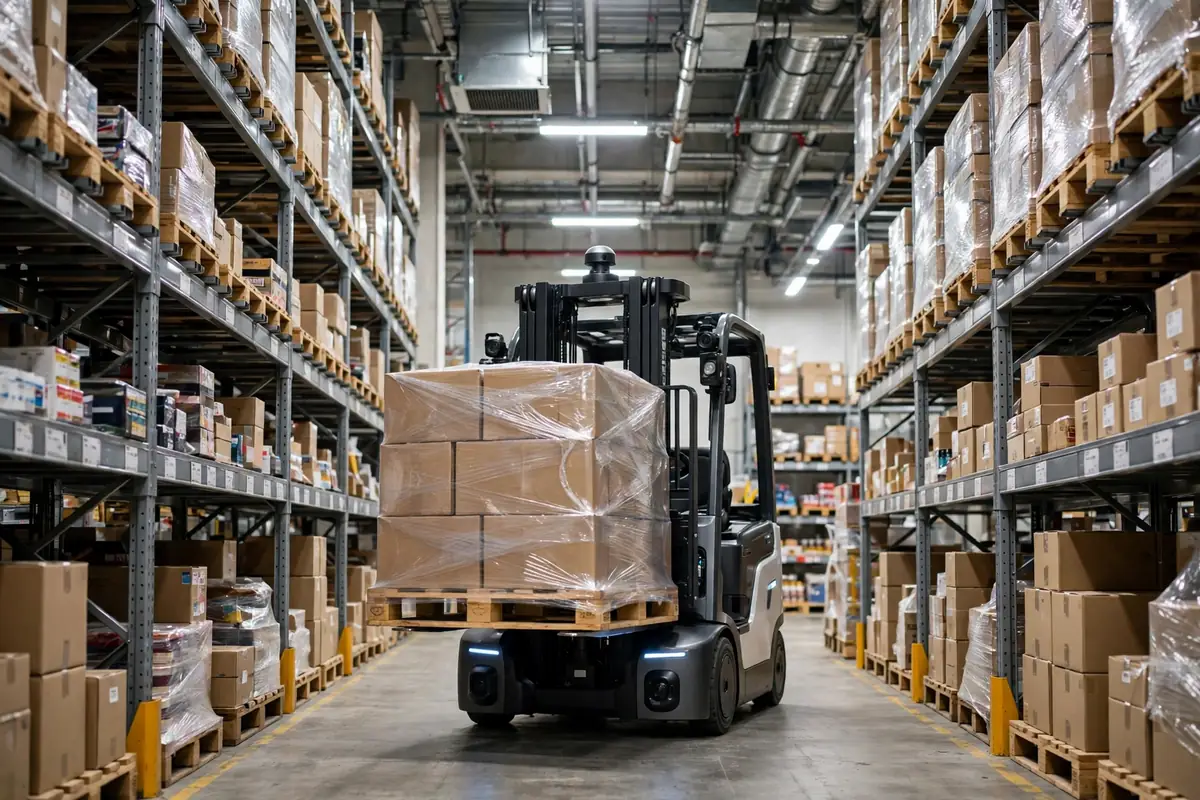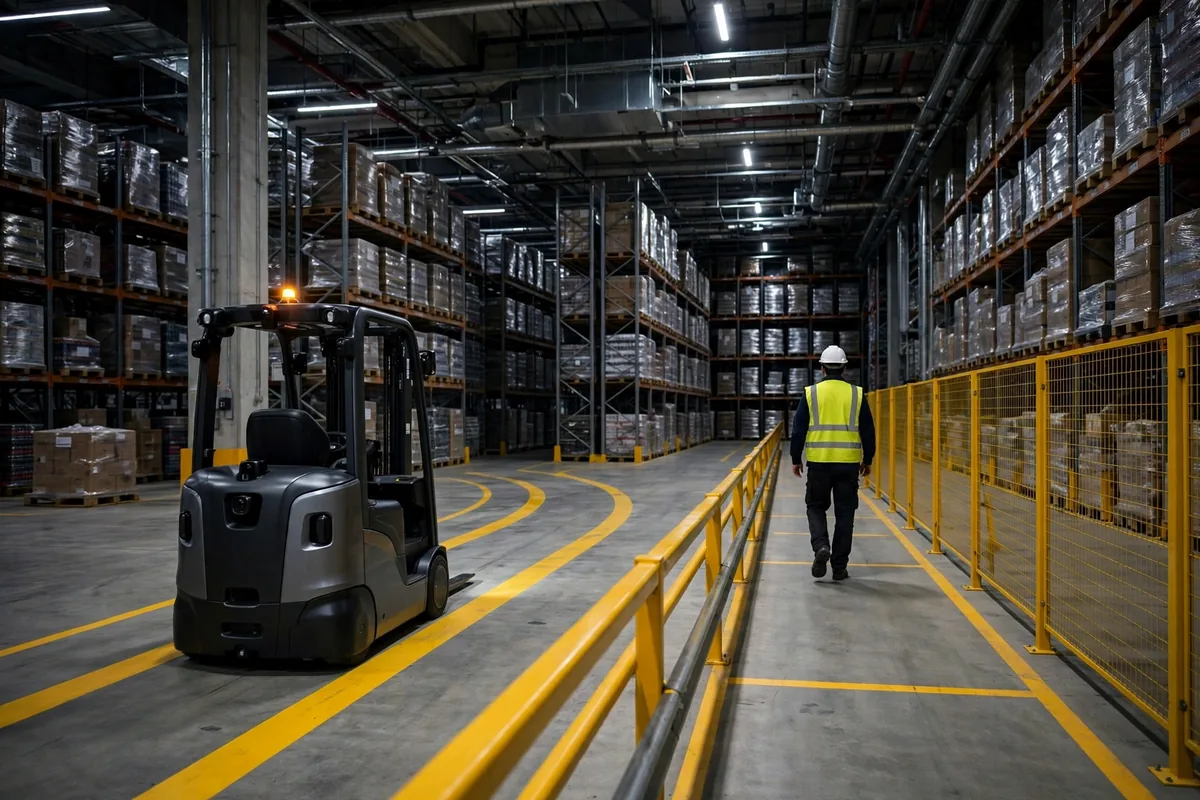
Autonomous forklift warehouse safety rules are not wall posters. They are the working agreement between people who walk and machines that never get tired or distracted. In June 2024, at a consumer-goods distribution centre in northern China, a driverless forklift stopped dead in a cross-aisle because a picker stepped out from behind a rack. Nothing was hit, yet the line lost 31 minutes: the second truck, three metres behind, could not see the picker, so it stopped too, a third queued behind it, and the aisle locked up until a supervisor walked it clear. Most shared-floor failures are not crashes. They are misunderstandings, multiplied by traffic.
Before the floor rules, get the standards straight, because they are the only numbers here that come from a document rather than a job site. ISO 3691-4:2023, the second edition published in June 2023, replaces the 2020 edition. It requires the manufacturer to carry out formal hazard identification and risk assessment under ISO 12100, and safety functions must meet the performance level, PL, in ISO 13849-1. In North America the main framework is ANSI B56.5, published by the Industrial Truck Standards Development Foundation and referenced by OSHA; in the European Union, CE certification follows the ISO 3691-4 route. They cover the truck as a product, not your floor. Nobody in Geneva knows where your cold-store door fogs up. That part is yours.
Autonomous forklift warehouse safety rules start with ownership, not paint
The usual mistake is to start with paint. Ownership comes first: at any given moment, who does this piece of floor belong to? On our sites we run three kinds of zone, written into the shift handover sheet. Autonomous-only: trucks run, people stay out, doors interlocked. Shared: both may enter, the truck holds the right of way, people stay in a marked walking strip. People-only: trucks stop at the boundary and wait. A zone without an owner is decoration.
We learned that the hard way. In March 2025, at a cold-storage site outside Tianjin, the dock-door aisle was a shared zone by day. On the night shift, a supervisor verbally reclassified it as autonomous-only to speed up outbound loading. Nobody told the night crew. A stocktaker walked in on his daytime habit, a forklift came through at autonomous-zone speed, and its lidar picked him up late through the fog at the cold-store door. The truck stopped in time. The man fell backwards getting out of the way, sprained his ankle, and the line stopped for 23 minutes. Our site rule since then: a zone changes state only through the system, with a record of who changed it, when, and who was notified. A verbal change does not count.
Between zones, leave a buffer: a transition strip at least one truck-length deep, hatched on the floor, where trucks drop to crawling speed and people cross only at a marked crossing. Think of it as the run-off area beyond the touchline. It exists for the worst moment, a person stepping out from behind racking just as a truck turns out of the aisle. Before you draw any of this, settle what autonomous forklifts are actually good for: long, fixed, repeatable hauls suit driverless trucks; docks where people constantly load and change their minds do not. Zone a job wrong and every rule afterwards is a patch on a bad decision.
Autonomous forklift speed limits and intersections: predictable beats slow
Here is the counterintuitive part: making everything slower does not necessarily make a shared floor safer. We tried that at a home-appliance warehouse in 2023, after a forklift knocked over a stack of empty pallets in aisle B. The trucks got so slow that pickers started overtaking them on foot and cutting across in front of them. Unauthorised crossings went up, not down. What matters is predictability: can a person ten metres away tell at a glance how fast that truck is moving and whether it will stop?
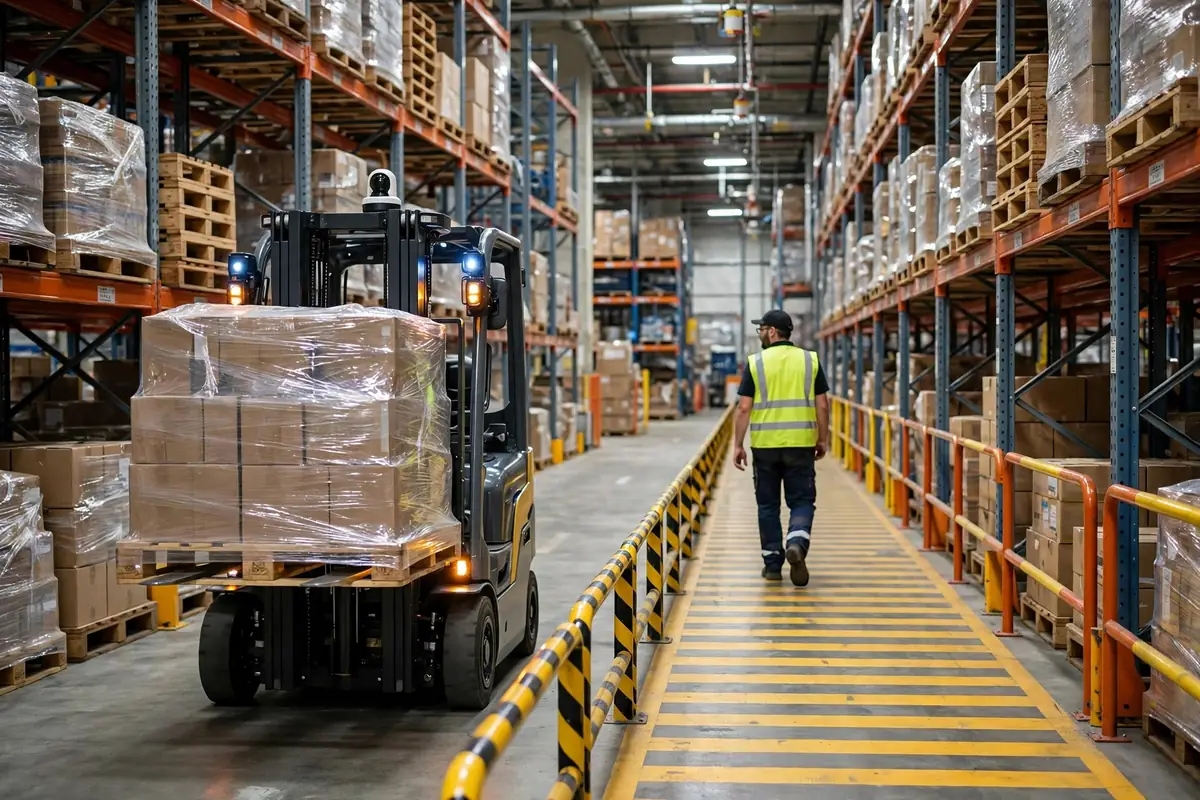
Our site practice is tiered speed by location, each tier paired with a fixed light-and-sound signal so nobody has to guess. Autonomous-only straights run at the truck's rated pace, shared aisles near walking pace, and intersections and rack exits drop another notch, with the truck slowing for the intersection whether or not anyone is there. The rule has to live in the floor and the system at once: stop lines on the ground, mirrors and warning lights on both approaches, and the intersection registered as a mandatory slow-down point.
Blind spots get their own register, and this is the part most sites skip. Every rack end, cold-store doorway, pillar, and corner where tall stock blocks the view gets a number, a sign saying in plain words "the truck cannot see you here," and a mirror or floor marking to go with it. The maintenance trap: a dirty lidar window, a curled reflective strip, a dead warning light. None of these is a minor defect. Our site practice puts them on a ten-minute pre-shift checklist, and a truck that fails it does not enter a shared zone that shift.
Graded stops: who clears a stopped autonomous forklift
A stop rule with only two settings, go and stop, does not survive contact with a real shift. Our site practice is three levels, each with its own trigger and reset authority:
| Level | Trigger | Truck action | Who resets it |
|---|---|---|---|
| 1, slow | Person in warning zone, or obstacle ahead | Slows, light and sound warning | System, automatically |
| 2, stop | Person in danger zone, or intersection obscured | Stops until area is clear | Shift lead, after a visual check |
| 3, lock out | Contact, sensor failure, emergency stop pressed | Powers down, locks, no remote reset | Equipment engineer, on site |
Reset authority is the point. A Level 2 stop goes to the shift lead, who is standing there and can see whether the person has actually left. A Level 3 lockout goes to the engineer, because a failed sensor has a root cause you cannot see from outside, and clearing it remotely puts the fault back into service. Every stop logs four things automatically: time, place, trigger, and who reset it.
Ownership of exceptions has to be decided before the exception happens. Our site practice splits it three ways. A floor exception, a person crossing where they should not or a pallet falling, belongs to the shift lead: stop the line, clear the people, then restart. An equipment exception, a sensor alarm, lost localisation, or a truck off route, belongs to the equipment engineer, and the shift lead does not reset it privately. Two Level 2 or higher stops at one location escalate to the safety owner the same day, with a written cause analysis and a fix: rezone, reroute, or change shifts. We also count by location: three Level 2 or higher stops in a month, and that location loses shared traffic until the cause is found.
Now the money. Before the incident, the appliance warehouse had skipped the intersection lights and transition strips in its shared aisles, saving, by our site estimate, a few tens of thousands of yuan. The pallet incident cost 47 minutes of stopped line, and the cold-store incident another 23: more than an hour of lost outbound volume, overtime to catch up, and a customer claim, all comfortably larger than the money saved. Cost safety work by one unplanned stop times how many times a year you expect one, reviewed quarterly. If the count is falling, the rules are working. If one location keeps triggering, the rules are wrong there.
Finally, the maintenance trap, and where I get blunt about pseudo-demand. Somebody always proposes wrapping every truck in extra sensors and adding a second vision system, as if more hardware were the same thing as more safety. It is like fitting airbags to a bicycle: expensive, and aimed at the wrong problem. More sensors mean more false alarms, and false alarms teach people to work around the system. Get four basics right first, zoning, tiered speed, graded stops, and the daily checklist, run them for three months, look at the data, and only then decide what hardware to add and where. The order is not negotiable.
So is the money worth it? That is what autonomous forklift warehouse safety rules are ultimately for: not a thicker manual, but a floor where people and trucks stop surprising each other. Watch one number: Level 2 and higher stops per 1,000 shared hours caused by a person crossing where they should not. If it is falling, people have learned the rules. If it is flat or rising, something in the zoning, the speed, or the signals is wrong. Go back and fix the rule. Do not buy another sensor.
By Da Liu, Automation Engineer