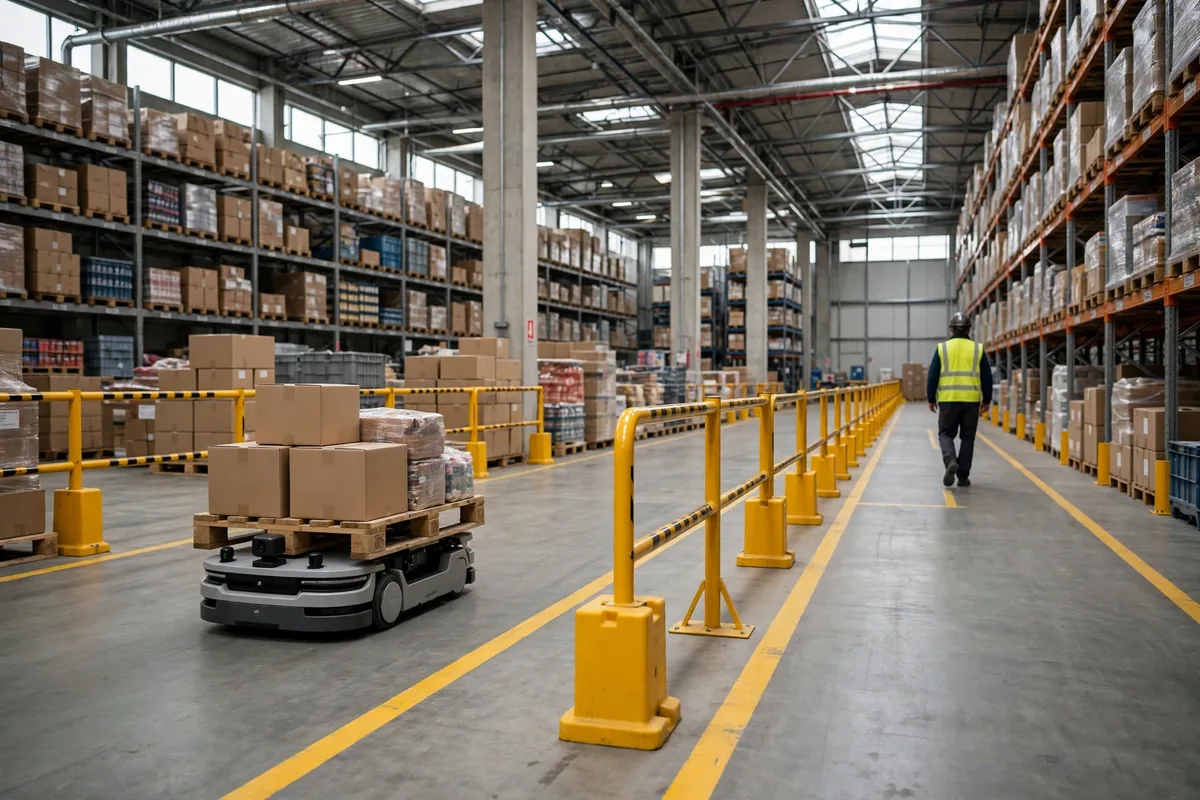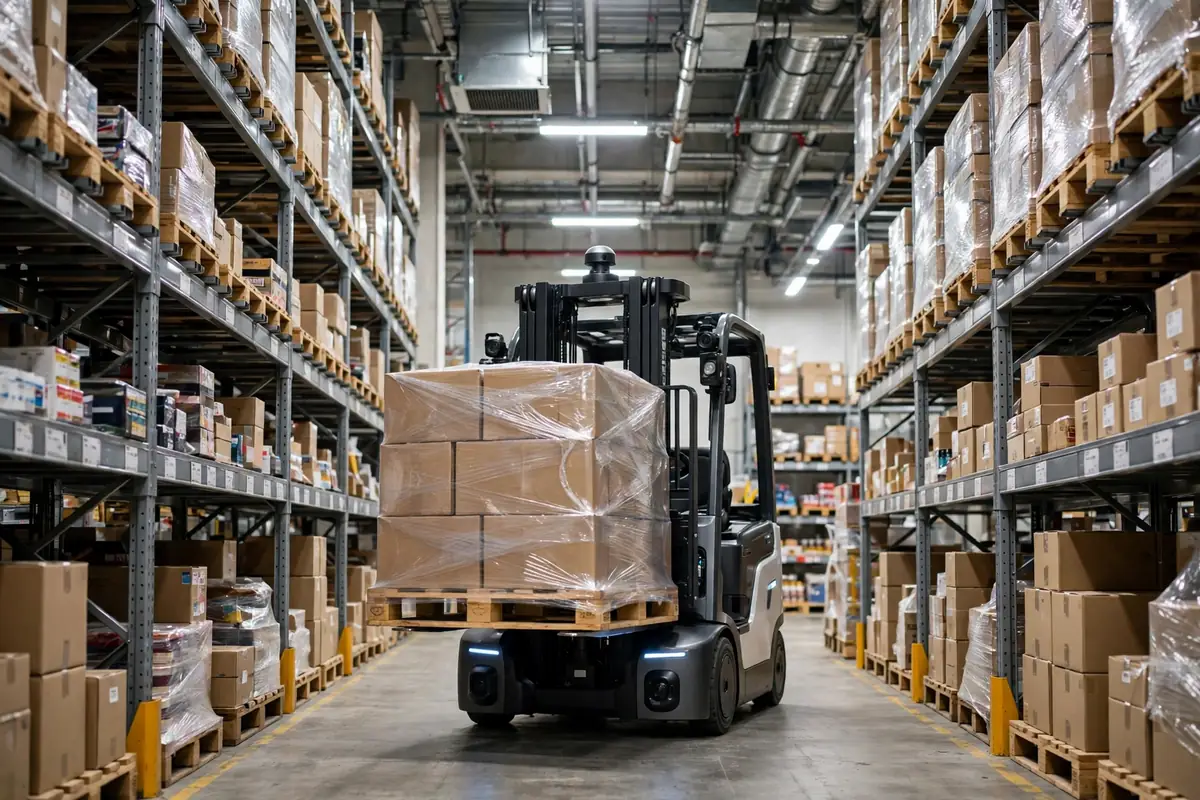
Last fall, the owner of an auto-parts 3PL slid an autonomous forklift warehouse quote across the table: two driverless forklifts at $180,000 each. One question: "Da Liu, does this pay for itself in three years?" I did not answer. I asked three questions back. How many shifts do you run? What does a forklift driver cost you per month, all in? How many pallet trips run from receiving to storage each day? He could not answer the third. That is the first problem with most autonomous forklift warehouse purchases: the price gets scrutinized to the dollar while the payback math gets guessed.
Here is the honest starting point. Based on public pricing guides for 2026, a forklift-style AGV runs roughly $60,000 to $150,000, and a self-navigating autonomous forklift runs roughly $100,000 to $300,000. Sounds expensive — until you learn the truck itself is only about 40% to 60% of the total project cost. The rest goes to fleet software, WMS integration, site mapping and commissioning, charging infrastructure, spares, and maintenance. Buyers who haggle the truck price down by $20,000 and then swallow a bloated integration bill have saved nothing. They just moved the cost to a different line.
Autonomous Forklift Warehouse Payback: Count Labor First, Then Cycle Time
One driverless forklift replaces roughly two to three forklift drivers on a three-shift operation. The math works like this: a staffed forklift costs about $15 to $25 per operating hour once you include wages, benefits, overtime, and injury risk. A driverless unit runs at about $3 to $6 per hour — mostly electricity, maintenance amortization, and consumables. A fourfold gap per hour looks decisive. It is only real when the truck keeps moving.
Run the numbers yourself. The example below uses stated assumptions: assume a fully landed cost of $250,000 per truck, including vehicle, software, integration, and charging. Assume it runs 20 hours a day, 300 days a year. Assume it saves $14 per hour against staffed operation. Annual savings come to 20 × 300 × 14, or $84,000. Divide $250,000 by $84,000 and payback lands near three years. Now change one variable. Run it a single eight-hour shift and annual savings drop to $33,600 — payback stretches past seven years. That is why the commonly cited ranges look like this: multi-shift operations running 20 hours or more a day pay back in roughly 12 to 18 months; two shifts in 18 to 30 months; single shift in 24 to 36 months, with two to four years as the broad industry range. The same truck is a money printer in a three-shift warehouse and a very expensive ornament in a single-shift one.
Here is the counterintuitive part. Most owners compare a driverless forklift against a manned forklift. Wrong benchmark. The real competitor is not a truck — it is a crew that never calls in sick, never hits a rack, and is still running at 3 a.m. A manned forklift is cheap on purchase day and expensive every day after: recruiting is hard, night-shift premiums keep rising, seasonal temps need training, and one rookie mistake can wreck a pallet of goods. In 2024 I worked on a project at a food 3PL in Ohio that could not staff its night shift for months. Day-shift overtime covered the gap, and two months of overtime burned more than $40,000. Once the driverless units took over the night lane, the owner told me the overtime savings mattered more than the wage savings. That is the part the brochure never prints.
Three Numbers to Measure Before Buying an Autonomous Forklift
Do not trust the sales deck. Measure three numbers yourself. First, daily pallet trips on fixed routes. A driverless forklift earns its keep on repetitive, fixed-lane moves. Fewer than about 150 trips a day on a lane means the truck spends half its life idle, and the payback math falls apart. Second, storage height. Autonomous forklifts can lift to about 35 feet, roughly 10.7 meters, but high-bay putaway speed and stability have to be tested on your floor, not read off a spec sheet. Third, floor and environment. Damaged floors, ramps, cold storage, and heavy dust all degrade navigation accuracy and push maintenance costs up — commissioning can easily take twice as long as quoted.
There is also a hard line in equipment selection. A forklift AGV follows fixed routes on magnetic tape or QR codes: cheap, but re-routing is painful, so it fits warehouses whose layout will not change for a decade. A self-navigating autonomous forklift uses laser or visual SLAM, dodges obstacles on its own, and re-routes dynamically: pricier, but flexible, and right for operations where volume swings and layouts shift. Before locking in a vehicle type, check your operation against a clear map of autonomous forklift warehouse use cases — if the use case is wrong, even the cheapest truck is the wrong purchase. I have watched buyers pick the cheap AGV on unit price, then pay more than the savings a year later to re-lay tape and re-commission when the business changed. More than once.
Safety is non-negotiable. The governing standards are ANSI B56.5 and ISO 3691-4:2023. Ask the vendor for compliance evidence against those standards, not a casual "we have lidar." During acceptance testing, run three live checks: a person stepping into the path, a tilted pallet, and debris on the floor. The truck must stop cleanly in all three. A unit that fails safety testing does not enter the building, whatever the discount.
One more cost people forget: maintenance. Driverless forklifts are not "fix it when it breaks" machines. They run on hour-based preventive maintenance. Batteries, drive wheels, and laser heads are consumables, and the service contract should lock in response times and spare-parts pricing. Some vendors quote a low truck price and then charge premium annual maintenance — over three years the total bill ends up higher. Put three years of maintenance into the payback model before you sign.
And a blunt word to close. The biggest fake demand in this category right now is "our competitor has one, so we need one." A single-shift warehouse with unsaturated volume and unstandardized processes is buying automation to compensate for management gaps. Sort out locations, flows, and shifts first, then talk driverless. On the other side, a warehouse running full shifts on fixed lanes that cannot hire night staff should not hesitate. Whether the money is worth it comes down to one number: effective running hours per day. Hold steady above 16 hours, and a three-year payback is a likely outcome. Below 10 hours, do not buy yet.
By Da Liu, Automation Engineer