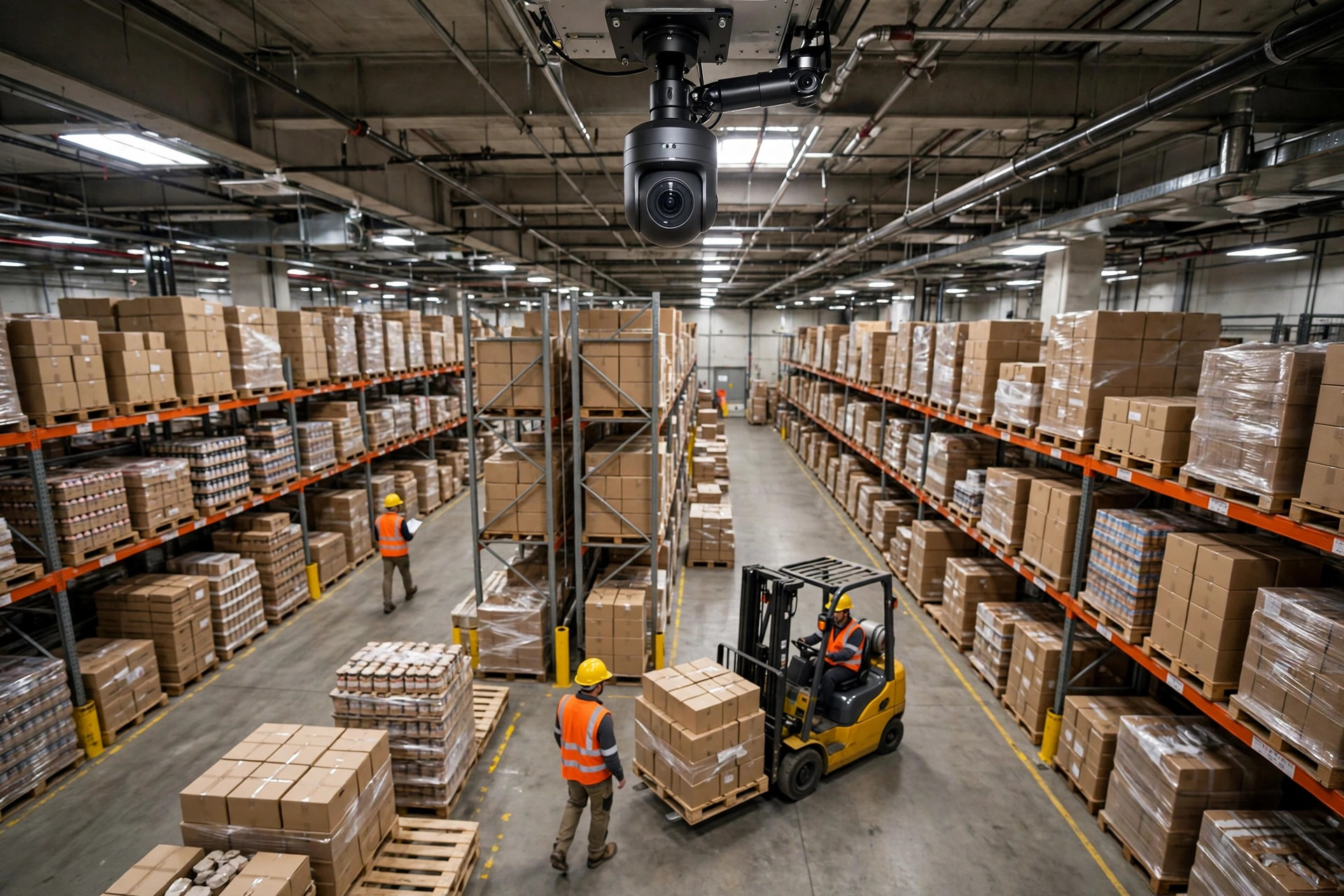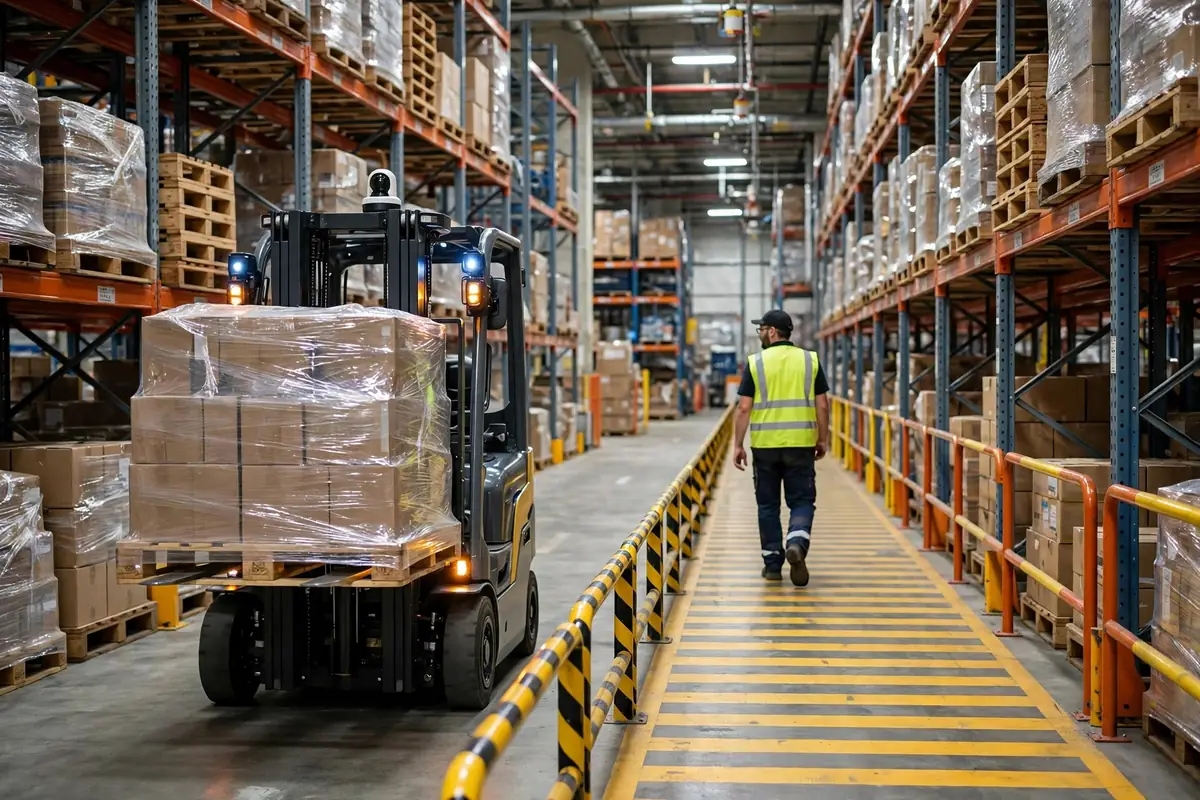
An autonomous forklift warehouse is not dangerous because the truck is fast. It is dangerous in the first week because people still walk the way they always walked. A picker cuts diagonally out from behind a rack. A handler pushes an empty pallet jack across the main aisle. In a warehouse run by human drivers, eye contact and a horn sort most of that out. A driverless truck has no eye contact. It has sensors and rules, and wherever the rules are silent, that is where the accident is waiting.
Take an illustrative scenario: April 2026, a 3PL warehouse of 80,000 square feet near Ontario, California, runs two driverless trucks moving pallets between dock and staging. Three quiet days. On the fourth afternoon, at 3:40 p.m., one truck brakes hard at a cross aisle and six cartons slide off the pallet. The sensor did its job — a picker pushing an empty pallet jack came out of a blind spot, and the truck stopped exactly as programmed. It stopped too hard, and the load was not secured for that kind of stop. The truck was not the problem. The deployment never mapped where people actually appear from.
That is why the use cases have to be settled before the routes are drawn — a clear-eyed look at which jobs driverless trucks fit, and which jobs they should not touch comes first, since zones and speed caps are just patches if the job itself was the wrong pick.
Why an autonomous forklift warehouse slows down on purpose
The first question most buyers ask is how fast it goes — the wrong question, like asking how fast a school bus should go past a school gate. The engine does not decide that.
The public numbers make the trade-off plain. One vendor's driverless truck tops out at 4.5 mph in autonomous mode, while the same truck in manual mode reaches 11 mph — more than half the speed deliberately given away. Another vendor rates autonomous travel at 2 metres per second, loaded or empty, with no empty-sprint trick. In tight aisles the cap drops to 2 to 3 mph, and near docks and pick stations it drops to 1 mph. These are not conservative vendors. They are the hard edge drawn by sensor reaction time: faster means a longer stopping distance and less time left to decide.
| Zone | Speed cap | Why this number |
|---|---|---|
| Open main aisle, no pedestrians | Up to 2 m/s | Clear sightlines, straight run, room to stop |
| Mixed-traffic aisle, people and trucks | About 3 mph | Someone can step out between racks at any moment |
| Cross aisles and blind corners | 1–2 mph | Worst blind spots; two seconds saved is not worth it |
| Near docks and pick stations | 1 mph | Crowded, hand trucks everywhere, precision beats pace |
| High-bay aisle | Set by load, one notch lower when fully loaded | High centre of gravity; a hard stop shakes the load |
Here is the counter-intuitive part: slowing the truck down can raise pallets per shift. A truck that sprints, brakes hard and waits for re-stacking will often move fewer pallets than one running steadily that never triggers an emergency stop. Hard stops are the enemy of throughput, not the price of safety. Lock the caps in the system as well — a cap anyone can casually change back is no cap at all.
The autonomous forklift warehouse blind spots no drawing shows
A LiDAR datasheet can look impressive: one vendor quotes detection out to 40 metres at 2-centimetre accuracy. The number is real and the conclusion is false — that 40 metres was measured on an empty test track, against a standard reflector, with no obstruction. Your warehouse is not a test track.
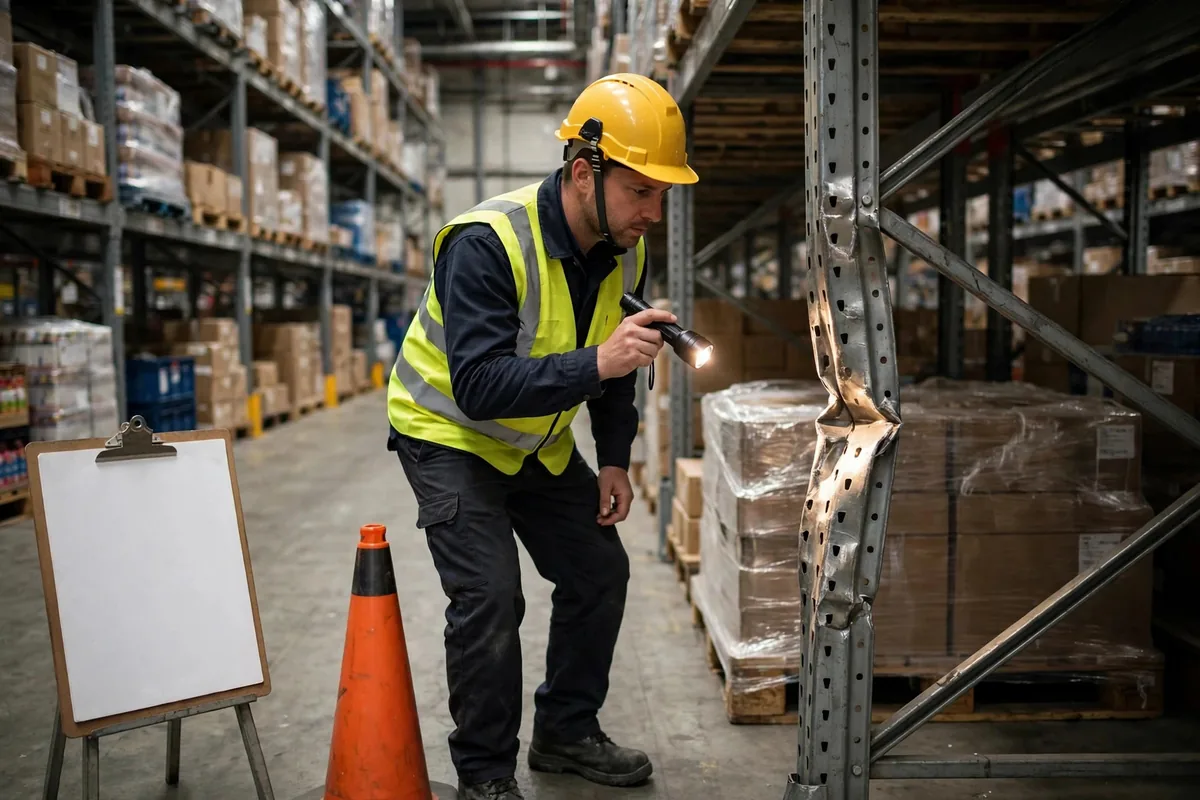
Three blind spots get missed most often. The first appears once the forks go up: the load itself blocks the lower half of the forward sensor, so the truck can see far away and cannot see its own feet. The second is the corner, where rack uprights and pallets stacked 2 metres high chop the view into slices — the sensor sees perhaps one metre past the turn, leaving under half a metre of stopping distance once a person's leg appears. The third is the floor: stretch wrap, loose cardboard, a patch of water — LiDAR can sweep straight over it, a wheel slips, and localisation drifts.
The stakes are not theoretical. The U.S. National Safety Council recorded 67 worker deaths involving forklifts in 2023, and OSHA estimates roughly 34,900 serious forklift injuries a year. Those figures cover all forklifts, not driverless ones — but this category of machine does not have a small-accident problem. Automation swaps "a person made a mistake" for "the system failed to see something." The risk does not disappear; it moves somewhere else and hides.
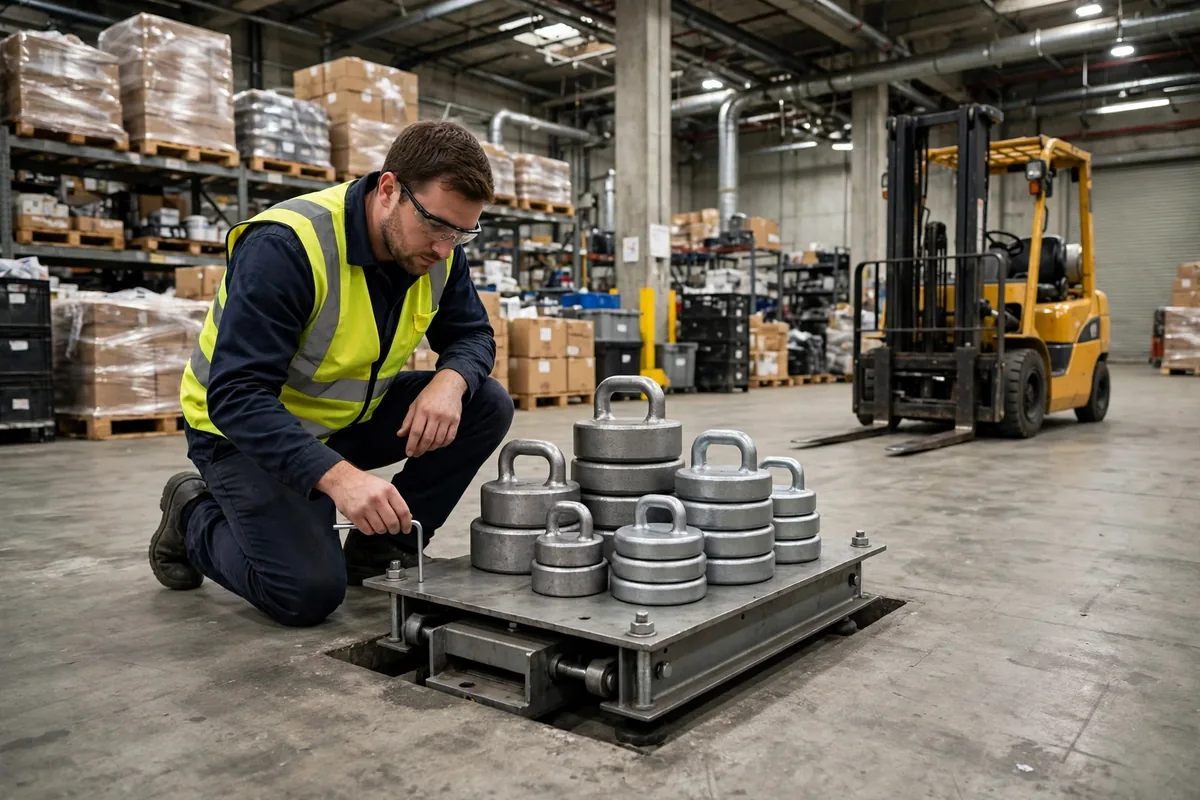
Maintenance is where that hiding place gets comfortable. A dusty LiDAR lens quietly shortens detection range, with no alarm — the stopping distance just gets a little longer every day. I put lens cleaning on the per-shift checklist and mop the autonomous lanes twice a week. Once a month, run an empty truck at full speed on a night shift and log stopping distance against day one; if it has drifted up more than 10%, stop the line and find out why.
My acceptance test is deliberately crude. The night before go-live, take two people — one pushing an empty pallet jack, one carrying a carton — and have them step out of every blind spot at each junction, corner and rack end. The truck has to stop before contact, stop smoothly, and keep the load still. Run it 20 times per spot, logging stopping distance and load condition. One failed set means that zone stays closed. A vendor test report is no substitute for this run in your own building. Your rack heights, your stacking habits, your lighting — none of them are in the vendor's report.
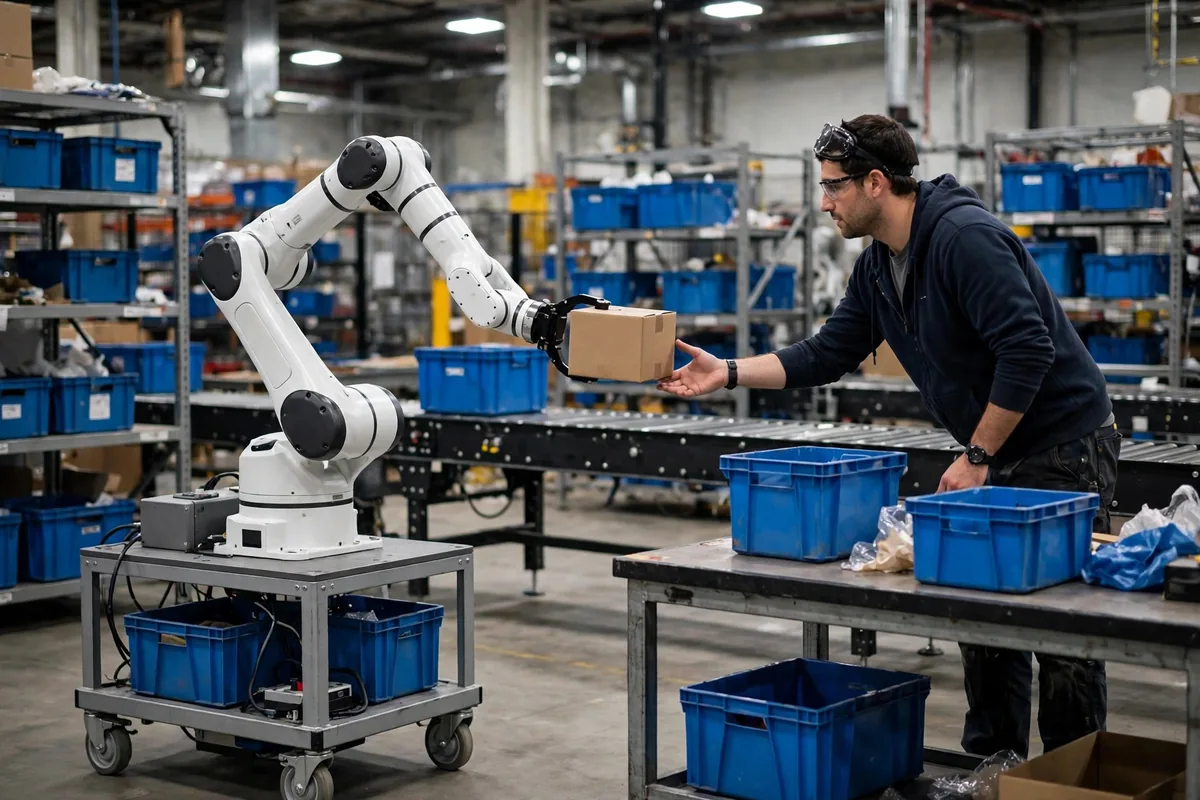
Mixed-traffic rules need the same bluntness. Pedestrians stay inside marked walkways and trucks stay out of them. At any junction, the driverless truck yields by default, whether or not it has "seen" anyone. Where manual and driverless trucks share an aisle, the manual truck runs with lights on and horn used, and the driverless truck runs at its lowest cap. In practice it is one idea: never let two parties — one a person, one a program — guess what the other is about to do at the same time.
The night before go-live, run this table
Go-live is not a ribbon cutting. It is an exam: every line below gets ticked the night before, and any failure means a delay and a retest the next morning.
| Check | Pass standard | Who signs |
|---|---|---|
| Emergency stop | Every e-stop point halts the truck; restart needs a human reset, never automatic | Equipment lead |
| Blind-spot runs | 20 runs per junction and corner, zero contact, load does not shift | Safety lead |
| Network and power loss drill | 30 seconds offline: truck parks safely in place, no wandering, no lost task | Integration engineer |
| Mixed-traffic drill | Manual truck, pedestrians and hand trucks together for one hour, zero emergency-stop alarms | Warehouse manager |
| Floor and markings | Route markers legible, no damage, water or debris in the lanes | Shift supervisor |
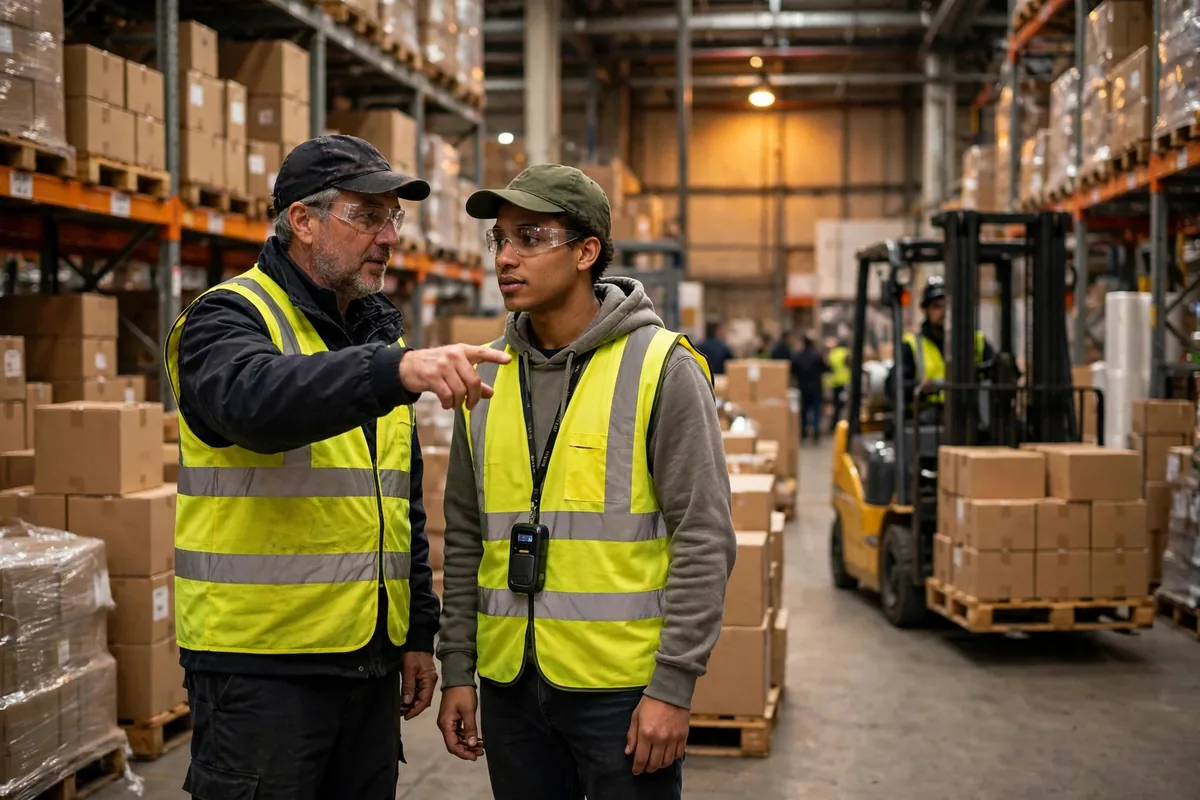
Two items get forgotten most often. The first is training — not how to drive the truck, but how not to provoke it. Do not stand in its lane on the phone, or stage a pallet in the autonomous aisle "just for a minute." Keep an attendance sheet; anyone who has not attended does not work that zone. The second is a rollback plan: keep one manual truck on standby for the first week, so a fault costs a swap, not a missed ship window. People call that waste. It is the reason you can afford to find problems in week one instead of hiding them.
Whether the money was worth it comes down to one number: human-machine-conflict emergency stops per thousand pallet moves in the first 90 days. Under 2, your zones and rules are holding. Still above 10, your map and speed caps are paperwork — and the faster the truck, the uglier the bill.
By Da Liu, Automation Engineer