Automated warehouse rack deformation inspection is not a walkthrough. It is the first line of defence for rack safety in an automated warehouse. A stacker crane follows the same programmed path day after day and does not complain when a rack bends. It keeps extending its fork until the clearance is gone. A small deformation means a jammed pallet; a large one means a whole bay loses stability. This article stays on the floor: what deformation looks like, what inspection should check, where the line sits between limited load and a full stop, and how to choose between repair and replacement.
What Rack Deformation Actually Looks Like
Rack deformation rarely comes from one big hit. It accumulates. Think of it like a bad back: one wrong twist may not hurt at the time, but years of poor posture add up until the spine will not straighten. One impact leaves a dent, uneven loading and floor settlement pile on top of it, and the upright slowly drifts out of line.
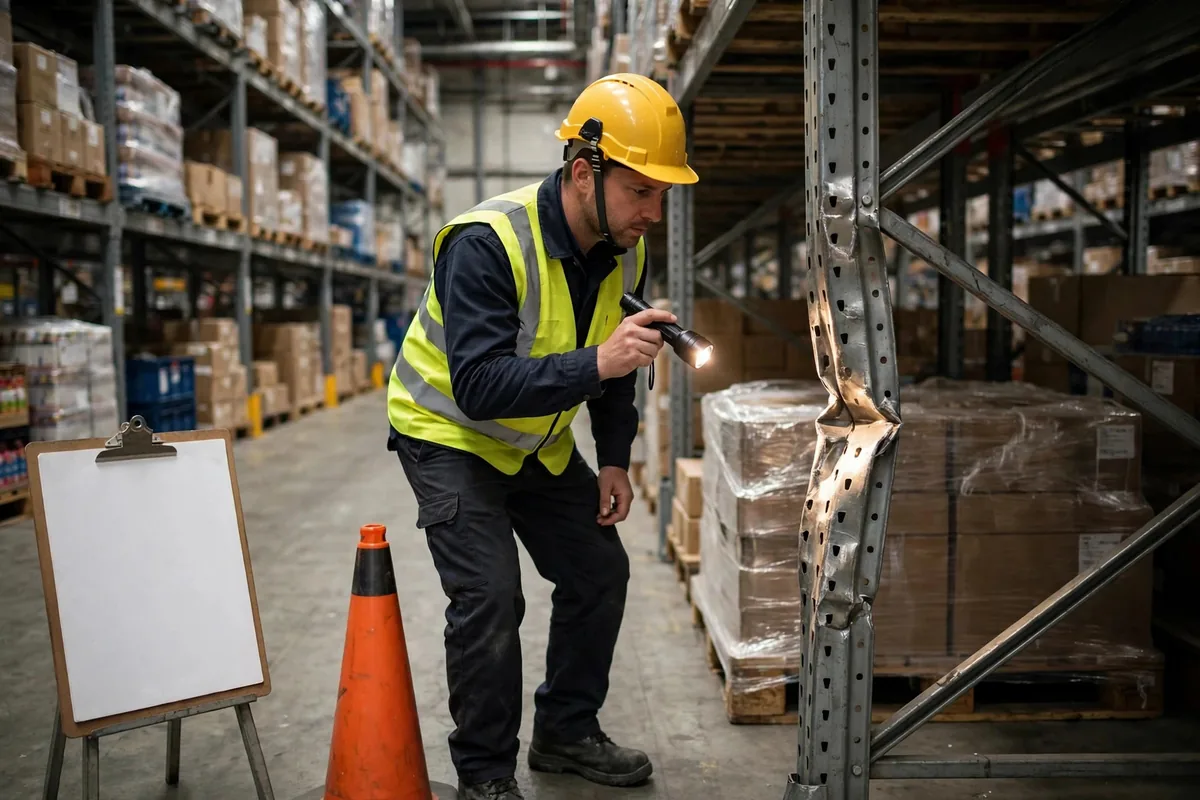
Four patterns show up most often. A bent upright bows near the impact point; sight along it from the floor and the line is no longer straight. A sagging beam dips in the middle, so a pallet sits unevenly and the fork catches. A loose or torn connection leaves a visible gap between beam and upright. A leaning bay tilts in one direction while the aisle narrows on one side.
Causes need to be separated, because each points to a different fix. Forklift impact is the most direct, concentrated at aisle entries and the lowest levels. Uneven loading is slower: the same location carrying heavy goods on one side for months loads the beam unevenly. Floor settlement is the easiest to miss: a small movement at floor level becomes an obvious offset at the top of a rack more than ten metres high. Then there is a quiet change of use: a location designed for light goods starts holding heavy goods.
In the autumn of 2024, an e-commerce warehouse in eastern China, less than three years old with racks more than ten metres high, showed the pattern. A crane hesitated briefly retrieving from the third level, with no alarm. On site, one upright bowed inward slightly, with an old scrape beside the dent. A forklift had brushed it months earlier and nobody reported it, because it had looked minor. The dent was small, but the fork had already lost most of its clearance. There is no minor scrape on a ground-level upright.
Rack Deformation Inspection: What to Look At, What to Measure, How Often
Inspection works in three layers. The first is the daily check by operators. Before the shift, walk the aisles on a fixed route and look for fresh impact marks on ground-level uprights, loose bolts or debris, and pallets sitting crooked. No instruments are needed.
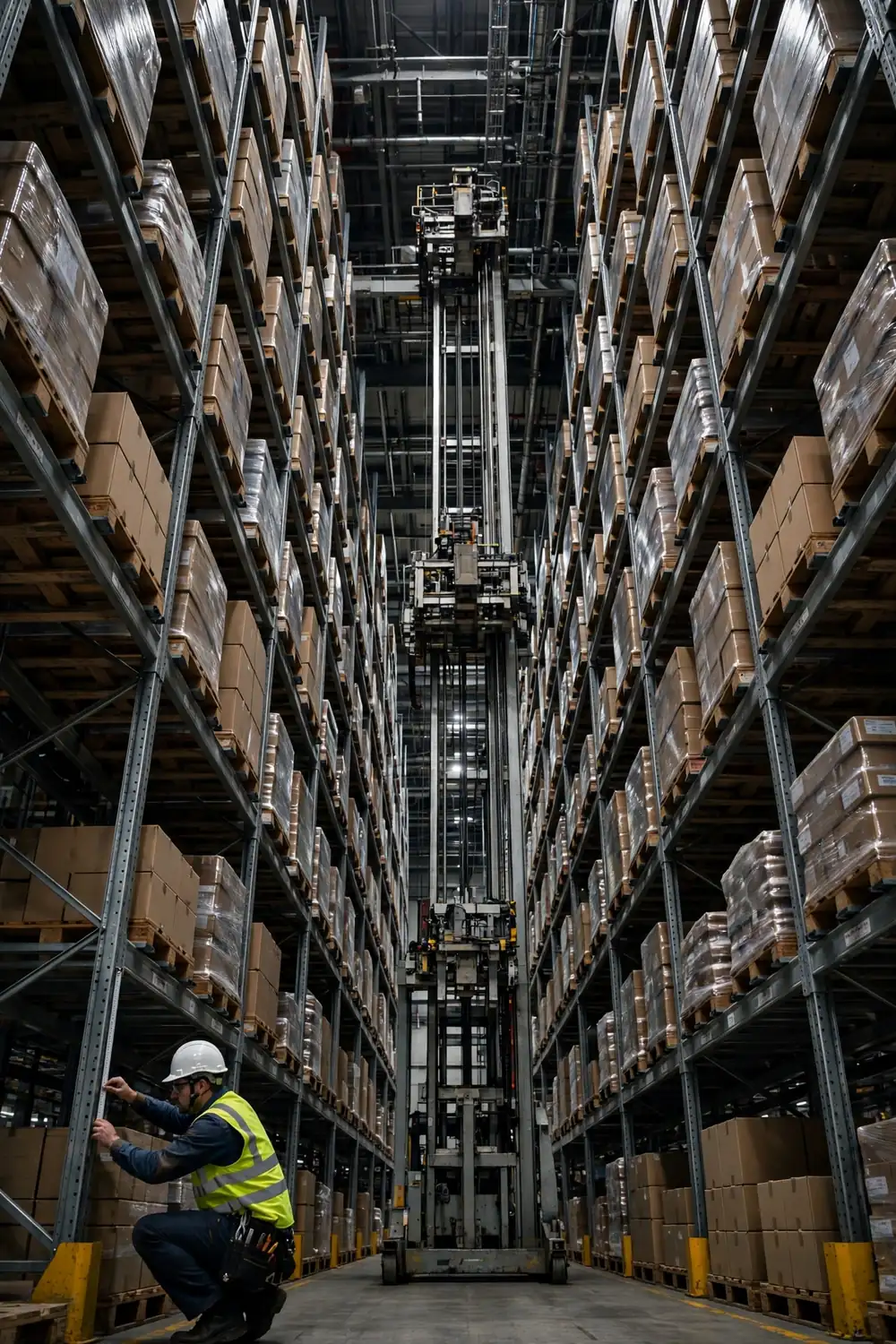
The second layer is the weekly check. Pick one aisle each week and look closely. Check beam-to-upright connections for gaps and corrosion, and measure beam sag at key locations with a straight edge. Measure the same point, the same way, every time. The same measurement drifting in the same direction over several weeks is the real signal. Also check anchor bolts and floor cracks.
The third layer is professional inspection, carried out according to the manufacturer manual and the applicable inspection standard. Inspectors measure upright verticality and beam deflection with proper instruments and issue a written report. Shorten the interval after an impact, a change of load, or floor movement. Read beyond the conclusion line: which location, which direction, how the trend moves. Three consecutive readings moving the same way is a real problem.
Listen to the crane as well. Unusual noise, a jolt during picking, and repeated failures at the same location are all indirect signs of deformation. Log these faults against the inspection record: date, inspector, aisle, finding, action.
When Deformation Means Stop: Limited Load or Full Shutdown
Deformation falls into three bands, each with a different response. Judgement must follow the manufacturer manual and the applicable inspection standard. Do not guess on site, and do not borrow numbers from another warehouse.
| Level | What you see on site | Action |
|---|---|---|
| Minor | Surface scrapes or a slight dent, uprights and beams still broadly straight, crane running normally | Keep in use, watch closely, shorten the recheck interval, log it |
| Visible | Upright clearly bent or beam visibly sagging, gap at a connection, repeated retrieval faults at the same location | Limit or suspend the affected locations and neighbours, arrange professional inspection and repair promptly |
| Severe | Upright badly bent or torn, beam sagging heavily or at risk of coming free, a whole bay visibly leaning | Stop at once, close the aisle, do not resume until inspection passes |
Minor deformation tests patience. Many teams think that if it still works, it can wait until the next maintenance window. Minor deformation itself is not the danger. Untracked deformation is. Track it with fixed-point photographs and regular remeasurement, and escalate early if it keeps moving.
Visible deformation means limiting or suspending the affected locations. Here is the counterintuitive part: the hardest single impact is often not the most dangerous event. The most dangerous period is the months after the impact, when nobody acts and the rack keeps running at full load. Deformation then grows slowly in the same direction, until the crane jams and the repair covers far more than one upright. Suspending a few locations costs a day of outbound volume. Not suspending them can cost a whole aisle.
In the spring of 2025, an auto parts warehouse in northern China handled this well. Two ground-level uprights in one bay had been bent by a forklift, visibly enough to see without instruments. The team limited the levels above to light goods only. Months later, reinspection showed the bend had not progressed, and the uprights could be repaired and reinforced rather than replacing the whole bay. The early load limit kept the repair small.
Severe deformation leaves no room for discussion. A torn upright, a beam that may come free, or a whole bay leaning: any one of these means the aisle stops immediately. Stop, close the aisle, then call for help. Stopping costs a day of throughput; a collapse costs far more.
Repair or Replace: Where Not to Save Money
The line between repair and replacement comes down to two questions: is the damage structural, and can the repair restore the strength the design requires? Surface dents, slight bends, and loose bolts can usually be repaired: straighten, reinforce, replace the connector, then remeasure and confirm. A torn upright, a cracked weld, a heavily sagging beam, or the same upright bending again after repair points the other way. Replacement is the steadier choice.
One common trap is straightening. A bent upright is pushed back with a jack, looks straight again, and goes back into service. Steel that has been bent and straightened does not behave like new steel: under the next load it will bend again, faster than before. Whether straightening is allowed must follow the manufacturer manual and the applicable inspection standard, not workshop habit.
Replacement also needs to be viewed as a set. When one upright is replaced, check the neighbouring beams, connectors, and anchors together. Deformation travels, so replacing only the most obvious piece plants the next failure. The repair plan should be confirmed by the manufacturer or a professional inspector, and the work is only closed after remeasurement.
There is also a false demand worth calling out directly. After an incident, some warehouses rush to install thicker guards and seal off every aisle entry. Guards have their place, but they do not prevent uneven loading, floor settlement, or a change of use. Spending everything on guards while nobody inspects only changes the cause of the next incident. Spend the money on the inspection system instead: a named person, a fixed route, a fixed record, and professional inspection on schedule.
Is the money worth it? Look at one number: how many locations you suspended on your own initiative because of deformation in the past year. If the answer is zero, ask first whether there really was no deformation, or whether nobody was actually looking.
By Da Liu, Automation Engineer