2:40 a.m. on a night shift last November. I was in the control room watching the monitors, and the multi-floor AMR task chain went red again. A bot sat waiting at the freight elevator downstairs. Upstairs, a picker was on the radio: "Chen, where's my freight? We're about to hit cutoff." I spent an hour at that elevator that night, counting. The truth: with multi-floor AMR work, the robot is never the hard part. The elevator is.
So this is how our two-floor warehouse got AMRs riding the elevator on their own. All of it learned on the floor. Nothing from a brochure.
The Night the Elevator Jammed and Exposed Everything
Let me be straight with you. For the first three months after the AMRs arrived, cross-floor moves ran on human relay. A first-floor AMR dropped freight at the elevator staging area, a worker unloaded it into the elevator, rode it up, and reloaded it onto another AMR on the second floor.
Then came a peak-season night. One of our guys, Xiao Zhang, was pushing a pallet of cartons into the elevator while an AMR queued up behind him. The freight wasn't stacked right, the doors clipped it twice, and the elevator shut itself down for fifteen minutes.
Fifteen minutes. Four pick lines upstairs stopped. We missed cutoff on two hundred-plus orders that night. I argued with the equipment vendor that night. They said: "Manager Chen, elevator integration is a value-add module." I said: "I don't care what you call it. Freight is stuck, and the chargebacks land on me." The next day we decided to do it ourselves — full elevator integration, AMRs calling the elevator and driving in and out on their own.
We Tried Three Approaches. One and a Half Survived.
Before we touched anything, we mapped out every route we could find. We tested three.
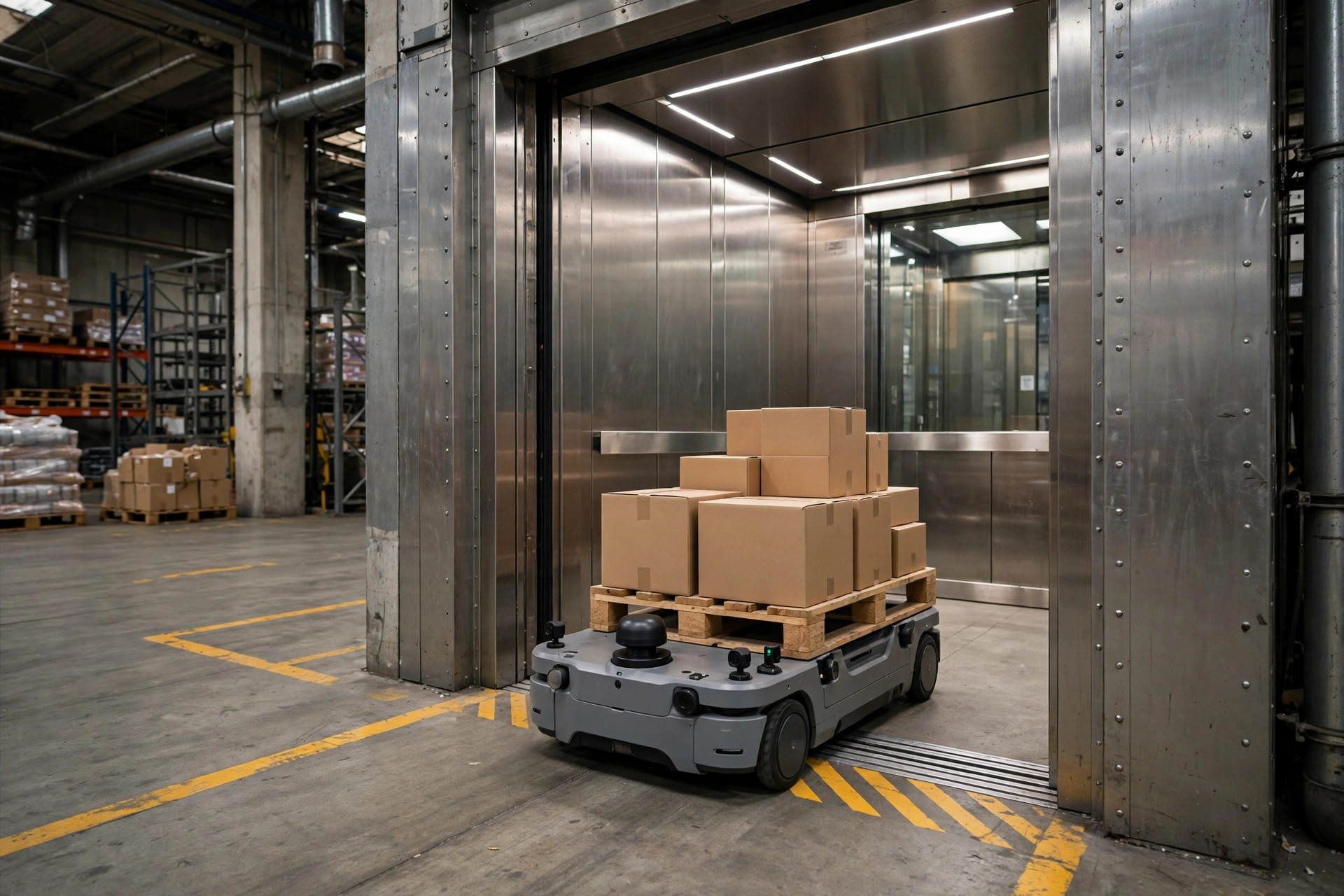
Option one: pure signal integration — the AMR and the elevator "trading passwords." You wire a communication module between the AMR fleet manager and the elevator controller. The AMR rolls up, sends a request, the elevator dispatches, doors open, the AMR confirms and drives in. Cheapest option, two-week retrofit. We tried it first. The problem? It was a shared freight elevator. People used it too. During morning and evening rushes, humans and robots fought for the cab, and the AMR would sit at the doors for five, six minutes at a time. The whole takt fell apart.
Option two: dedicated mode — during AMR task windows, the elevator belongs to the robots. We added an AMR-priority mode: when the fleet manager has a batch of cross-floor tasks, it books the elevator. People use the passenger elevator instead. This one moved the needle hard — average cross-floor trip time dropped from 4 minutes 50 seconds to 1 minute 40. The cost was complaints. Workers had to walk around, and the grumbling was loud at first. We settled it by writing the AMR elevator windows into the shift schedule, posting it at the doors, and keeping it clear of clock-in and meal times. People got used to it.
Option three: a separate AMR fleet upstairs, no cross-floor traffic at all. We costed it out and killed it. Four bots per floor, the human relay never goes away, and four extra robots cost more than three years of elevator retrofit money.
Final call: option one plus option two. Signal integration as the foundation, dedicated mode as the accelerator.
Safety Retrofits for Multi-Floor AMR: Three Places Where You Do Not Cut Corners
Before going live, we spent a full week on the safety review. An AMR riding an elevator isn't the same as carrying people. Three retrofits — copy these directly.
First, door anti-pinch. An AMR drives in slower than a person. The factory door hold-open time was only a dozen seconds — the doors would start closing while the bot was halfway through. We extended hold-open to 40 seconds during AMR windows and added a light-curtain sensor: if the chassis is in the door zone, the doors stay open. That retrofit cost under three thousand dollars. One door-crush incident on a robot costs more than that in repairs alone.
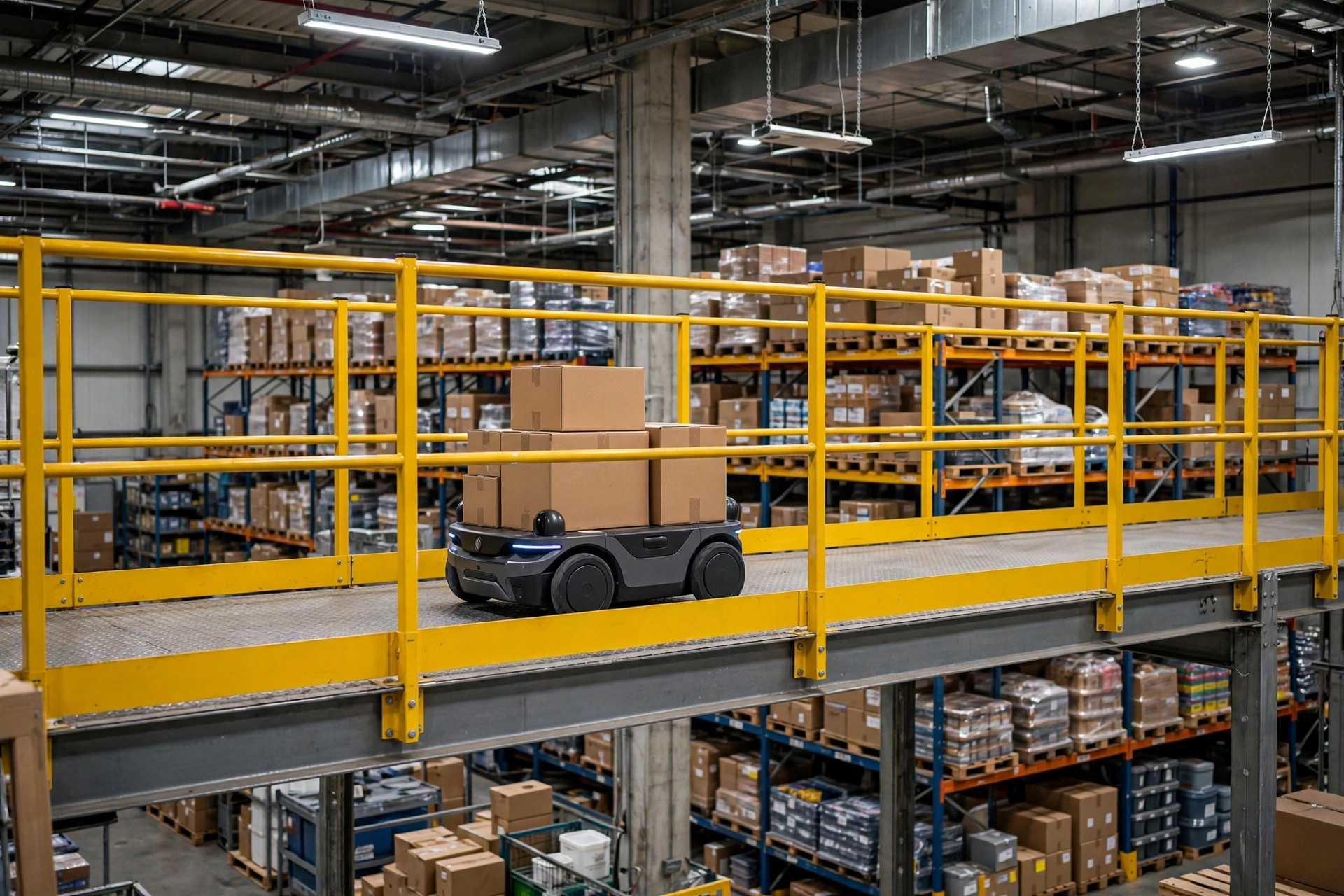
Second, floor-level access control and physical barriers. We installed automatic sensing doors at the second-floor elevator lobby — the AMR triggers them with a signal, people walk through a separate pedestrian passage. More important: a full ring of 1.1-meter guard railing along the second-floor platform edge. If an AMR ever loses it upstairs, that railing is the last line of defense. It hurt to pay for. The fire marshal and safety inspector took one look and signed off.
Third, load verification. Our freight elevator is rated for 2 tons. One AMR, fully loaded, comes in under 800 kilos — no problem solo. But during peak we tried two bots sharing a cab, so we hardcoded a rule in the fleet manager: one robot per ride, no exceptions. The elevator tech's exact words: "Rated load is a ceiling, not an average." That one stuck with me.
Elevator Wait Time Has to Go Into Your Takt Calculation
This is the most expensive lesson we learned on scheduling. When I first built the capacity model, I only counted AMR travel speed. I never counted elevator waiting. The schedule said "30 trips an hour." Reality delivered 18. My night-shift supervisor came to complain every single day.
So we camped at the elevator with stopwatches for three days, and the numbers went up on the dispatch room wall:
- AMR drives from first-floor staging to the elevator: about 25 seconds
- Call to doors-open (dedicated window): about 15 seconds; shared window: 1 to 5 minutes, unpredictable
- AMR drives in, turns, settles: about 20 seconds
- Elevator ride, one floor: about 12 seconds
- AMR drives out to the second-floor handoff point: about 30 seconds
One trip: roughly 1 minute 40 seconds in a dedicated window, up to 7 minutes outside one. Now we schedule at 2 minutes per trip for dedicated windows, and only low-priority tasks run outside them. Every number on that takt sheet was timed by a person standing at the elevator with a stopwatch. Skip the stopwatch, and the whole schedule is fiction.
The Counterintuitive Part: Elevator Speed Doesn't Matter. The 20-Second Drive-In Does.
Everyone's first question: how fast is the elevator? Can we swap in a faster one? I thought so too, at first. Then the data showed the ride itself is 12 seconds. The real time-eaters are the call wait plus the 20 seconds the AMR spends driving in, turning, and settling.
We put all our optimization into those 20 seconds. We painted AMR parking markers inside the cab — the bot knows exactly where to stop the moment it rolls in. We changed the turn from a spin-in-place to straight-in, straight-out, which saved 6 seconds. We treated the floor at the doors with anti-slip coating so the wheels don't spin on rainy days. Same elevator. Not a dollar more on the car. Nearly 20 seconds faster per trip. At 300 trips a day, that's 100 minutes back.
Vendors love selling you big headline specs. Floor people only care about the bottleneck. Find the bottleneck, spend the money there.
A Few Warnings for Anyone About to Do This
We've run this setup for almost a year. Cross-floor tasks are forty percent of all AMR work here, on-time rate above 98%. Warnings for anyone going down this road:
One, talk to the elevator maintenance company before you talk to the AMR vendor. Elevators are regulated equipment. Touching the controller requires sign-off from the original manufacturer or the authorized service company. Rewire it on your own and every bit of liability is yours. We got all three parties in one meeting — AMR vendor, elevator service company, and us — and locked the design in one sitting.
Two, write the dedicated elevator windows into the shift schedule and post them. Unposted, workers think you're favoring the machines. Posted, everyone works to the same sheet, and half the arguments disappear.
Three, keep a manual fallback lane. Annual inspections, breakdowns — the elevator is down a few days a year no matter what. Our contingency is switching back to human relay when the elevator is out, and we keep the staging racks standing for exactly that reason.
Four, do not go live a month before peak season. We ran a two-month pilot in the slow season and only opened it up fully at peak. New system plus new process — give the shakeout period its time.
Honestly, multi-floor AMR is thirty percent technology and seventy percent floor management: scheduling, people, safety, fallbacks. The equipment is new. The people-management experience is old. That's my parting line to every warehouse manager about to take this on.
By Chen Feng, Warehouse Operations Manager