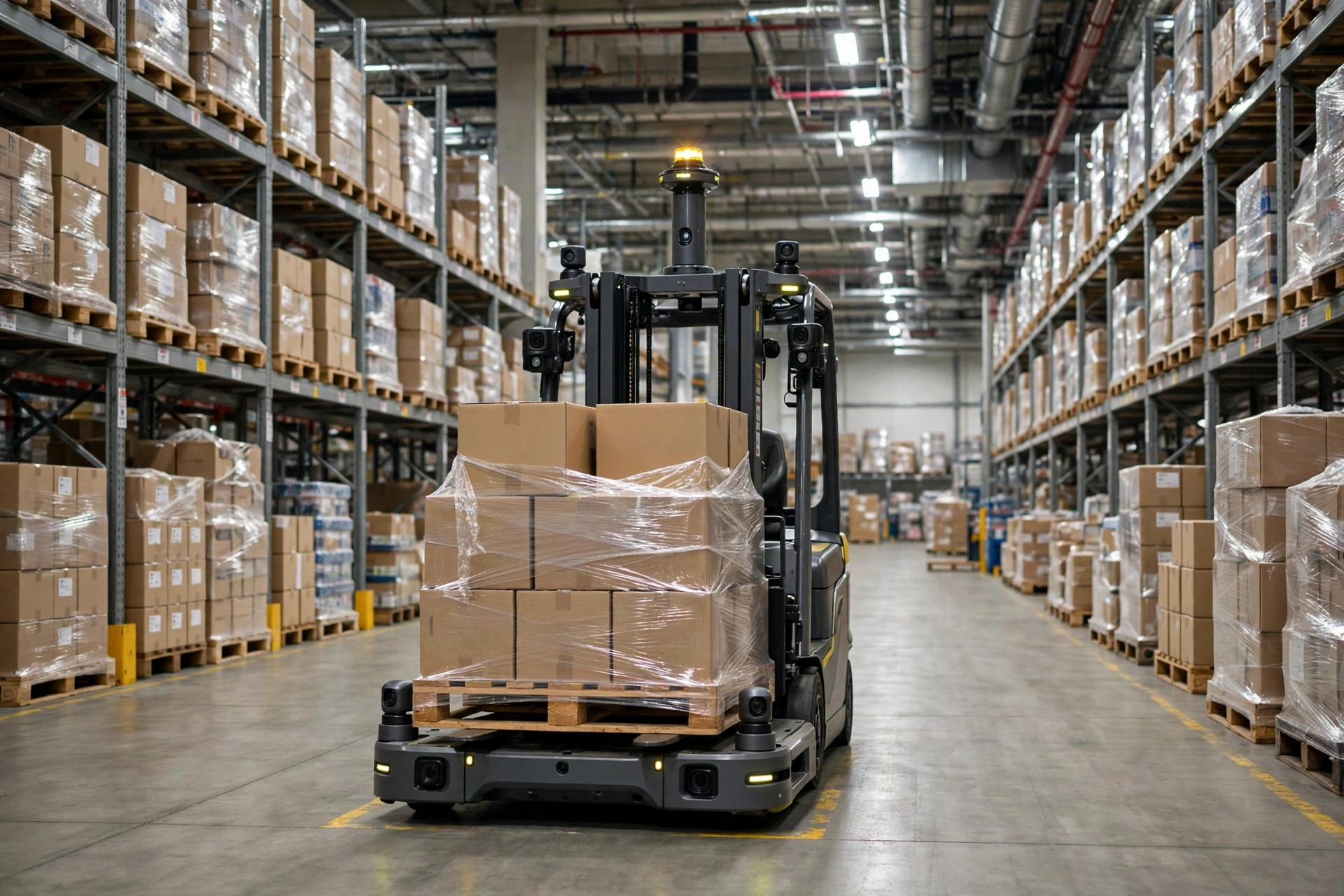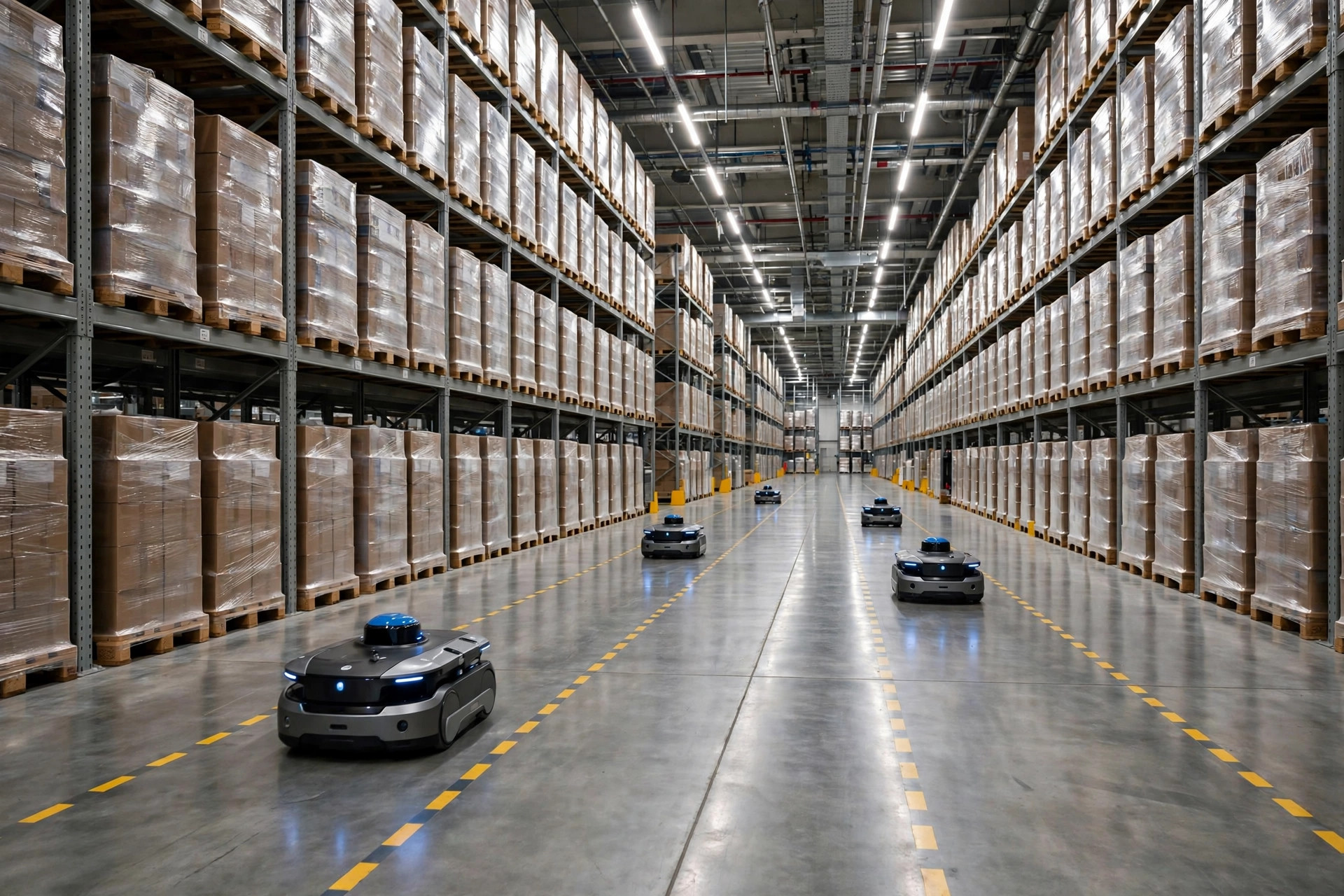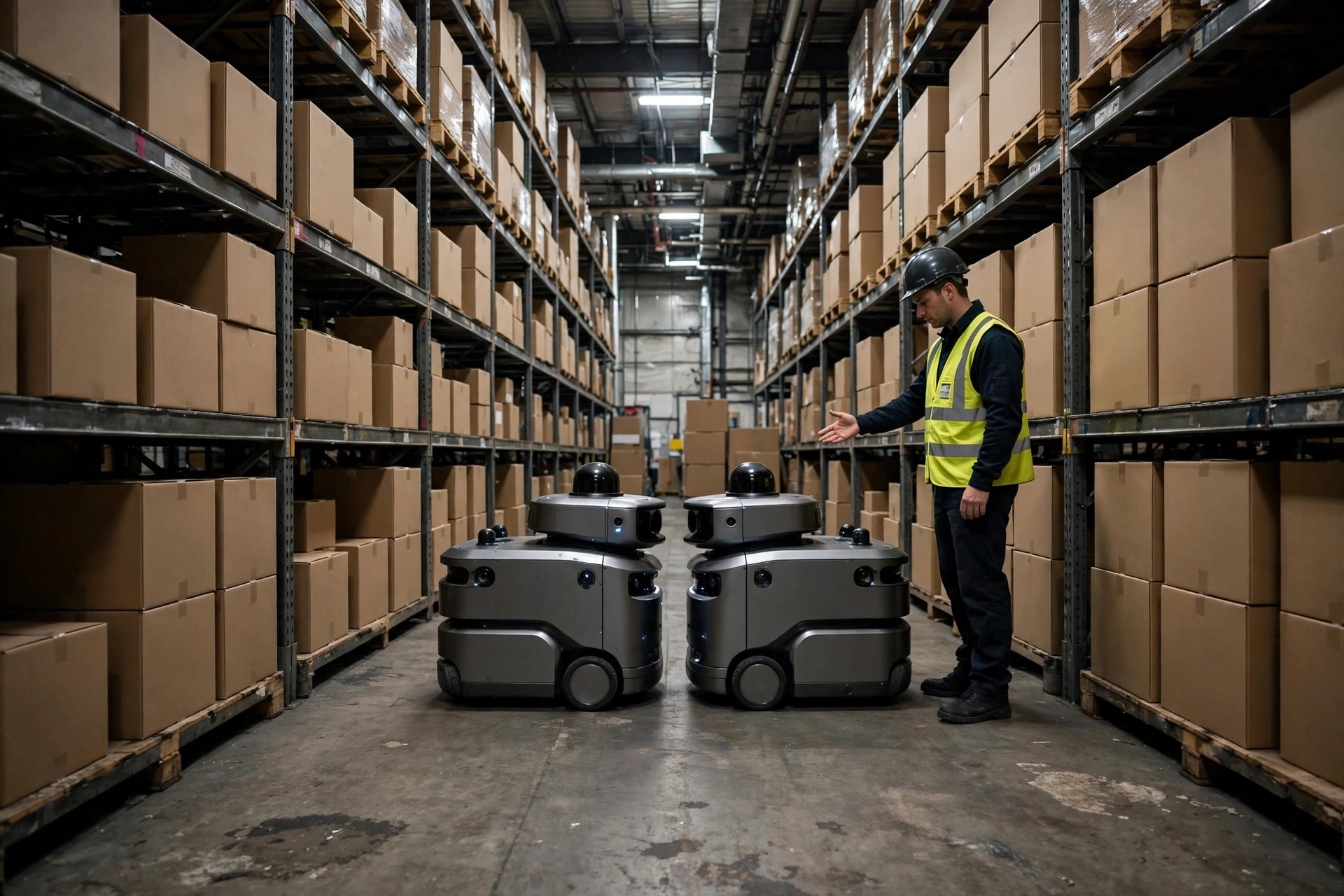
Last fall I sat outside a 3PL warehouse in the Inland Empire for the better part of two hours, waiting on a pickup I'd scheduled for 2 PM. The plant manager finally walked out to apologize in person: their brand-new fleet of AMRs had locked horns in a narrow aisle. Two robots nose-to-nose, neither able to pass, neither allowed to back up, the whole line down. Workers were moving the machines one by one, by hand. If you've ever searched for amr deadlock narrow aisle traffic rules, that scene is exactly the nightmare you're trying to avoid.
Let me tell you something. I've spent fifteen years behind the wheel of a truck. I've seen pileups on I-10, I've seen lines of rigs backed up for miles outside the ports. But two machines in a staring contest? That was a new one. The manager told me the industry calls it an AMR deadlock in a narrow aisle. Sounds fancy. Strip away the jargon and it's one sentence: the warehouse never gave its robots traffic rules, so the smartest machines in the building sat there doing nothing.
What an AMR Deadlock in a Narrow Aisle Actually Looks Like
Plain English: a one-robot-wide aisle, two AMRs entering from opposite ends at the same time, meeting in the middle. Drive forward? No room. Reverse? The safety system usually won't let a robot back up on its own with something behind it. Turn around? Not in an aisle that tight. So both robots sit there, alarms going, and everything upstream and downstream grinds to a halt.
Highway drivers live this every day. Two semis meet on a narrow two-lane country road and somebody has to back up — and backing up a loaded rig is no joke, ask anyone who's done it. The difference is, truck drivers can talk it out, wave each other through. Robots can't negotiate. Two stubborn machines meet with no pre-agreed rule for who yields, and the only outcome is both of them freezing.
I asked the manager how wide his aisles were. About 1.5 meters, he said. Of course. Industry-standard narrow aisles run 1.5 to 2 meters — the whole point is squeezing in more racking per square foot, and the rent savings are real money. But one AMR plus its safety margin leaves no room for two machines to pass in a 1.5-meter aisle. None. Some compact models advertise squeezing through an 80 cm doorway — that's one robot, one doorway. It says nothing about two robots passing each other in a narrow aisle. Different thing entirely, and plenty of buyers never think it through.
Here's the counterintuitive part: the "smarter" the AMR, the easier it deadlocks. A robot with sensitive obstacle avoidance spots the oncoming machine from far away and politely stops to wait. Both robots do the polite thing. Neither moves first. It's exactly like two people meeting in a narrow hallway, both stepping left, both stepping right, both ending up standing there awkwardly. Add more robots and it gets festive — the queue piles up behind, the whole aisle clogs bumper to bumper, and the fleet software just watches.
Traffic Rules: Three Fixes, From Duct Tape to the Real Deal
The manager asked me, Shifu, you run roads for a living, what would you do? Same medicine as the highway. Three fixes.
Fix one, the duct-tape stopgap: post a person at the narrow aisle during peak hours to direct traffic, or stagger dispatch so two robots never enter the same aisle at the same time. Costs almost nothing, works today — but it treats the symptom. The moment the person walks away or volume spikes, you're jammed again. Fine for a small site where deadlocks are rare and the fleet just went live.
Fix two, the hundred-year-old highway answer: one-way aisles plus a loop. Make the main travel lanes one-way, allow only one direction in the narrow stretches, and give robots a loop to circle back. Deadlock becomes structurally impossible. Paint the lane markings and arrows on the floor — OSHA already expects plant aisles to keep safe clearance and stay marked, so the paint job was overdue anyway. The price is a slightly longer trip each run. But it never, ever gridlocks. Why do big cities run one-way grids? Better a long way around than a head-on meeting. The math was settled a century ago.
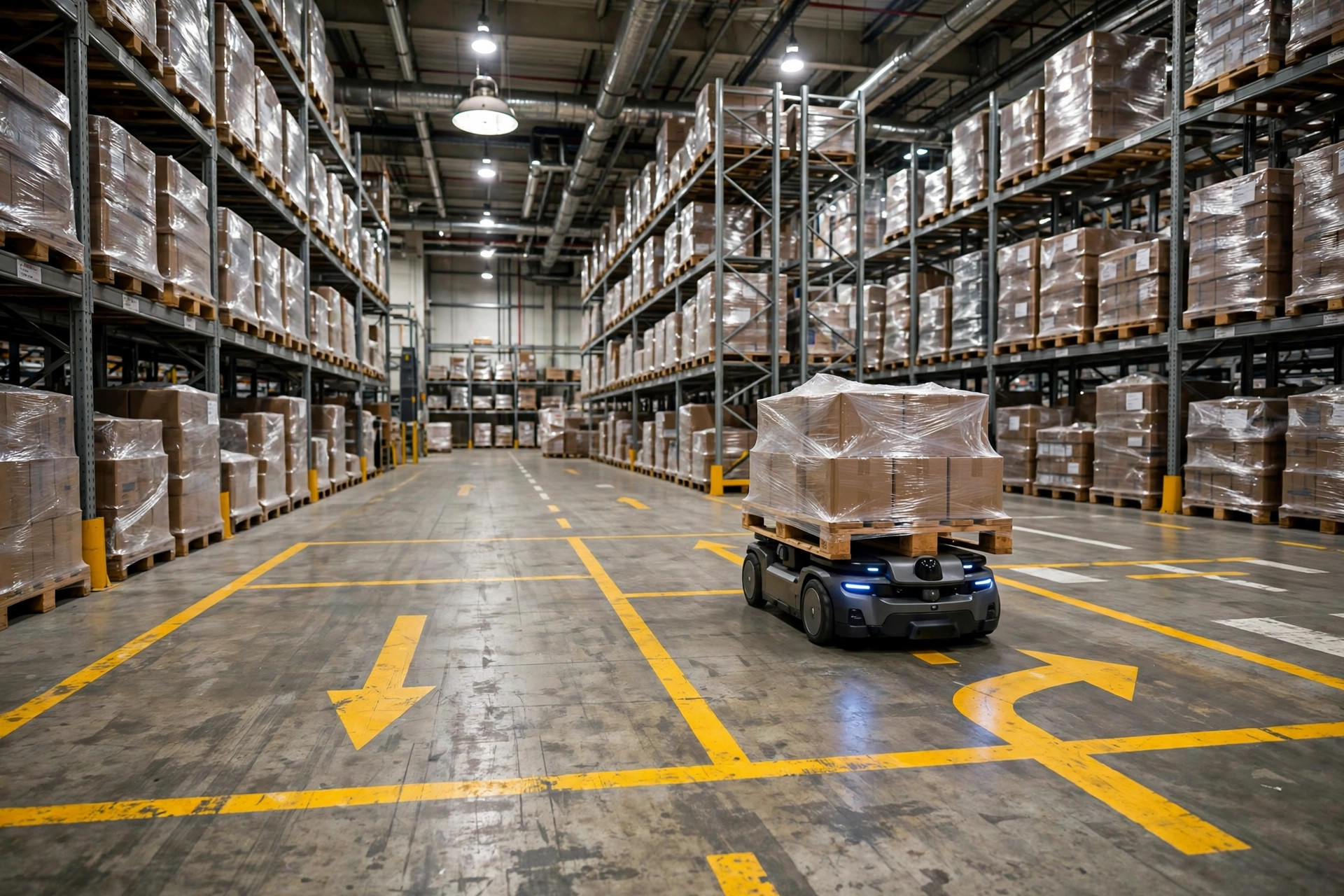
Fix three, the real cure at the software level: an occupancy lock on each narrow aisle. One robot in at a time; the rest queue outside and get waved in as each one exits. The most thorough fix, but it means touching the fleet software and paying the integrator, which is the heaviest lift — tough on a small operator's budget.
Side by side:
| Fix | Cost | How fast it helps | Symptom or cure | Catch |
|---|---|---|---|---|
| Human spotter + staggered dispatch | Nearly free | Today | Symptom | Depends on people watching; jams return at peak |
| One-way aisles + loop + floor markings | Small | A week or two | Cures most of it | Every trip runs a bit longer |
| Aisle occupancy lock in fleet software | Biggest investment | Project timeline | Cure | Budget pressure for small sites |
I told the manager: do fix two now — paint and lane changes take days. Do fix three once the fleet is stable and volume justifies it. And start fix one tonight, don't wait.
Doing the Math: Is the Longer One-Way Route Worth It?
Somebody always objects: one-way routing adds dozens of meters to every trip, hundreds of trips a day — aren't we burning battery and time? Let's run the numbers.
One deadlock shuts the aisle down. Workers hand-move robots, everything upstream waits. That day I sat outside for nearly two hours with three rigs ahead of me in line. A truck idling for two hours means driver hours, fuel, and a blown appointment window at the next stop. The warehouse lost that whole morning's outbound plan. Forget penalties — what it really lost was the customer's trust.
One-way routing? A few dozen extra meters per trip. At AMR speeds that works out to seconds per order. A few hundred orders a day, and the total extra time is roughly one robot running a few extra loops. Trading "never gridlocks" for "each order takes a few seconds longer" — a schoolkid could do this math.
The trade-off in one line: narrow aisles save rent; deadlocks cost downtime. The rent savings land every single day. A deadlock bills you per incident. If you've already squeezed your aisles down to 1.5 meters, the traffic rules have to keep up. Don't expect the machines to negotiate it out among themselves — robots don't negotiate, they execute rules. No rules, they lie down.
Straight Talk for Warehouse Owners
Three layers.
First, draw the traffic map before you buy the robots. Too many owners order a few dozen machines, roll them onto the floor, and only then discover the aisles are two-way with no right-of-way rules at the intersections. Backwards. Mark the one-ways, the loops, and the narrow stretches on the drawing first, then talk about how many robots and which model.
Second, don't worship "smart scheduling." Fleet software, however clever, only plays inside the rules you set. Physical rules — one-way, occupancy locks — are the 1; software optimization is the zeros after it. Without the 1, all the zeros in the world add up to nothing.
Third, a tip for shippers and receivers: picking up at a site that just deployed AMRs? Call ahead and ask whether the fleet has settled in. If it hasn't, pad your appointment by two hours. Don't ask me how I know.
Old drivers have a saying: better a long way around than a head-on meeting. Works on the highway. Works in the warehouse too. A narrow aisle isn't the problem. No rules is.
By Shifu Zhao, Trucking Veteran (15 yrs)