Talk about amr goods lift warehouse work in a mezzanine building and my first question is never how fast the robots run. It is how many lift trips you get per hour. Think of a house with one bathroom: add more people and mornings do not get easier. The bathroom was the limit all along. The lift was treated as a door. A door is not a road. A door is a clock everybody lives by.
The principle: a lift is a stretched piece of road
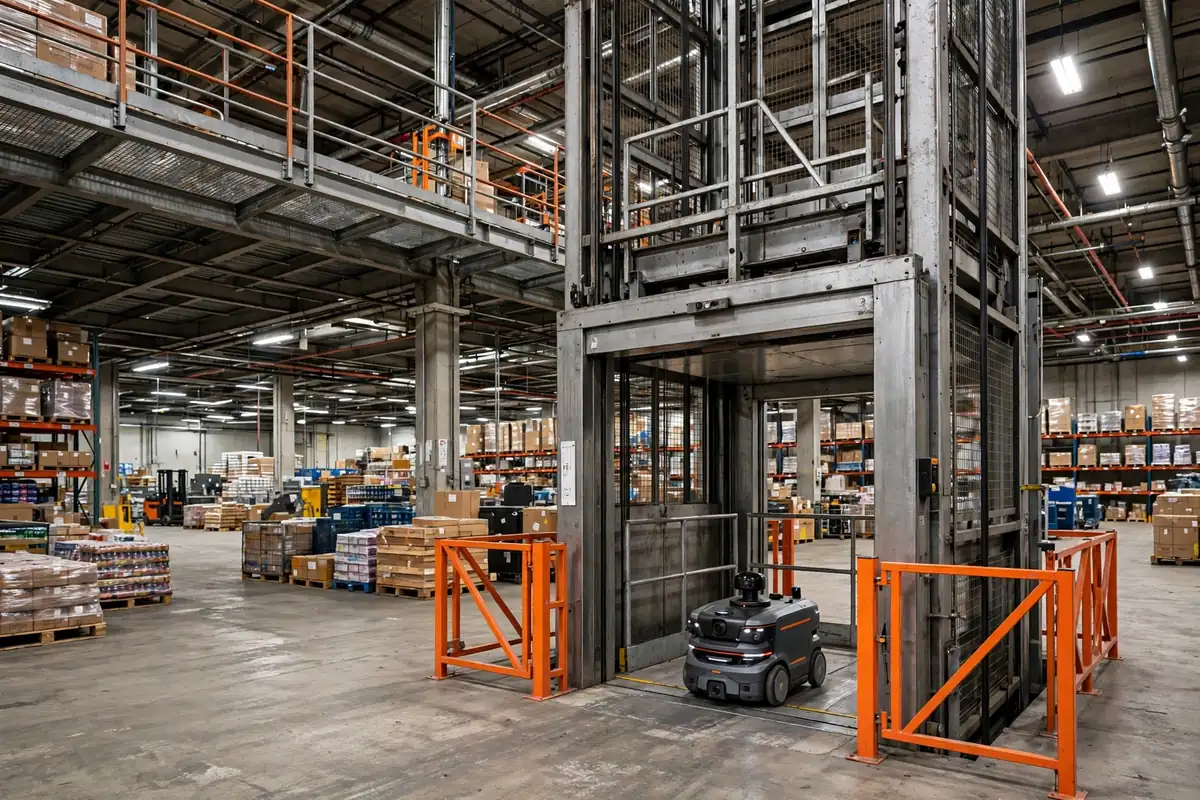
On one floor, a robot spends its time travelling. In a mezzanine warehouse, a vertical segment is inserted into every cross-floor trip: align, enter, confirm doors and interlocks, rise, exit, clear the shaft. Each piece is short. Together they are rigid, and while they run, nobody else can use that lift.
So do the capacity maths on the lift cycle, not on robot top speed. Top speed is the prettiest number in a brochure. Cycle time is the bill you pay daily. Hide any piece of a round trip in a proposal — empty travel, aligning, door confirmation, the ride, clearing — and the promised rate looks a third better than reality. The few square metres in front of the shaft are the most expensive floor in the building. Block them and you block both floors at the throat.
How one amr goods lift cycle eats the hour
I split a round trip into five parts and measure them with a stopwatch, not from a report. Waiting, while the lift is elsewhere or the previous car has not cleared. Entry and alignment, the slow creep in until the parked position confirms. Doors and safety checks: light curtain, door lock, vehicle-in-place signal, and miss one and nothing moves. The ride, the only part the motor decides. Exit and clearing, because the next robot cannot enter until the first has moved away.
An illustrative example, not a benchmark: a two-level site, storage above and shipping below, with a full round trip assumed at around four minutes once all five parts are counted honestly. The ceiling is then stuck in the low teens of trips per hour, and the usable figure is lower after waiting and clearing. If the upper floor needs more downward trips than that, a bigger fleet changes nothing. Extra robots make the queue longer and tighter.
Single lift, twin lifts, or a continuous hoist
One lift is enough when cross-floor traffic is light, peaks are short, and quiet periods can repay what peaks borrowed. It is cheaper and simpler to maintain. Its weakness is plain: one breakdown stops all cross-floor work.
Two lifts do not automatically double anything. Side by side under one dispatch logic, the same traffic wave hits both at once. Twin lifts earn their money through division of labour: one mainly runs down, the other up, or one serves receiving and the other shipping. Two lifts that simply take turns are not a system. They are two single lifts sharing a wall.
A continuous hoist is a different animal. Goods ride up in a steady stream, like an escalator for cartons. The catch: it carries goods, not robots, so something must receive the load at the top and odd, oversized pieces do not ride at all. Whole robot workflows crossing floors call for a reciprocating lift. Only standard cartons crossing floors often call for a continuous hoist.
Before any selection meeting, I put this comparison on the table (illustrative example only, never a purchasing promise):
| Option | Traffic it suits | Biggest weakness | Maintenance focus |
|---|---|---|---|
| Single reciprocating lift | Low volume, short peaks | One failure stops the flow | Door operator, interlocks |
| Twin reciprocating lifts | Busy both ways, needs cover | Poor dispatch, mutual blocking | Calibration of both units |
| Continuous hoist | Steady standard cartons | Goods only, awkward shapes excluded | Chains, handover points |
| No mezzanine | Land affordable, lead times tight | More floor area | Ground traffic discipline |
Two sites where the pace quietly leaked away
The first was an automotive parts warehouse in the Netherlands, reviewed one winter two years ago. Two levels, slow movers upstairs, packing and shipping below. Every afternoon the upper doorway grew a long queue while shipping complained about shortages. The cause: order waves were released on the hour, all at once, so tasks flooded the lift together, drained slowly, and then the lift sat idle. Nothing mechanical had failed. The release rhythm had. Splitting the waves and pre-staging downward loads near the lift shortened the queue without changing the lift or adding a robot.
The second was a homeware warehouse in North Rhine-Westphalia, Germany, during expansion acceptance last spring. Twin lifts, and repeated fault stops before sign-off. The root cause was not the machinery. One robot had uneven wheel wear and kept parking slightly off position inside the car, so safety confirmation failed and doors cycled again. New wheels and a recalibrated parking point cut the stops sharply. Half a lift system's reliability lives in the manual. The other half lives in robot wheels and floor markings.
When amr goods lift queues form, adding robots makes it worse
Back to amr goods lift warehouse dispatch: the instinctive fix is usually wrong. A queue forms, someone orders more robots, and more robots mean more tasks arriving per minute, so the queue grows. It is the tollbooth problem: pouring more cars onto the road does not speed up the booth.
Manage the arrival rhythm instead. Give the lift a virtual departure interval and release tasks at the source to match it. Waiting half a minute among the racks beats waiting three minutes at the doorway, because racks can absorb waiting and the doorway cannot. Group tasks too: several robots heading the same way ride as one batch, where size and load limits allow, with the rules written into the dispatch system. Stagger the flows as well: offset upward replenishment from downward shipping and the same lift owns a much larger effective capacity. Plan replenishment ahead of the wave and the lift stops being a fire engine and becomes a bus: not fast, but predictable.
The handshake between fleet software and lift controls deserves suspicion. Calling the lift when the robot reaches the door, versus reserving it when the robot sets off, differs by a whole empty-lift journey. The first pattern is the default in cheap integrations: it saves interface work and bills operations forever. At acceptance I always ask when the call signal is sent. A vague answer means nobody has done the cycle maths. Equipment shape itself is covered in a separate piece on choosing between lift types for AMR fleets. This one is about fleet rhythm.
Alignment, interlocks, and the maintenance traps
A robot entering a lift is one self-driving machine stepping into another moving machine. Each side must confirm the other's state: the robot parked correctly before the lift moves, the lift arrived and fully open before the robot moves. Shave these interlocks to win a few seconds and you borrow against an accident, after which the shutdown repays the loan with interest.
Alignment rests on parking marks inside the car, the robot's own positioning, and floor flatness. The step and gap between landing and car floor are the enemy of small wheels: one catch and the parked position drifts. Put handover step limits into acceptance testing, then measure monthly. While a robot is in the car, nobody steps in, and if somebody does, nothing moves. Define in advance what happens on network loss.
Maintenance repeats the lesson. Doors are the most underestimated part: a door operator cycles far more often than the lift travels, and dust in the track shows up first as an occasional refusal to close, then as peak-hour stops. Plan service by cycle counts, not calendar dates, and keep door components and key sensors on site. Read the dispatch data too: waiting time, alignment failures, door faults. A drifting number is next month's stoppage introducing itself early.
When to skip the mezzanine entirely
Some warehouses should never build a mezzanine. If lead times are brutal and cross-floor traffic is heavy, the rent saved may not cover the pace it costs. Where land is affordable, a single level with taller racking is often the dumber and better answer. My test uses one ratio: cross-floor trips as a share of all tasks. Low share, and a mezzanine is clever. High share, and the building's fate rests on one or two machines. That is why, on any amr goods lift warehouse proposal, I demand the ratio first and the equipment list second.
Whether the money was well spent comes down to one number: the average wait at the lift door during the peak hour. Keep it short and the whole account adds up.
By Da Liu, Automation Engineer