Let me put it bluntly: amr battery swap vs opportunity charging is not a contest of which technology is newer. It is a question of whether your takt can afford to have robots parked. I spent years on the integrator side, and the most common failure I still see is a proposal sized for a single 8-hour shift being dropped into a three-shift warehouse. It looks fine on the spreadsheet. It collapses in week one.
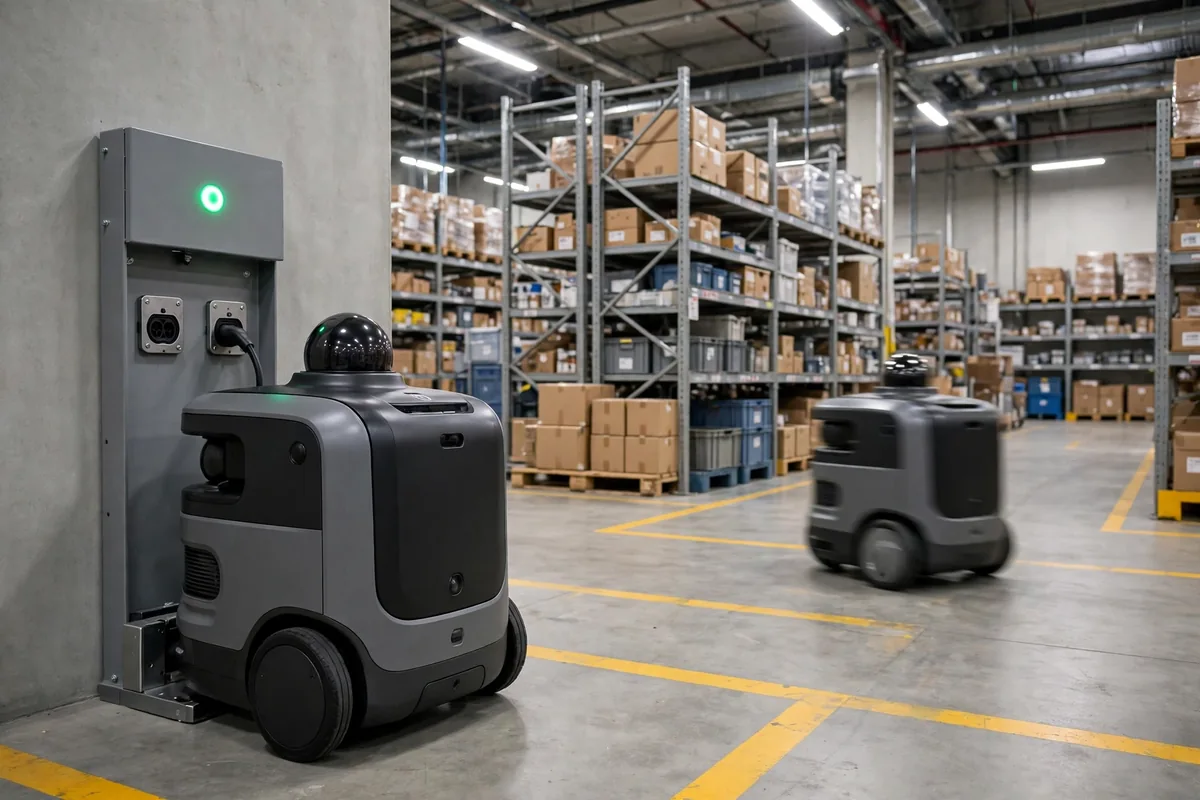
Think of them as two refueling logics. Battery swap is like swapping a gas cylinder: the AMR drives to a station, a person or automated mechanism pulls the depleted pack in 2-5 minutes, drops in a charged one, and the robot leaves. The empty pack charges in the background. Opportunity charging is like topping up your phone whenever you sit down: the robot docks during task gaps or idle moments, takes 10-15 minutes of charge, and buys another hour or two of runtime. It never tries to fill up in one go. It tries never to starve. Per vendor specifications, most warehouse lithium packs in this class charge around 1C, with some fast-charge packs rated higher, and operators normally work only the middle of the state-of-charge window. Running from 100% to zero every cycle would age the pack far too fast.
battery swap: clean takt, expensive backstage
Swap wins on one thing: predictability. A swap costs a robot only a few minutes, and even with queuing at the station, the loss of single-vehicle availability is typically in the low single digits. Last year I reviewed a 3PL site in Suzhou with 42 latent-lift AMRs on two shifts. Their picking peaks hit twice a day, late morning and mid-afternoon, with task release intervals compressed to a little over 20 seconds. The floor lead told me if eight robots went off to charge during a peak, the rack queue backed up, pickers downstream stood idle, and the whole zone stalled. For that profile I pushed swap without hesitation — not because swap is cheaper, but because it almost removes charging from the capacity equation.
The cost is backstage. First, spare packs. With 42 robots you typically need 30%-50% extra packs rotating in the cabinet, or the pack you just removed will not be ready when the next robot arrives. Second, the swap operation itself. Manual swap needs a person on every shift to pull, carry, inspect, and log packs — who does that at 2 a.m.? Automated stations remove the labor but add alignment, locking, and communication failure points, each with its own MTBF. Third, pack health. Dozens of packs mixed across a fleet will diverge in cycle count and degradation. If you do not track health per pack, sooner or later a tired pack lands on a long-travel task and triggers a low-battery alarm mid-aisle.
Here is the counterintuitive part: the smaller the fleet, the worse swap looks. For a 10-robot warehouse, the fixed cost of spare packs and a swap station spread over ten robots is brutal. You would often be better off buying two extra robots and rotating them through chargers. Swap tends to pay when the fleet is larger — think 30 robots and above — running 16 hours a day or more, where the recovered availability outweighs the fixed investment. Treat those thresholds as industry-typical magnitudes, not guarantees; confirm them against vendor specifications and your measured peak takt.
opportunity charging: cheap packs, expensive scheduling
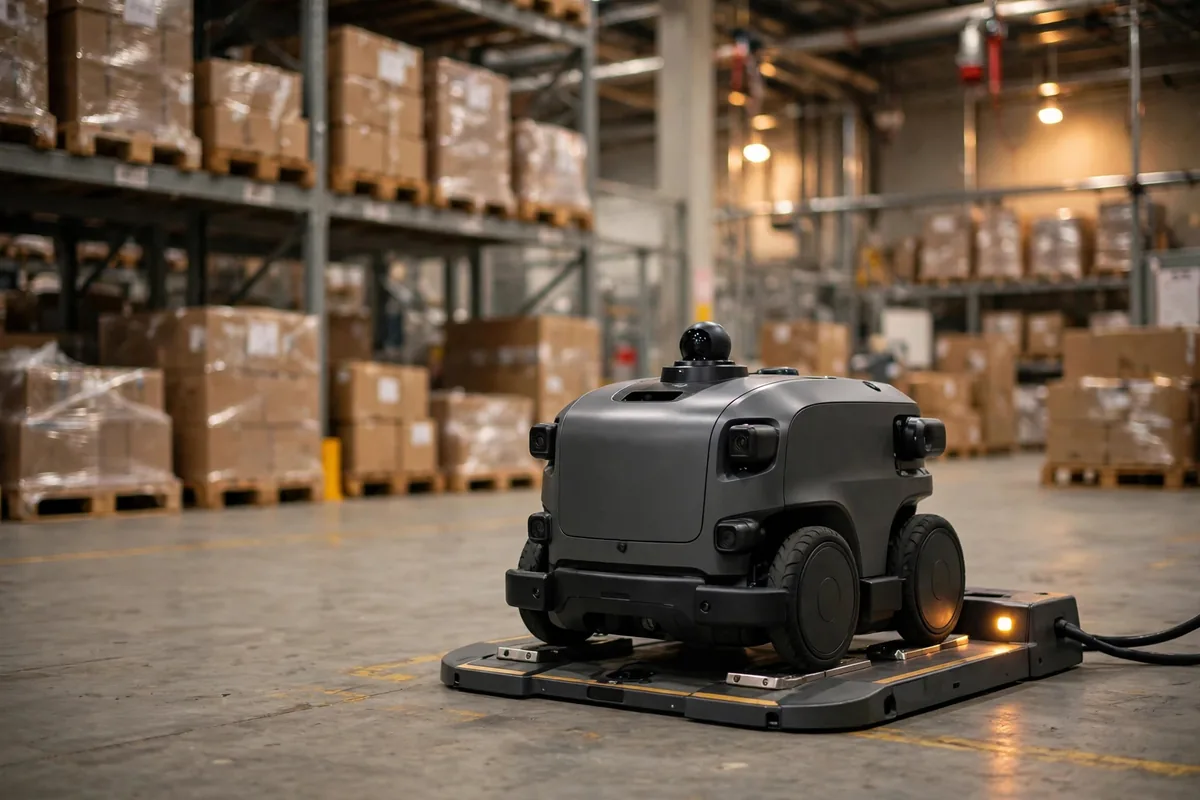
Opportunity charging flips the cost structure. One robot, one pack, no large spare pool, no swap station. Upfront spend is lower. What you pay for instead is dock placement and dispatch intelligence.
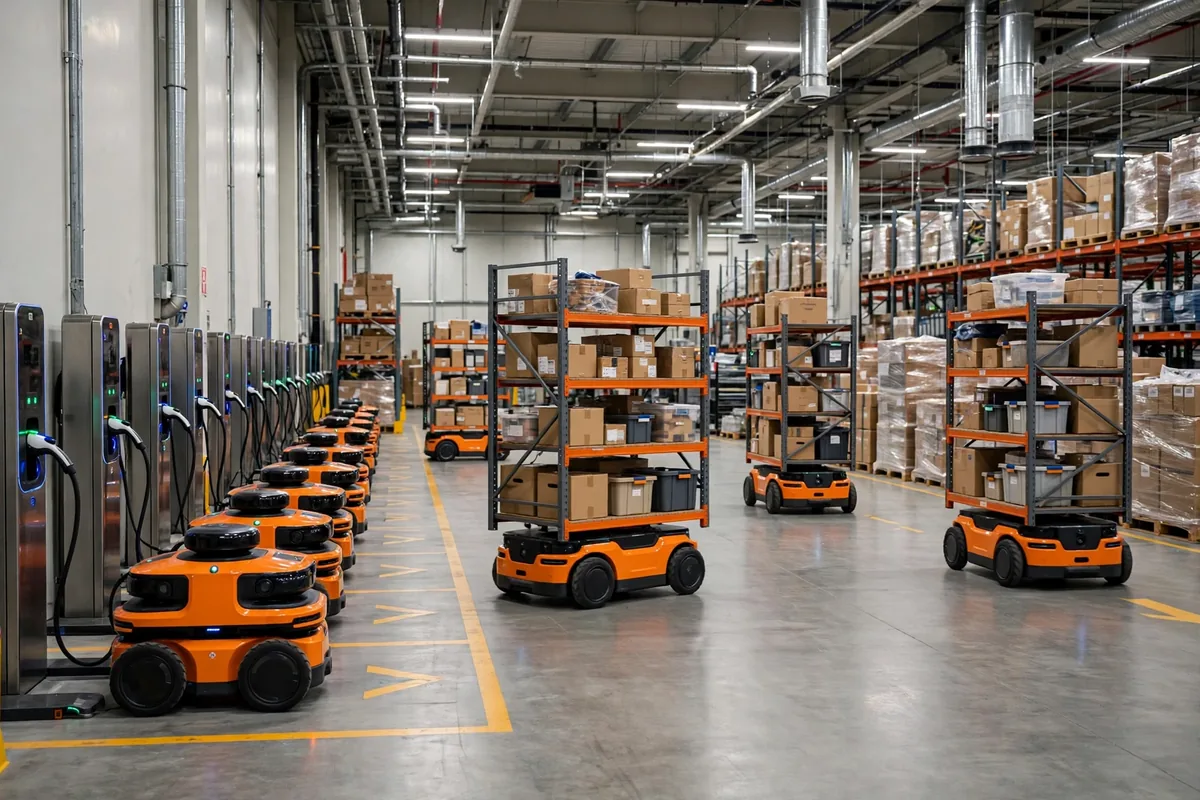
In 2023 I helped retrofit an e-commerce warehouse near Ningbo with 28 AMRs on a shift-and-a-half pattern. They had been charging overnight as a block, and robots were running dry by mid-afternoon. We did not install swap. We added eight charging docks along waiting areas and at the ends of main aisles and rewrote the rules: the dispatcher had to weigh current state of charge, estimated energy for the next task, and dock occupancy together. The first two weeks were messy — five robots would head for three free docks, two would wait in the travel lane, and we created the very congestion we were trying to avoid. Once we added low-battery priority and dock reservation, fleet uptime climbed from the low 80s to the low 90s in percentage terms. That range is illustrative; your aisle layout will move it.
Degradation behaves differently here too. Frequent shallow cycles are generally gentler on lithium cells than deep discharge followed by a full charge, but only if you do not chase speed with aggressive charge rates all day. Push high-rate charging to squeeze energy into 10 minutes, repeatedly, and heat and aging climb with it. There is also a space tax nobody mentions: every dock is a parking spot where a robot sits still. That floor cannot be used for travel or staging while it charges. In a tight building, dock footprint is real money.
That is why opportunity charging fits operations with real valleys: single or two-shift work, clear lulls between waves, and peaks that do not require every robot online at once. The failure mode is the opposite building — a near 24-hour operation with no valley at all. If robots never pause, there is no opportunity to charge. The system quietly degrades into block charging at night, a row of parked robots, and a capacity cut you did not budget for. That is also why amr battery swap vs opportunity charging cannot be decided from average utilization. Averages hide the peak that breaks you.
The decision table I actually use
Do not start with price. Start with these four numbers from your own floor:
| Decision factor | Leans toward swap | Leans toward opportunity charging |
|---|---|---|
| Daily runtime | 16-24 hours, almost no valley | 8-16 hours, clear valleys |
| Fleet size | 30+ robots | Roughly 10-30 robots |
| Peak tolerance | Cannot lose robots at peak without jamming | Can tolerate a small share offline at peak |
| Space and labor | Dedicated swap room, fire separation, staff or automated station | Wall space for docks, no swap room, lean staffing |
| Battery management | Can maintain per-pack health records and rotation | Prefers one pack per robot, simplest possible handling |
The table is a filter, not a verdict. The real dividing line for amr battery swap vs opportunity charging is one ratio: in your busiest two hours, how many robots can you afford to have offline? Pull that window, run the order math with 15% of the fleet missing, and see if outbound still clears. If it clears, opportunity charging will probably serve you and cost less. If it does not clear, you need swap or more robots. There is no clever third option hiding in the charger settings.
Safety differs by route. A swap room concentrates dozens of lithium packs in one area, so detection, isolation, and thermal runaway response must follow local fire code — you cannot just park a charging cabinet next to racking. Distributed docks spread the risk, but every dock needs collision protection, cable management, and clear egress; a charging robot must never block a fire lane. On aging, ignore headline cycle-life claims alone. Degradation depends on temperature, depth of discharge, and charge rate together. Ask for the degradation curve at your actual operating window, per vendor specifications.
Two maintenance traps close the loop. On the swap side, fleets forget pack life alignment: packs bought together tend to fade together, and a fleet-wide pack replacement three years in is a capital hit that should have been amortized into total cost from day one. On the opportunity side, docks fail silently: a dead dock still shows as a destination, robots dock, draw nothing, and only alarm when they are already low. Put chargers and swap stations into the same preventive maintenance and MTBF tracking as the robots themselves. Uptime is a fleet number, not a robot number.
Whether the money is well spent comes down to one number: available robots divided by required robots during your peak two hours. If that ratio lives below one, no charging strategy will save the operation — you are short of capacity, not short of chargers. If the ratio has headroom, then compare spare packs, docks, and labor, and that comparison is the honest version of amr battery swap vs opportunity charging.
By Da Liu, Automation Engineer