AMR goods lift integration looks trivial on a slide and turns expensive on the floor. The robot drives itself, the lift runs itself — so combining them should be easy. I have watched too many projects learn otherwise. The robot waits a minute or more at the lift door, and across a few hundred trips a day, every labor hour the robots saved is paid straight back into waiting. It is like building a highway and putting a traffic light in the middle of it: the road can be as wide as you like, the bottleneck is the one intersection.
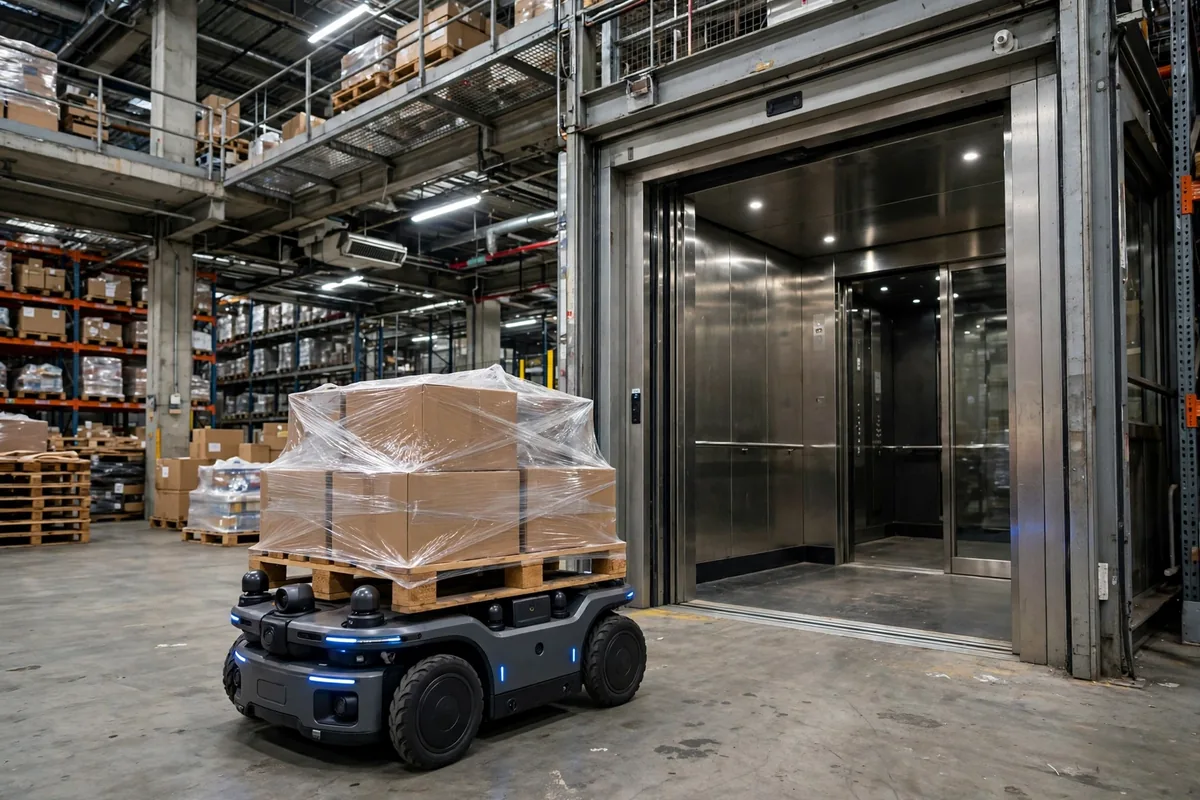
In the autumn of 2024, an e-commerce warehouse in Hangzhou asked us to review their setup. Twelve AMRs rated about 1.2 meters per second unloaded. But at peak, a cross-floor trip averaged around 9 minutes, over 4 of them spent waiting at the lift door and getting in and out. The AMR called the lift through an add-on call box that pretended to be a person pressing a button. Once the car arrived, the robot had no idea how far the doors had opened, whether anyone was inside, or whether a pallet was already in there. The scheduler dispatched robots but had no idea where the lift was, so the robot only called the lift after arriving at the door, the car rode empty down from the third floor, and the robot waited through another cycle. At peak, three robots queued at one lift door with no room behind to turn around.
The second story is more typical, and more expensive. In spring 2025, an auto parts warehouse in Suzhou put eight lift-type AMRs on transfers between a second-floor line-side store and a ground-floor finished goods area. To save money, the team built only the most basic link: the AMR sent a relay signal saying "I want to go up," the lift arrived and opened, and the robot drove in on its own laser navigation. In the third week after go-live, a robot carrying more than 400 kilograms entered the car, and the edge of the load tripped the door light curtain. The doors cycled while the robot sat stuck halfway, until someone hit the emergency stop and dragged it out by hand. Nobody was hurt, but that was luck, not design. The rework afterward — door feedback, load confirmation, in-car beacons — cost noticeably more than doing the full job on day one.
AMR Goods Lift Integration Comes Down to Three Questions: Who Calls, Who Opens, Who Decides
Strip the integration down and there are only three questions, in this order. First, who calls the lift? The scheduler, in advance — not the robot after it arrives. The scheduler knows the destination floor and where the lift sits, so it should call the car to the departure floor 30 to 60 seconds early. Second, who opens the door? The door state must come back from the lift controller as a signal: door fully open, car levelled, load permitted. All three present, the robot may enter; one missing, it stays behind the yellow line. Never let the robot guess the door state from its own sensors. Third, who is in charge? The moment a person touches the lift — an emergency stop, a manual door operation — control passes back to the lift at once, and the AMR may only stop, never compete.
My hard line, stated bluntly: if your lift is an older unit with no open communication interface, and all you have is dry-contact signals for basic calls and door status, do not schedule cross-floor trips densely. Dry-contact integration works — I have built it — but its vocabulary is basically two words, "arrived" and "open." The robot learns nothing about obstacles inside the car or fault codes. In that setup, keep one lift under about 20 cross-floor trips per hour; schedule more and you are paying to run a queue. If the lift vendor opens up the protocol — floor, direction, load, fault status — the scheduler can do real floor scheduling: pairing an up trip with a down trip in one car run, or pre-positioning empty robots in quiet periods. Protocol openness directly sets how smart your scheduling may be. A smarter fleet on a dumb lift interface is money thrown at the wrong layer.
The Dividing Line: Where AMR Goods Lift Integration Pays and Where It Does Not
Most teams do the cost math in the wrong place: they price robot speed. One cross-floor trip equals driving time, plus lift-call waiting, plus entry and exit time, plus lift travel time, plus exit confirmation time. Raising drive speed from 1 to 1.5 meters per second saves maybe ten seconds a trip. Cutting call waiting from 90 seconds to 20 seconds saves 70 seconds on that same trip. At 300 cross-floor trips a day, that one item frees close to 6 robot-hours — and robot-hours are what let you shrink the fleet, which is where the real money sits.
| Leg of the trip | Without advance lift call | With proper integration |
|---|---|---|
| Lift-call waiting | 60–120 seconds | 0–20 seconds, car already waiting |
| Entering and confirming position | 40–80 seconds, repeated probing | 20–30 seconds, entry only after all signals |
| Lift travel | Set by lift speed and floor difference | Unchanged — the physical limit |
| Exiting and handover | 30–60 seconds | 15–25 seconds |
Lift travel time is fixed; everything you can improve sits in waiting and confirmation. Faster robots do not dissolve a lift-door queue; they just make it form more neatly.
Before investing in the integration at all, it is worth settling how to choose between AMRs and forklifts for your loads and frequencies. That choice decides what carries the goods; the call protocol, the interlock, and the floor scheduling decide whether the carrying runs smoothly.
Here is the counterintuitive judgment most teams resist until reality teaches it: the more cross-floor trips you have, the less every robot should share a single lift. One lift at peak is a single point of failure, and waiting climbs steeply as you add vehicles. The working fixes are dedicating lifts by floor zone, or staggering cross-floor work — replenishment trips in the gaps between picking waves, an operator-assisted route as fallback for urgent picks. One policy line — "cross-floor tasks rank below same-floor tasks" — will often raise peak throughput. Protect same-floor work from stopping first; only then argue about cross-floor speed.
The Maintenance Traps Nobody Budgets For
The most dangerous phase is not go-live day but the first month after. Trap one: the lift vendor pushes a firmware update, the communication points move, and the robots keep reading the old addresses. The fix that works is a signed signal-point table, held by both sides, with changes requiring advance notice and a joint test — written into the maintenance contract, not a handshake. Trap two: positioning inside the car. An AMR in a lift car has no floor codes or reflectors, so it runs on wheel odometry alone. One trip is fine; a few hundred trips a day and drift can reach well over ten centimeters, and the robot starts clipping the door frame on exit. Beacons inside the car, or one attitude re-localization while the car moves, is money you cannot skip. Trap three: fault fallback. A lift fault, a communication loss, a robot losing power inside the car — each needs its own written playbook. If the lift faults with a robot inside, the robot must not try to escape on its own. If communication drops beyond a set threshold, the scheduler must mark that lift unavailable and reroute. If a robot dies inside the car, someone named in advance must own the manual push-out. Skip the playbooks and the first real fault turns into everyone improvising at once.
At acceptance, do not judge by a few smooth demos. Run a full shift of real task volume and watch three numbers: average trip time, average lift-door waiting, and integration-caused task failures. When those three hold for a full week, the integration is genuinely standing. A clean demo only proves the wiring is right; surviving a full shift proves the sequence is right.
So is this money worth spending? Look at one number: what share of total trip time is lift-door waiting plus entry and exit confirmation? Get that share under 30 percent and the integration is earning its keep. Miss that mark and no matter how many robots you buy, you are just running a more expensive queue at the lift door.
By Da Liu, Automation Engineer