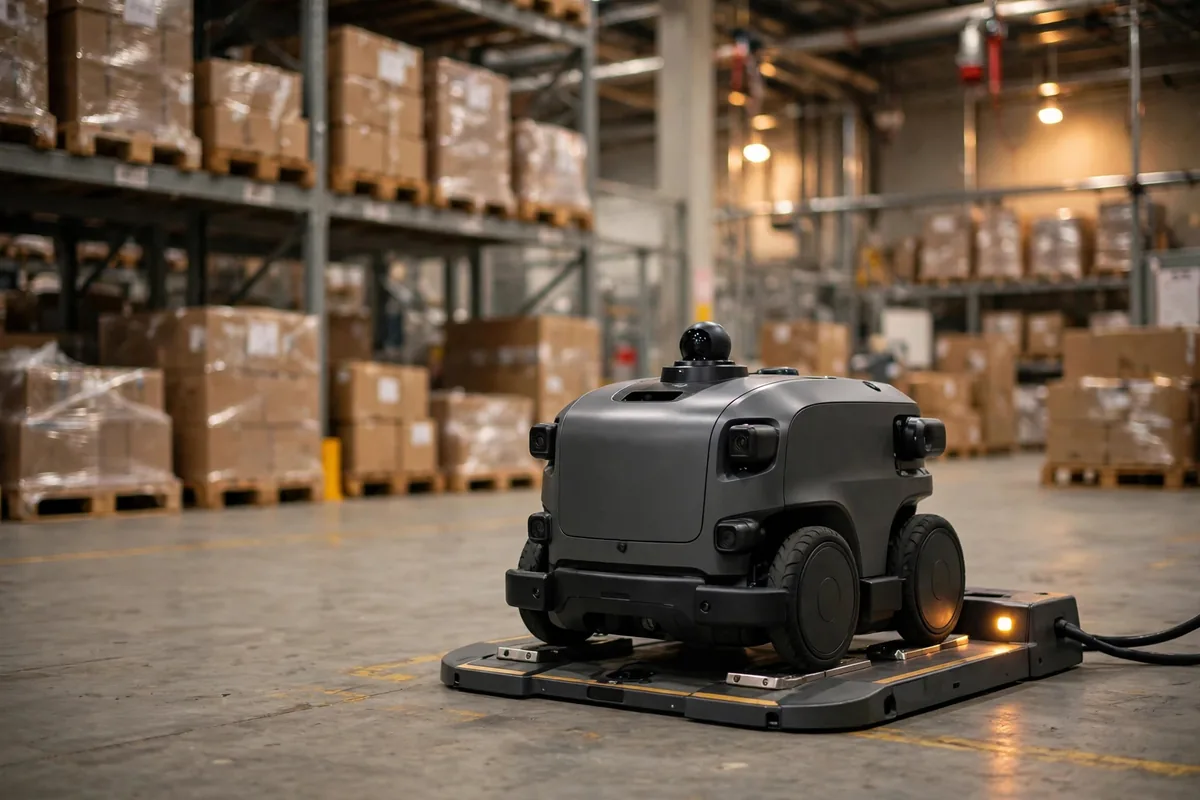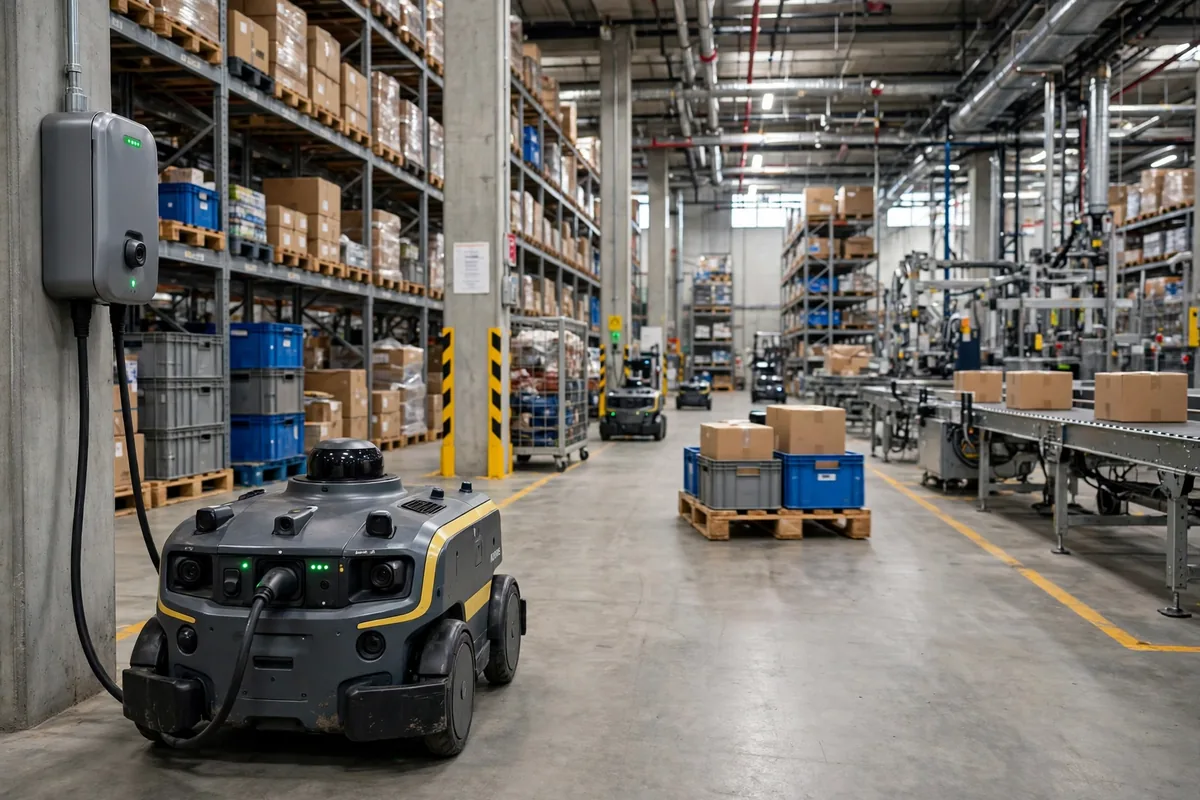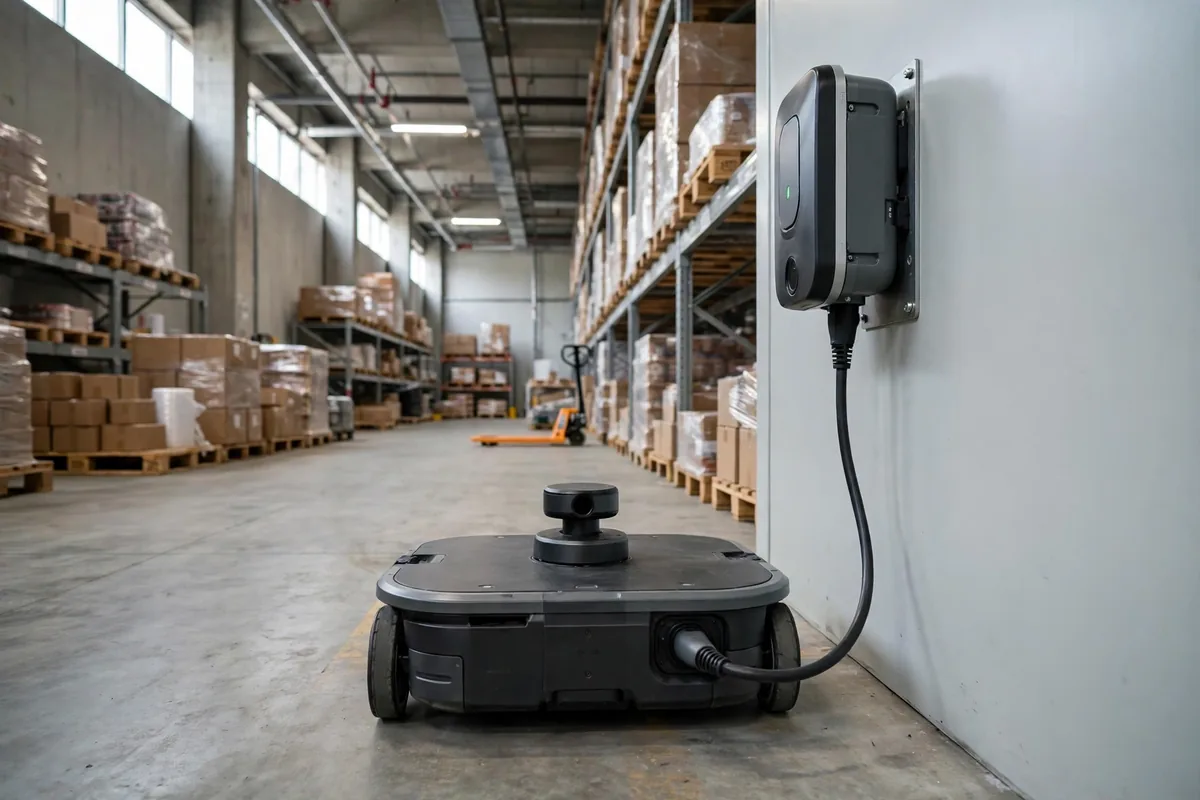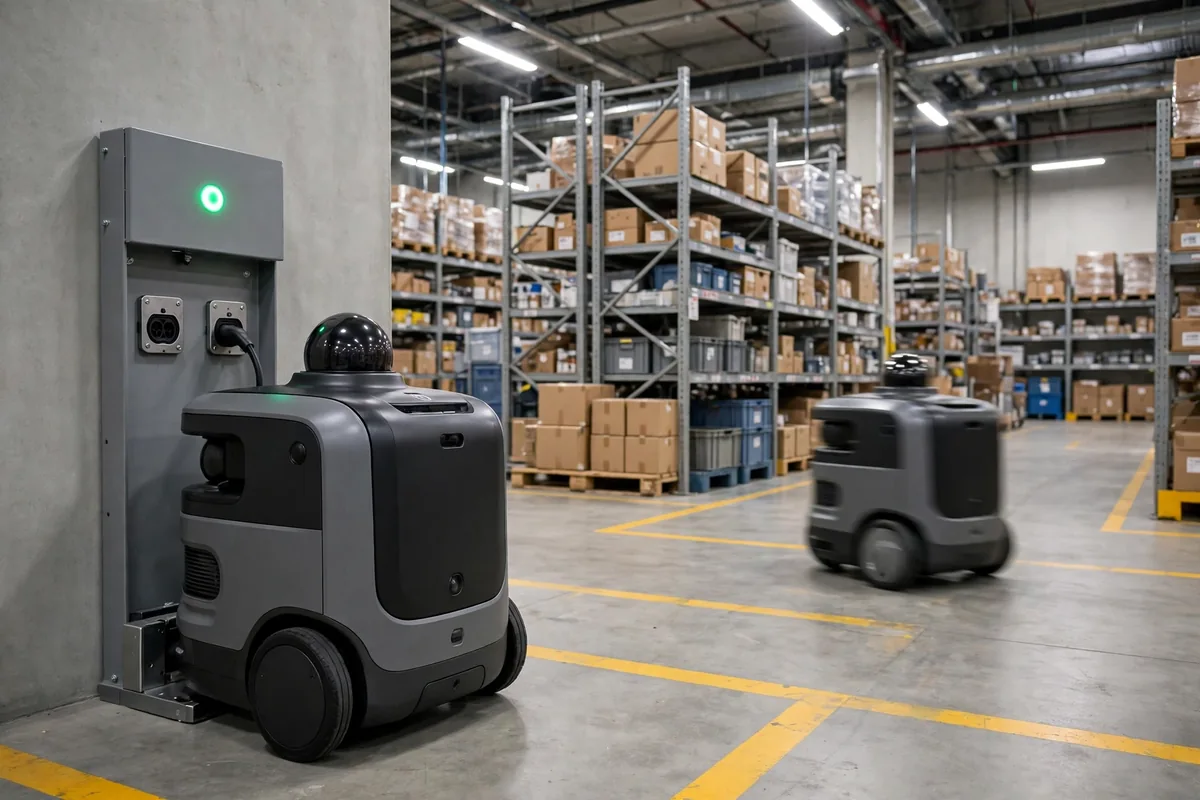
Many warehouses buy the AMRs first and think about the AMR charging strategy later. The robots run fine. Then charging starts biting: at peak hours several robots return to the docks at once, the task queue grows, the dispatcher starts shouting, and the vendor shrugs and says that is how it was designed. It is like buying a fuel-efficient car and discovering the only gas station in town always has a line. Whatever you saved on fuel, you pay back in waiting.
Start with the principles, then the money. Overnight charging is the simplest: robots work the day and recharge in one long session at night, so chargers can be low-power, but the pack must last a full shift. Battery swap is the most direct: a depleted pack comes out, a full one goes in, and the robot is back on the line in minutes — at the cost of two to three packs per vehicle plus a swap mechanism and spare inventory. Opportunity charging is the clever one: the robot sips charge for a few minutes during natural dwell moments — waiting at a pick station, pausing at a conveyor, sitting between tasks — dozens of times a day, so the pack never runs low.
AMR charging strategy in three moves: swap, opportunity, overnight
The principle that decides everything is battery chemistry. Industry guides consistently cite the same pattern: lithium iron phosphate (LFP) packs deliver roughly 3,000-5,000 cycles, against roughly 1,000-1,500 for lead-acid; LFP recharges fully in under 2 hours, while lead-acid needs 8-10 hours plus cooling time. LFP tolerates partial states of charge with no memory effect, and that is exactly what makes opportunity charging viable. Lead-acid hates being topped up halfway; a few half-charges and sulfation starts eating capacity.
The charge curve matters too. Lithium cells accept high current happily during the bulk constant-current phase, roughly up to 80% state of charge, but acceptance falls off sharply in the final constant-voltage phase. Pushing maximum current into a nearly full pack only creates heat and accelerates wear. A good AMR charging strategy follows the curve: opportunity charging tops up the first 80% and stops, while overnight charging can afford to finish slowly. Contact docking runs at about 99% efficiency according to industry guides, against roughly 85-93% for wireless charging — a small gap on the electricity bill, but a real one in heat.
Illustrative scenario: in 2025, a 30-AMR e-commerce warehouse running two shifts used overnight charging plus one midday top-up round. On the first day of a big sale, 18 robots hit low battery at midday and headed back to a charging area with only 8 docks. The queued robots showed as "standby" in the system while orders piled up, and the night shift needed 3 extra hours to clear the backlog. The robots were fine. The batteries were fine. The AMR charging strategy and the dock count had never been designed for the worst simultaneous-return moment. Here is the counterintuitive part: dock count should be sized for the worst peak, not the average. Averages are worthless at peak hour.
The opportunity charging math: how much uptime charging eats
Availability is the only number worth arguing about in AMR charging strategy. A robot running 16 hours a day that spends 2 hours charging has 87.5% availability. An 8-robot fleet at that rate is effectively 7 robots working. The table below is a hypothetical worked example for a 48 V robot running 16 hours a day, showing the structural differences between the three approaches. It is not any vendor's committed specification:
| Item | Overnight charging | Opportunity charging | Battery swap |
|---|---|---|---|
| Time per charge/swap | Hypothetical: 6-8 hours | Hypothetical: 5-10 minutes each | Hypothetical: 2-5 minutes each |
| Total charging time per day | Hypothetical: ~2 hours (after shift) | Hypothetical: ~40-60 minutes (fragmented) | Hypothetical: ~10-15 minutes |
| Daily availability | Hypothetical: ~87% | Hypothetical: ~95% | Hypothetical: ~98% |
| Packs per vehicle | 1 | 1 | 2-3 |
| Charger count | Few, low power | Many, high power | 1 swap station |
The third row is the easiest to misread. Opportunity charging looks efficient only because its charging time hides inside idle time that already existed. That only works if your process genuinely has idle time. A 24-hour line where robots never stop has no "opportunity" at all, and opportunity charging in that setting is a pseudo-requirement. I use that word deliberately, because too many vendors sell "opportunity charging" to customers whose operations have no idle windows to exploit.
There is also a temperature bill most people forget. An industry rule of thumb says that for every 10°C above 25°C in average operating temperature, calendar aging roughly doubles. If the charging area sits in an unventilated corner and hits 40°C in summer, the battery life numbers will look far worse than the datasheet promised. Dock layout is not a matter of finding any spare wall. It needs ventilation, maintenance access, and fire separation.
Battery swap: worth it or not, the fleet-size dividing line
The selection line is actually clear. Single shift, 8-10 operating hours a day, with a long quiet night: overnight charging wins. It is the cheapest charger, the simplest system, and the pack is big enough. Multi-shift, 16-plus hours a day, with plenty of natural waiting in the process: opportunity charging is the default, with dense dock placement and fleet software smart enough to judge whether a 90-second stop is worth charging. Twenty-four-hour operation where one minute of downtime hurts: battery swap earns its keep, but only after you price the swap station, the spare packs, and the maintenance of the swap mechanism.
Fleet size draws a second line. For a 5-robot fleet, the swap station cost per robot is absurd. For a 50-robot fleet, the availability gained converts directly into robots you do not have to buy. Hypothetical example: 50 robots moving from 87% to 98% availability gains the output of more than 5 additional robots, and the purchase cost saved could fund two swap stations. Run the same arithmetic on 5 robots and the answer flips. That is why the same solution is a money-saver in a big warehouse and a money-burner in a small one.
AMR charging dock layout, fire safety, and the maintenance traps
Three maintenance traps to close with. First, charging contacts. Contact charging depends on metal contacts mating over and over. Once they oxidize, collect dust, or wear, efficiency drops and docking failures rise, and robots burn time retrying at the dock. Put contact inspection on the preventive maintenance list, and follow the manufacturer's published service intervals — check the latest official guidance for your model. Second, battery health monitoring. Watch the battery management system data. Capacity below 80% of original is the signal to replace the pack. Do not wait until a robot dies mid-aisle. Third, fire safety. Keep the lithium charging area separated from general storage, fit the right extinguishers and smoke detection, and never stack cartons or packaging above the chargers. Fire compliance has no "close enough"; follow your local fire authority's latest requirements.
Is the money worth it? Look at one number: how many hours per day each robot actually moves goods. Charging strategy, dock count, spare packs — every investment finally converts into that number. If productive hours do not go up, the trendiest charging scheme is decoration. If they do go up, even the most old-fashioned overnight charging is a good solution. Calculate that number before you choose between battery swap and opportunity charging.
By Da Liu, Automation Engineer