Last September, the owner of an auto-parts warehouse asked me: "Lao Zhou, I want to run an AI pilot — how much should I budget?" I didn't answer. I asked him back: "How much money does your warehouse burn on picking errors every month?" He went quiet. He wanted to spend money before he'd done the math. That's how money gets wasted.
Budgeting an AI pilot project has exactly one correct order: first calculate what the problem costs you, then talk about what the fix costs. Reverse the order and every dollar is a gamble. Below are three tiers, based on typical market ranges as of October 2026 (actual quotes vary by vendor — treat every figure here as a range, not a promise). For each tier: where the money goes, what it's good for, and how to calculate ROI.
Tier 1: The $200–800/Month SaaS Tier — Rent the Tool, Prove the Problem
This tier is simple: rent an off-the-shelf AI tool, pay monthly, cancel anytime. Money goes to the subscription. Typical range is $200–800/month, implementation takes 1–2 weeks, and you barely need IT involved.
In November 2024, a 3PL in Ontario, California — 22,000 square feet, 18 floor staff, handling outdoor gear — was pulling 3 people off the floor for two full days every month-end for cycle counts. And the counts still came back wrong. I told the owner not to buy any system. Just subscribe to a $99/month visual counting tool: point a phone camera at a pallet, the AI counts the cartons and flags anomalies.
Run the numbers: before, 3 people × 16 hours × $24/hour = $1,152/month in labor burned on counting. After, month-end counts dropped to 4 hours of labor ($288) plus the $99 subscription — $387/month total. Monthly savings: $765. Annual: $9,180. That's 7.7× the subscription cost.
Tier 1 fits exactly one kind of problem: single-point, visible, measurable — cycle counts, inbound photo documentation, exception reporting. The ROI test is dead simple: monthly subscription < hours saved × hourly wage. If it passes, try it. One warning: SaaS-tier pilots almost always die the same way — "we bought it, nobody used it." A $400/month tool left idle for a year is $4,800 in the trash. That money was wasted. Pay quarterly, never annually: if nobody touches it after 3 months, kill it and cap the damage. That's also the cheapest way to discover your real AI pilot project cost before committing to anything bigger.
Tier 2: The $5,000–12,000 Light-Integration Tier — Buy Certainty, Not Software
Here you're wiring AI into an existing workflow: a one-time investment of $5,000–12,000, plus a small monthly platform fee ($100–300/month). The money goes to hardware (cameras, station screens) and integration work. Timeline: 4–8 weeks, with light IT involvement.
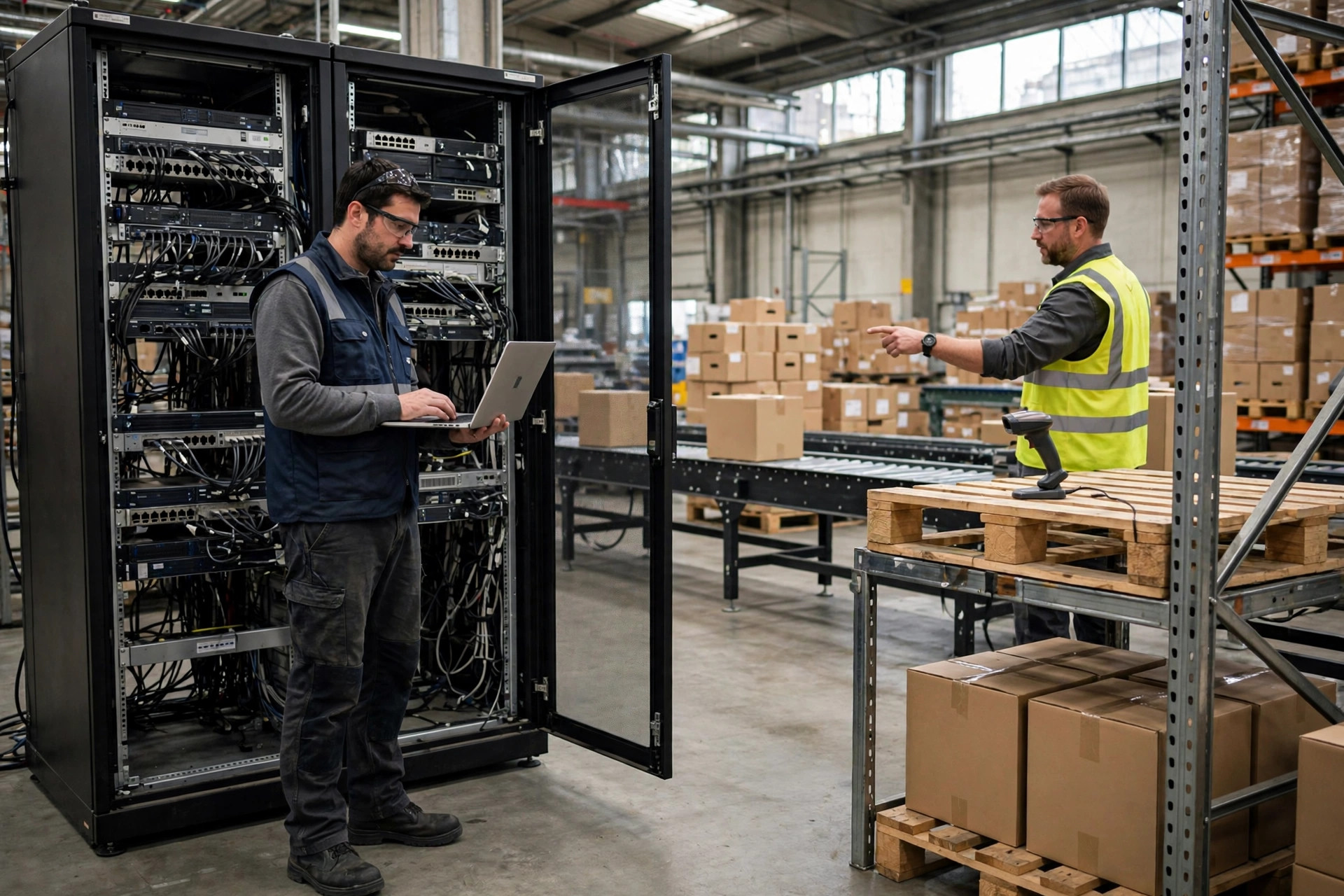
In March 2025, an e-commerce warehouse in Dallas, Texas — 45,000 square feet, 3,000 orders a day — had a picking error rate of 1.2%. Each error cost about $6.50 in rework: re-picking, re-packing, customer service back-and-forth. First, the problem's price tag: 3,000 orders × 30 days × 1.2% × $6.50 = $7,020/month, or $84,240 a year, burned quietly.
The fix: one camera per pack station (4 stations), AI verification that photographs each order while scanning and flags mismatches on the spot. One-time cost $8,500 (hardware + integration), $150/month platform fee. Live in 3 weeks. Error rate fell from 1.2% to 0.4%. Monthly savings: 3,000 × 30 × 0.8% × $6.50 = $4,680, minus the $150 fee = $4,530 net. Payback period: 8,500 ÷ 4,530 ≈ 1.9 months.
The ROI rule for this tier: payback = one-time cost ÷ (monthly savings − monthly fee). If it exceeds 6 months, walk away. Best fit: a closed loop around one or two fixed processes — pack verification, inbound QC photos, yard vehicle recognition. And remember: at this tier, pilots succeed or fail on the floor, not in the algorithm. Camera angle, lighting, network — get one wrong and accuracy drops from 99% to 90%, and 90% verification is the same as no verification. The classic failure: cameras mounted in the wrong spot, blurry footage, another $3,000–4,000 to redo it. Before signing, spend a week testing light and angles with a phone on the actual station. Don't skip that.
Tier 3: The about $20,000 Custom Pilot Tier — You're Paying for Data Assets
A model built for your business: $15,000–25,000 one-time, 8–16 weeks. Where does the money actually go? Not the algorithm. Data cleaning and business integration — typically 40–50% of the total.
In September 2025, a cold-chain food distributor in California — 30,000 square feet — was writing off about $9,000/month in dead stock. A custom demand-forecasting pilot: $18,500 one-time, 12 weeks, covering historical data cleanup, the forecasting model, and a replenishment recommendation dashboard. After 3 months live, monthly write-offs fell from $9,000 to $5,200. Monthly savings $3,800, annualized $45,600, payback ≈ 4.9 months.
But count the full cost: $7,000 of that $18,500 went to data cleaning — their sales history lived in 3 spreadsheets with inconsistent date formats. If your data already sits in a system and it's clean, the same pilot lands around $12,000. So the first budget line of a custom AI pilot project should be $0: export your data and look at how dirty it is. Clean data, custom is worth it. Messy data, and $20,000 buys you a pretty dashboard nobody acts on.
There's also a hidden cost no quote includes: your people's time. A 12-week project needs your operations lead for 4–6 hours a week on requirements and validation — that's another $3,000–5,000 in implicit cost. If you won't commit that time, don't touch the custom tier.
Tier 3 fits: core-process transformation, decisions driven by data — demand forecasting, replenishment strategy, labor scheduling. ROI rule: annualized savings ÷ total cost > 2, or don't start.
AI Pilot Project Costs at a Glance: The Three-Tier Comparison
| Dimension | Tier 1: SaaS Tool | Tier 2: Light Integration | Tier 3: Custom Pilot |
|---|---|---|---|
| Total investment | $200–800/month | $5,000–12,000 one-time + $100–300/month | $15,000–25,000 one-time |
| Timeline | 1–2 weeks | 4–8 weeks | 8–16 weeks |
| IT involvement | Barely any | Light (cameras/APIs) | Heavy (data + deep business participation) |
| Where the money goes | Subscription | Hardware + integration work | Data cleaning (40–50%) + model + integration |
| Best fit | Single-point problem validation | Closed loop around 1–2 processes | Core process transformation, data-driven decisions |
| ROI rule | Monthly fee < hours saved × wage | Payback < 6 months | Annualized savings ÷ total cost > 2 |
| Biggest risk | Bought, never used | Integration stalls, rework costs more | Vague requirements, dirty data |
The Counterintuitive Truth: the Most Expensive Pilot Is the One You Abandon
Most people assume custom is the most expensive tier. Wrong. Do the real math: a $400/month tool nobody opens for a year — $4,800 gone. A $9,000 integration that stalls halfway because the cameras can't see clearly, plus $4,000 in rework, then the owner kills it in frustration — $13,000 gone. An $18,500 forecasting dashboard nobody uses to place orders — worth zero.
The line item every AI pilot budget needs most is a kill switch — written down before you start: if error rates haven't dropped 30% by week 4, stop; if it can't pay back in 8 weeks, stop. A pilot without a kill switch has an unlimited budget. Flip side: an owner willing to write the kill switch won't lose big in any tier. Put the kill criteria in the contract and in an email — not just in your head.
Lao Zhou's Formula: One Equation to Pick Your Budget Tier
Stop asking "how much does an AI pilot cost." Calculate P first — what this problem burns every month (labor + rework + write-offs + shrinkage, all of it, no mercy):
- P < $2,000/month → Tier 1. Validate with a SaaS tool.
- $2,000–10,000/month → Tier 2. Build the closed loop.
- P > $10,000/month → Tier 3 custom is on the table.
One iron rule on top: for any tier, total pilot investment ≤ P × 6 — never spend more than 6 months of the problem's burn. Example: your P is $3,000/month, Tier 2 costs $8,000, the ceiling is $18,000 — the math works, go. If someone opens with a $25,000 custom quote for that same problem, show them the door.
Calculate P and the tier picks itself. The question behind every AI pilot project cost discussion is always the same: what does the problem cost you? If you can't calculate P, don't talk budgets yet — go do the math first.
By Lao Zhou, Logistics Cost Analyst