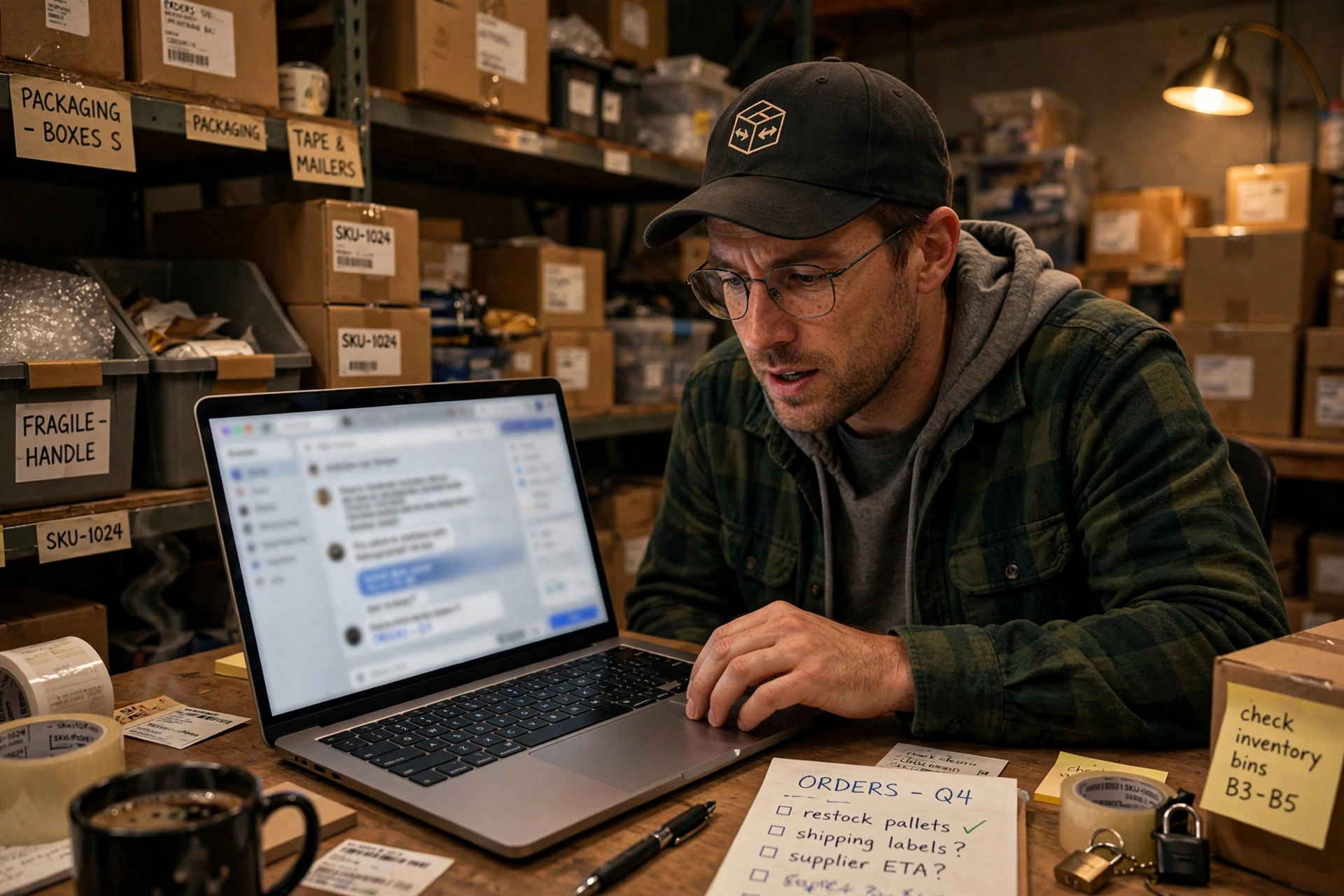
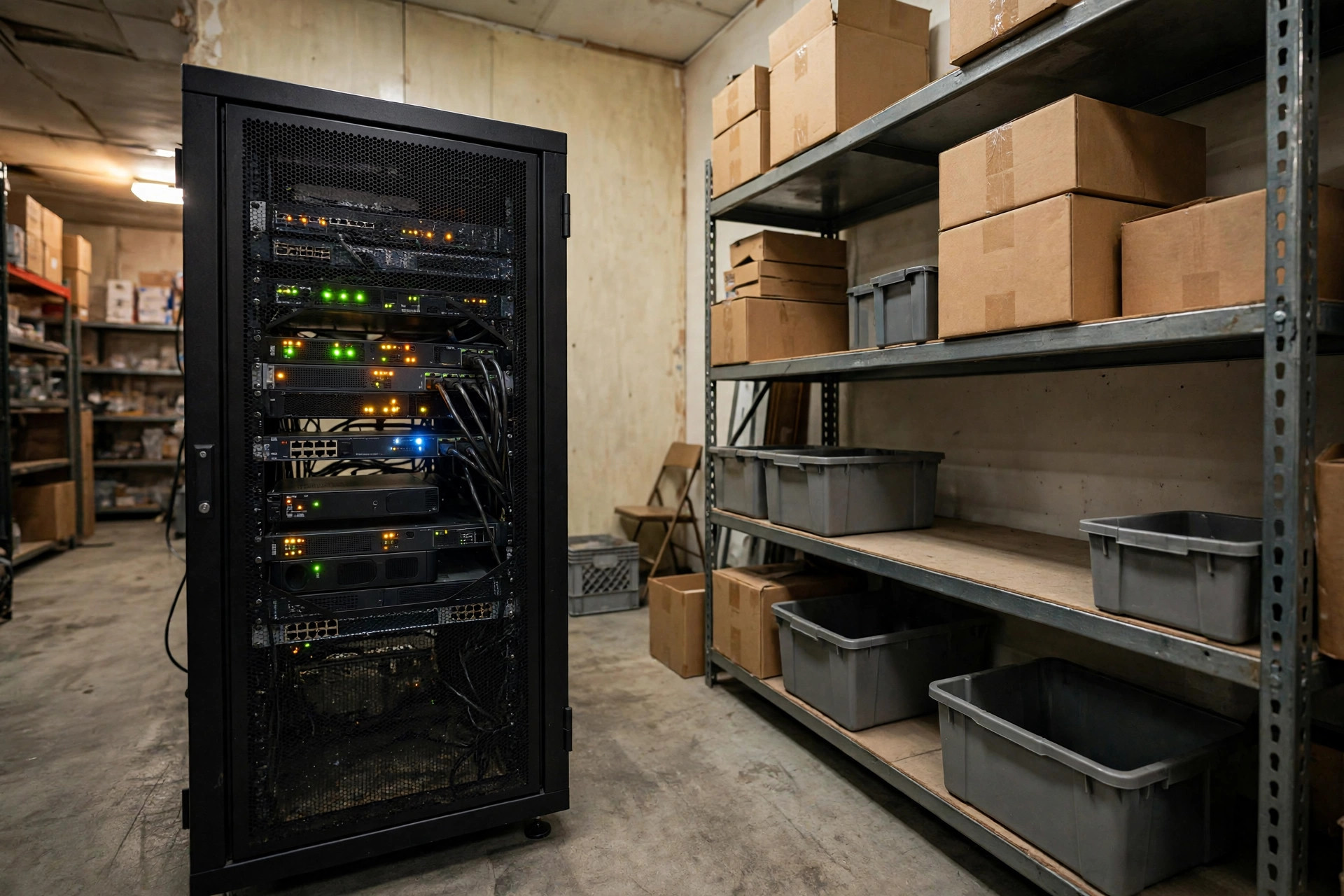
If you had to name the quietest structural change in warehouse digitalization in 2026, local deployment of open-source LLMs would rank near the top: no launch events, no funding headlines, yet it is steadily changing how warehouses consume AI. Until recently, an AI assistant meant sending data to the cloud and paying per token; today, more warehouse operators are asking a serious question — can the model simply live in a server cabinet on our own floor?
The phenomenon: warehouse Q&A is moving back from the cloud
This is not a lab fantasy. On October 10, 2026, the local-first RAG platform AnythingLLM published its "Stop Renting Your Intelligence" thesis: document processing, vector search, and model execution unified into one installable package, so an enterprise can stand up a multi-user knowledge assistant on its own network in about five minutes. Earlier, a publicly released business-case document (arxindustries, 2026) had already walked the path: a 14-billion-parameter open model on workstation-class hardware, 100GB of confidential documents in a local vector database, served through an internal web interface for at least three concurrent users — with the stated primary motive being not cost saving but "sensitive data never leaves the organization's premises."
Meanwhile, the recipe for a local enterprise Q&A system has become highly standardized in the open-source community: Ollama runs the model, an open-source vector database holds the knowledge, and OpenWebUI or AnythingLLM provides the chat interface — every component free. The technical bar for deploying an AI assistant in a warehouse has fallen from "hire an NLP team" to "an IT generalist who can install software."
The data: first the API bill, then the local bill
To judge whether local deployment pays off, both sides of the ledger need computing honestly. Take a typical scenario — a warehouse SOP Q&A assistant on RAG, each question consuming roughly 3,000 input tokens (including retrieved SOP chunks) and 500 output tokens. Using vendors' public list prices as of October 2026:
- GPT-4o: $2.50 input / $10.00 output per million tokens — about $0.0125 per question
- GPT-4o-mini: $0.15 / $0.60 per million tokens — about $0.00075 per question
- Claude Sonnet 4: $3.00 / $15.00 per million tokens
- Gemini 2.5 Flash: $0.075 / $0.30 per million tokens
- Qwen3.8-Flash (hosted): $0.15 / $0.47 per million tokens
On the local side, per U.S. open-market prices in October 2026: a used RTX 4090 (24GB VRAM) trades at roughly $2,600–3,000 (median around $2,860 across sold eBay listings); a workstation able to host it costs about $1,000–1,500 — roughly $4,000 all-in, one time. Electricity, estimated at about $0.20/kWh for U.S. commercial power: the card draws roughly 450W at full load, which works out to about $870 per year running 24/7, or about $290 per year running two shifts (roughly 8 hours a day). The software stack — Ollama, AnythingLLM, the vector database — is entirely open source and free.
| API (GPT-4o tier) | API (mini/flash tier) | Local (used-4090 build) | |
|---|---|---|---|
| Upfront investment | $0 | $0 | ~$4,000 |
| Annual cost at 150 questions/day | ~$675 | ~$40 | Power ~$290–870 |
| Annual cost at 1,500 questions/day | ~$6,750 | ~$405 | Power ~$290–870 |
| Data leaves the building | Yes | Yes | No |
| Works offline | No | No | Yes |
The payback math, and a counterintuitive finding
Read the table carefully and the conclusion is more subtle than intuition suggests. At 150 questions a day, the API costs about $675 a year while local power alone costs $290–870 a year; amortizing the $4,000 upfront spend stretches payback beyond ten years — and if the machine runs around the clock, it may never pay back. At 1,500 questions a day across multiple shifts, the API bill reaches roughly $6,750 a year while local running costs barely move, so the upfront investment pays for itself in about seven to nine months.
The counterintuitive finding is this: the lower your usage, the worse local deployment looks. Local is fixed-cost logic; the API is variable-cost logic. For most small and mid-size warehouses, "pay per question" is the more rational choice, and "open source is free" never meant "deployment is free." A second finding: cost is often not the real decision variable. The arxindustries case document lists data sovereignty, not savings, as the primary motive — warehouse SOPs, customer SKU profiles, and rate sheets frequently carry confidentiality requirements that no API, however cheap, can satisfy. A third judgment: free weights do not mean a free bill. Building the RAG pipeline, ingesting and cleaning documents, isolating permissions, and patching security are ongoing labor costs; open source merely converts the "intelligence rent" from a monthly payment into upfront engineering plus long-term maintenance. And cheap mini/flash-tier APIs have nearly erased the cost advantage of local deployment for pure Q&A — for local to make sense, at least one of three conditions should hold: high volume, sensitive data, or a need to run offline.
Attribution: why the second half of 2026, of all times
Why now? Four conditions arrived simultaneously in the second half of 2026, and each one was necessary.
First, licensing. On August 10, 2026, Meta released Muse Glimmer, a 30-billion-parameter model under the Apache 2.0 license — the first flagship-grade open weight that is genuinely worry-free for commercial use. Before it, the Llama family shipped under a community license: products with over 700 million monthly active users needed a separate grant, and multimodal features carried regional restrictions in the EU — enough to make any careful legal team hesitate.
Second, capability density. Mixture-of-experts architectures made "small activation, large knowledge" practical: Llama 4 Scout (released April 5, 2025), with 17 billion active parameters out of 109 billion total and a 10-million-token context window, was shown by the community to run on 12GB of VRAM through Ollama; Qwen3.8-27B (weights opened in August 2026) runs on a single GPU with 262K tokens of native context. Warehouse Q&A does not need a frontier model's full power — it needs "good enough, and fits in the box."
Third, hardware. The 32GB RTX 5090 lets a single consumer card hold models that previously required professional accelerators — though the 2026 memory shortage pushed street prices to $3,900–4,400 (against a $1,999 MSRP), making the used RTX 4090, at roughly $2,600–3,000, the value entry point instead.
Fourth, tooling. Zero-code RAG platforms like AnythingLLM and OpenWebUI reduced "drop documents in, start asking" to minutes, so warehouse IT no longer needs to understand embeddings or reranking to get a system running.
Looking toward 2027: will every warehouse have its own AI assistant?
My judgment: most likely yes — but not as "one local model does everything." The probable shape is hybrid routing: a small local model as default, cloud frontier models on demand — high-frequency closed-knowledge questions (SOPs, equipment manuals, customer profiles) stay local at near-zero marginal cost with data never leaving the building; complex reasoning and anything needing live data (rates, regulatory updates) goes to the cloud. The basis: the cost curve above puts each question class where it is cheapest to answer.
On timing, the second half of 2026 is the pilot year, and 2027 may be the inflection point: a flagship open model under Apache 2.0, mature one-click deployment tooling, and GPU prices easing if the memory shortage subsides would together compress the deployment threshold to "one workstation." At that point the binding constraint stops being technology and becomes organizational readiness — whether documents are digitized, whether permission structures are clear, whether someone will maintain the system.
The boundaries deserve to be drawn now. Local models excel at closed-knowledge Q&A; they are poor at three things: information requiring live internet access, decisions resting on very long reasoning chains (network optimization, site selection), and domains where knowledge must track the frontier continuously. The 2027 question for warehouse managers may not be "should we use an AI assistant" but "which questions is it allowed to answer, and which must go to a human or a cloud model" — designing that routing policy is itself a new management discipline.
An open question for 2027
When compute becomes a fixed asset like racking, where does the line between the IT budget and the operations budget fall? AI used to be a monthly service fee booked as operating expense; after local deployment it becomes one-time capital expenditure plus electricity — fixed assets and energy cost. That accounting shift quietly changes who approves AI spending and how it is measured: from "how much did we spend on tokens this month" to "what is this machine's utilization rate." Warehouses in 2027 may need to answer the budget-ownership question before the technology-selection question — and for that, no standard answer exists yet.
By Dr. Chen, Supply Chain Researcher