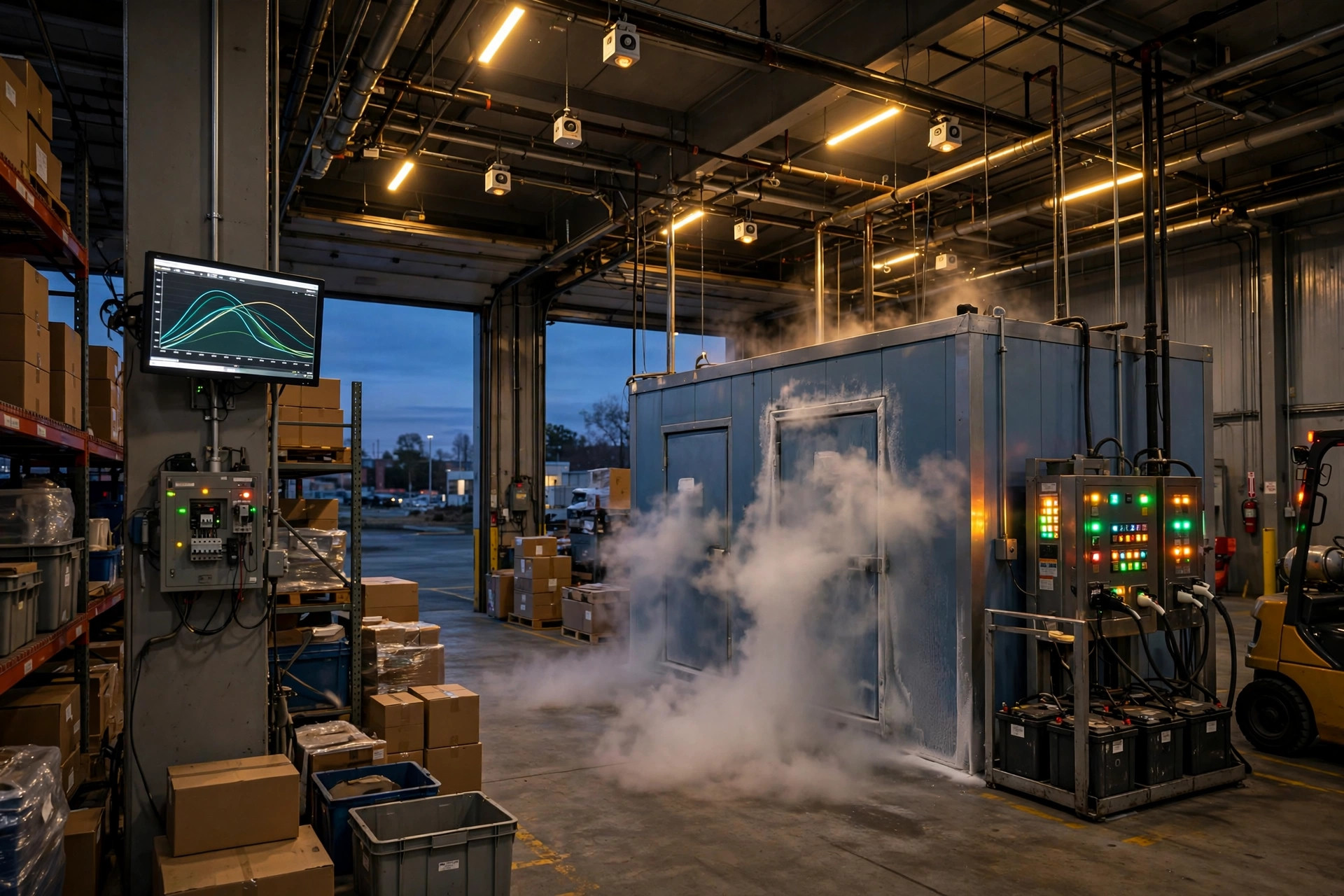
When I first heard "AI energy optimization," my gut reaction was: great, Big Tech invented another expensive toy. I run a 3,000-square-meter warehouse. The power bill lands every month like a ransom note. AI feels about as relevant to me as Mars. But last summer my bill nearly doubled, and desperation is a wonderful teacher. So here's the honest version, small-operator to small-operator: what AI can actually shave off your power bill, and which tricks are worth our money.
Our Predicament: The Power Bill Is a Second Landlord
We run mixed ambient and small cold-storage operations. Last July a California heat wave hit, the compressors never cycled off, lighting, forklift charging, and AC all ran full tilt — and the bill came in at roughly double the usual. I stared at it and reached a painful conclusion: the landlord collects rent, and the utility collects a second rent.
Per the U.S. Energy Information Administration (April 2026 data), California's average commercial rate sits around 25.75 cents per kWh — the priciest on the mainland US (check your local utility's latest tariff for exact rates). Big warehouses negotiate volume rates. Small operators have zero bargaining power. Worse, California's time-of-use structure makes 4pm–9pm the peak window — exactly when a cold-storage compressor works hardest. That's not coincidence, that's physics.
So the first question in AI energy optimization for a small warehouse isn't "how smart is the AI." It's "where is my electricity going?" I broke our usage down: refrigeration first, lighting second, forklift charging and office AC third. Buy a system before you know that split and you're buying medicine with your eyes closed.
What AI Energy Optimization Actually Does
Strip the buzzwords and AI does three unglamorous things:
First, it shops for cheap hours. Off-peak power is cheap, peak power is brutal. AI shifts whatever can move: charge forklifts overnight, pre-cool the cold room in the small hours, rest compressors during the peak window. The principle is obvious; the hard part is doing the math and switching every single day — humans forget, machines don't.
Second, it predicts load. Say 2,000 cases of frozen goods arrive tomorrow. The system pre-chills instead of waiting for the temperature spike and making the compressor sprint. Like driving: the driver who reads the road ahead always burns less fuel.
Third, it links equipment. An open cold-room door is money flying out the window. A sensor sees the door open ten minutes, ramps up the air curtain, pings the manager's phone. Nobody in the aisle, lights dim to 20%. Not black magic — sensors plus rules wearing an AI costume.
The essence is "automated penny-pinching." The enterprise pitch involves digital twins and deep learning. We can't use that stuff, and we can't afford it.
A Real Case: Lao Chen's Cold Storage and the Bill That Forced a "Dirt-Cheap AI"
My friend Lao Chen runs an 8,000-square-meter cold-chain warehouse near Ontario. In August 2024 his summer bill came in nearly double, and he briefly considered a sledgehammer for the compressor. An AI energy vendor quoted him: sensors, gateway, subscription — the annual cost equaled about two months of his power bill. His words: "I'm saving on power, not funding a software company."
So he built a dirt-cheap version:
- Rescheduled defrost cycles. Compressors used to defrost four times daily on a fixed timer, needed or not. He switched to door-open-count-based defrosting, only in off-peak night hours. That alone visibly cut the refrigeration portion.
- A $30 motion sensor on the door. Door open over five minutes, a red light flashes by the entrance — wired to the air curtain. After two flashes, drivers learned to close the door.
- A forklift charging roster. One A4 sheet taped to the charging station: no plugging in 4pm–9pm; violators buy bubble tea for the whole shift. Compliance: 100%.
Three months later his bill was down roughly 20%. I nearly spat out my tea. "You call that AI?" He said, "Human intelligence is still intelligence."
The lesson: for a small warehouse, step one of energy optimization is getting the manual process straight — not buying a system. Automating a mess just builds an automatic mess-maker.
Our Own Experiment: Lighting Paid for Itself
Our old metal-halide lamps were hogs and took forever to warm up. In early 2025 I bit the bullet: full LED retrofit plus motion sensors — full brightness only with someone in the aisle, 30% otherwise.
The U.S. Department of Energy says LEDs can use up to 75% less energy than traditional lighting. I metered it for a month instead of trusting the brochure: our lighting consumption dropped about 60%. Payback in under a year — better than my first used forklift.
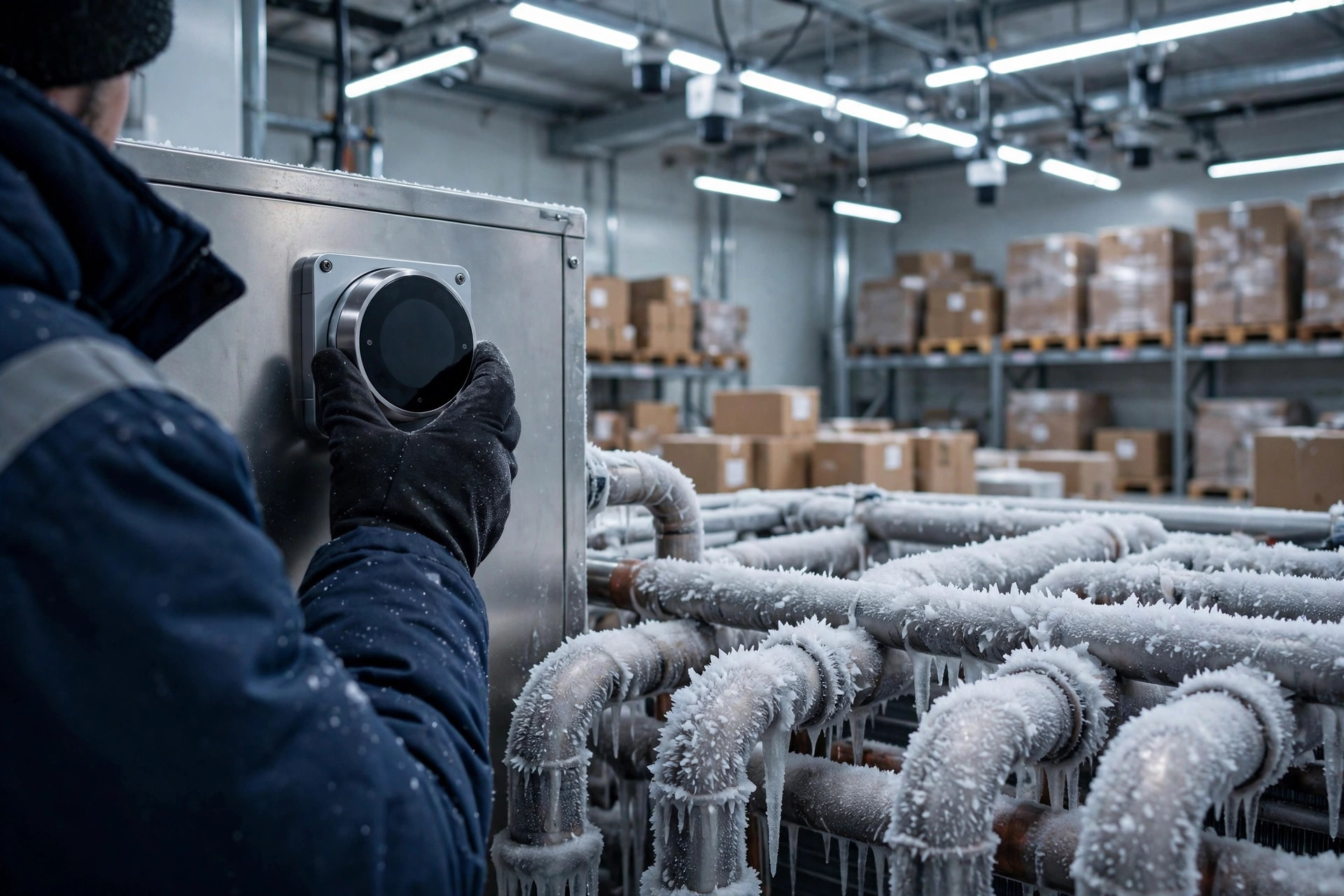
On refrigeration I skipped surgery — just added a timer-plus-thermostat controller: extra cooling off-peak, take it easy at peak. It trims a little monthly. My takeaway: lighting is the low-hanging fruit — pick it first. Cold storage is the tough nut; fix the process before touching equipment.
The Counterintuitive Part: Small and Big Warehouses Do Different Math
Big warehouses save on scale: hundreds of thousands of square feet, dozens of compressors — the AI squeezes 5% out of each run curve, multiplied by an astronomical base, and the savings buy new machines. That's why enterprise price tags make sense to them.
A small warehouse? Much of our bill is the demand charge — billed on your single highest spike of the month — plus fixed fees. No AI can touch the fixed portion. It can only move "how many kWh" and "when the peak hit." Small base, 10% optimization, and the savings might not cover the subscription.
So the small-warehouse playbook runs in reverse: first read the bill and split fixed from variable charges; crush the variable part with zero-cost manual moves (off-peak shifting, charging rosters, closed doors); only when human attention can't keep up, consider a system. Wrong order and you're paying tuition.
When a rep says "our AI cuts power costs 20%," ask three questions: 20% of the total bill or of the variable portion? Does it touch the demand charge? After the subscription, what's left? Ninety percent of reps start looking at their shoes.
The Three Rungs of AI Energy Optimization: From $0 to a Real System
| Rung | Investment | What you do | Rough effect |
|---|---|---|---|
| Rung 1: Manual penny-pinching | $0 | Read the bill, charge off-peak, reschedule defrost, close doors | 10–20% off the variable portion |
| Rung 2: Dirt-cheap automation | A few thousand dollars | LED + motion lighting, smart timers, sensors with phone alerts | Another cut; lighting pays back fastest |
| Rung 3: A proper AI system | Thousands to tens of thousands per year | Load forecasting, equipment coordination, TOU-aware scheduling | Vendors claim another 10–20%; verify, don't trust |
My advice: 90% of small warehouses capture nearly all savings on rungs one and two. Rung three is for bills so big that "5% saved" covers the subscription. Quick test: annual bill × 10% > system fee × 2 — then consider it. I earned that formula the hard way.
One warning: make vendors show a real case at your scale. They'll show flagship projects at hundreds of thousands of square feet — irrelevant to you. No same-scale case? Walk away. No shame.
Three Pieces of Advice for Fellow Small Operators
First, read the bill before talking AI. Know every line: per-kWh, peak-demand, fixed. Call the utility if it's unclear — your right as the payer. If you don't know where the money goes, energy optimization is just a spell.
Second, lighting first, refrigeration later. LED plus motion control is the highest-ROI move there is. Don't touch refrigeration equipment yet — touch the process: defrost timing, door discipline, pre-cooling. All zero cost.
Third, exhaust the cheap fixes before the fancy ones. Rosters, a printed notice, a $30 sensor — the "primitive" fixes solve 80% of it. Let AI handle the 20% human attention can't cover. AI is here to watch the night shift, not to collect your tuition.
Energy optimization is a scale game for big warehouses and a penny-pinching game for small ones. The enterprise playbook isn't for us — and doesn't need to be. Small warehouses have their own way: treat every kilowatt-hour like your own money. Because it is.
By Xiao Ma, Small Warehouse Owner