End of last month, I stared at a weighbridge ticket for a full ten minutes. The supplier's delivery note said 25.4 tons. Our weighbridge said net weight 25.1 tons. Three hundred kilos of copper rod, vanished into thin air. You know what 300 kilos of copper is worth? About half a year of my warehouse rent. Today I'm going to tell you how our tiny warehouse uses AI to read weighbridge tickets and reconcile weights automatically — and full disclosure up front: we can't afford the fancy stuff. Everything we did is the scrappy, duct-tape version.
Our Predicament: Weighbridge Tickets Are Sketchier Than You Think
We run a 3,000-square-meter warehouse serving small factories nearby — mostly bulk raw materials and heavy goods. Almost every inbound load goes over the weighbridge. The process sounds legit: truck rolls onto the scale, the gate guard notes the plate number, the weighbridge office prints a paper ticket, and the warehouse clerk carries it back to the office and types it into the system by hand. Sounds fine, right? It's a mess.
Back in March 2026, a cable manufacturer from Hebei sent in a truckload of copper rod. Delivery note: 25.4 tons. Our weighbridge net weight: 25.1 tons. A 300-kilo gap. The customer wanted to settle on the delivery note; the supplier insisted 25.4 tons left their factory and our scale must be off. They argued for a week. Finally both sides got their scales calibrated — both were fine. The two scales just drifted in opposite directions, and the errors stacked up to 300 kilos. We split the difference that time, but it taught me something: without automatic reconciliation, every weight discrepancy is a mystery, and whoever shouts loudest wins.
Then July 2026 got even more ridiculous. Our clerk Xiao Chen was typing in a ticket and misread the net weight "26.6" as "26.8" — booked 200 extra kilos into the system. The customer paid on our receiving record, overpaid, and only caught it a month later. Refund, apology, dinner on me. And my personal favorite: a driver left a ticket lying around, and that night it became a coaster for instant noodles. Grease soaked through, the numbers blurred, and the weight of that entire load remains a mystery to this day.
So there are exactly three holes in this process, and each one costs real money: manual entry — one wrong digit, one phantom transaction. Paper tickets — lose it or smudge it, and you've got zero evidence at reconciliation time. And the supplier's paperwork and your scale will never perfectly agree; if nobody watches that gap daily, it just gets quietly "absorbed."
The Enterprise Playbook? Not for Us
After those incidents I did flirt with "going proper." I called two weighbridge integration vendors. The quote: tens of thousands for hardware retrofits plus software, annual maintenance on top. The sales rep painted this beautiful picture of "fully automated unmanned weighing." I told him: "Our gate guard takes great photos with his phone. We don't need unmanned."
Here's the thing the enterprise guys don't get: their logic is "you have so many trucks that humans can't keep up, so automate everything." We get maybe fifteen, twenty trucks a day. The guard glancing at each one is plenty. Spending tens of thousands to automate "the guard glancing" — I ran that ROI three times, and it hurt more each time.
Our Scrappy Fix: Phone Camera + AI Ticket Reading
The breakthrough came late last year from a warehouse WeChat group. Someone shared their setup: snap a photo of the weighbridge ticket, feed it to an OCR service, auto-extract plate number, gross, tare, net, and timestamp, straight into a spreadsheet, then auto-compare against the purchase order. I looked at it and thought: built for warehouses like ours.
Here's our current workflow — ugly, but it works:
The truck rolls onto the scale. The gate guard snaps a photo of the ticket with his phone — just the regular camera, no special app. The photo lands in a group chat, a script sends it to an off-the-shelf OCR service, and five fields come back: plate number, gross, tare, net, timestamp, straight into our shared spreadsheet. The PO weight for that load is already in the sheet, a formula computes the variance, and anything over our threshold turns the whole row red and pings us on chat.
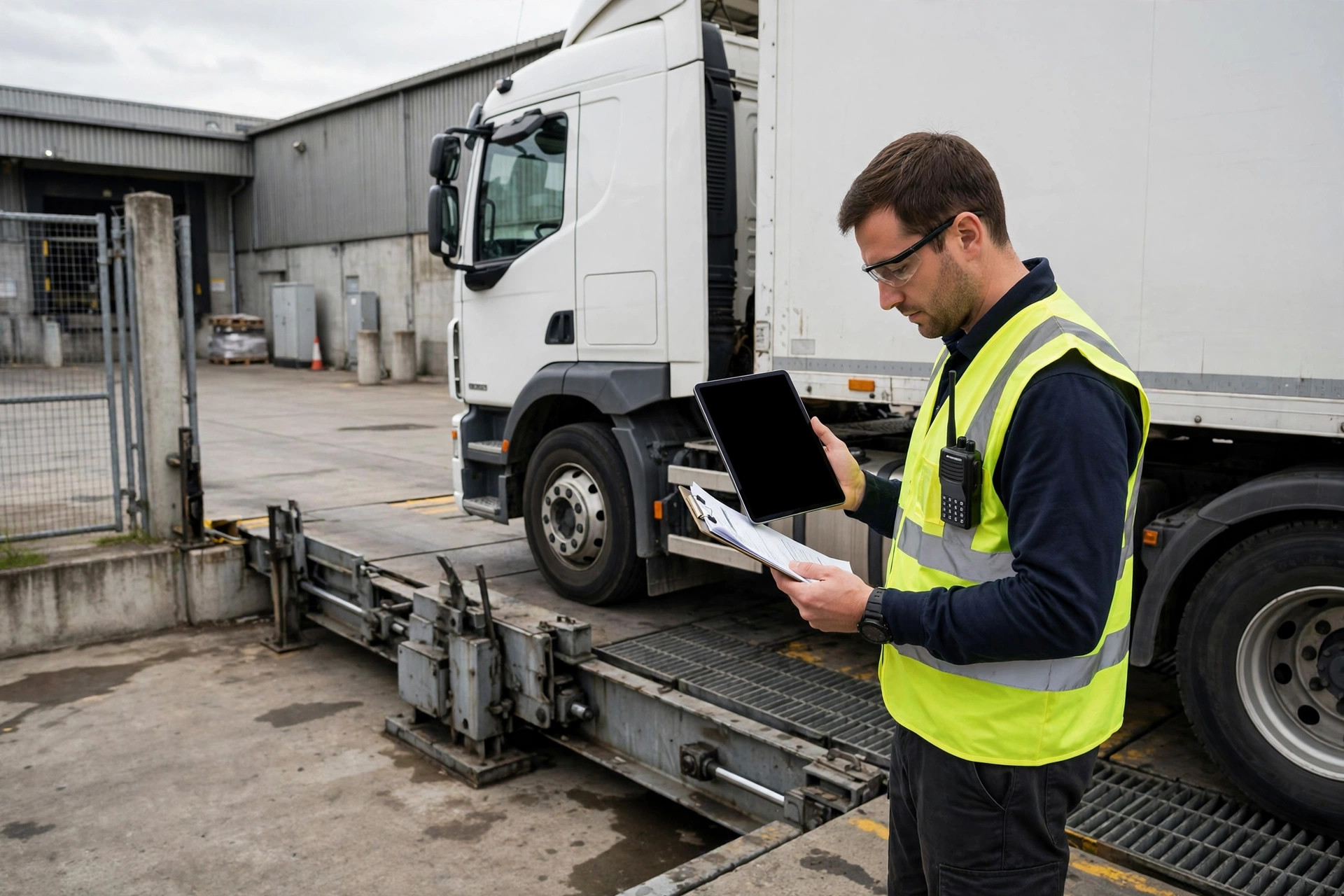
Weighbridge tickets are beautifully boring documents: same layout for years, big print. Machines read them better than tired human eyes at 6pm. A blurry shot or a glare misreads a digit now and then; fixing it in the spreadsheet takes a minute.
Two weeks after launch, the system caught its first "thief," and the punchline was on us: a load flagged red, delivery note vs. actual weight off by 200-plus kilos. I was gearing up for a fight with the supplier when I walked over to the weighbridge office — our own scale was overdue for calibration and the sensor had drifted. Got it recalibrated, the variance vanished. The first thing automatic reconciliation exposes is usually your own problem. In the manual-entry days, the supplier would have carried the blame for those 200 kilos forever.
The Math: Is the Scrappy Version Worth It?
I know this is the part you care about. Here's the honest comparison:
| Approach | Upfront cost | Ongoing cost | Error rate | Who it's for |
|---|---|---|---|---|
| Pure manual entry | Zero | Half an hour of clerk time daily + dispute drama | High — a slip-up or two every month | Under 3 trucks a day, eyes-closed tiny ops |
| Full weighbridge integration | Tens of thousands in hardware | Annual maintenance | Near zero | Hundreds of trucks a day, big DCs and parks |
| Phone photo + OCR, semi-auto | Basically zero, one phone | OCR usage, a few hundred a month | Low — machine reads, human glances | A dozen or two trucks a day, small warehouses |
At our volume the OCR bill runs a few hundred a month. Catching one 200-kilo variance pays for the whole thing — at copper prices back then, those 200 kilos were worth the better part of a thousand bucks.
Reconciliation Is Where the Real Money Is
Most people think the magic here is "AI recognition." Wrong. The magic is reconciliation — putting the variance on the table where everyone can see it. An OCR misreading a digit or two is harmless; a human fixes it in a minute. What used to cost us real money was having no reconciliation step at all — variances nobody ever saw.
One hard-won lesson on the trade-off: don't set your alert threshold too tight. Weighbridges have their own error margins, loading losses and fuel burn add noise. Set it at ±0.1% and you'll get alerts every day; within three days everyone goes numb and the alerts become wallpaper. We use ±0.5% — tight enough to catch real problems, loose enough that a red row still means something.
And here's the counter-intuitive take: don't chase 100% automation. Keeping a human "tap to confirm" step actually makes small warehouses more robust. Enterprises want unmanned operation because their labor is expensive and their truck volume is insane. Our labor is relatively cheap and our volume is low — the guard tapping "confirm" also glances at the load, and that gut feeling of "this truck looks off" is something AI doesn't have.
Advice for Fellow Small Warehouses
First, start with photo archiving — it costs literally nothing. Have the guard photograph every ticket and dump the photos in a dated chat album. That alone kills the "lost ticket" hole. When a dispute comes up now, we check the photos first. Photos don't lie.
Second, standardize the ticket format. Talk to the weighbridge office or the industrial park and lock down the layout — same fields, same positions, no redesigns every quarter. OCR loves fixed layouts; the more stable the format, the better it reads. This step is free, but it sets the ceiling for everything after.
Third, don't believe "99% accuracy" marketing. Test with your own real tickets — the blurriest, glariest ten you've got. In real conditions, a solid majority read cleanly plus a minute of human review is completely fine for a small warehouse. Good enough is a win.
Fourth, keep the reconciliation rule dead simple at first. Just one rule: actual weight vs. paperwork weight, alert when the gap exceeds the threshold. Get it running first, make it pretty later.
At the end of the day, getting weighbridge data into the system was never a technology problem. It was always a "do small warehouses deserve this" problem. My answer: yes — but do it the small-warehouse way.
Small warehouses have their own way of surviving.
By Xiao Ma, Small Warehouse Owner