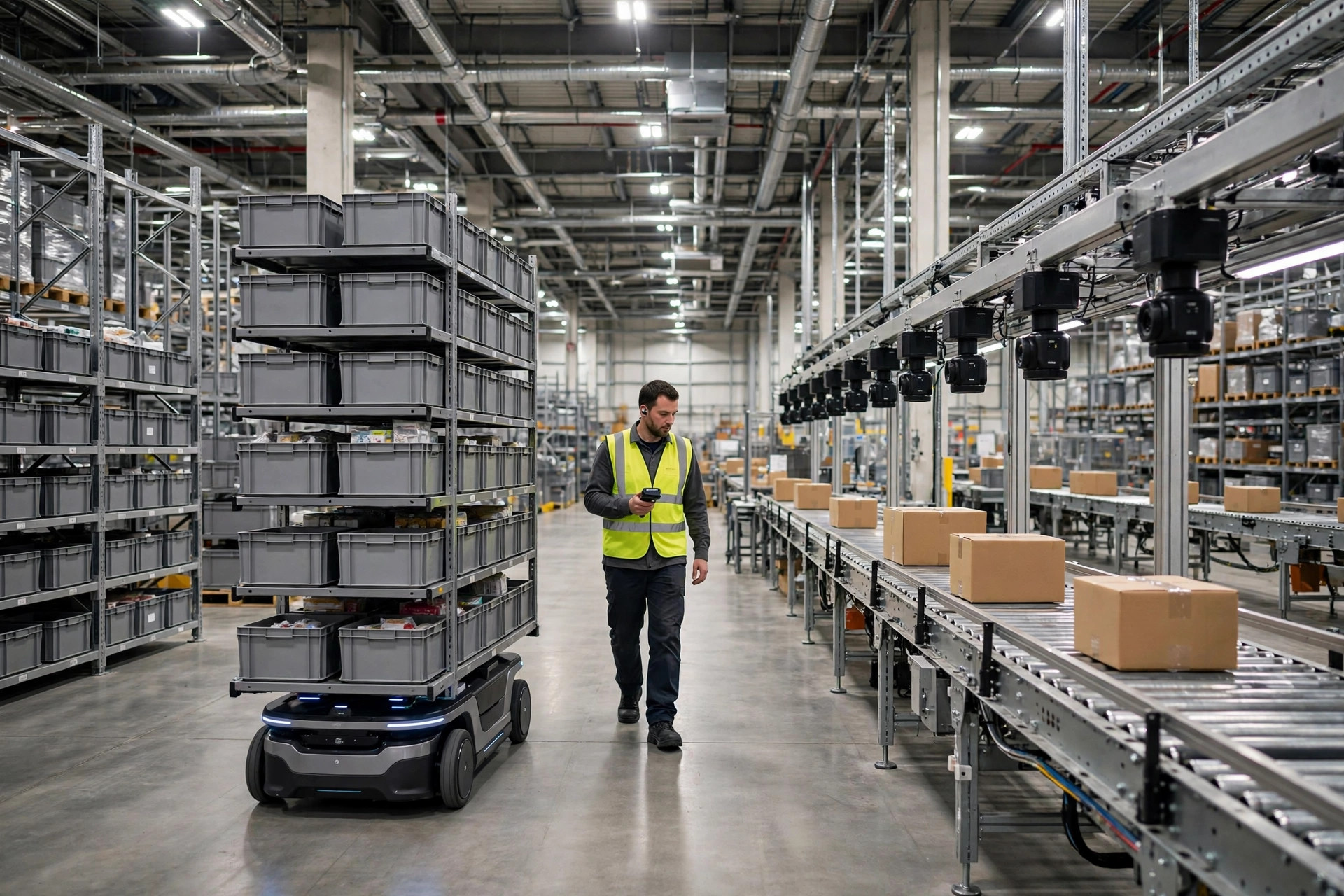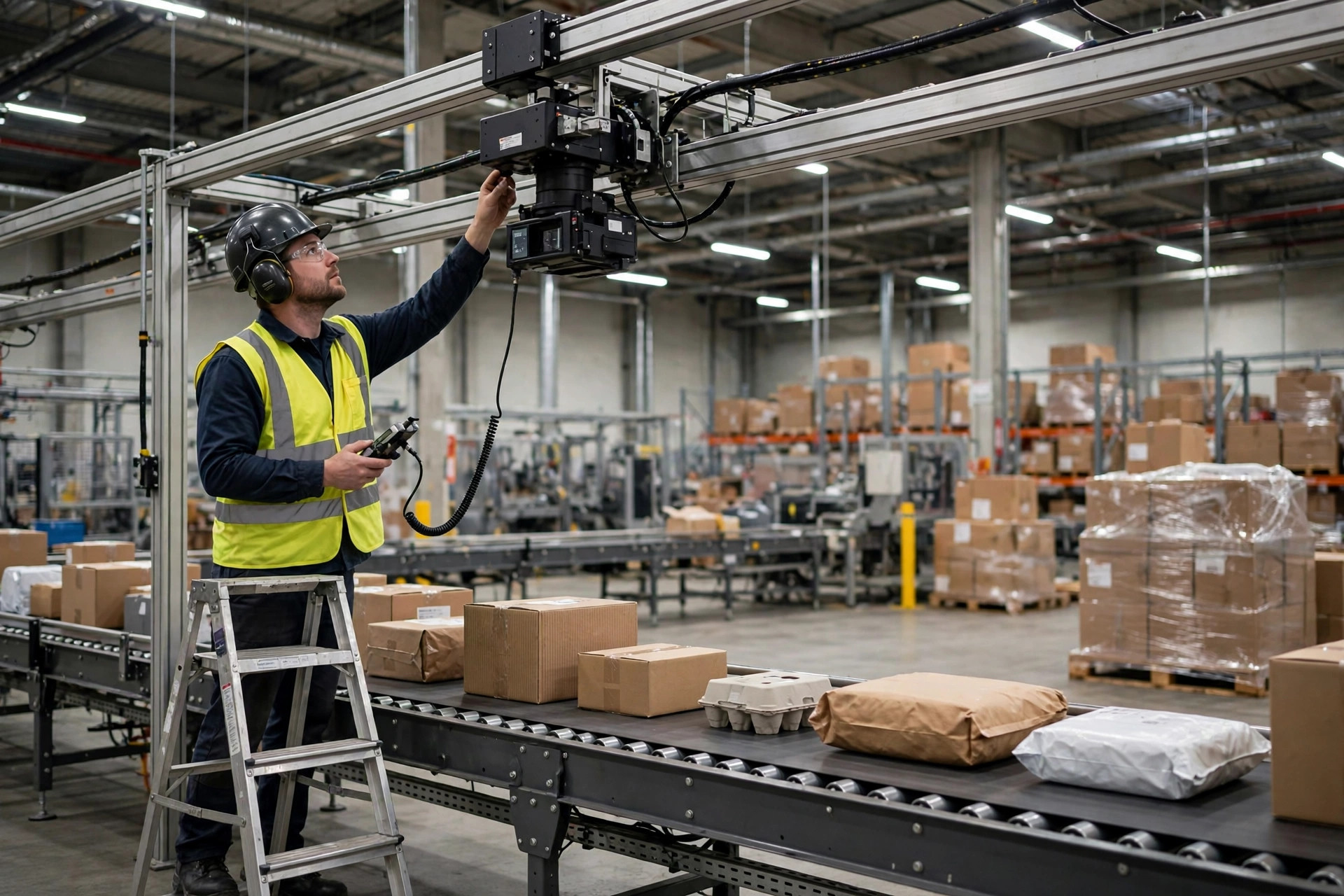
Warehouse vision-AI projects have an open secret: when the budget overruns, the money rarely went to the model.
The Overrun Rarely Happens at the Model
In 2023, a regional 3PL in the American Midwest deployed a parcel-damage vision inspection system. The original budget was allocated the way these projects usually are: algorithm team, GPU compute, on-site deployment — classic "model thinking." By month six the budget had overrun by 40%, and the post-mortem found that more than half of the overrun sat in a line item that had occupied exactly one row in the original plan: data labeling.
A parallel story unfolded the same year at a large e-commerce fulfillment center in eastern China, which set out to automate SKU verification and replace a manual checking step. The algorithm demo worked in two weeks and looked great on the test set; it collapsed the moment it met the real production floor — night-shift lighting changed, cartons stacked differently, and recognition rates fell off a cliff. The team spent three months re-shooting and re-labeling data, and the project timeline doubled.
According to enterprise AI adoption surveys published in recent years by firms such as Gartner and McKinsey, data preparation and labeling typically account for 40 to 60 percent of total project investment — the single largest cost line. The number deserves a pause: the industry conversation about AI adoption revolves around models and compute, while the money flows into the least glamorous link in the chain. "AI is 1% model and 99% data" — in warehouse settings, that line is closer to literal truth than anywhere else.
Methodology First, Then Magnitude: How Many Photos Is Enough
"How many photos are enough" has no standard answer, because the answer depends on four variables: number of categories, similarity between categories, magnitude of scene variation, and the target accuracy. Any answer that gives you a number without discussing these four variables can be safely ignored.
Here is a magnitude estimate, with the assumptions stated explicitly:
| Assumption | Value (assumed) |
|---|---|
| Active SKUs | 10,000 |
| Usable samples per SKU | 200–500 images |
| Total sample volume | 2–5 million images |
| Cost per annotated image | Per vendor quote (order of magnitude: cents to fractions of a yuan/RMB per image, depending on annotation complexity) |
| QA rework rate | 15%–30% (order-of-magnitude assumption) |
The labeling line lands in the "millions of RMB" order of magnitude (actual figure depends on quotes and rework rates). The most striking row in this table is not the total — it is the rework rate. Annotation is not a one-time expense; quality control and rework are the bottomless pit. Shooting the photos is the cheap part. What costs money is "labeled correctly," and "labeled wrong, do it again."
One dimension is routinely overlooked: the organizational cost of annotation capacity. Market research firms' estimates put the data-annotation services market growing at over 20% annually in the early 2020s (check each firm's report for its exact scope) — which means annotation is turning from "project busywork" into a standalone industry. For warehouse operators this is good news (supply is growing, unit prices trending down over time) and bad news: industrialization brings standardized pricing, not understanding of your warehouse's business. An annotator cannot tell "sealing tape peeling" from "carton damage," and the resulting label noise is ultimately paid for by your model's accuracy. Outsourcing annotation is therefore never "hand it off and forget it" — the client must staff someone who understands the business to write the rules and audit samples. That headcount almost never appears in the project budget, yet it always shows up in the overrun list.

Why Warehouse Annotation Is Especially Expensive
The attribution has four layers, each harder to sidestep than the last.
First, SKU variety and fast turnover. A mid-size e-commerce warehouse easily carries more than ten thousand active SKUs, and seasonal goods rotate every three months — the model is still training when the data is already stale. This "data depreciation" is unique to warehouse settings in both speed and scale; few other industries face it.
Second, lighting variation. Day shift has skylight, night shift has overhead fluorescents, and the same carton under two lights is two different data points. Autonomous driving at least has standardized roads; every warehouse has its own lighting environment, so data rarely transfers across sites.
Third, occlusion and stacking. Products on shelves are half-hidden, parcels on conveyors pile up — annotation rules must define "how much visible counts as one," and every rule change invalidates previously labeled work. Rule drift is the most hidden cost in annotation projects: the labels were not wrong, the standard changed.
Fourth, long-tail anomaly samples are brutally hard to collect. Damage, leakage, wrinkled labels — precisely the scenarios where vision AI delivers the most value — may occur only a few dozen times a year in one warehouse. To gather 500 damage samples, some teams have resorted to deliberately damaging goods for the camera. The cost speaks for itself.
Here is the counterintuitive judgment: more photos are not always better. Past a certain inflection point, marginal returns on sample volume collapse; what decides a project is not the middle 95% of routine samples but the hardest 5% of long-tail cases and the consistency of labeling. Many teams spend 80% of their annotation budget on categories that were already easy to recognize — the money went where it was least needed.
Two Cost-Cutting Paths: Synthetic Data and Pretrained Models
The trend judgment needs two separate lines, each with its evidence and timeline.
The first line is synthetic data. Rendering training images in 3D engines gives you as much damage, occlusion, and extreme lighting as you want. After 2021, as rendering engines and generative models matured, the cost of synthetic data fell by an order of magnitude. But the sim-to-real gap persists: models trained on synthetic data usually take a discount the first time they meet a real warehouse. The current landscape is "synthetic data supplements the long tail, real data remains the backbone" — not replacement. Betting on pure synthetic data in one leap is not realistic today.
The second line is pretrained vision models. After 2023, the few-shot capability of vision foundation models arrived: categories that once needed thousands of labeled images to converge can now reach usable accuracy with dozens to a few hundred. This is restructuring the demand for custom annotation — from "mass generic labeling" toward "small volumes of high-quality hard cases." The timeline is clear: total annotation volume is falling while the technical content per label is rising.
Which path to take depends on the situation, summarized in this decision framework:
| Strategy | Fits | Costs |
|---|---|---|
| In-house labeling team | Long-term, high-volume, stable rules | High management overhead; suits large operators |
| Outsourced labeling | Short-to-medium projects with clear rules | Transparent unit pricing, but rework disputes are common |
| Synthetic data for the long tail | Scenarios where anomaly samples are hard to collect | Must validate the sim-to-real gap |
| Pretrained model + light labeling | Fast onboarding of new categories | Depends on foundation-model capability; accuracy ceiling follows the model |
Superimposing the two lines, one verifiable judgment emerges: over the next three to five years, warehouse vision-AI annotation costs will keep falling, but the ability to define annotation standards will grow scarcer — because models are running out of data less and less, while what they lack is precise business definitions of things like "what counts as damaged."
A Question Without an Answer Yet
If annotation costs keep falling and model capability keeps rising, the competitive threshold for warehouse AI will shift from "do you have data" to "do you have labeling standards." At that point, the contest may not be about who owns more GPUs, but about whose SOPs are written more clearly — and SOPs are precisely what the warehouse industry has in abundance and values the least.
The transition is underway; it just has not finished. The open question is this: are your warehouse's SOPs precise enough to be executed, word for word, by an AI?
By Dr. Chen, Supply Chain Researcher