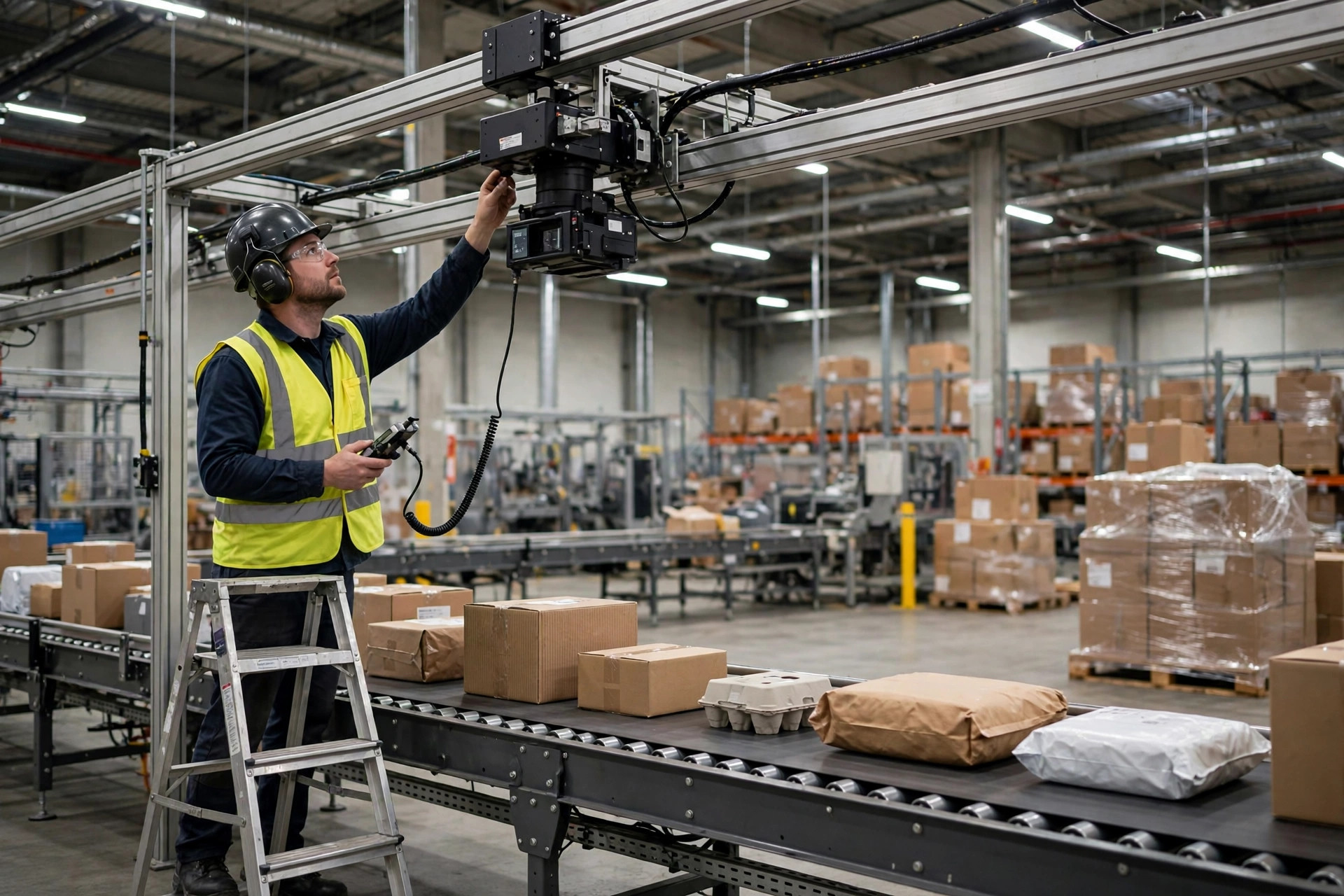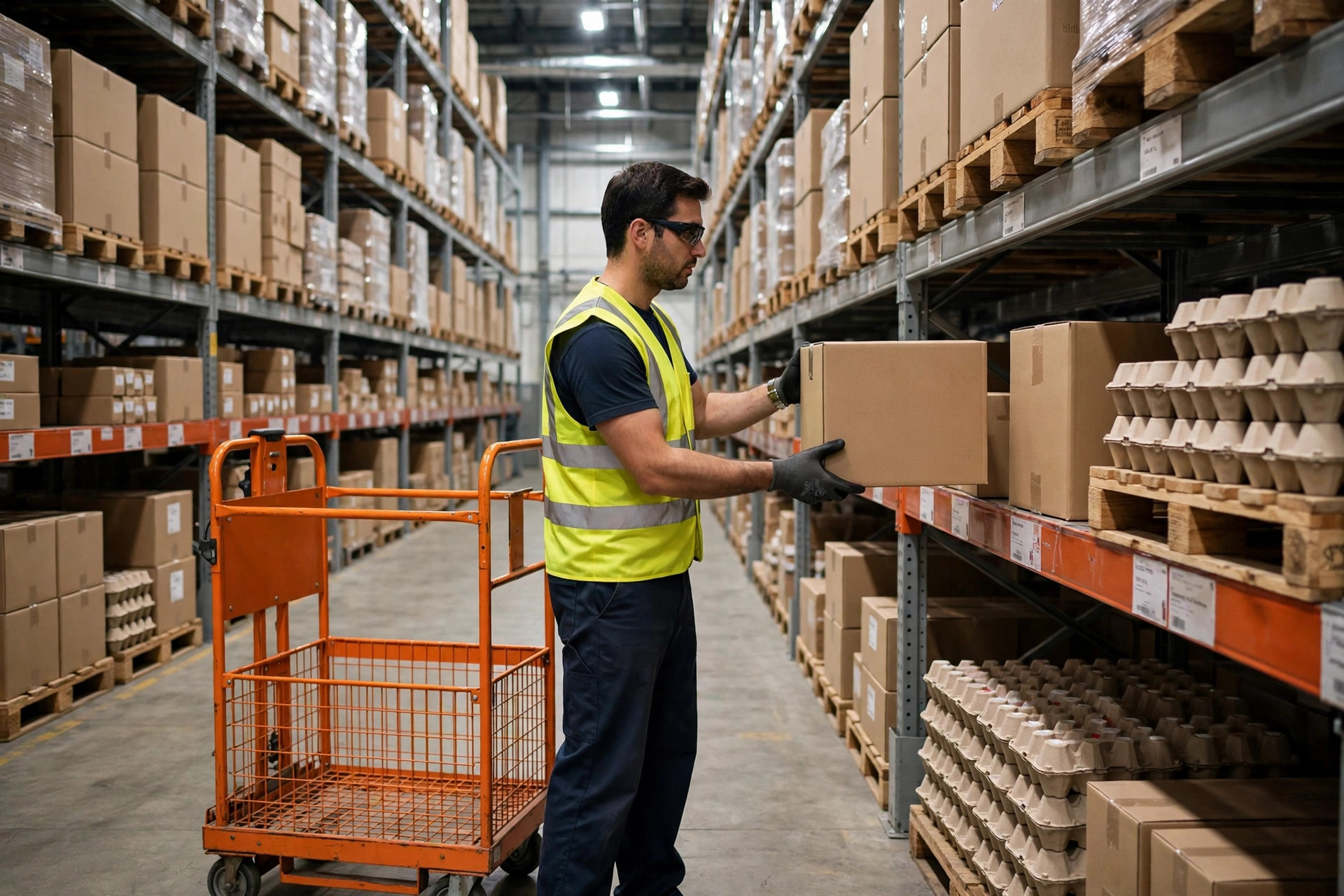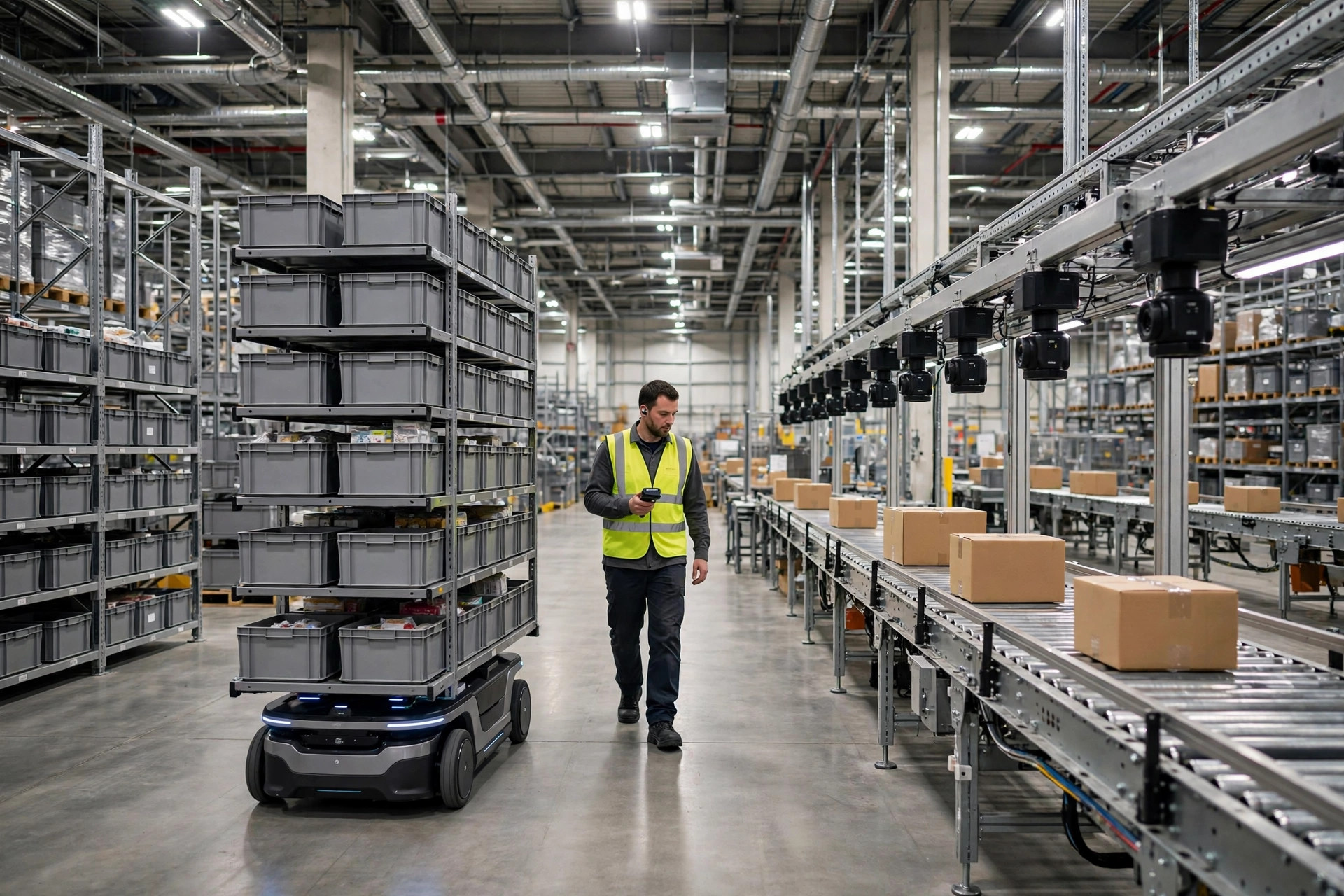
A recurring scene in warehouse AI post-mortems has little to do with algorithms. The vision system passes acceptance testing, the AMRs run their routes — and three months later, the operation is barely using any of it. Ask why, and the answers are never about model accuracy. They are about the SOP nobody rewrote, the exception nobody owned, and the KPI that still measures the old way of working. The project did not fail on technology. It stalled on change management — the budget line that usually reads zero.
The pattern holds across technologies. Kotter made this point decades ago in Leading Change: transformations rarely collapse on the tool, but on the organization never redesigning work around it. Warehouse AI is replaying that logic, only faster and with far more frontline workers affected.
The sticking points cluster into three areas: process, org, and KPIs. Each looks manageable alone; the difficulty is that all three must move in lockstep.
Change Management Starts With the SOP, Not the Software
The first question when AI enters a warehouse is not which equipment to install, but: which steps does the AI own, which stay human, and who wins when the two disagree? Those answers are the new SOP.
In late 2024, an apparel-returns 3PL near Ontario, California, deployed AI vision inspection for damaged and mispacked units. The technology passed acceptance on the first try, but the SOP was still the manual version: auditors worked as before, now with a camera raising alarms above the station. Within days the conflict surfaced — the AI flagged "suspected damage" on fine-looking units, and with no escalation path, auditors routed every flagged unit to detailed manual review rather than take the risk. The inspection area backed up. Two weeks in, the site switched the AI off.
The failure was not the recognition rate; it was a process never redesigned for human-machine division of labor. The rewritten SOP spelled out four things: the AI does first-pass screening with confidence tiers, and low-confidence units go to humans; auditors work only from the AI handoff list; disagreements escalate to the shift lead for a ruling, on record; disputed cases flow back as training samples. Only then did the system go live again — the moment it actually landed.
One more expectation for management before go-live: pilot efficiency follows a J-curve. Brynjolfsson and colleagues described the productivity J-curve — after a new technology arrives, the organization needs time to build complementary intangibles, and measured efficiency dips below baseline before climbing past it. In warehouse terms: for the first few weeks, labor input may rise at constant volume while people learn the new motions. Without that expectation, leadership easily declares "this doesn't work" at the bottom of the curve — where the investment is sunk and the payoff hasn't arrived. So the pilot needs a defined ramp with staged targets, making "down first, then up" planned, not a surprise.
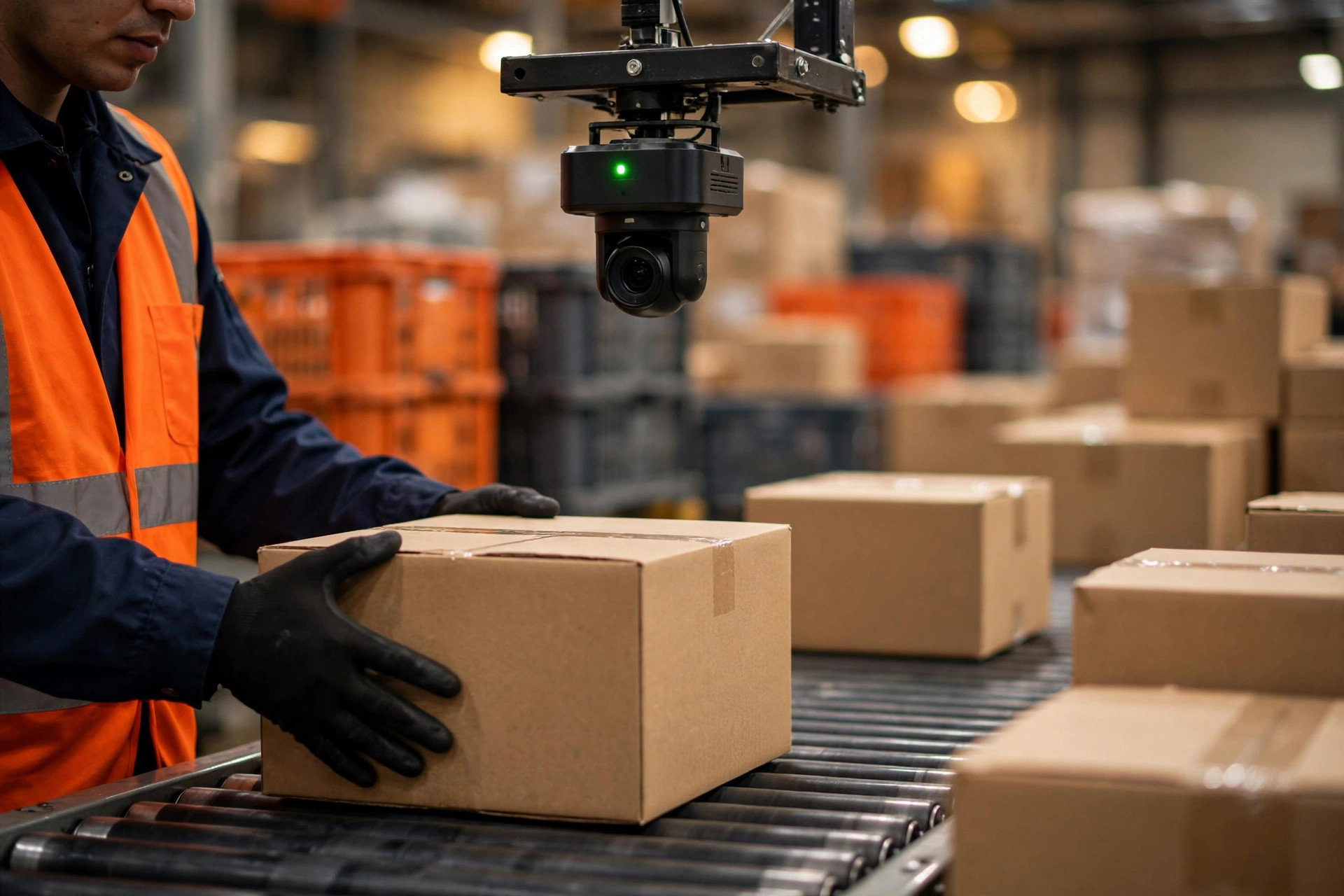
Someone Has to Own the AI on the Floor
Process answers "how"; the org chart must answer "who is responsible." The first month after go-live guarantees unplanned situations: AMR tasking misbehaves at peak, vision accuracy slips on new packaging, forecasts misfire during promotions. Traditionally these problems have no owner — IT calls it operations, operations calls it systems, and it becomes everyone's problem, which means no one's.
Early in 2025, a fulfillment center near Dallas hit exactly this with a new goods-to-person AMR fleet. The tasking engine occasionally issued visibly inefficient routes; pickers stood idle, the shift lead said he couldn't override the system, IT said the algorithm belonged to the vendor. Trust drained from that point. Some pickers began bypassing the system to pick manually — the more it was bypassed, the worse its data got, and the worse its tasking became. A textbook negative loop.
The turnaround was an org change: the site named an "AMR super-user" — a six-year veteran picker, seconded for two weeks to tune tasking rules with the vendor, then stationed permanently on the floor. Frontline issues went to him first; fixable ones he fixed on the spot, the rest he took to the vendor with field data. The role did three things: it gave the AI system a face on the floor, so problems had an entry point; a veteran testing and tuning the system was the site's largest training exercise; and most subtly, when the most experienced person on the floor publicly backs the new system, the watching majority follows. In Prosci's ADKAR model — awareness, desire, knowledge, ability, reinforcement — desire is the hardest for top-down mandates to produce. A super-user manufactures it from inside the frontline.
The org piece is not about headcount. It is two explicit decisions: who owns the AI system on the floor, and in what capacity veterans participate. Labeling data, joining testing, defining exception rules — that work turns senior staff from objects of change into designers of it.
KPIs Are the Steering Wheel: Measure the Old Way, Get the Old Behavior
People follow the metric — one of the stablest regularities in organizational behavior. When AI changes how work is done but KPIs still describe the old way, employees rationally vote with their feet.
The classic collision is units per hour. After AMRs go live, a picker's job shifts from walking aisles to waiting at a station, and wait time depends on fleet dispatch efficiency — beyond the picker's control. Keep the KPI at individual picks per hour and every dispatch hiccup eats into the worker's score; the rational response is to resist the system and return to manual mode. Quality metrics distort the same way: after vision inspection goes live, the denominator of "inspection error rate" shifts from everything a human inspected to the low-confidence units the AI handed off — numerator and denominator move at once, and historical comparisons break overnight.
The fix is to redesign KPIs with the work itself: from individual units per hour toward human-machine cell output — throughput per station cell, with system wait time tracked separately and excluded from individual scoring; error rates rebaselined. A one-to-two-month dual track is worth the accounting cost: run both KPIs in parallel so employees see the new formula doesn't penalize them, then switch fully. Dual-tracking costs bookkeeping hours, but it is cheap next to the behavioral distortion of a hard cutover. The KPI is the steering wheel — the crew goes wherever it points.
The Counterintuitive Proposal: Give Change Management Its Own Budget Line
Everything above — rewriting SOPs, staffing a super-user, redesigning KPIs, training, hand-holding the pilot — costs real labor and real time. Yet in most AI project budgets it is buried inside a "training" line or absent entirely, assumed to be absorbed by "departments cooperating." The judgment to correct: change management belongs next to software licenses and hardware as a first-class budget category, with an explicit share of total project budget. Not zero.
The basis is straightforward: the three workstreams map to measurable effort — SOP rewrite cycles, super-user secondment, training shifts, a ramp capacity buffer, dual-track accounting labor. Rolled up, a usable framework (shares are the author's recommended planning ranges):
| Budget line | Covers | Suggested share |
|---|---|---|
| Process redesign | SOP rewrite, escalation design, ramp plan | 3%–5% |
| Org enablement | Super-user secondment, seed team, frontline participation | 2%–4% |
| KPI transition | KPI redesign, dual-track accounting, communication | 1%–3% |
| Training and floor support | Tiered training, floor coaching, manuals | 2%–4% |
| Pilot buffer | Ramp capacity loss, rollback contingency | 2%–4% |
That sums to roughly 10%–15% — and the other side is a trade-off: skip it and you save a budget-sheet number but pay in delay, rework, and possibly an idle system. Rework from underinvested change management consistently costs more than funding it properly. And timing matters — this money must be spent early: SOPs and KPIs final before go-live, since remediation afterward is exponentially more expensive.
Put bluntly: judge a warehouse AI project by the change management line on its budget sheet. A project without one is not carrying technology risk. It is carrying organizational-readiness risk.
From Project Activity to Organizational Capability: An Open Question
Zooming out, the question itself is shifting. Change management used to be a one-off exercise attached to a rollout. AI's defining trait is continuous iteration — models get retrained, rules adjust with assortment changes, the human-machine boundary keeps moving. "Change" is becoming the steady state: version-controlled SOPs, a standing super-user role, KPIs that move with the work.
The question worth watching: as AI shifts from "project" to everyday warehouse infrastructure, does change management graduate from project activity to organizational capability? Companies that get the process-org-KPI trio right may simply move faster next cycle — their organizations have learned how to learn. That, arguably, is the real long-term return on warehouse AI adoption.
By Dr. Chen, Supply Chain Researcher