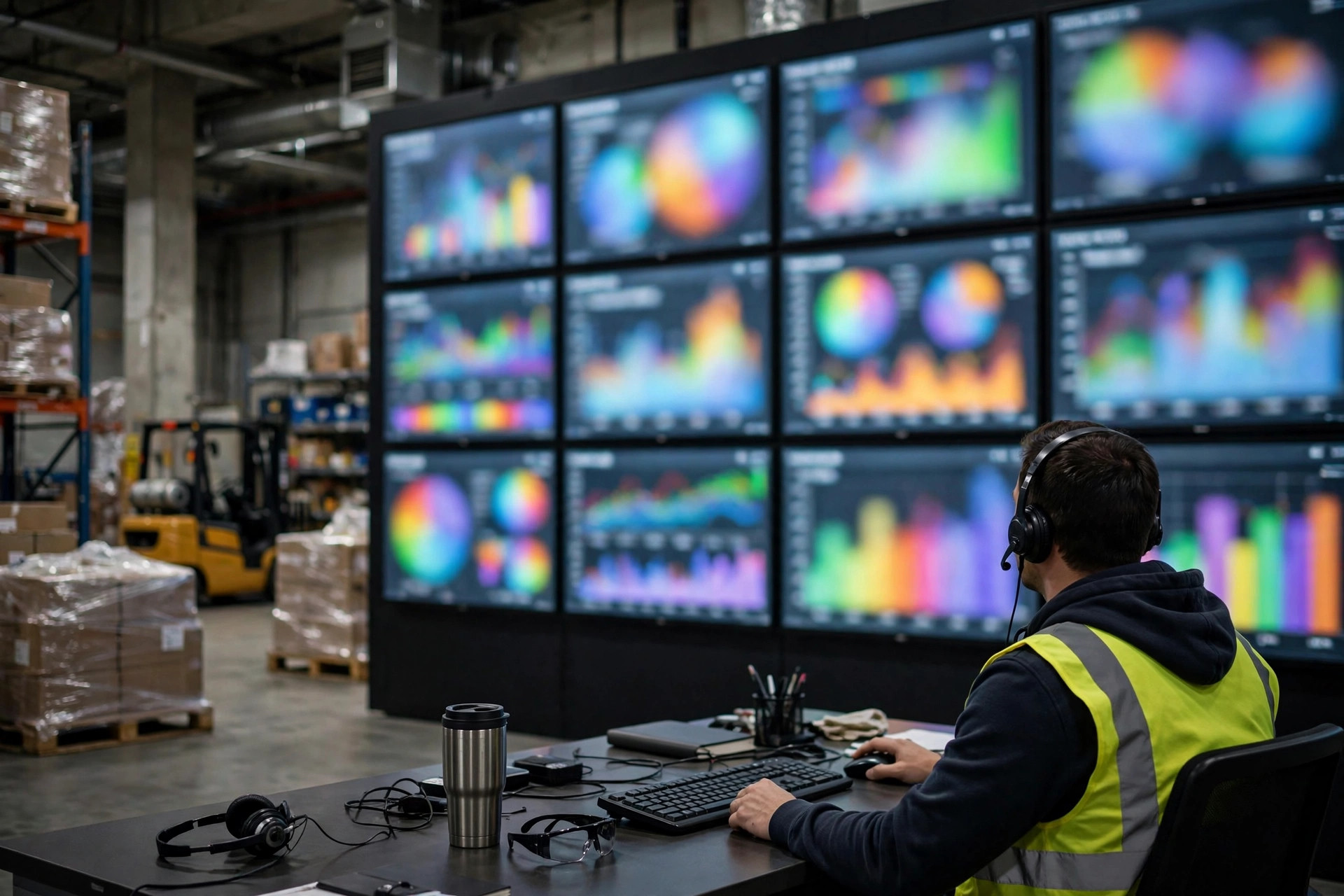
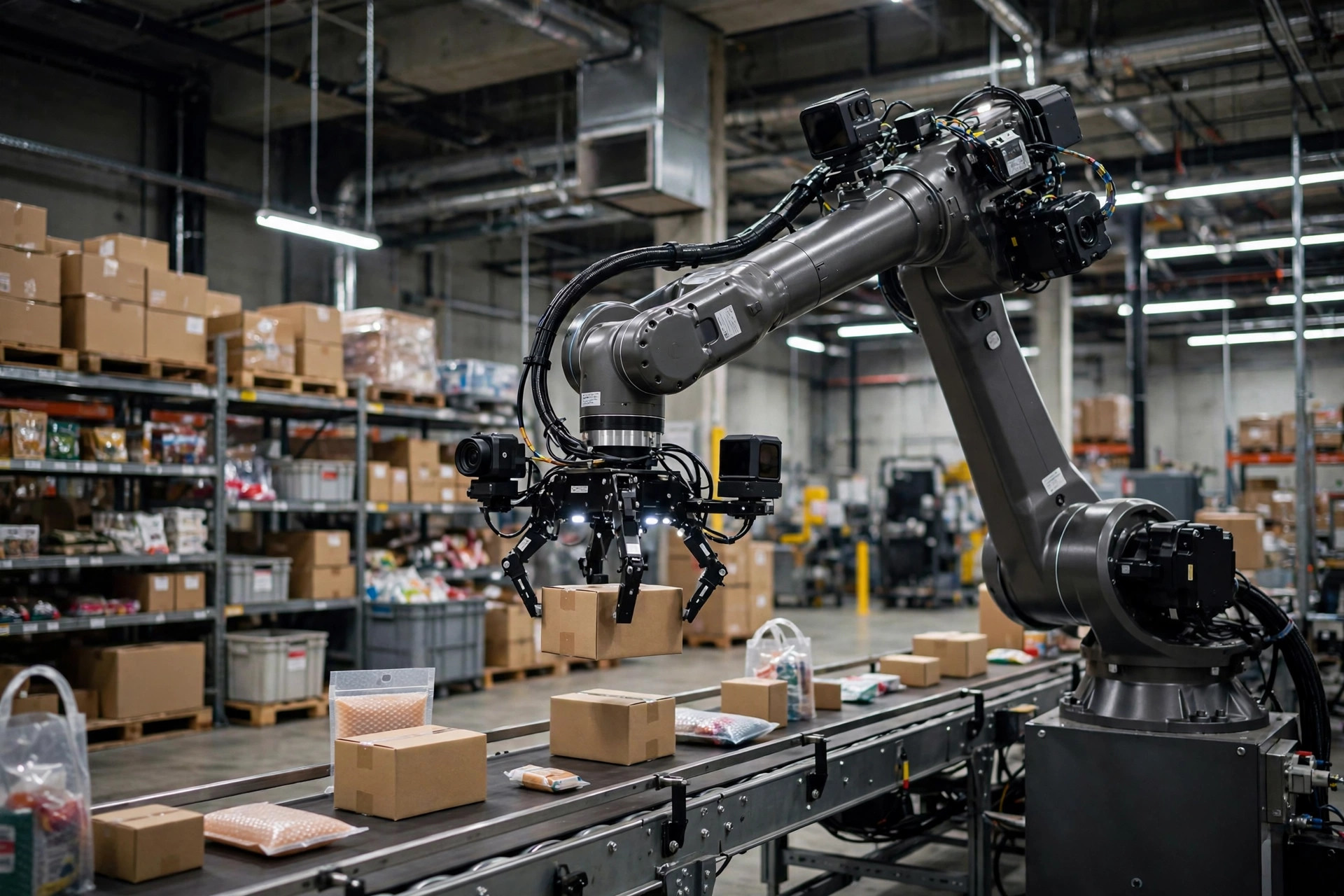
Here's my verdict up front: most warehouse AI projects don't die on the algorithm. They die waiting for data. You can photograph damaged cartons for a year and still not have 200 usable shots. A forklift clipping a pallet happens when it happens — you can't schedule it. A model can't learn what it has never seen. Synthetic data is how you write the textbook the model never got: generate, in simulation, the sights it's missing.
This cuts two ways. Done right, it saves money and ships in months. Done wrong, you get 99% in simulation and a failing grade on the floor. Let me lay out the three roads, one pitfall, and the math.
I've Seen Too Many Projects Die Waiting for Data
In 2024, a 3PL in Ontario, California wanted automated damage detection at outbound. Solid idea: thousands of parcels a day, manual spot-checks weren't catching damage claims. The blocker? Data. The ops team had everyone photographing damaged boxes for the better part of a year and ended up with fewer than 300 usable images — damage is a low-probability event, and it splits into "crushed corner," "split tape," "water stain," "forklift puncture," dozens of shots per class. The model couldn't learn the difference. The project sat stuck for four months, nearly killed.
The turn came when their engineer stopped waiting for data and started manufacturing it. They built the outbound audit area 1:1 inside their warehouse digital twin — box dimensions, tape colors, conveyor speed all modeled from the real floor — then rendered in bulk: different lighting, angles, damage types. Fifty thousand "damaged boxes" in a week. And because every image was born in simulation, the bounding boxes came free — zero labeling cost.
They fine-tuned and validated on those 300 real photos, and the model went live. By their own numbers, damage interception beat the old manual spot-checks by a wide margin, and the timeline shrank from "wait another year for data" to three months, live.
Bottom line: synthetic data doesn't fix a bad algorithm. It fixes an unschooled model.
Three Roads to Synthetic Data — Costs Differ by 10x
Road one: 3D simulation rendering. That's the Ontario play — "photographing" inside a digital twin. The cost is up front: roughly two to three weeks of one engineer to build the scene. The payoff: once built, you can generate as much as you want, including the extreme scenarios (3 a.m. backlight, peak-season pileups), every image self-labeled. Best for geometrically stable tasks: object detection, counting, segmentation.
Road two: generative augmentation. Take real photos and mutate them — lighting, angles, occlusions, noise. An integrator ran AMR pedestrian detection at a DC in the Inland Empire this way: 2,000 daytime photos expanded to 30,000 overnight. The catch: every variant is still a cousin of the same few originals. Long-tail scenarios that never happened in real life can't be mutated into existence. The upside: cheap and fast, running the same day.
Road three: hybrid training — synthetic for the base, real for fine-tuning, real for validation. This is the right way. My plain-spoken version: do your homework on synthetic, but sit the exam on real data. Synthetic widens what the model has seen; real data pulls it back to reality.
Where Synthetic Data Breaks: the Sim-to-Real Gap Is Real
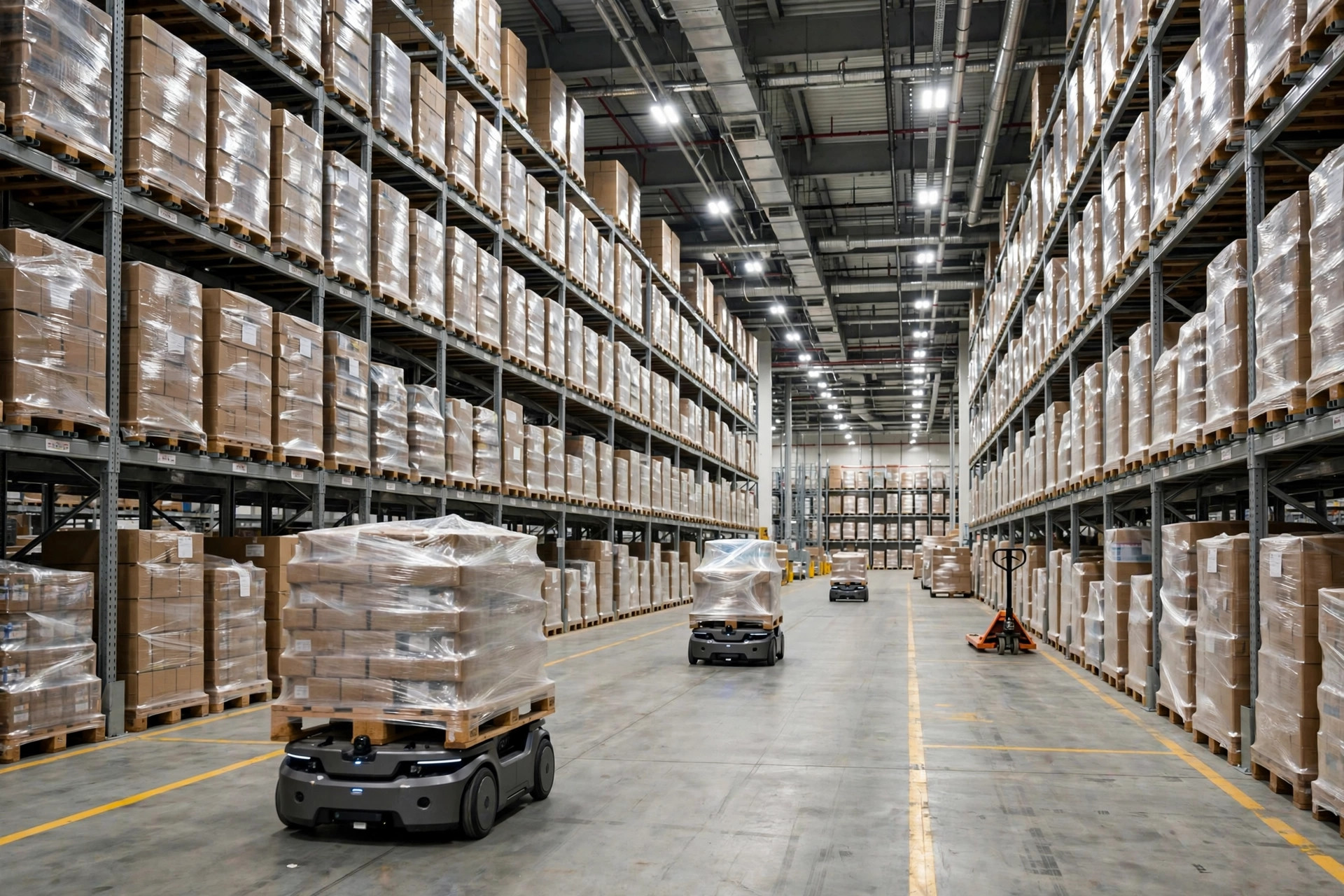
Back to that AMR project, 2023. Night-shift pedestrian detection under low light with forklift headlights blasting straight at the camera — real data is brutally hard to collect there. Night shifts are thinly staffed, and if a real incident happens, that's an accident, not a dataset. They trained on "augmented daytime photos plus 10,000 simulated night scenes." Looked great on the test set.
It fell apart on the floor: reflective vests. In simulation, the reflective strips behaved too "perfectly," and the model learned a bias. On the real floor — mirror-like glare off black stretch-wrapped pallets plus forklift headlights — the model hallucinated pedestrians out of reflections. The AMRs kept stopping and starting, and night-shift throughput dropped about twenty percent. It took 500 real night-shift photos of fine-tuning to beat the false positives down.
That's the sim-to-real gap, and it's real. My rule of thumb: synthetic data works well on geometrically stable tasks — detecting boxes, counting cartons, recognizing pallets. The moment you hit material reflectivity (black stretch film, metal racking), extreme backlight (dock doors), or transparent materials, you need real data for calibration. The more "perfect" the simulation, the further it can drift from a real warehouse — which is dusty, dim, and messy.
The Math: Pure Real vs. Synthetic + Real
Target: 10,000 usable training images.
| Pure real-data route | Synthetic + real hybrid | |
|---|---|---|
| Sourcing | 2–3 months on the floor, waiting for scenarios | Build the sim scene once, render 80k–100k images in hours |
| Labeling cost | Box labeling runs ~$0.30–$0.50/image; 10k images = $3,000–$5,000, before collection labor | Synthetic labels are free; only 1,000–2,000 real photos for fine-tuning/validation, $300–$1,000 |
| Timeline | Counted in quarters; long-tail scenarios never arrive | Counted in weeks; extreme scenarios generated overnight |
| Risk | Distribution matches reality | Sim-to-real gap — you must hold out real data as the "exam paper," non-negotiable |
The hybrid route costs less than half and turns "wait quarters" into "count weeks." But own the trade-off: build the sim scene wrong and everything downstream is garbage. And the validation set must be real data — that's iron law. Cut anything else before you cut that.
The Counterintuitive Take: Short on Data? Don't Buy Labeling First
Two judgments that run against the grain.
First: when you're short on data, don't rush to buy labeling services. Ask first: can this scenario be simulated? Labeling vendors charge per image — the bigger your data gap, the happier they are. Every dollar that can go to simulation instead of labeling is a dollar better spent.
Second: the biggest value of synthetic data isn't saving money. It's saving time. The scenarios you can't afford to wait for in real life — the accident instant, peak-season chaos, 3 a.m. dock-door backlight — simulation builds overnight. The savings are a bonus; the time is the point.
I'll say the two-sided part once more: synthetic data is the most practical shortcut to getting warehouse AI live, but it doesn't replace real data. Synthetic lets the model see more; real data lets it judge right. You need both — the ratio depends on the scenario.
So next time an AI vendor tells you "we're short on data, you'll need to pay for labeling," ask one question first: can this scenario be simulated? If they can't answer, keep your wallet shut.
By Lao Mi, Supply Chain Veteran (20 yrs)