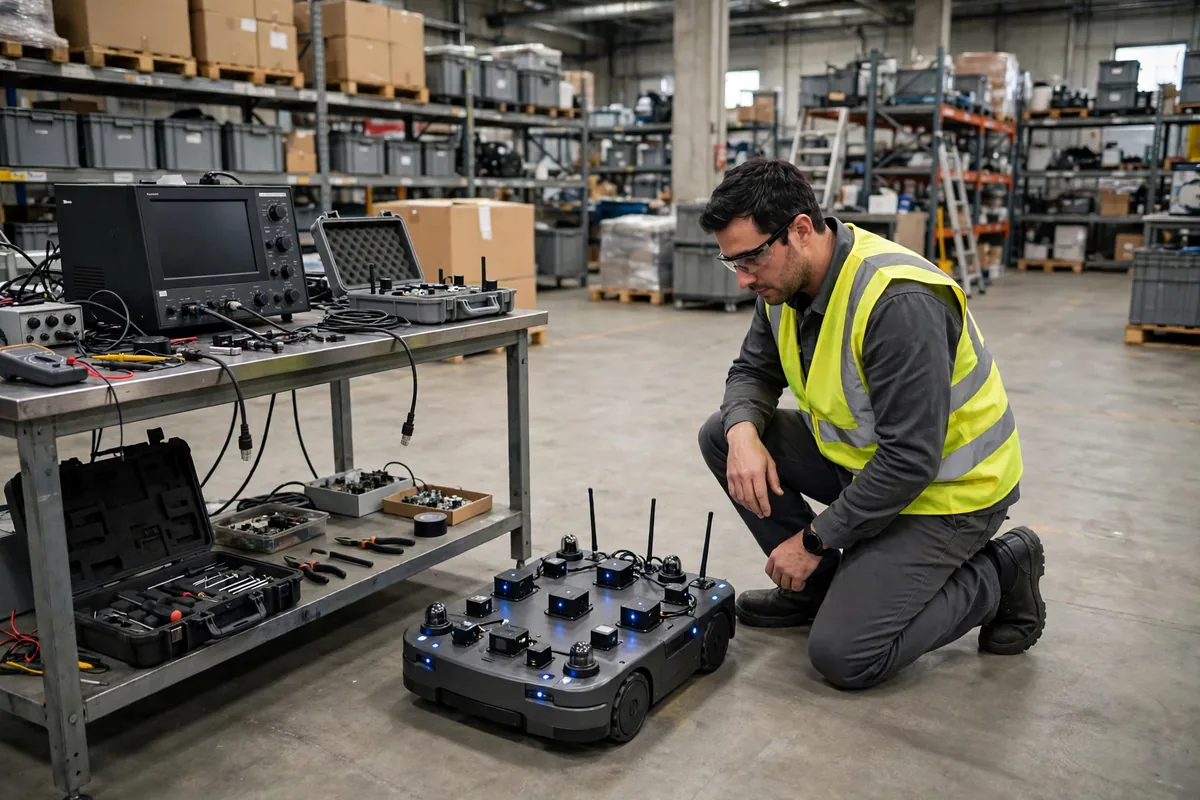
We have a client who learned this the expensive way
We have a client — a mid-sized importer — who bought a fleet of wireless AGVs last year and assumed the certification was the vendor's problem. The robots arrived, the warehouse team started testing them, and three months later someone in procurement asked a question nobody had asked at signing: has this equipment actually passed FCC Part 15? The vendor's answer was a long email that boiled down to "the module is certified, the finished vehicle is a different story." The rollout paused, the vendor went back for additional testing on the complete machine, and my client paid for a delay that was never in anyone's budget. The hardware was fine. The paperwork was the project.
I tell this story because in 3PL sales, I have watched this exact misunderstanding happen more than once, and it always happens the same way: everyone talks about speed, payload, and uptime, and nobody talks about the radio inside the machine until it becomes a schedule problem.
What FCC Part 15 actually covers — and what it does not
Here is the part most buyers miss. FCC Part 15 governs unlicensed radio frequency devices in the United States: the Wi-Fi radio, the Bluetooth module, the proprietary wireless link that lets an AGV talk to the fleet manager. A vendor can buy a pre-certified radio module and still owe you testing on the finished vehicle, because the rules look at the device as it actually ships — antenna, enclosure, and all the other electronics that can change how it radiates. Module certification is a head start, not a finish line.
The second misunderstanding is about who owns the risk. If the AGV is sold as a complete product in the US market, the party placing it on the market carries the compliance responsibility. That can be the vendor, or it can quietly become you, depending on how the contract is written — especially if you import the units yourself, rebrand them, or modify the wireless configuration after delivery. I have seen contracts where the vendor warrants "compliance with applicable regulations" in one sentence and then excludes radio certification in an appendix nobody read.
The FCC Part 15 vendor playbook: what quotes leave out
Vendor quotes come in three flavors, and which flavor you get mostly decides what you will pay for later. The first kind builds whole-vehicle certification into the proposal, with a test plan and report numbers attached. It costs more and it is the one that lets you sleep. The second kind says only "module certified" and never mentions the finished vehicle at all — that is the trap my client walked into, because a full round of vehicle-level testing sits between a module certificate and a compliant machine. The third kind says nothing about certification until you ask, and then offers testing as an extra, at an additional price.
Another client of mine found the trap from the other side. Six months into running their fleet, someone swapped in a higher-gain antenna to improve coverage. The signal got better, and the original test report quietly stopped applying, because changing the antenna changes the radiated profile. Nobody broke a rule on purpose. Nobody had ever told them that an antenna swap counts as a configuration change. So your contract needs to say more than "certified." It needs to say what counts as a change, and who pays for retesting when one happens.
The real cost is not the test — it is the timeline
| Cost driver | What actually happens |
|---|---|
| Testing the finished vehicle | Lab time for radiated and conducted emissions, plus any retest after a fix |
| A failed round | Redesign or shielding, then back to the lab — this is where schedules die |
| Documentation | Test reports, labeling, and the compliance file your customer may one day ask to see |
The counterintuitive point: the cheapest AGV quote is often the one most likely to blow up on certification. A vendor who priced no testing margin into the deal has every incentive to treat your first failed round as your problem. Meanwhile, the vendor who quoted slightly higher and included a certification plan is the one who ships on time. In this business, the test fee itself is rarely the painful number — pricing and timelines vary, so treat any specific figure as subject to the latest quotes from the official site and the certification body rather than gospel. The painful number is the month your deployment sits idle.
Next time you negotiate a contract, ask these three questions
First: is the finished vehicle certified, or only the radio module inside it? Get the answer in writing, with the test report number attached. Second: who pays for retesting if the first round fails — and who owns the delay while it happens? Third: what exactly changes if we modify the wireless setup after delivery, and does that void the certification?
If a vendor hesitates on any of the three, that hesitation is your answer. The best vendors answer all three before you ask, because they have been through it before. The rest are selling you a robot and letting you discover the radio.
Put four clauses in the contract. First, the whole-vehicle test report number and the issuing lab, attached as an exhibit. Second, who pays for retesting and who carries the delay — in plain language, not "to be mutually agreed." Third, a list of post-delivery wireless changes that count as modifications, and what process each one triggers. Fourth, an exit clause if certification problems make delivery impossible. With those four in place, there is very little left to argue about at the negotiating table.
And if a vendor pushes back on any of this, that is useful information too. A vendor who has done this before will not flinch at putting a report number in an exhibit or naming who pays for a retest. A vendor who treats those requests as unusual is telling you, politely, that they have not done this before — and you get to decide whether you want to be the customer they learn on. There is always another vendor. There is rarely another launch window.
Next time you negotiate a contract, remember these three questions. They cost nothing to ask and can save you a quarter.
By Susan, 3PL Sales Director