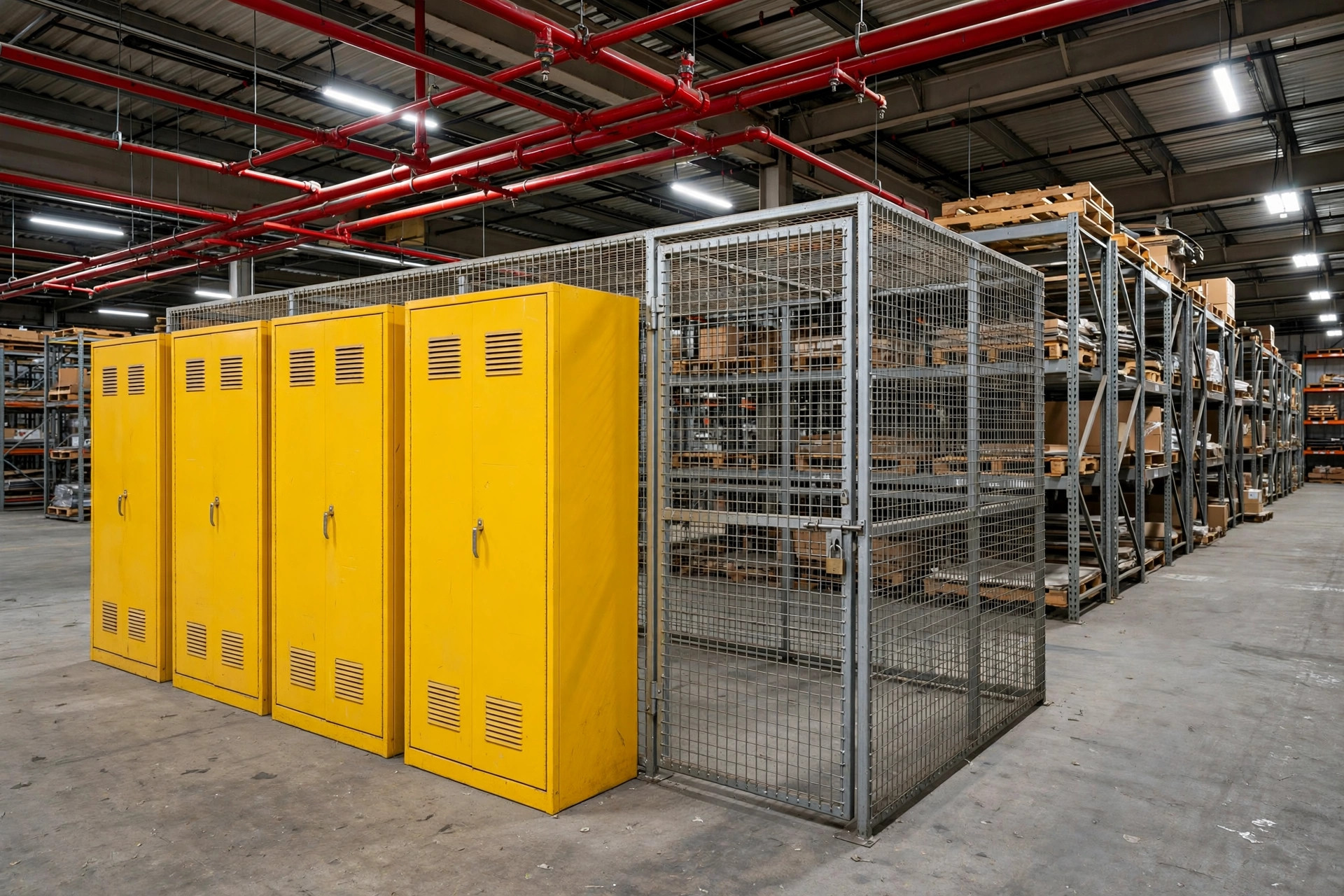
Aerosol cans occupy one of the most underestimated compliance corners in American warehousing when it comes to aerosol storage warehouse requirements: they are neither straightforward flammable liquids with a mature compliance playbook, nor ordinary commodities you can put on any rack. They sit in a regulatory gray zone between the two, and warehouse managers often first encounter Chapter 51 of the International Fire Code only after a fire inspector hands them a correction notice. This article connects three bodies of rules — OSHA 29 CFR 1910.106, IFC Chapter 51 (Chapter 28 in older editions), and NFPA 30B — and works down from classification logic to quantity caps, segregation, and sprinkler protection, ending with a checklist a warehouse manager can use tomorrow morning.
Classification First: Why Level 1, 2, and 3 Determine Everything Downstream
The entire regulatory structure for aerosol storage warehouse requirements rests on one technical foundation: classification by chemical heat of combustion. Per IFC Table 2803.1 and NFPA 30B, aerosol products fall into three tiers. Level 1 products have a heat of combustion at or below 8,600 Btu/lb. Level 2 covers the 8,600 to 13,000 Btu/lb band. Anything above 13,000 Btu/lb is Level 3. This is not an academic taxonomy; it determines whether your pallets may sit on ordinary racking.
| Level | Heat of combustion | Typical products | Storage treatment |
|---|---|---|---|
| Level 1 | ≤ 8,600 Btu/lb | Shaving cream, window cleaners, carpet shampoos | Treated as ordinary Class III commodity; standard NFPA 13 warehouse sprinkler rules apply |
| Level 2 | 8,600–13,000 Btu/lb | Deodorant sprays, hair sprays, antiseptics, furniture polish | Subject to IFC and NFPA 30B quantity caps and arrangement rules |
| Level 3 | > 13,000 Btu/lb | Engine cleaners, lubricants, spray paints and lacquers | Strictest control; generally requires a dedicated storage area or segregated room |
Two details routinely catch warehouses off guard. First, cartons that do not bear a classification marking are treated as Level 3 by default. The IFC requires cartons to be marked "LEVEL ___ AEROSOLS" on at least one side; if your supplier did not print it, the liability lands on you. Second, Level 1 products deserve their own economic judgment: many facilities lock all aerosols into segregation rooms out of caution, which is compliant but wasteful, because Level 1 products could legally sit on standard racking as ordinary commodities. In 2023, a California 3PL warehouse received a correction notice in the opposite direction — Level 2 deodorant sprays mixed with cartons on general racking, no classification markings on any outer box, and the fire department cited it under Level 3 thresholds. The same rule cuts both ways, and both directions carry a price.
Quantity Caps Under the Code: Three Storage Scenarios for Aerosol Storage Warehouse Requirements
With classification settled, the three rulebooks divide the labor. OSHA 29 CFR 1910.106(d) governs the design and capacity of inside storage rooms and storage cabinets for flammable liquids generally; aerosol products in the warehouse context are governed more directly by the fire codes. IFC Chapter 51 answers the building-occupancy question — how much you are allowed to keep. NFPA 30B provides the technical detail: classification, packaging, storage arrangements, and sprinkler design. The hierarchy runs from general regulation to building code to technical standard, and in practice a warehouse manager lives in the latter two.
The quantity caps can be summarized by storage scenario. States enforce different vintages of the IFC, so precise figures should be confirmed against the edition your local fire department enforces — but the orders of magnitude below have been stable across editions:
| Storage scenario | Level 2 cap (net weight) | Level 3 cap (net weight) | Notes |
|---|---|---|---|
| General warehouse area, no segregation | ~1,000 lb (454 kg) | ~500 lb (227 kg) | Level 2 + 3 combined not to exceed 1,000 lb |
| Dedicated storage room, ≤ 500 sq ft | ~1,000 lb | ~500 lb | Combined cap 1,000 lb |
| Dedicated storage room, > 500 sq ft | ~2,500 lb (1,135 kg) | ~1,000 lb | Combined cap 2,500 lb |
| Approved sprinklered storage rooms (multiple) | Aggregate ~5,000 lb (2,270 kg) | Same, on a combined basis | Sprinkler design must cover the highest-level product present |
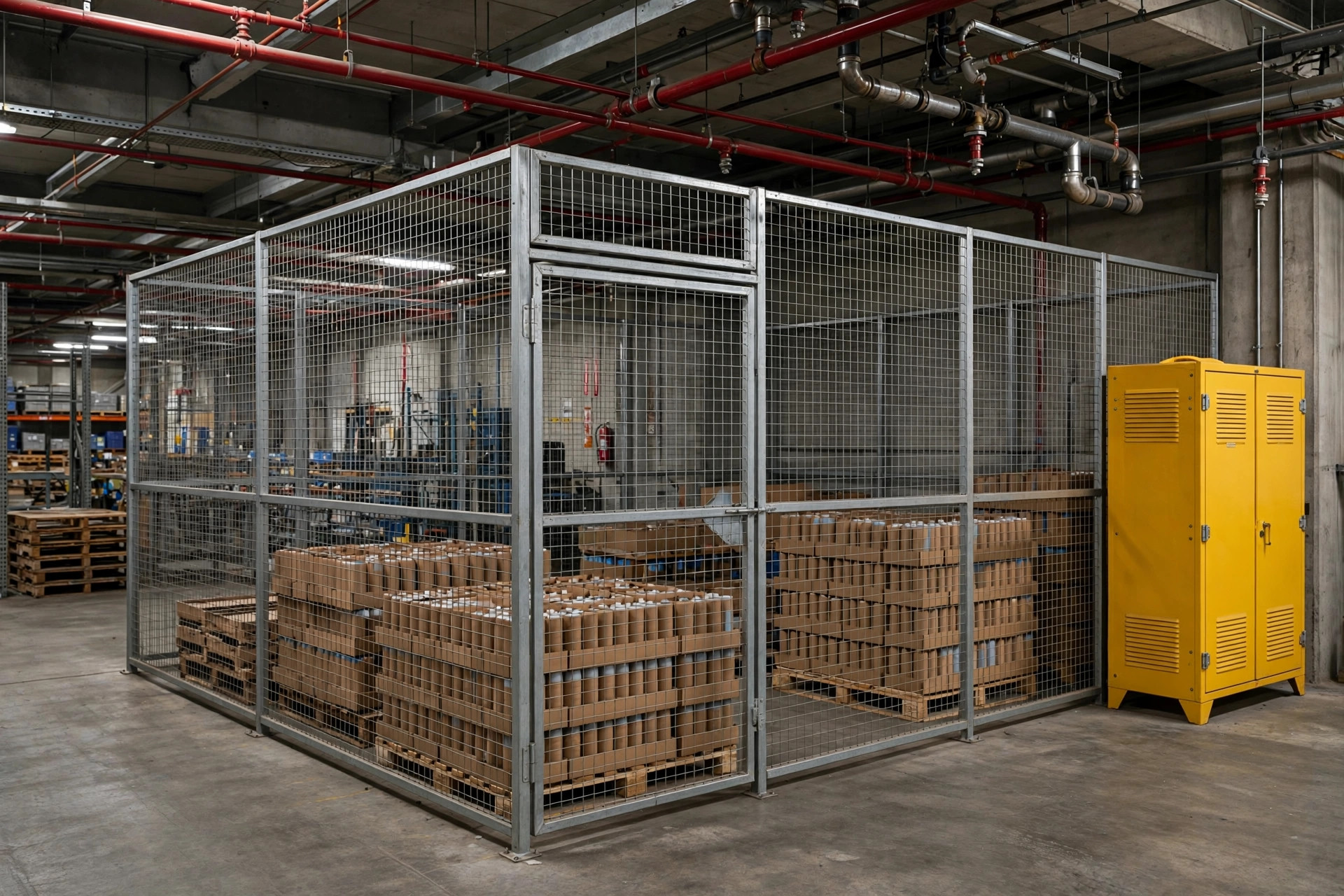
A 2025 case from an Ohio automotive-supply distributor illustrates why these numbers matter in practice. Their aerosol segregation room measured roughly 600 square feet, but the Level 2 and 3 inventory inside approached 3,400 lb net — well above the 2,500 lb combined cap for that size band. The fire department offered two remediation paths: split the inventory across two compliant rooms, or upgrade the sprinkler system with a full hydraulic recalculation. The distributor chose the former, because the latter would have cost more than three times as much. The lesson operators often miss: these caps are not guidance; they are the hard lines inspectors write citations against.
On sprinklers, NFPA 30B follows the same level logic: the sprinkler design must be based on the highest level of aerosol product present in the protected area. A single pallet of Level 3 in a room means the entire room's sprinkler design follows Level 3 criteria. Facilities mixing levels usually find it cheapest to enforce physical level separation at receiving, rather than paying for the highest level across the whole fire protection system.
The Counterintuitive Trade-off: Sprinkler Upgrade Versus a New Segregation Room
When a facility hits a quantity cap, the instinctive response is "upgrade the sprinklers." That instinct deserves scrutiny. In my observation of multiple retrofit projects, upgrading a sprinkler system in an operating warehouse is rarely a matter of adding heads: it typically triggers a full hydraulic recalculation, and if the existing water supply is insufficient, it cascades into fire pump work or even municipal supply upgrades. The timeline runs in months, and the warehouse needs an interim storage plan for the aerosols in the meantime.
A new compliant segregation room — fire-rated walls, self-closing fire doors, explosion-proof electrics, dedicated ventilation — looks intimidating as a one-time capital figure, but it is a project with clean boundaries, a clear approval path, and zero impact on the existing building's fire protection certification. In the Ohio case, the room-split option passed fire reinspection in three weeks. Viewed over the full lifecycle, a segregation room is a known cost; a sprinkler upgrade is an unknown cost — and uncertainty is precisely what warehouse operations cannot afford. The exception, naturally, is a facility already planning a building-wide fire protection retrofit, where reaching the required density comes nearly free. The deciding variable is how much water supply margin you have left.
A Working Checklist for the Warehouse Manager
Translating the code language into actions, the following checklist can go straight onto the warehouse office wall:
- Receiving: Verify every incoming aerosol shipment carries the "LEVEL ___ AEROSOLS" carton marking; log unmarked cartons as Level 3 and push the supplier to add markings.
- Level ledger: Maintain separate inventory records by Level 1/2/3, tracked by net weight — never substitute gross weight or carton counts.
- Cap audits: Reconcile Level 2/3 net weights against the caps above for each storage area monthly; run a dedicated audit before every peak season.
- Physical segregation: Keep required separation between Level 2/3 products and general goods; confirm segregation-room fire doors are self-closing and kept closed.
- Sprinkler match: Confirm the sprinkler design in each storage area covers the highest-level product stored there; reassess whenever the product mix changes, for instance when a Level 3 line is added.
- Cabinet strategy: Route small quantities of Level 2/3 products into approved flammable storage cabinets — the code grants a 100 percent quantity increase for cabinet storage, making it the cheapest compliance expansion available.
- Emergency information: Post a summary of product levels and quantity ledgers outside each segregation area so the fire department gets accurate data within five minutes of arrival.
An Open Question to Close On
The aerosol category is fragmenting: e-commerce returns, small-batch beauty sprays from influencer brands, and novel cross-border products are pushing SKU counts up while per-SKU quantities fall. The existing regulatory logic was built for an industrial world of "few SKUs, large volumes," where a warehouse manager knew the level of every pallet. When the reality becomes hundreds of SKUs, a few cases each, and incomplete markings, the maintenance cost of a level ledger rises exponentially — while the code revision cycle moves far more slowly. Over the next three to five years, the real question may not be "what is the cap," but "in a world of SKU fragmentation, can the cap still be enforced?" There is no standard answer yet. It is worth thinking about early, especially for anyone running 3PL or e-commerce fulfillment operations.
By Dr. Chen, Supply Chain Researcher