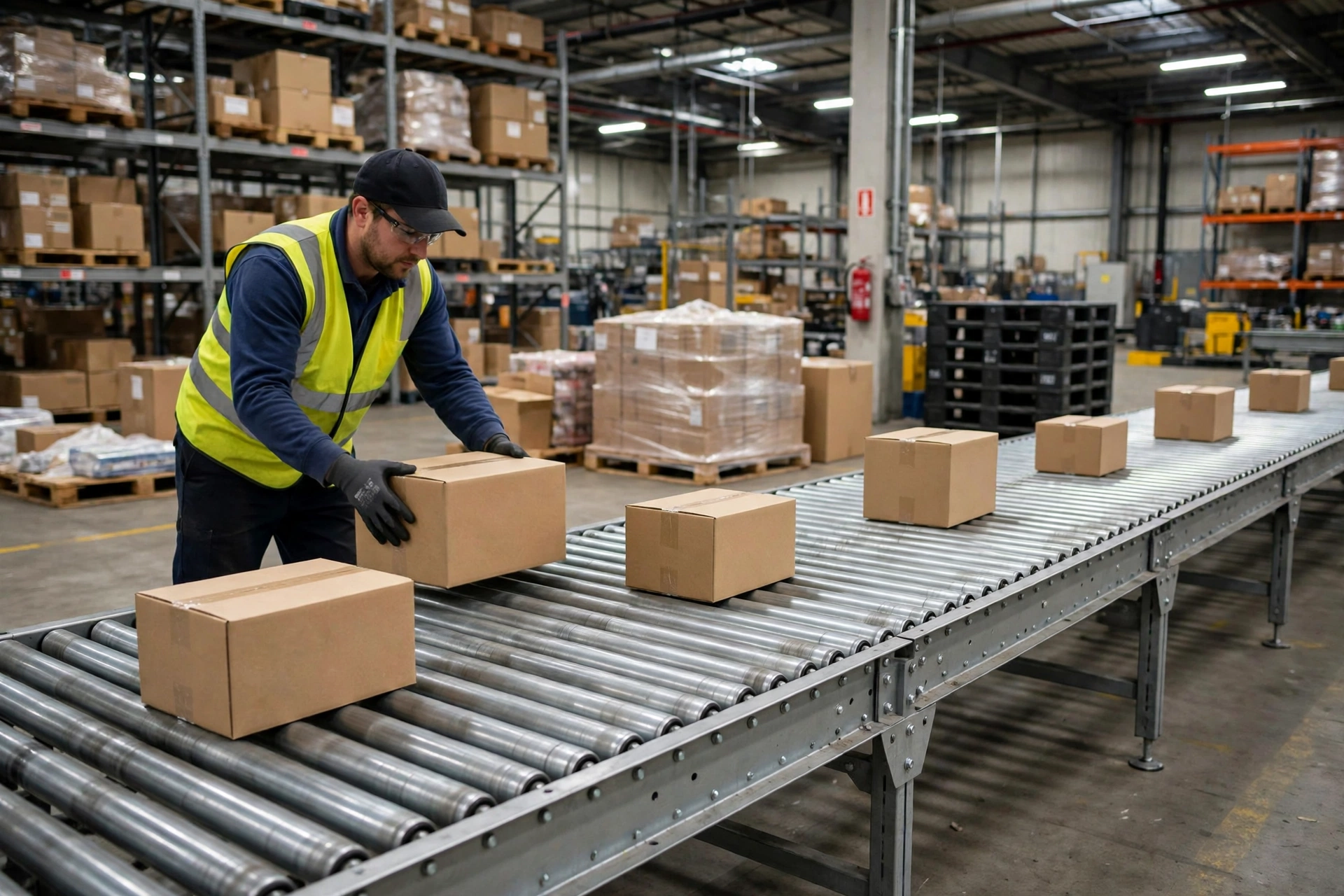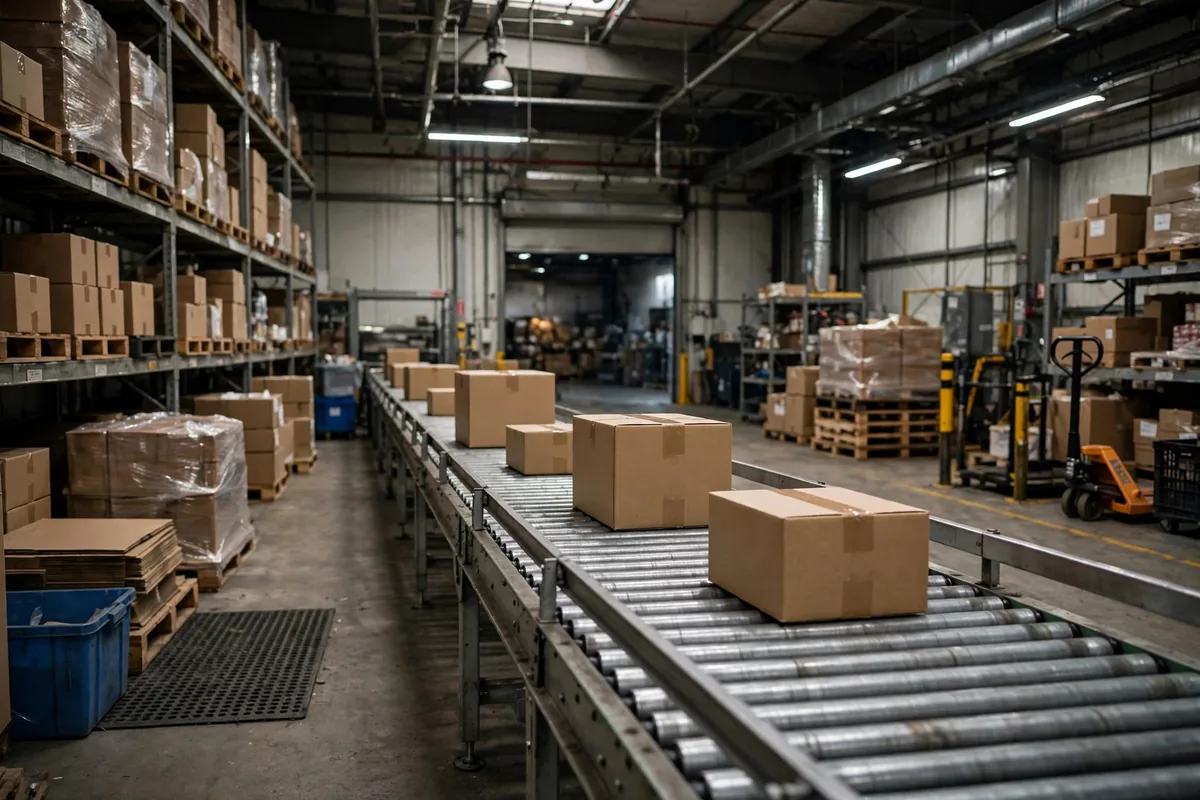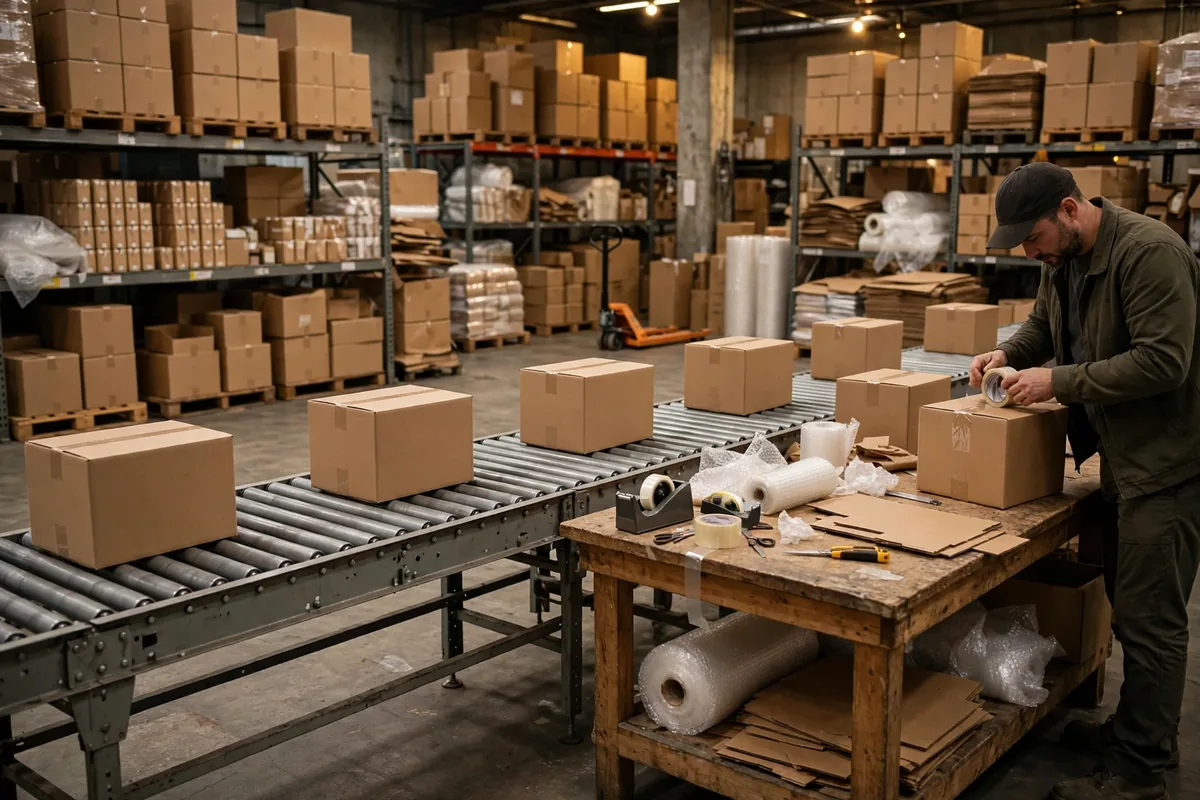
Our warehouse is 3,000 square meters, and for years one old roller line did all the work between picking and packing. Then came a stretch where cartons rear-ended each other every single day. Packing slowed down for ten seconds, and the boxes behind kept coming, corners dented, one carton of glass bottles shattering right there on the line. We paid for the goods and missed the shipment. I asked around about a zero pressure accumulation conveyor, and every salesperson followed up with a quote that made my hands shake. Look, our little warehouse cannot burn money like that. So I figured the thing out properly before spending a cent. This is that homework, shared with other small-warehouse owners.
A zero pressure accumulation conveyor sounds fancier than it is. The whole line is cut into short sections called zones, and each zone minds its own business. Inside every zone sits a motorized roller, usually a 24V DC unit, plus a photo eye watching the zone ahead. When a carton rolls in, the photo eye checks whether the next zone is free. Free means go; occupied means stop and wait, with a gap in front of it at all times. When the zone ahead clears, the waiting carton moves up one zone, and the one behind it follows. Compare that with a plain roller line, where one big motor drives the whole run. The line keeps turning even when the front is blocked, so every carton behind just shoves into the one ahead of it. All that backpressure lands on the first carton in the queue. Dented corners, jammed boxes, crushed goods — that is where most of it comes from.
Fragile freight benefits first: glass bottles, ceramics, anything with a precision instrument inside. The steps downstream benefit too. A carton arriving on its own is easy to scan and weigh: the scanner does not have to hunt for a barcode in a pile of touching boxes, and a scale does not get pushed around by the carton behind. There is one more case people overlook. When the packing bench runs at an uneven pace, an accumulation section works as a buffer. Cartons wait patiently in their own zones instead of forcing the whole line to stop.
Zero pressure accumulation is not a speed upgrade
Here is the counterintuitive part, and it is the part the brochures skip. A zero pressure accumulation conveyor does not make your line faster. It makes your line able to stop. Common accumulation lines run at around 60 to 65 feet per minute, which works out to under 20 meters a minute — slower than plenty of plain roller lines. If you buy one expecting a throughput jump, you will be disappointed the week it is installed. What you are buying is "no more collisions," not speed. After we changed our line, damage disappeared, but peak-hour throughput did not move at all. What moved was the time our packers used to spend dealing with crushed cartons.
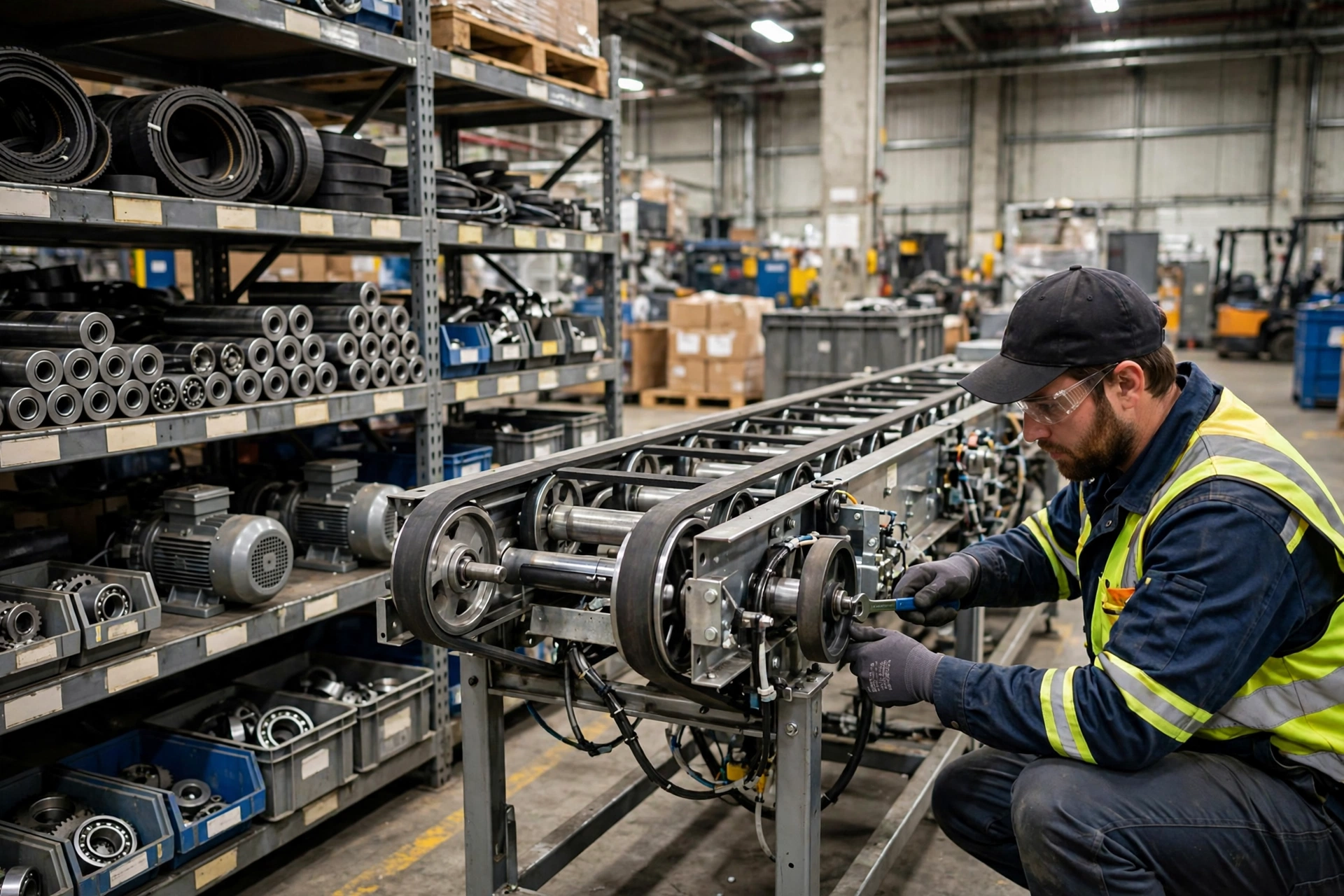
The drive choice decides how much maintenance you inherit. The mainstream option today is the 24V DC motor-driven roller setup: one motorized roller per zone driving its neighbors through O-bands or poly-V belts, with no compressed air involved. The older route is pneumatic accumulation, where air cylinders engage and release the drive. The line itself can be cheaper, but you need a steady air supply, and leaks and air-line upkeep become a permanent chore. Vendor documentation generally puts the recommended working pressure around 35 PSI for those pneumatic models.
Then there is the zone-length catch. One zone holds exactly one item, so the zone has to be as long as your longest product — the usual rule is the longest product plus about 100 millimeters, with standard zone lengths of 12, 18, 24, 30, and 36 inches. Mixed carton sizes cost you here, because short cartons occupy long zones. Measure your cartons before you talk to any salesperson, not after the line is bolted to the floor.
Load rating is where small warehouses trip up most often. These lines are built for cartons and totes, not pallets. Published vendor specs put a standard motor-driven roller zone at about 70 lbs per zone, roughly 30 kilograms. Heavy-duty poly-V versions go up to 110 lbs per zone with a two-rib belt and 350 lbs with a three-rib belt, at a slightly lower speed. Medium-duty models are rated around 125 lbs per linear foot. Pallet loads are a different world: chain-driven accumulation conveyors are rated around 300 lbs per foot with single pallet loads up to 1,200 lbs, and they sit in a different price bracket entirely.
The math on a zero pressure accumulation buffer
Let me be straight about the numbers below: this is a hypothetical worked example, with prices I made up from the range of quotes I have seen. They are not any vendor's real prices. Use them to follow the logic, and check the real figures against the manufacturer's latest selection manual before you sign anything.
Say we want a 10-meter accumulation section in front of packing to act as a buffer. In this hypothetical example, 10 meters of plain roller conveyor costs 20,000 yuan, and the same length built as a 24V motor-driven roller accumulation line costs 50,000 yuan. Where does the 30,000 yuan gap go? Every zone adds a motorized roller, a zone controller card, a photo eye, and a share of the 24V power supplies.
So how long does that gap take to pay back? Same hypothetical example: our warehouse used to lose about 3,000 yuan a month to carton damage, rework on crushed boxes, and re-labeling after failed scans, and at least half of that came from cartons shoving into each other. If the new line saves that half, that is 1,500 yuan a month, and the 30,000 yuan gap takes 20 months to recover. Twenty months is a long time for a small warehouse. So my verdict is blunt: if your cartons are sturdy, your freight is not fragile, and your downstream never blocks, that 30,000 yuan is money thrown away. If you are bleeding money and time to collisions and jams every week, it is money well spent.
There is a middle path, and it is the one we took. Instead of replacing the whole line, we added a short accumulation section, just 3 to 4 meters, right in front of packing as a buffer, and kept the old line everywhere else. Salespeople are not thrilled to sell it that way, but for a small warehouse it is the best value compromise I found. The result in our warehouse: damage fell by roughly 80 percent, by our own rough count, not a vendor promise.
A friend of mine, Lao Chen, runs a warehouse full of household goods and learned the opposite lesson. His cartons are tough, nothing ever got crushed on his line, and he still bought a full accumulation line last year because everyone else seemed to be doing it. It cost him a small fortune, throughput did not change, and the power bill did not drop. The only thing he got was a quieter line. Quiet is nice, but a small fortune for quiet is not a trade our kind of warehouse can afford.
Three questions before you order anything
First, is your freight afraid of impact? Glass, ceramics, precision goods, anything with a fragile label on it — yes. Second, is your downstream pace steady? If picking, packing, labeling, or scanning ever runs fast and slow in turns, a buffer section earns its keep. If the whole line runs at one even speed from inbound to outbound and never stops, accumulation is decoration. Third, how mixed are your carton sizes? Uniform standard cartons are the ideal case. Wildly mixed sizes force the zone length up to the biggest box and waste a lot of line. And heavy pallet lines should stay away entirely — this equipment was not born for pallets, and forcing it will cost you more and work worse.
If money is tight, here is my advice. Measure your cartons and count your collision losses first, and put a monthly number on what "cartons shoving cartons" costs you. If you cannot put a number on it, do not buy. Then consider adding one short buffer section instead of replacing the whole line. Ask the vendor for the selection manual and check three numbers against your own freight: zone length, load per zone, and line speed. If any of those three does not match your goods, walk away no matter how sweet the quote looks. The big-company playbook of full-line automation is not for us. But swapping one short section for the right equipment can still make the whole operation run smoothly. Saving money is not being cheap. It is spending it where it actually counts.
Small warehouses have their own way of surviving.
By Xiao Ma, Small Warehouse Owner