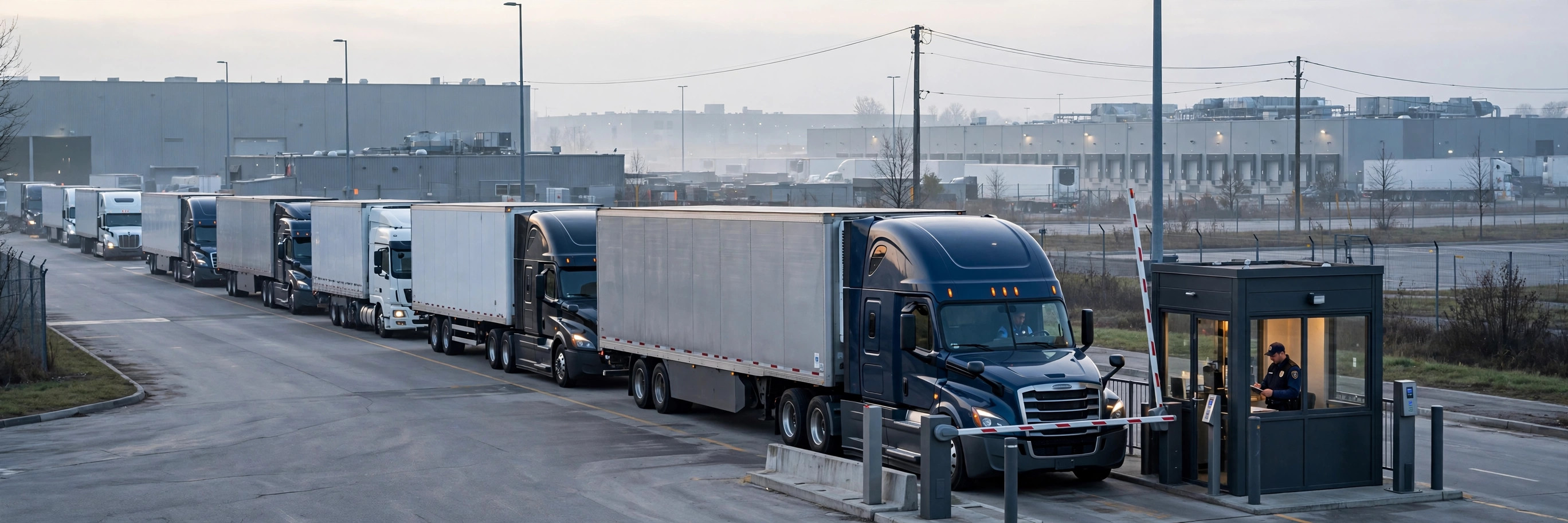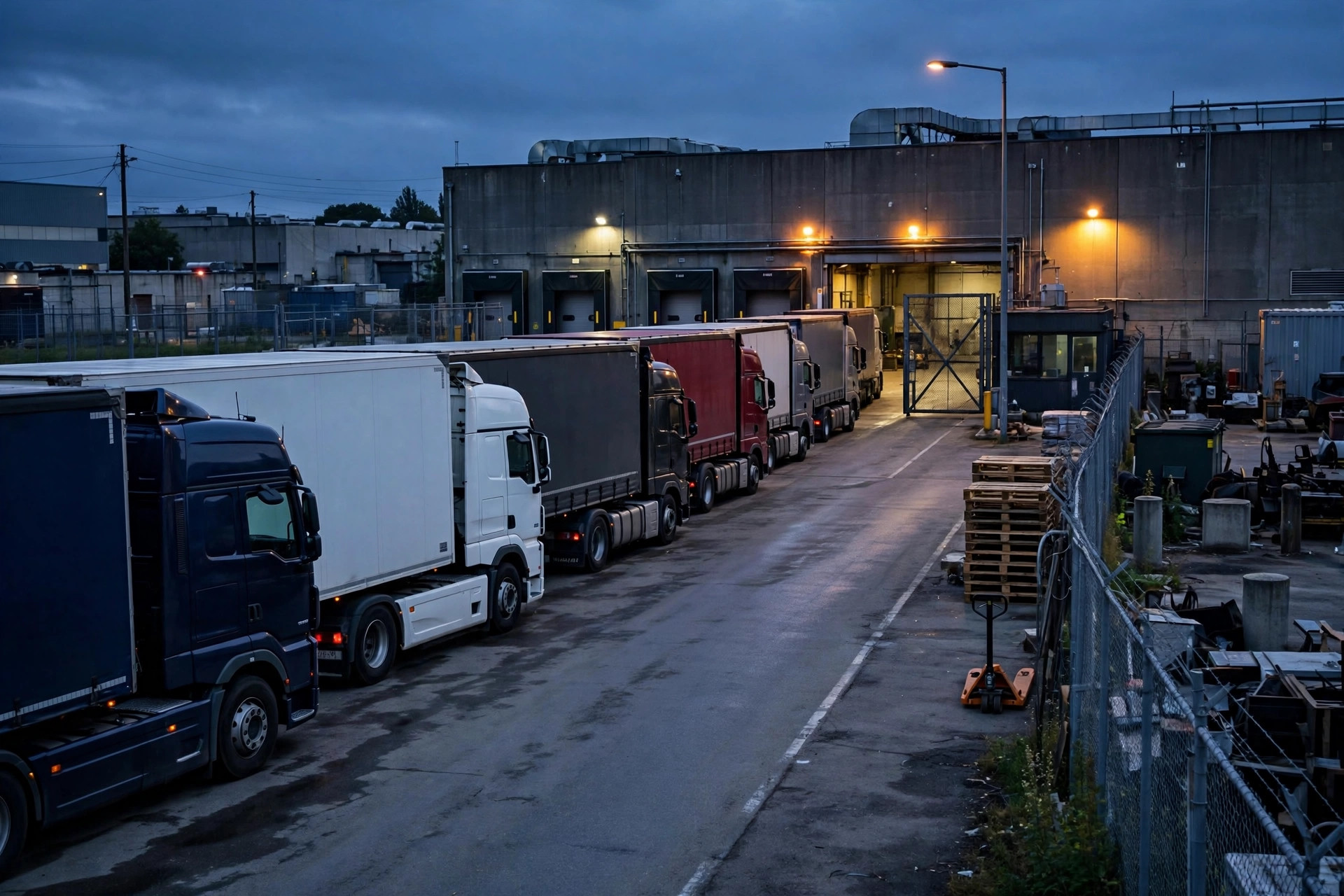
Bottom line up front: in the yard, the system decides which move goes to which driver — not the dispatcher on the radio. Two rules do 90% of the work: priority sets the order, proximity sets the driver. And deadhead (empty running) is the number-one killer of yard jockey productivity: measure it before you try to fix it, and aim to get it under 25%, not to zero.
Why Yard Jockey Radio Dispatch Always Breaks
I've seen this exact failure three times. The pattern is identical: 3–5 yard jockeys, a dispatcher with a radio — "Mike, grab the trailer at D-12 and spot it at door 38." Sounds fine. In practice, three diseases:
- Dispatch lives in one person's head. The dispatcher remembers who's close and which door is hot — until task number 40. Night shift, different person, productivity drops 30%.
- Nobody measures deadhead. An empty tractor crossing the yard to pick up a job burns fuel and time, and nobody logs it. Field-measured from my projects: radio-dispatched yards run 40–50% deadhead.
- Status is a black box. "Yeah, I'm there" on the radio is your proof of arrival. I watched a door sit empty for 40 minutes in an Inland Empire project in 2023 because the tractor was on the other side of the yard. The customer paid a full day of detention for that one.
Two Project Stories: From Radio to System
Story 1: Inland Empire DC — 2.2 to 3.5 moves/hour
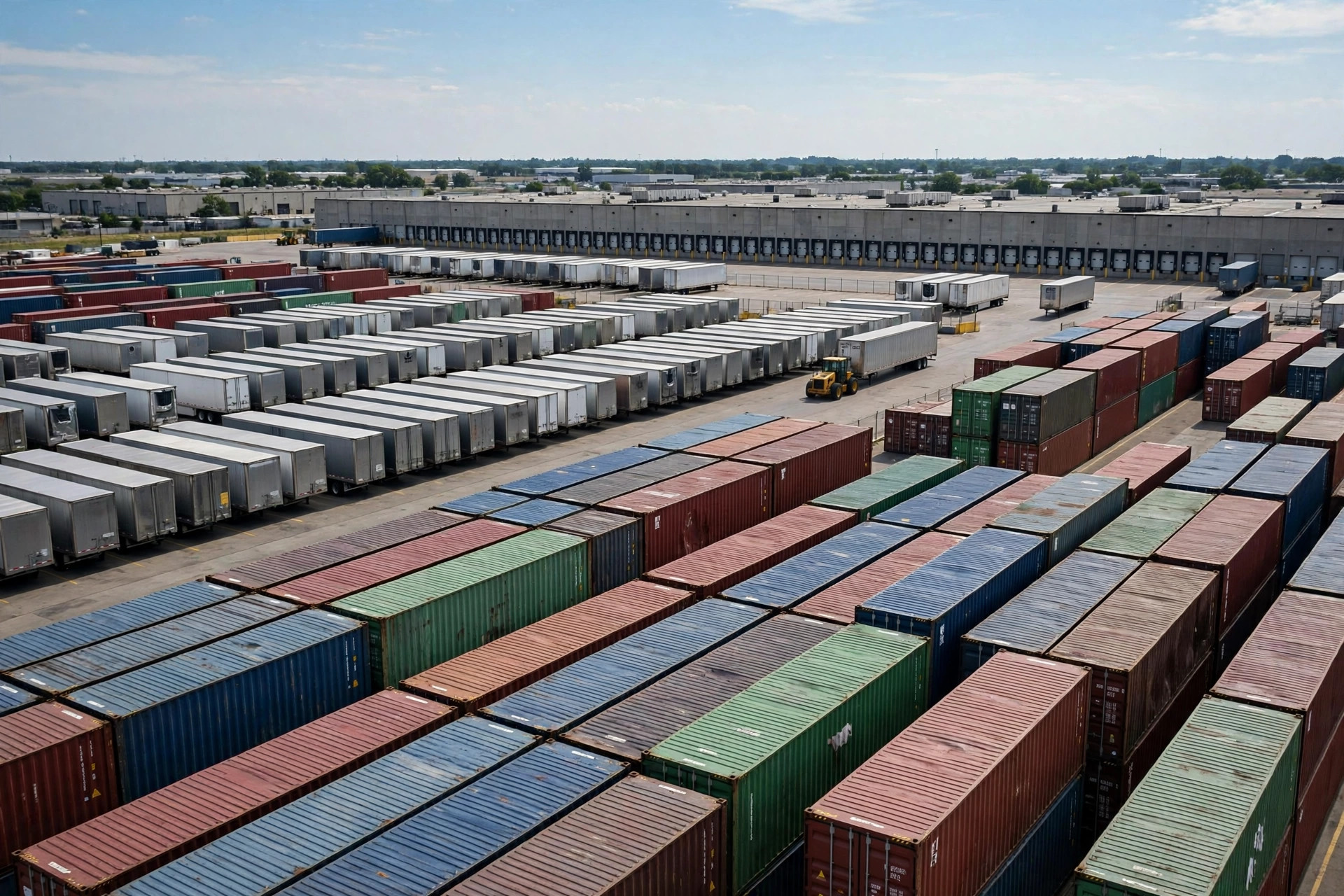
Fall 2023. A 380,000 sq ft retail distribution center in California's Inland Empire: 120 dock doors, 90–110 trailers parked in the yard year-round, 4 yard jockeys across two shifts. Baseline before the YMS (field-measured): 2.2 moves per hour per tractor, 47% deadhead.
We spent two weeks finding the problem and three days riding along. Drivers spent 40% of their time running empty — finishing job A, then crossing the entire yard empty to job B, while another empty tractor sat 200 meters from B's pickup point. The dispatcher in the office couldn't see any of this.
After switching to system dispatch we did three things: (1) proximity dispatch — assign the closest tractor by live position (GPS + yard zones); (2) a priority queue — overdue moves and reefer doors auto-escalate; (3) forced status updates — drivers tap Arrived / Hooked / Complete on the in-cab terminal. Three months later (field-measured): 3.5 moves/hour, 28% deadhead. Not one extra tractor, not one extra headcount.
Story 2: Dallas cold storage — when priority beats proximity
Early 2024, a cold-chain 3PL near Dallas, Texas. The lesson: proximity dispatch is not enough. Get the priority wrong and it gets expensive.
The system once assigned an empty tractor to a plain dry-van move while 200 meters away a reefer trailer's unit alarmed — it had to be at a temperature-controlled door within 30 minutes. Proximity logic said "correct." Business logic said "catastrophe." That trailer held pharmaceutical product insured at $2M (per the customer's policy).
After we recovered, we hardcoded the rule in the YMS: reefer alarms, overdue moves, and customs holds always jump the queue and skip proximity sorting. The order is fixed: safety/compliance > time-critical > routine — distance only breaks ties within the same tier.
Radio Dispatch vs YMS Dispatch
| Dimension | Radio dispatch | YMS dispatch |
|---|---|---|
| Assignment basis | Dispatcher's memory | Priority rules + live position |
| Deadhead (field-measured) | 40–50% | 25–30% |
| Traceability | Radio recordings — half a day to investigate | Timestamped per move — seconds to look up |
| Night shift / staff change | Productivity drops 20–30% | Nearly flat |
| Key-person risk | Dead without the veteran dispatcher | Rules live in the system |
| Cost to implement | Zero | System + terminals + GPS |
| Right fit | < 40 moves/day | > 60 moves/day or multi-shift |
Decision framework: under 40 moves a day, radio is fine — don't over-engineer. Over 60 a day or two shifts, system dispatch pays for itself within a year on deadhead fuel savings plus half a dispatcher's salary (field-measured).
Four Steps to Stand Up Dispatch
Step 1: Measure the baseline for two weeks.
Don't configure rules on day one. Log for two weeks first: moves/hour per tractor, deadhead share, average task wait time, average door idle time. These four numbers anchor everything after. No baseline, no proof you improved anything.
Step 2: Set priorities — three tiers, no more.
Don't build seven tiers; nobody will remember them. Three:
- P0 — safety/compliance: reefer alarms, customs holds, hazmat. Jump the queue, no exceptions.
- P1 — time-critical: overdue moves, appointment windows within one hour.
- P2 — routine moves.
Within a tier, longest-waiting goes first. Simple. Executable.
Step 3: Proximity dispatch — but zone the yard first.
GPS drifts 10–30 meters inside a yard (field-measured), so raw coordinates will misassign tractors. Divide the yard into 4–6 zones around the door blocks; match tractor zone to task zone, same zone first, adjacent zone second. Hardcode the zone logic in the YMS — don't let drivers pick their own zone. I've seen this exact failure three times: drivers always pick the zone closest to the break room.
Step 4: Four status updates — all mandatory.
Every move needs four taps: Assigned → Accepted → Arrived → Complete. Two seconds per tap on the terminal or phone app. Skip "Arrived" and the door team never knows the tractor is actually there; skip "Complete" and the next job can't dispatch. The taps feed your KPIs.
Three Ways to Kill Yard Jockey Deadhead
- Chain moves. The drop point of one move is the pickup point of the next — the system links them automatically. Drop trailer A at door 38, and door 38 happens to have an empty trailer heading back to the yard: two moves become one, deadhead goes to zero. Highest ROI of the three.
- Pre-dispatch. Assign before the task even exists. The WMS releases an outbound wave — the YMS knows door 38 will need a tractor in 20 minutes and sends the nearest one to wait, instead of dispatching from across the yard after the task is created.
- Manage the staging spots. Where a jockey waits decides the next move's deadhead. Mark 2–3 staging points; after finishing, park at the nearest staging point — not back at the break room door. Break rooms sit in yard corners; starting every move from there adds half a kilometer of empty running each time (field-measured).
The Counterintuitive Part: Zero Deadhead Is the Wrong Goal
Plenty of customers tell me: "Lin Xiao, our target is zero deadhead." My answer: stop dreaming — and you shouldn't want it anyway.
Yard jockey dispatch is a trade-off between responsiveness and empty-running cost. Zero deadhead means a tractor is always perfectly positioned, which means you either own too many tractors or have too few moves. The healthy band is 15–25% (field-measured): below 15%, you're over-fleeted; above 35%, your dispatch logic is broken. The goal is to turn deadhead from unknown waste into a costed line item — not to eliminate it.
One more counterintuitive truth: productivity usually drops 10–15% in the first week after system dispatch goes live. Drivers aren't used to following a terminal and quietly keep coordinating over the radio. Don't panic — that's a normal break-in period. Week two it recovers; after a month it beats the old numbers. Every customer who demanded a rollback in week one was really missing change management, not missing a good system.
Common Failures (Read Before the Go-Live Checklist)
- Drivers swap jobs off the books. A takes the job, B actually does it, the system still says A. Fix: bind the terminal to the tractor, require shift check-in/out, flag GPS tracks that don't match the assignment.
- KPI is moves/hour alone. Drivers chase the count — trailers unhooked sloppily, spotted off-mark, door complaints explode. Fix: pair moves/hour with first-time-right rate, weighted 70/30.
- Too many priority tiers. Six tiers from P0 to P5 — nobody remembers them, so effectively there's no prioritization. Three tiers is the ceiling.
- No manual override for the dispatcher. No system covers every exception. The dispatcher must be able to reassign and insert jobs manually, with every manual action in the audit log. Without this, the business will force you to switch the system off on day one.
Go-Live Night Checklist
- Yard zone map loaded in the YMS — 4–6 zones, each with a staging point
- Three-tier priority rules configured, P0 list signed off with operations
- All terminals/GPS online, drift-tested (drive the yard loop, check the track)
- Four status taps work on the terminal; the door board shows live status
- Dispatcher can manually reassign/insert and knows where the audit log lives
- KPIs published: moves/hour + first-time-right, 70/30 weighting
- Management aligned on the week-one dip (10–15% down is normal)
Yard dispatch comes down to one thing: turning the veteran dispatcher's head-knowledge into system rules. You only need two rules — priority sets the order, proximity sets the driver. The rest is watching the numbers: check deadhead weekly, and when it crosses 30%, find out whether the rule is wrong or the people aren't following it.
By Lin Xiao, WMS Implementation Consultant