Everybody in trucking asks how to reduce truck detention time — and after 15 years behind the wheel, I'll tell you straight: a yard management system with real appointment scheduling is the closest thing to an answer I've seen. Not negotiating harder. Not yelling at the gate guard. Getting the yard's clock under control.
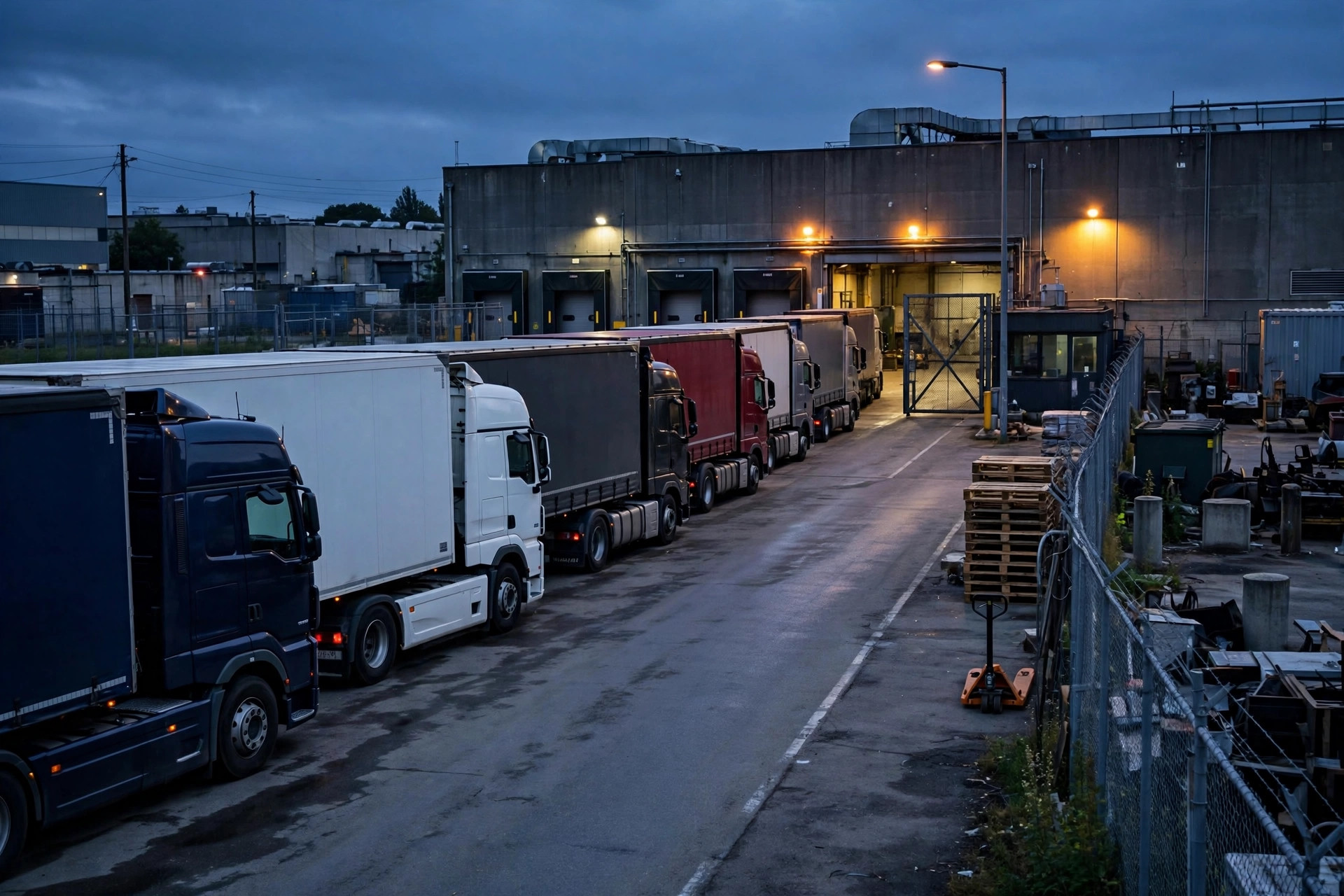
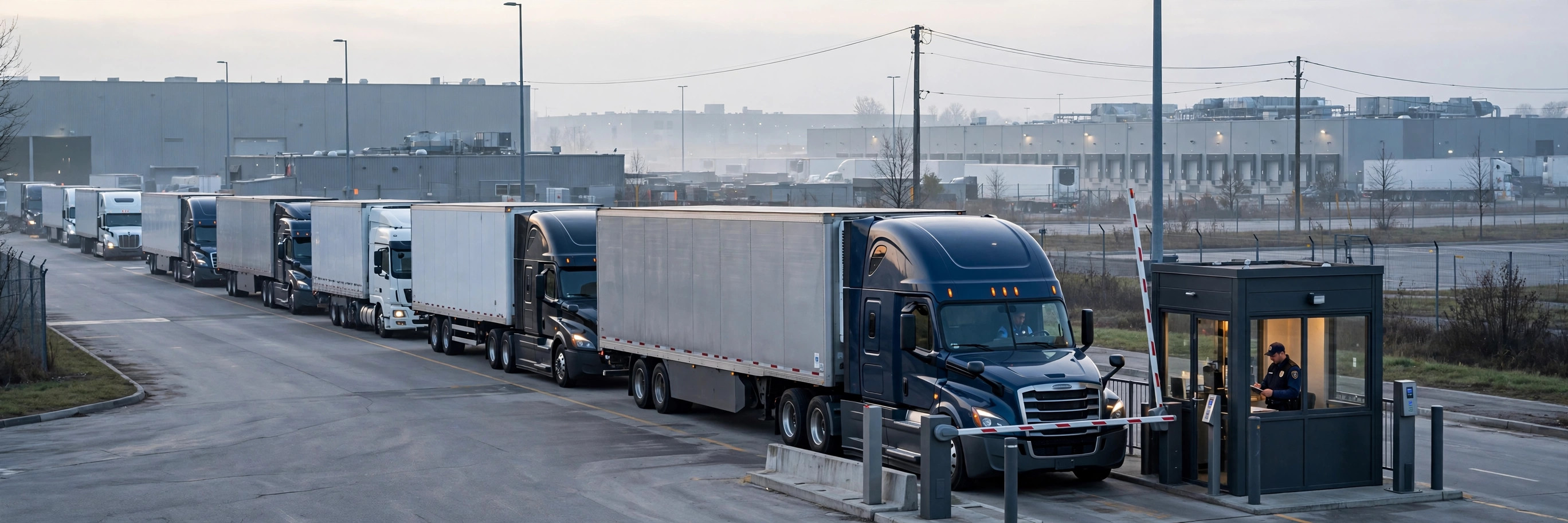
Let me tell you about a morning I'll never forget. Fall of 2023, I was hauling a reefer of frozen food to a big grocery chain's distribution center in California's Central Valley. Appointment was 5 a.m. I rolled in at 4:40 — and there were already seven trucks ahead of me. The guard took his sweet time, five minutes a truck. I finally got through the gate after 7, then waited on a dock door, then waited on the unload crew. I didn't roll out until almost 10. Four and a half hours, burned at the gate.
Here's the math that stung: the first two hours are free by industry custom, so 2.5 hours should have been billable detention. Going rate runs about $50 to $75 an hour, so I was owed somewhere between $125 and $187. What I got was zero. The broker said the detention clause in the rate confirmation was vague, and the warehouse's unload records didn't match my story. That happens all the time out here — the American Transportation Research Institute found that roughly three-quarters of detention incidents get invoiced, but only a little over half of those invoices ever get paid.
Do the math: what the queue costs a facility every year
Detention looks like small money until you multiply it. I once walked a DC manager through it: 40 trucks a day, averaging 1.5 hours past free time each, at $60 an hour. That's 40 × 1.5 × 60 = $3,600 a day. Over 300 working days, you're past a million dollars a year — gone, with nothing to show for it.
And that's just the invoices. A 2018 U.S. Department of Transportation study estimated American drivers lose $1.1 to $1.3 billion in earnings every year to detention. The same study found that every extra 15 minutes of detention pushes the expected crash rate up by 6.2% — a driver who's been drained at the gate is a driver rushing to make up time on the highway. FreightWaves' SONAR data puts the average wait at 119 minutes per pickup or drop-off. That's just under two hours. Right at the edge of the free window, which is no coincidence.
So the shipper thinks the driver is padding the bill, the driver thinks the warehouse doesn't respect his time, and the warehouse says "what can I do, they all show up at 8 a.m." Everybody's right, and the money keeps burning.
The counterintuitive part: the free two hours are the most expensive ones
Most people think the way to cut detention is to negotiate the rate down with carriers. I'm telling you, that's backwards.
The industry gives two hours free. Because they're free, the warehouse is in no hurry to move you through them. FreightWaves once interviewed a few food-and-beverage logistics executives who basically admitted it: retailers will consume every single minute of that free time. Nobody hurries through something that costs nothing — so the first two hours in the queue are the least efficient two hours of the whole operation.
The real play is to get trucks in and out within those two hours, so detention never gets a chance to start. And you don't do that with shouting and walkie-talkies. You do it with a YMS that puts real order at the gate.
Use YMS appointment scheduling to flatten the morning spike
The root cause of detention is the arrival spike. I've seen it a hundred times: fifteen trucks show up between 8 and 9 a.m., the building has four doors and two unload crews. Of course there's a line.
YMS appointment scheduling exists to shave that peak. Carriers book time slots in advance, and the system spreads arrivals across dock capacity and labor — those fifteen trucks that used to crush the 8-to-9 window get spread from 6 to 11 a.m. The driver sees his slot on his phone: what time, which gate, which staging spot. Research on 3PL yards running a YMS found detention occurrences dropped significantly, and this is the mechanism that does it.
But let me be honest about the weak link, because it's never the software — it's the people. Drivers don't check their phones and barge in anyway. The unload crew ignores the schedule and unloads the buddy's truck first. The finest system in the world is worth nothing if nobody follows it. So step one of a YMS rollout isn't buying software. It's establishing the rule: no appointment, you wait at the gate.
Know exactly when your free time starts ticking
This is a trap I've fallen into myself. A lot of drivers assume the free clock starts when they arrive. It doesn't. Industry practice is that free time runs from the appointment time, not the arrival time. Show up an hour early and that hour at the gate doesn't count. Show up fifteen minutes late and the warehouse can say you missed your window — and the whole queue behind it becomes your problem.
That's where the fights start. The driver says "I was here at five." The warehouse says "our log shows 5:40." No proof either way.
Gate management in a YMS fixes exactly this: plate recognition or a driver QR scan logs the entry timestamp automatically, and the exit gets logged the same way. How long each truck spent inside the yard, down to the minute. When free time started, how many minutes ran over — the system does the math, and the invoice has evidence behind it. Carriers can't inflate it, and warehouses can't dodge it.
Reduce truck detention time with YMS timestamps that settle every dispute
Once you have timestamps, detention goes from a shouting match to an accounting exercise. There are three moves worth making:
First, kill bogus invoices. A carrier sends a detention bill at month's end claiming a truck waited five hours. You pull the YMS gate log: in at 8:05, out at 10:20 — two hours fifteen total, two free, fifteen minutes over. Billed in fifteen-minute increments, you pay exactly what's owed and not a cent more.
Second, spot the carriers that are always "getting detained." Pull average dwell time by carrier and you'll sometimes find one whose trucks are all mysteriously stuck for three hours while everyone else flows through. That's a tell — usually a driver arriving early and camping in the yard to run up the clock.
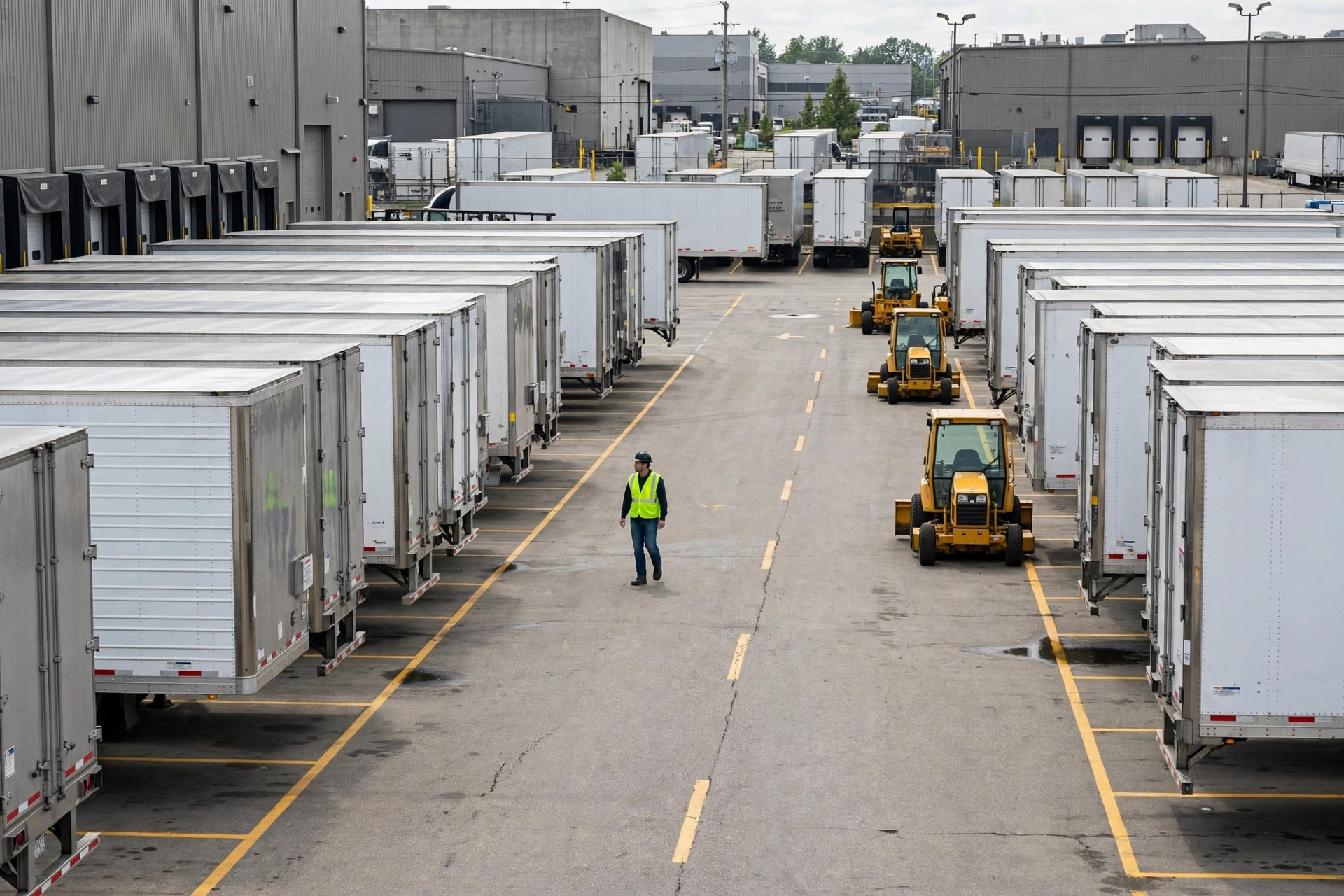
Third, the nuclear option: drop trailers. Where the operation allows it, the driver drops the trailer in an assigned spot and leaves. Loading and unloading are completely decoupled from the driver. Zero driver wait, zero detention. The YMS tracks where every trailer sits and which door needs which one, and yard tractors move them on system instructions. It works best on high-volume, fixed-lane freight.
The trade-off nobody mentions: tighter slots mean less flex
Now the ugly part, because a YMS isn't magic and I'd be lying if I said otherwise.
The trade-off of strict appointment scheduling is that ad-hoc trucks have nowhere to go. Peak season hits, a promo needs emergency replenishment, unplanned trucks show up with no slot in the system — and the gate backs up anyway. I've heard warehouse managers complain that the appointment system runs beautifully on normal days, but in peak season the dispatcher spends all day manually reshuffling slots, which is worse than the old phone-call chaos.
My advice: always keep 10 to 15 percent of the schedule as flex windows, reserved for walk-ins and late arrivals. A YMS is a tool, not a cage. You need order at the gate, but not a dead set of rules — because nothing scares a working driver more than "your name's not in the system, so you're not coming in, no matter what."
We have an old saying out on the road: slow I can handle, but standing still is what kills you. A truck rolling slow still burns a little extra fuel and gets the freight there. A truck parked at the warehouse gate burns fuel, burns the driver, burns money — and earns nothing. A YMS, at the end of the day, is about keeping the trucks at the gate from standing still: appointments, a schedule, timestamps. Get those two hours at the gate under control and detention takes care of itself. Lose control of them, and no amount of money fixes it.
By Shifu Zhao, Trucking Veteran (15 yrs)