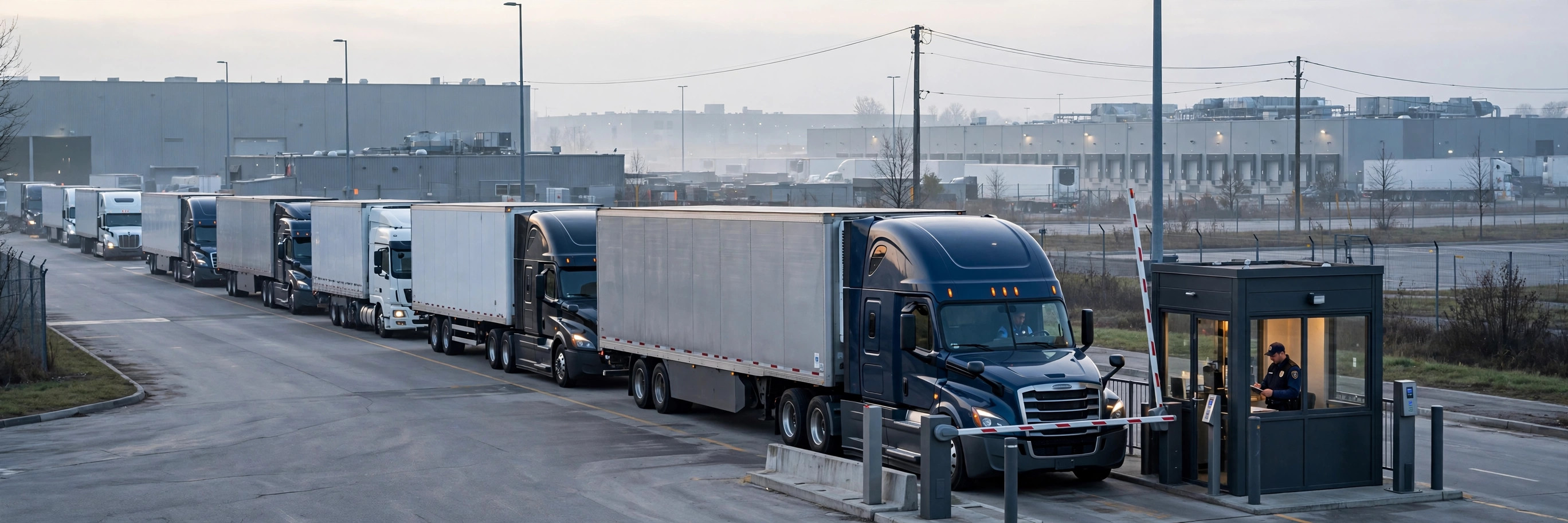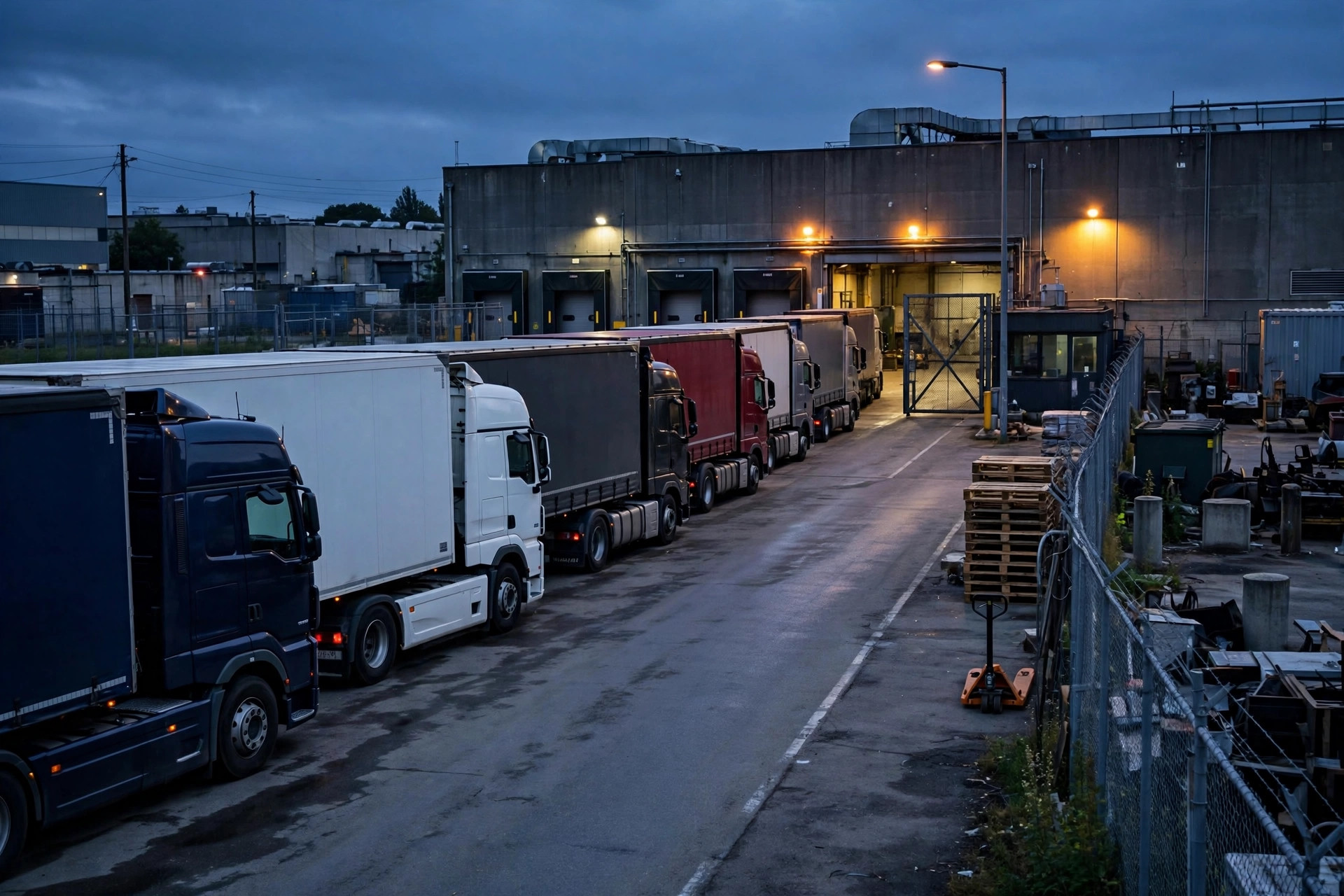
A driver waits 4 hours at your gate. You get a $200 detention invoice. The money is wasted, and most shippers can't even say exactly where the waste is.
One note on sources before the math: the industry ranges I use here are the 2-hour free waiting period followed by $50–$100 per hour, and a carrier-side driver pay of $25 per hour after the 2-hour mark. Every calculation below uses those numbers, nothing else.
The detention bill: what 4 hours of waiting actually costs
No stories, just the ledger. One load, one driver, 4 hours from arrival to departure at your gate:
| Item | Calculation | Amount |
|---|---|---|
| Free waiting period | First 2 hours | $0 |
| Detention (shipper pays carrier) | 2 hours × $50–$100/hour | $100–$200 |
| Driver pay (carrier pays driver) | 2 hours × $25/hour | $50 |
Invoice-wise, that is $100–$200 in detention per load. Two hundred loads a month, every one of them waiting 4 hours, is $20,000–$40,000 a month—hundreds of thousands a year, walking straight off your books. And that is only the visible part.
A cautionary tale from the other side: a 3PL warehouse in the US Midwest spent three straight weeks of the 2025 peak season with a line at the gate—up to 9 trucks waiting at once, averaging 3.5 hours per load. Month-end reconciliation showed over $40,000 burned on detention alone, before counting the customer claims from missed outbound cutoffs. Their operations director put it plainly afterward: every hour of that queue was cash on fire.
Below the waterline: detention invoices are the tip of the iceberg
The invoice is what you see. The expensive part is the four hidden costs:
Receiving overtime. Trucks bunch up in the evening, the receiving crew works overtime at 1.5× wages, and a few thousand dollars of extra labor a month becomes routine.
Expedited freight. Upstream freight is stuck at your gate, the production line downstream is starving for material, and you fire off an expedite to save the day—at several times the normal rate.
The "problem shipper" markup. Carriers keep their own books. A driver burning 4 hours at your gate gets priced into your next bid, so the same lane quotes higher for you than for your neighbor. You never see an invoice for it, but you pay it every year.
Lost throughput. Trucks queued at the gate while dock doors sit idle—your yard's throughput ceiling is set by the queue, not by your warehouse. In peak season that means turning away freight, which costs revenue, not just money.
Add those four back in, and the true cost of one 4-hour wait easily runs 2–3× the invoice amount. Anyone who tells me "the gate just feels a bit congested" gets one response from me: finish the math first.
Three levers: where YMS actually cuts the cost
YMS savings are not magic. They come from three concrete levers:
Lever one: appointments. Turn "whenever the truck shows up" into a plan. The gate releases by appointment window instead of first-come-first-served, peaks flatten, and the queue shrinks. Cheapest lever, fastest result.
Lever two: gate automation. License-plate recognition, automatic appointment verification, barrier arms lifting on their own—replacing manual check-in. A large retailer's publicly shared 2026 case: yard automation cut gate wait time for its own drivers by 20+ minutes, which at a detention rate of roughly $90/hour worked out to about $30 saved per load—and that saving was deducted straight from the bid rates.
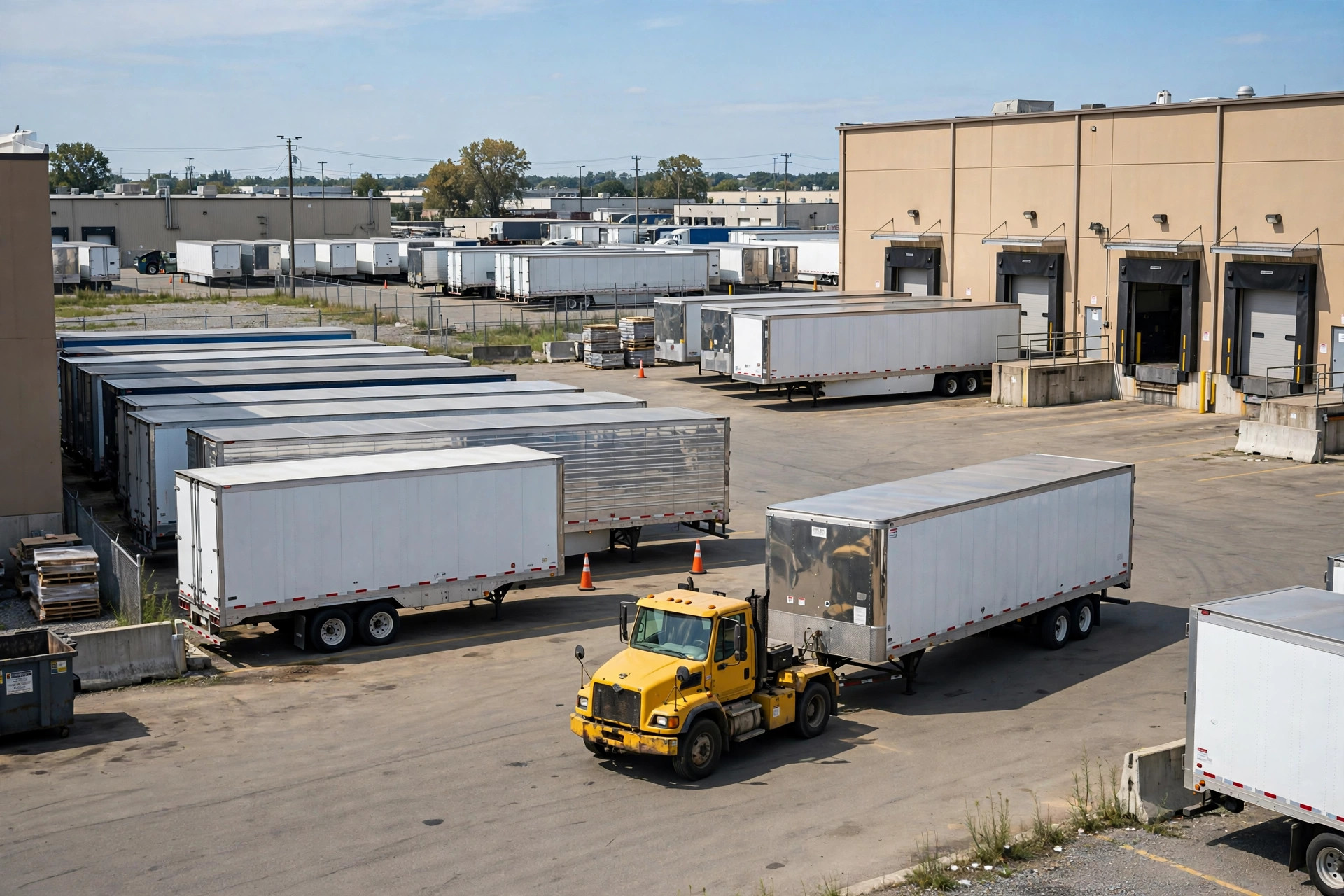
Lever three: yard scheduling. Drop-and-hook moves, trailer repositioning, and dock assignments run on a system schedule instead of a radio. Dock turns get faster, total dwell time compresses, and waiting moves from "at the gate" to "planned."
Note the multiplication effect: appointments fix "when they arrive," gate automation fixes "how fast they get in," yard scheduling fixes "how smoothly they move inside." Deploy only one and the result is discounted.
Scale it to a year with a comparison table. Assumptions for a mid-size yard: 40 loads/day, currently averaging 3 hours of wait per load, $75/hour detention rate, 300 operating days:
| Item | Without YMS | With YMS (wait cut by two-thirds) |
|---|---|---|
| Annual detention spend | 40 × 1 × 75 × 300 = $900,000 | 40 × 0.33 × 75 × 300 ≈ $300,000 |
| Annual detention savings | — | ≈ $600,000 |
| Hidden-cost recovery (estimate) | — | 0.5–1× the detention savings |
Note: 3 hours of wait minus the 2-hour free period bills 1 hour; cutting wait by two-thirds leaves about 0.33 billable hours. Hidden costs are estimated by magnitude, not precision—even at 0.5×, that is hundreds of thousands a year.
Three self-checks before you buy
Don't rush to buy YMS. Run three self-checks first to see whether your yard qualifies:
Step one: pull the data. Export three months of gate logs and compute two numbers: average wait time, and the share of loads exceeding the 2-hour free period. If average wait sits under 1.5 hours, your gate was never the problem, and the YMS math won't close.
Step two: find the bottleneck. Where does the wait actually happen—stuck at gate check-in, or inside waiting for a dock? Gate automation fixes the former fast; the latter needs appointments plus yard scheduling. Misdiagnose the bottleneck and you spend the money in the wrong place.
Step three: check your rate. Dig out the detention rate in your carrier contracts—is it $50 or $100? That single number doubles or halves your savings. Yards on the low end of the rate band face naturally longer paybacks; set expectations accordingly.
The conclusion: your payback formula
No pep talk at the end—a formula. Plug in your own numbers:
Annual detention savings = daily inbound/outbound loads × hours of wait eliminated per load × your detention rate (use your contract's $50–$100 figure) × operating days per year
Use the table above directly: 40 loads/day, billable wait per load cut from 1 hour to 0.33, saving 0.67 hours, at $75/hour, 300 operating days:
40 × 0.67 × 75 × 300 ≈ $600,000/year
That excludes the hidden-cost recovery. Divide by your annual YMS investment (software subscription plus amortized gate hardware) and you have the payback period. Most mid-size yards land at a few months. If your result stretches past 18 months, your wait problem was never serious enough, and you can park the YMS budget for now.
One last thing: detention money hurts when you pay it, and hurts more when you don't—because the carrier buries it in the next rate cycle. Better to run an orderly gate than to keep paying the queue tax year after year.
By Lao Zhou, Logistics Cost Analyst