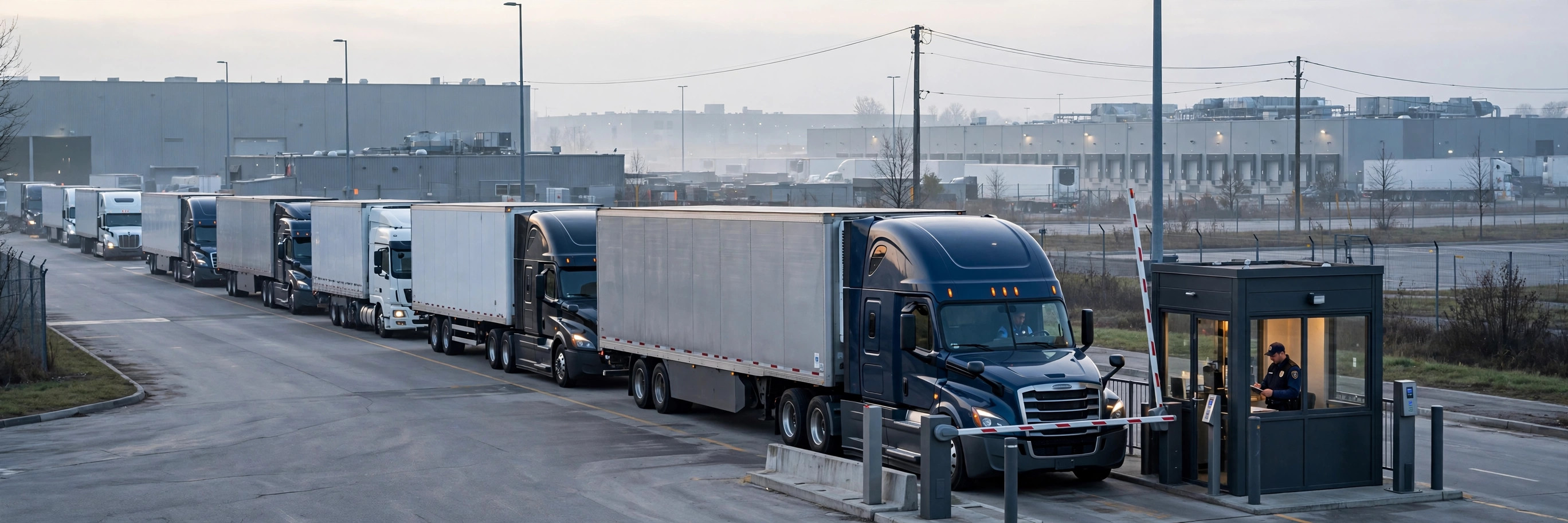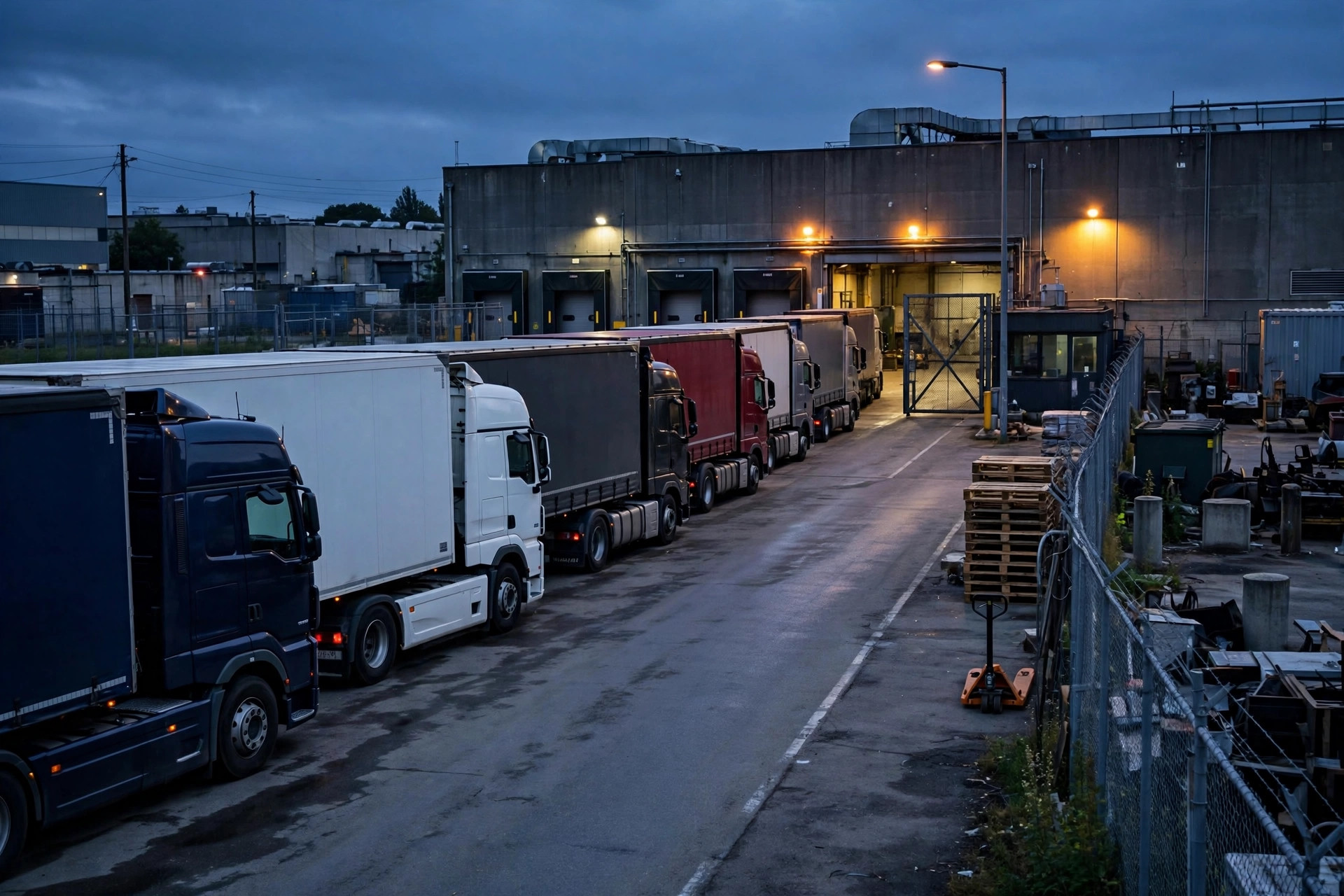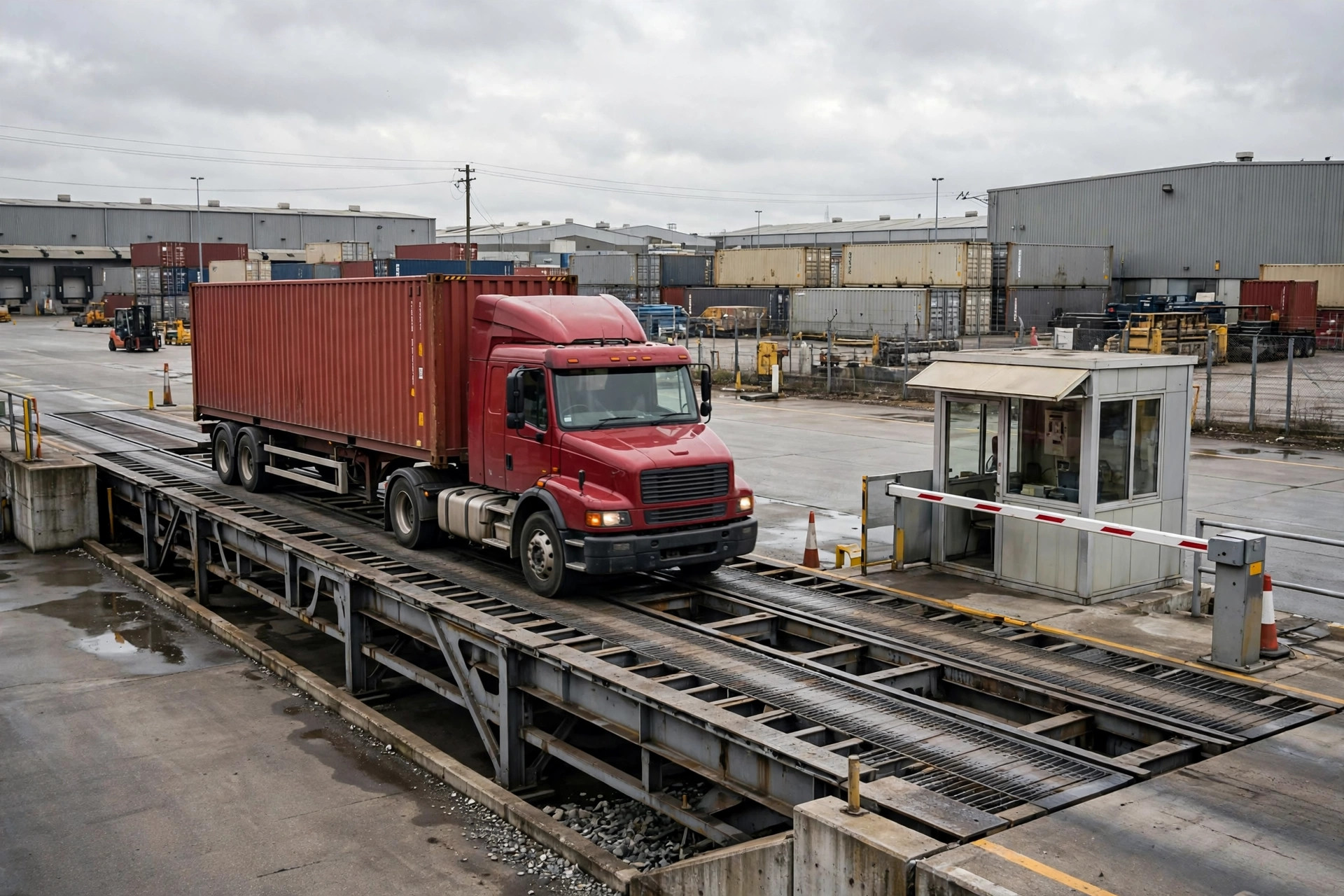
Last winter, while visiting a third-party logistics warehouse in the American Midwest, the site's operations director told me about a problem that had been nagging him for months: outbound pallets kept weighing slightly less than inbound records. Not by much, not on any pattern — just enough to make every reconciliation feel like guesswork. His YMS tracked every gate appointment with precision — yet how much the freight actually weighed did not exist in the system. The facility had a weighbridge at the entrance; every truck rolled over it. But the printed tickets went into a drawer in the guard booth, never meeting the flow of appointments, dock assignments, and loading tasks inside the YMS. Weighed, in effect, meant nothing.
This "weighed but unused" state is remarkably common. Weighbridges are not rare — but sites feeding weighbridge data into their YMS in real time and auto-reconciling inbound against outbound weight remain a small minority. The underlying problem is old: freight weighing more on the way in than on the way out, shrinkage along the way, the occasional sticky fingers at the loading dock, billing disputes over declared weight. What is new is the obvious question people have finally started asking — if the truck already rolled over the scale, why can't the system do the math?
The Outbound Freight That Kept Getting Lighter
Consider the first case. A 3PL handling fulfillment and storage for consumer goods, roughly twenty thousand pallet positions, serving mostly small and mid-sized brands. In the second half of 2025, finance noticed during quarterly reconciliation that several high-value SKUs showed persistent gaps between inbound and outbound records — small, but always short, never over. Two months of reviewing footage, pick records, and cycle counts produced no conclusion. The break came from a retrospective comparison of weighbridge tickets against outbound load sheets: over several consecutive weeks, the actual weighed net weight of outbound trucks ran systematically below the theoretical weight on the load documents, with a cumulative gap in the neighborhood of seven metric tons. The trail led to the loading dock, where individual high-value small appliances were being slipped out, a few units at a time, buried inside full pallets — invisible to manual piece counts.
After integration, the change was mechanical. Every truck is weighed on exit; the system subtracts the vehicle's tare weight, compares the result against the theoretical weight of that trip's load sheet, and holds the gate if the deviation exceeds tolerance. In the first month alone, three outbound weight anomalies were intercepted — one of them revealing, on the spot, a loaded quantity that did not match the paperwork. The point, the operations director later told me, was to make pilferage calculable: what used to be undetectable was now only a matter of time.
The second case comes from the import side. A freight forwarder pulling containers out of the Port of Los Angeles had a driver flagged at a highway weigh station, roughly four hundred kilograms over the legal limit. Fine, delay, and the entire margin on that move wiped out in one stop. The root cause sat upstream, at stuffing: the container had been loaded by volume overseas, nobody re-verified total weight on the US side, and the driver simply picked up the box and drove. The forwarder has since installed a weighbridge at its transload yard and wired the readings into the YMS pickup workflow. Every box is weighed on entry; the system checks measured gross weight against declared bill-of-lading weight and axle limits in one pass. Overweight units get held and reworked inside the yard instead of paying fines on the interstate.
The Weighbridge: A Data Island at the Gate
Why do facilities own weighbridges yet ignore the data? The attribution, in my observation, works on three levels. The first is physical: the scale sits at the perimeter, operated by security, producing paper tickets. Its data belongs to "entry logging" — nobody imagined it traveling downstream. The second is systemic: a YMS manages appointments, gate movements, and dock allocation — it cares when the truck arrives and which door it backs into, not how much it weighs. A TMS cares about weight only when freight charges depend on it. A WMS tracks inventory in units and pallets, and weight is not even an inventory dimension for most product categories. Three systems, each minding its own domain, leave "freight weight" as nobody's number.
The third level is subtler and organizational: there is no standing process for handling a weight anomaly. Even if a guard notices a truck leaving two tons lighter than it arrived, there is no defined owner — the dispatcher? The warehouse manager? The customer? Data with no process to receive it decays into "noted, but nothing we can do." That is why so many weighbridges end up serving one function: satisfying an inspector, or digging up a historical ticket after something has already gone wrong.
What Interception Looks Like Once the Scale Talks to the YMS
Connecting a weighbridge to a YMS is not technically difficult; the hard part is turning "weight" into an event a process can catch. Drawing on the early adopters I have studied, a workable handling flow looks roughly like this:
| Step | Action | Notes |
|---|---|---|
| 1 | Weigh inbound, record gross | Matched to the YMS appointment by plate |
| 2 | Weigh outbound, record gross | System applies stored tare weight |
| 3 | Compute net weight for the trip | Outbound gross minus tare, per trailer |
| 4 | Compare against theoretical weight | From the ASN, load sheet, or bill of lading |
| 5 | Auto-hold on excess deviation | ±0.5% or ±50 kg, whichever is stricter; separate bands for bulk and palletized |
| 6 | Manual verification | Re-check scale, pull dock footage, verify documents |
| 7 | Classify and close | Release with logged variance; route suspected loss to claims |
Three details matter. First, tare weight: the same tractor with different trailers, or a full versus empty fuel tank, shifts the tare — refresh the tare database regularly, or every baseline is wrong. Second, tolerance: too tight and normal scale drift holds trucks all day; too loose and anomalies sail through. Start wide, run one to two months of data, then draw the line. Third, compute net weight per tractor-trailer combination on drop-trailer moves — lock this in before go-live.

One site running the integration for two quarters flags a little over forty anomalies a month: roughly seventy percent turn out to be loading errors or normal scale variance, about thirty percent go to deeper review, including suspected loss and billing disputes. That ratio is the interesting part — most anomalies are not theft but records disagreeing with reality: a mis-keyed document, an over-loaded pallet, a declared weight that was always an estimate. The first thing a connected weighbridge fixes is not human nature. It is data quality.
Will Gate Weighing Become the Default?
On the trend, the evidence first. Highway weight enforcement in the US has been tightening, and an overweight stop now costs more than the fine — insurance and carrier-qualification consequences follow, so shippers are writing "verify gross weight before dispatch" into 3PL contracts. Second, weight-related billing disputes have long been among the messiest items in freight settlement; an independent gate-weigh record collapses the cost of evidence, and contract language citing "site weighbridge data" has started to appear. Third, YMS vendors' roadmaps: gate-weighing modules are showing up with noticeably higher frequency, which tells me demand is already asking.
My judgment, on that evidence: gate weighing is moving from a nice-to-have to standard risk control for mid-sized and large 3PL campuses, with the transition window sitting roughly in 2026–2027. The first movers will be two profiles — high-value-goods fulfillment operators, where the dollars of shrinkage force the issue, and large private fleets, where fines and fuel costs force it. The rest will follow once peers publish numbers. This industry has always worked that way.
Still, feeding the scale into the YMS only turns the invisible visible. The harder questions come after: who sets the tolerance band, the site or the shipper? Does scale variance belong to the carrier or the warehouse? Who pays for the labor of investigating every hold? There are no standard answers — each site's contract structure gives a different one. But once weight becomes a data stream, it stops being a paper ticket in a drawer and becomes a fact that can be counted, traced, and written into contracts. In that sense, the YMS–weighbridge integration is less a technology project than a process of making weight factual again. Where that process takes the industry, we will see more clearly once the first cohort of adopters closes out a full year of data.
By Dr. Chen, Supply Chain Researcher