3:30 in the morning. The streetlights outside the Yantian terminal are still on, trucks are backed up two kilometers down the road, and every light in our warehouse is on too. That night, all 200 of us missed clocking out on time — three US sailings changed schedule on the same day, container arrival times went sideways, the yard was pushing us to pull boxes, and customers were pushing us to ship. Let me be straight with you: after all these years in warehousing, Yantian China port warehouse logistics is decided on nights like that. Not on the shipping schedule. On the roster.
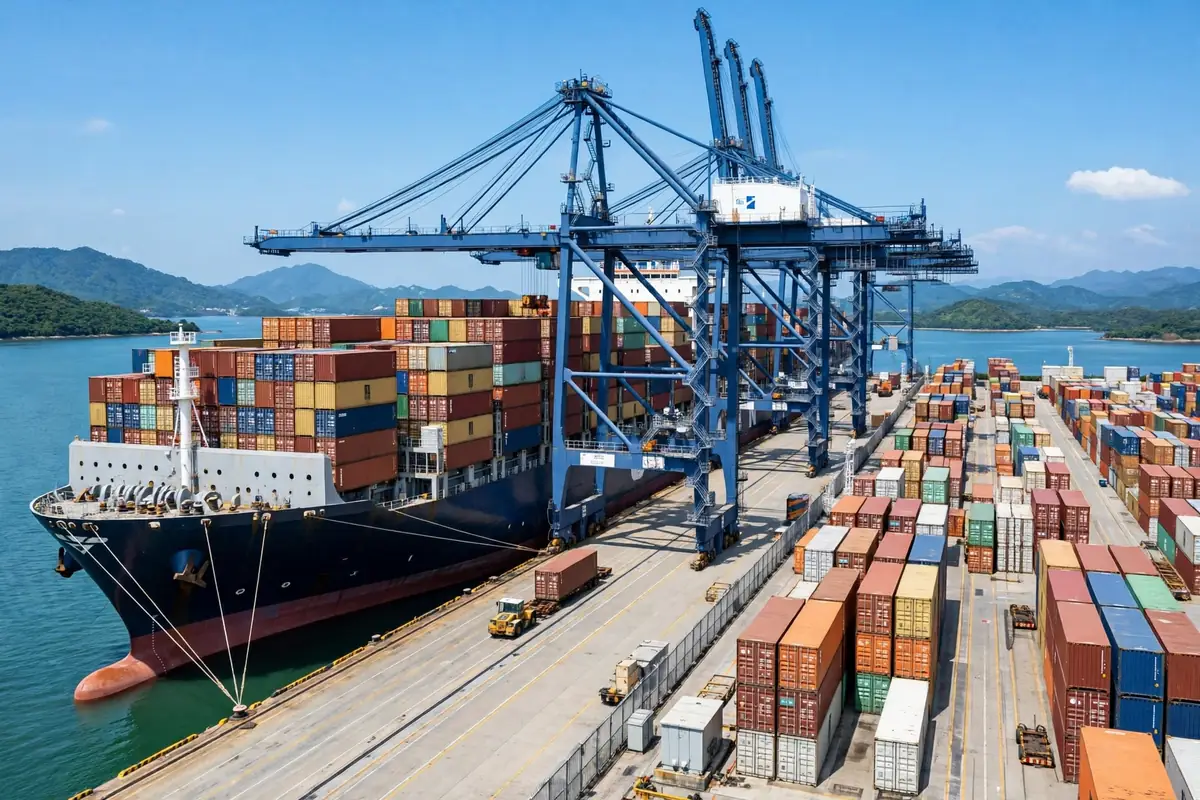
First, the scale of the place. Yantian handled 16.1 million TEU in 2025, up 7.1 percent year on year, according to the Shenzhen municipal government. Work backward from that growth rate and 2024 comes out at roughly 15.0 million TEU. The terminal carries more than a third of Guangdong's foreign trade and about a quarter of China's container exports to the United States, with nearly 100 international routes a week. On October 2, 2026, a single vessel was worked for 28,684 TEU here — a record for any Chinese port. The East terminal's automated twin-trolley cranes lift 55 meters high and reach 75 meters out, built to work 32,000-TEU mega-ships. In August 2026, monthly throughput passed 1.6 million TEU, the best month in the port's 33 years. Big ships, a strong port, a lot of cargo. That is the scale Yantian China port warehouse logistics runs at every day.
When the Schedule Changes at Yantian Port, the Roster Falls Apart
So how does it go wrong? Peak season on the US lane, and the sailing schedule changes whenever it wants. One notice from a carrier pushes a berthing back two days, and the whole pull plan we made collapses. Containers do not arrive, so the crew stands around waiting. Then they all arrive at once, the yard fills up, trucks queue at the gate, and the warehouse door turns into a traffic jam.
The hardest part is people. One peak season (illustrative scenario), a crew worked four night shifts in a row, and on the fifth morning two of them called in sick. The line nearly broke. Veterans stepped in to cover rookies, and a rookie who could not tell general US cargo from battery cargo nearly put a batch in the wrong zone. I stood at the warehouse door that day, looking at the crew under the lights, and I had one thought: if we keep going like this, the people break first.
Let me be straight with you. When a warehouse goes wrong, eight times out of ten it is not the equipment. It is the roster and the people. You cannot control the sailing schedule. The only thing you control is how your own people are scheduled and where your cargo sits. Morale is practical, too: whether the night-shift meal is hot, whether time off is actually honored, whether overtime is calculated clearly — the crew keeps score on all of it. Get that wrong and people leave, and no roster on paper will save you.
Yantian Port Night Shifts Are Won on the Roster, Not on Muscle
Here is how we tried to fix it. Year one, we added people — hired a batch of temp workers for peak season. The rookies were not trained fast enough, errors went up, and the rework cost more than the extra hands saved. Year two, we tried locking slots in advance: 72 hours before a ship berths, slots and staffing are set, so cargo goes straight to its zone when it arrives instead of piling up at the door waiting for someone to decide. That one worked. Queue time for pulls dropped sharply (illustrative scenario). Year three, we added another move: get the advance manifest from the carrier and the forwarder, so before the ship even berths, we already know which boxes come off first and which come later. Battery cargo and general cargo get their zones fixed at the same time — battery cargo in its own zone, with labeling, separation, and fire-safety rules non-negotiable, so even a confused rookie cannot put it in the wrong place. When the yard is jammed, we also learned to pull off-peak: skip the daytime crowd, pull at 3 or 4 in the morning when the roads are clear and the yard is quiet. One night shift can make two or three extra trips that way (illustrative scenario). It looks crude. In peak season it works best.
The roster changed with it. Night shifts no longer run more than three in a row. Subsidies and time off are written into the roster. Veterans mentor rookies one-on-one, and a rookie has to shadow two full night shifts before working alone. What we do now comes down to three rules: when a sailing changes, the roster is rebuilt within two hours; slots are locked 72 hours ahead; no one works more than three night shifts in a row, and the shift leader answers for it.
Three Ways to Ship the US Lane from Yantian
On the US lane, rhythm beats speed. Three common approaches in Yantian China port warehouse logistics, and the math is different for each (table below is an illustrative example to show cost structure, not real quotes; rates per the latest official policy):
| Approach | What you do | Biggest cost | Fits who | | Stock ahead in the warehouse | Cargo in a week before sailing | Storage time | Sellers with steady orders and predictable lead times | | Cut it close to the cutoff | Ship right against the closing time | Overtime + rush handling | Sellers with tight deadlines and small volumes | | Split the shipment | Break a big order into several sailings | Repeated handling fees | Sellers who fear rolled cargo and want to spread risk |
Here is the counterintuitive part: the bigger the ships and the stronger the port, the easier it is for a small shipper to get rolled. When mega-ships bunch up at the berth, the terminal protects its big customers' boxes first, and small lots sit at the back of the queue. When the schedule tightens, yours is the cargo that gets left behind. So do not just watch the sailing schedule. Watch your own stocking rhythm. If your cargo is ready in the warehouse, a schedule change does not scare you. If it is not ready, the most reliable sailing in the world has nothing to do with you.
What We Do Now, Every Peak Season
These days our US-lane peak season runs on three rules. First, the sailing schedule gets reviewed every Friday, and the roster follows the schedule — never gut feeling. Second, slots are locked 72 hours ahead, and night-shift staffing is set before the big ship arrives. Third, no rookie works a night shift alone. A veteran mentors them one-on-one for two full night shifts before letting go. The mentoring is not a formality: the veteran teaches the rookie to read zones, read cargo, and read orders by hand, and only when the rookie can handle a normal shift alone does the veteran sign off. The rules are printed and posted on the shift leader's office wall. Nobody changes them on a hunch.
A word to fellow operators: Yantian China port warehouse logistics will not manage your warehouse for you, no matter how big or fast the port gets. The sailing schedule belongs to the carrier. The roster is yours. Get your own house in order, and peak season on the US lane is where you make your money.
By Chen Feng, Warehouse Operations Manager