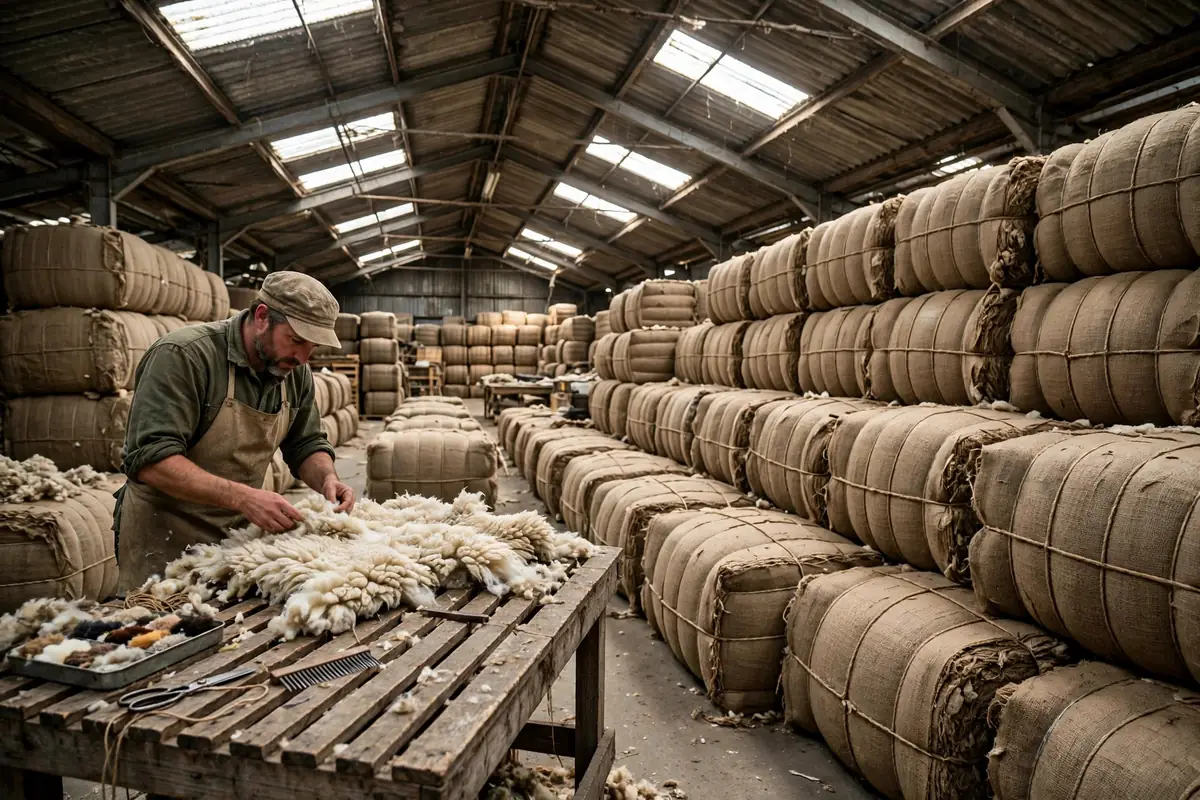
Start with the ledger. A 170-kilogram wool bale priced at the 2024-25 season's Eastern Market Indicator average of 1,167 Australian cents per kilogram clean carries a greasy value of roughly A$1,984. If that same bale is pressed overweight and sent back for rework, the handling charge plus a missed auction slot costs tens of dollars, and more for fine wool. Australia wool export warehouse storage is not a rent problem. The money sits in three details — bale weight, classing, and auction timing — and a mistake in any one of them shows up on the bottom line the same week.
Australian shorn wool production fell to 280.1 million kilograms greasy in 2024-25, down 11.8% on the previous season and the lowest in a century. Supply shrank, but prices did not jump to compensate. The Eastern Market Indicator averaged about 1,167 cents per kilogram for the season, down 5.7% year on year. A New South Wales grower sheared 400 bales of Merino that year at 18.5 micron, expecting fine wool to pay well. Thirty bales came in under 120 kilograms, below the minimum, and the auction house required rework before they could be offered. The grower missed that week's Sydney sale, and by the time the bales went up the following week, the price for that micron had slipped a notch. The loss was not the rework fee. It was the auction window.
Do the Math First: A Badly Pressed Bale Loses Money Before It Sells
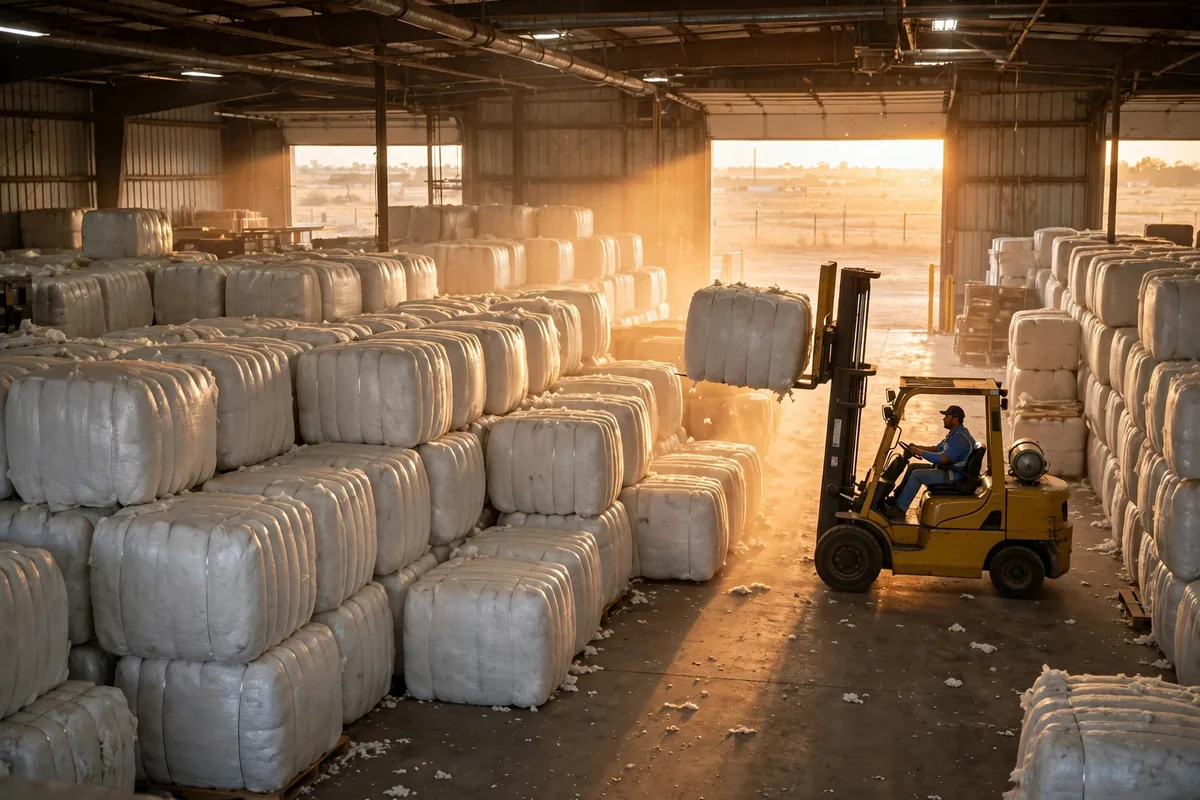
Australia runs its wool bales on hard rules. A bale must weigh between 120 and 204 kilograms, with superfine wool allowed down to 90 kilograms, and no longer than 1.25 metres. Most bales land between 170 and 190 kilograms. Under 120 kilograms is a butt, and over 204 kilograms the auction house will not sell it without repacking at the vendor's expense. A minute saved on the press in the shearing shed costs half an hour in the warehouse: an overweight bale has to be opened, reweighed, re-pressed, and re-labelled, forklifts and labor get tied up, and the auction house's receival plan slips.
The table below is a scenario illustration, for a mid-sized grower shipping 400 bales a year at 180 kilograms each:
| Item | Bales in spec (170-190 kg) | 30 bales needing rework |
|---|---|---|
| Auction slot | Offered that week in Sydney/Melbourne | Missed one week, offered late |
| Rework and handling | Zero | Tens of dollars per bale, over A$1,000 for 30 bales |
| Price risk | Settles at that week's indicator | One week later, fine-wool spreads can widen |
| Warehouse space | Turns over on schedule | One extra week of storage, dearer in peak season |
The figures are illustrative, but the conclusion is arithmetic: pressing to spec is not a shearing-shed craft issue, it is the first cost control in the export chain. My advice is to put a calibrated floor scale in the shearing shed and weigh one bale in every ten as they come off the press. Adjust the pressure the moment weights drift, instead of discovering the problem after the whole lot reaches the warehouse. The scale pays for itself in one season of avoided rework fees.
Classing in Australia Wool Export Warehouse Storage Lives on the Bale Label
Classing is the most underrated link in Australia wool export warehouse storage. Merino made up 79% of first-hand wool offered in 2024-25, and the price gap between microns is plain to see: 18 micron averaged about 1,600 Australian cents per kilogram, 21 micron about 1,326, a gap of 274 cents. On a 180-kilogram bale, one classing grade is worth close to A$500. The stencil on the bale — farm brand, wool description, bale number, classer number — is everything a buyer in a Sydney auction room has to bid on. Get the description wrong or mix wool types in one bale, and the bid comes in discounted.
Here is the counterintuitive part: in a short season, classing is worth more, not less. First-hand offerings fell to 1,541,414 bales in 2024-25, down 13.4%, and auction turnover shrank to A$1.94 billion with it. When supply is tight, buyers get pickier. Bales of the same micron with low vegetable matter, even staple length, and good strength get taken first. Bales mixed with seed and short wool wait for the end of the sale. The warehouse rule is to stack by micron, length, and vegetable matter in separate zones, and never mix classes in one stack. Whatever floor space mixing saves gets paid back double at sorting time the next day.
The Shipping Ledger for Australia Wool Export Warehouse Storage: Sailings, Currency, and Pressing in One Sum
Shipping is the last line, and the easiest to miscalculate. Australian wool exports were worth about A$2.8 billion in 2024-25, and China took 86.8% of the volume and 84.4% of the value. The ships mostly head for China. Bales leave the Sydney or Melbourne auction warehouse, get dumped three to a tri-pack, and go into containers. Currency moves the ledger: the Australian dollar averaged about US 65 cents in 2024-25, and a weaker dollar supported local auction prices in Australian dollar terms, while an exporter earning Australian dollars and paying freight in US dollars can watch the freight line eat the margin if the exchange rate is read the wrong way.
My method is to price the three ledgers together, never separately. Pressing decides whether the wool makes its auction slot, classing decides what each bale sells for, and sailings plus currency decide what is left in hand. Here is a formula any grower or small exporter can run before a lot leaves the store: net price per kilogram equals the auction average, less rework, storage, road, and sea freight per kilogram, converted at the exchange rate. If the number comes out negative for a given week, wait for the next sale rather than forcing the lot through. In a short season, defending unit price beats chasing volume out the door.
The 2024-25 numbers are on the table: production of 280.1 million kilograms, China taking 86.8% of exports, fine wool averaging 1,600 cents. Next season's production is forecast about 10% lower again, so supply will be tighter and buyers pickier still. Before your next lot goes to the auction house, run the formula. If the net price per kilogram is positive after every charge, ship it. If it is not, the wool is losing money sitting in the warehouse, and no auction slot fixes that.
By Lao Zhou, Logistics Cost Analyst