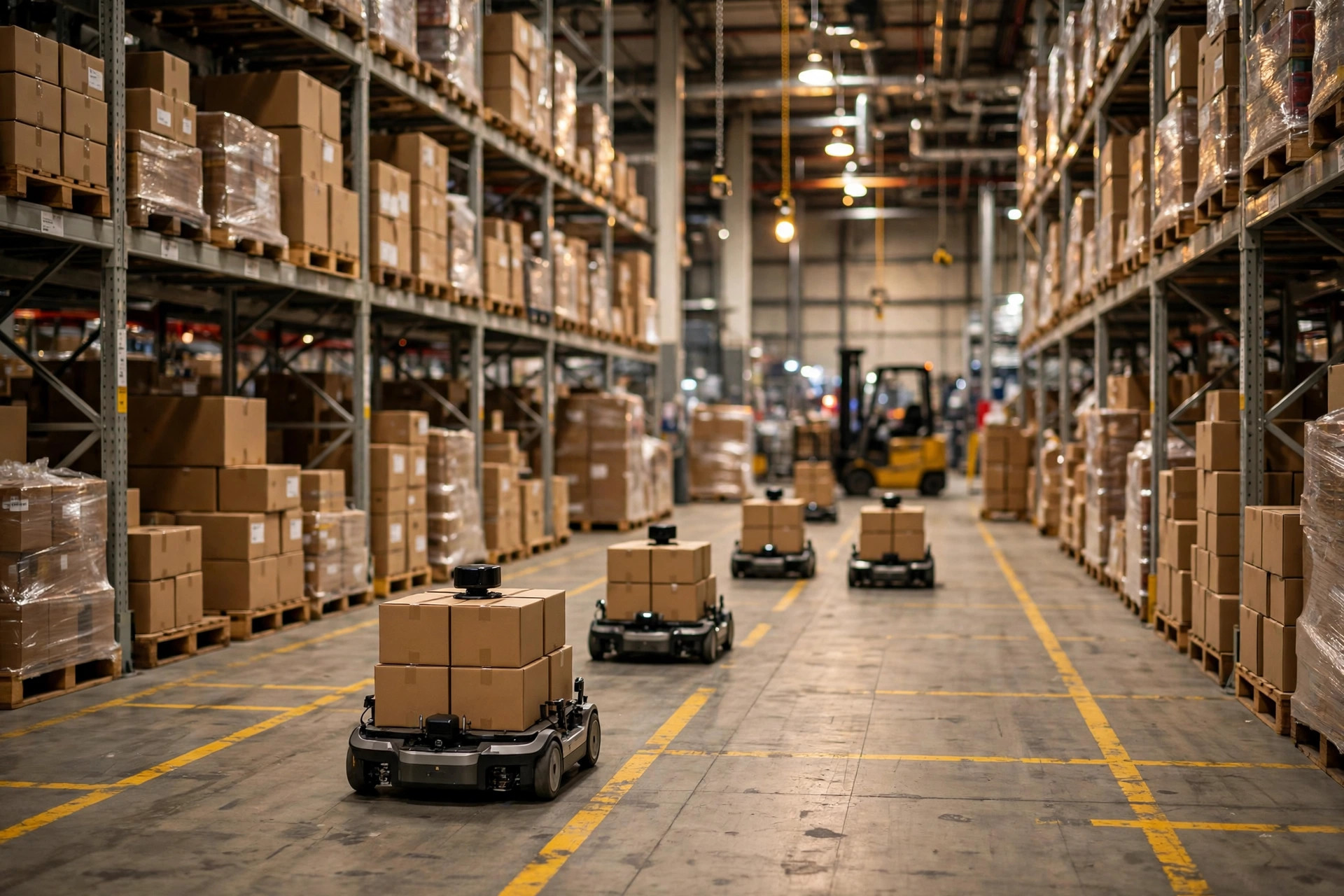
Buy now or wait two years — when to buy warehouse robots is the question every operations manager eyeing a mobile robot fleet has to settle in the next three years. Start with the arithmetic. A 20-unit fleet of lift-type AMRs lands around $680,000 in 2026. At a 15% annual price decline, the same fleet costs roughly $490,000 in 2028. On paper, waiting saves $190,000. But your labor costs don't wait for price curves: at $35,000 a month in material-handling labor, 24 months of waiting burns $840,000. You save $190,000 and bleed $840,000. The word "wait" in this equation is worth negative $650,000.
Buy now or wait: run the total first
Break "wait two years" into what it really costs. The first cost is visible: the labor that keeps flowing out while you wait. The second is invisible: by the day you finally take delivery of the cheaper robots, your competitor has spent two years tuning their fleet management — failure rates, task allocation, charging queues, all the painful lessons already learned. You start that learning curve from zero. The $190,000 on the price sheet doesn't buy back 24 months of that curve.
Consider a composite scenario drawn from several public cases. Summer 2024: an 80,000-square-foot e-commerce warehouse in Ohio. The owner held two quotes for 12 lift-type AMRs — $456,000 all-in from vendor A, $420,000 from vendor B. "The price war is just starting," he reasoned, "it'll be cheaper if I wait." He waited a year. By fall 2025 the same configuration quoted at $340,000 — a genuine 20% drop. But that year, unable to staff the night shift, he outsourced two temporary crews through peak season at an extra $280,000. The cheaper robots were bought with expensive labor. That money was wasted — wasted because the math only counted the equipment price, never the price of time.
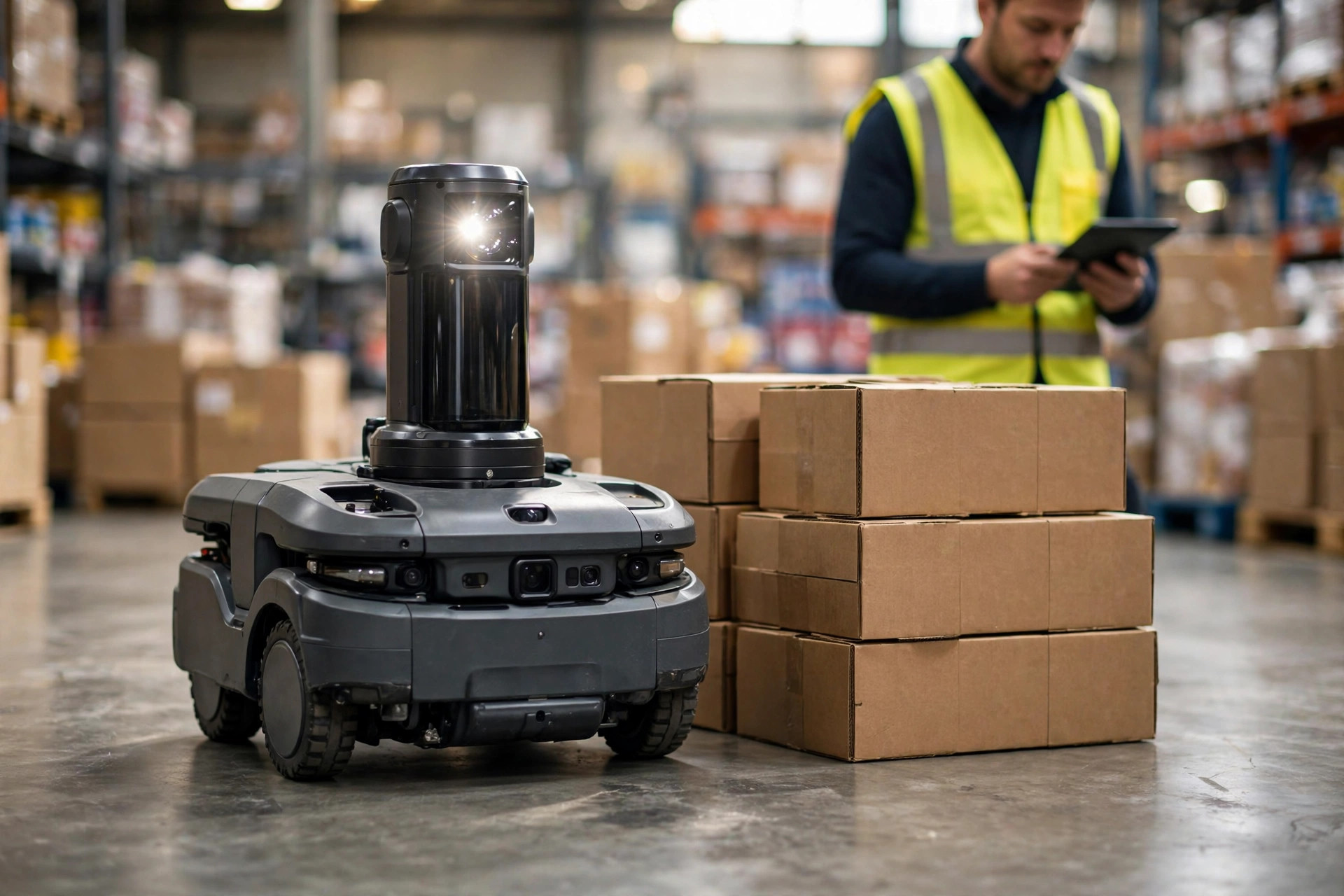
The reverse scenario is just as instructive. Early 2025: a California 3PL handling auto parts, with a brutally standard use case — pallets from receiving to storage, 80 meters one way, 400 trips a day. The owner deployed 8 units at $32,000 each in March 2025. His peer deployed the same use case in mid-2026 at $27,000 a unit — 15% cheaper. The early buyer didn't lose. His warehouse ran $42,000 a month in handling labor; eleven months of operation saved $462,000 in labor, dwarfing the 15% price gap. The cold conclusion: the price drop is real, but it can never cover the labor bleeding out — unless your labor was never expensive to begin with.
Tear down the cost stack: three components falling, three that aren't
AMR prices aren't falling as a whole. The parts are falling; the services aren't. The three falling components:
First, lithium batteries. LFP cell prices have more than halved over three years, and this is the single biggest slice of AMR price decline. A lift AMR's battery pack was roughly 25% of unit cost three years ago; now it's around 15%. Cells are still getting cheaper, but the big gains are already eaten.
Second, lidar and sensors. Domestic alternatives have cut 16-line lidar prices by more than half; vision modules are cheaper still. Sensors are about 20% of unit cost and still declining — but only 8–10% a year.
Third, compute modules. Edge compute boards get faster and cheaper every year, but they're under 10% of unit cost, so the impact on total price is limited.
Now the three costs that haven't budged. Deployment and integration: site survey, floor work, WMS integration, fleet tuning — $3,000 to $5,000 per unit, barely moved in three years, because it's human service and human labor only goes up. Annual service contracts: vendors charge 10–15% of unit price per year, batteries and spares extra — completely decoupled from hardware price drops. And the sneakiest one: software subscriptions. Fleet management, digital twins, remote ops — increasingly billed annually, and part of what hardware prices give, software subscriptions take back.
Here's the counter-intuitive call: over the next three years, the "equipment price" of AMRs will keep falling, but the "all-in landed price" will fall slower than you think. Equipment down 15%, integration and services flat — total cost of ownership might only drop 8–10%. People who wait for the quote sheet to drop are waiting on the fastest-falling slice while paying the three slices that never move. That's why plenty of managers who waited from 2024 to 2026 found total quotes only a dozen points cheaper — the parts got cheap, the labor stayed expensive.
The decision frame: three profiles that should buy now, three that can wait
The math at this point stops being "buy or wait" and becomes "which warehouse are you." Here's the frame:
| Your situation | Verdict | The math behind it |
|---|---|---|
| Monthly handling labor over $20k, and hiring is hard | Buy now | A year of waiting burns $240k+ in labor — far beyond any price-drop gain |
| Standard pallet-transfer use case, no special integration | Can wait 12–18 months | This category commoditizes fastest; the discount is real |
| Need forklift-type, cold-chain, or other specialized units | Buy now | Specialized hardware declines slowly; two years of waiting saves under 10% and costs you capacity |
| Budget is hard-capped, cash flow can't take the upfront hit | Wait — but don't wait idle | Negotiate monthly rental first; lock the capability, not the price |
| Major process change coming within 6 months (relocation, new WMS) | Must wait | Robots tuned to today's layout become scrap the day the process changes |
| Just "curious about automation," no clear pain point | Don't buy | Automation without a pain point is an expensive decoration |
Buried in that table is the second counter-intuitive judgment: the robots whose prices fall fastest are exactly the ones worth waiting for — and the specialized units you're most eager to buy barely get cheaper if you wait. Standard pallet-transfer AMRs have many vendors and mature designs; they're going the way of home appliances, and patient buyers get real discounts. Forklift-type, heavy-payload, cold-chain units have a handful of suppliers and real technical moats; their price curves are flat. Plenty of people wait for a discount on the wrong model — waiting on precisely the unit that won't get cheaper.
The leverage points: how to hedge the risk of buying now
If you decide to buy now, three levers keep the wasted money to a minimum.
First, buy in batches to hedge the decline. For a 20-unit plan, deploy 6–8 on the main lane first and run everything — fleet management, charging, exception handling — until it's smooth. Add the second batch 12–18 months later, catching the price decline while avoiding the "bought everything at the peak" trap. The first batch costs 15% more but buys learning time; the second costs 15% less and buys mature pricing. Average the two and total cost lands near optimal.
Second, negotiate the service contract, not the equipment price. Equipment pricing is transparent — squeezing 5% out of the vendor already hurts them. But an annual service fee from 15% down to 10%, a free spares kit, half-price software subscription in year two — that's where vendors have real margin to give. On a $30,000 unit, cutting service from 15% to 10% saves $7,500 over five years — the equivalent of another 25% off the equipment. Cut where the other side has margin to give.
Third, demand a price-protection clause. If the same model's official price drops more than 10% within 12 months, the vendor rebates the difference as spares or service credits. Large vendors will agree to win the order. It's a contract that cashes in the "waiters'" discount in advance.
The calculable conclusion
One formula you can plug your own numbers into. Let M = your monthly handling labor cost (USD), P = the fleet's current total quote (USD), r = annual price-decline rate (use 0.15), n = years you'd wait.
Net gain of waiting = P × (1 − (1−r)^n) − M × 12 × n
Positive: waiting pays. Negative: buy now. Plug in typical numbers: P = $680,000, r = 0.15, n = 2, M = $35,000 — net gain = 680,000 × (1 − 0.7225) − 840,000 = 189,000 − 840,000 = −$651,000. Negative $651,000. Can't afford to wait.
The one-line version: if your monthly labor M (in thousands of USD) × 8 exceeds the fleet quote P (in thousands) × 0.28, don't wait. For a $680,000 fleet, monthly labor above $23,800 makes two years of waiting a pure loss. Pick up a calculator, substitute your three numbers, and the answer speaks for itself. Gut feelings lie. Formulas don't.
All figures above are range estimates based on publicly observable market information, not formal vendor quotes. Assumptions: lift-type AMRs, standard indoor scenarios, US domestic deployment. Confirm with formal vendor quotes before purchasing.
By Lao Zhou, Logistics Cost Analyst