The AI era is repricing the warehouse manager's job.
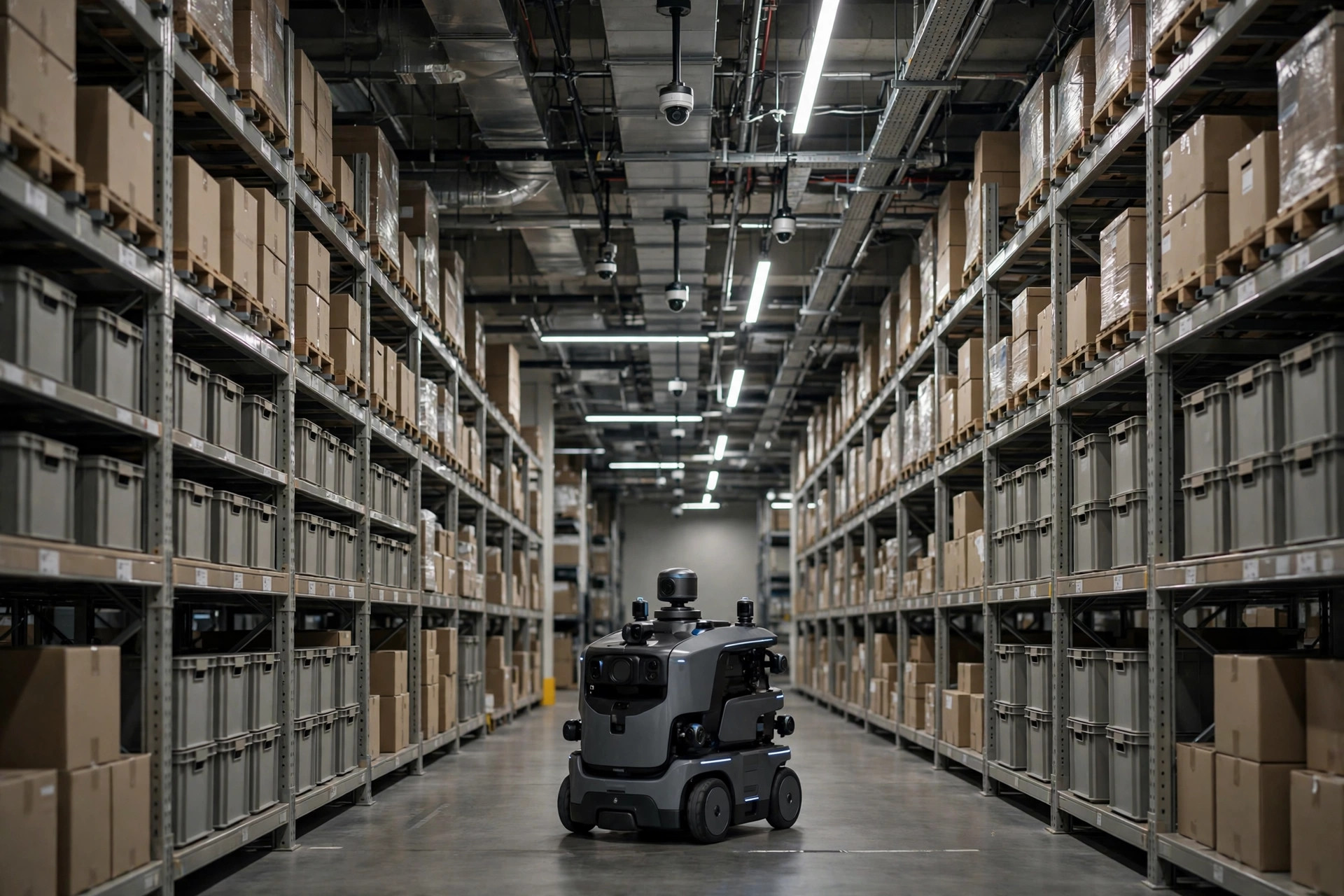
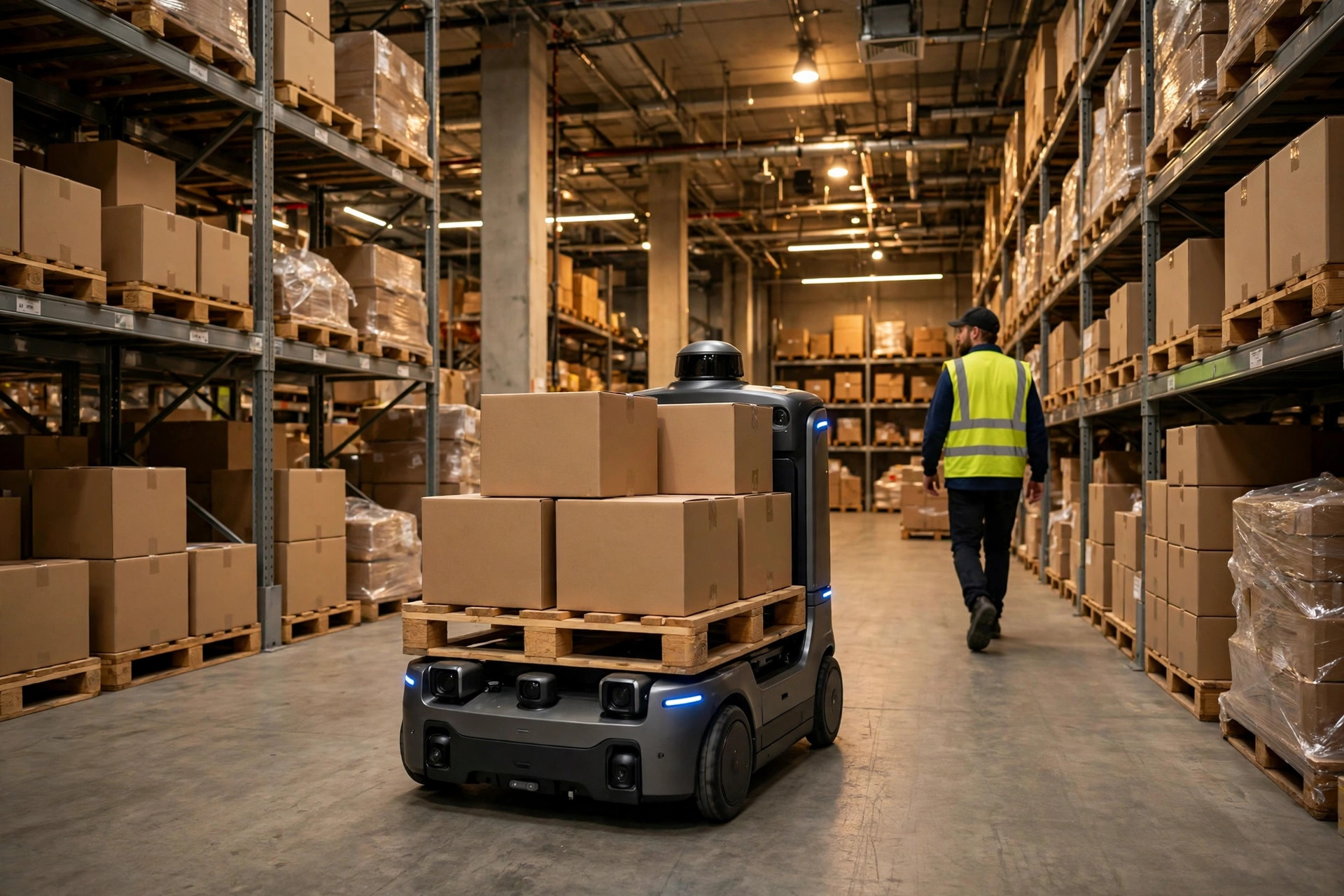
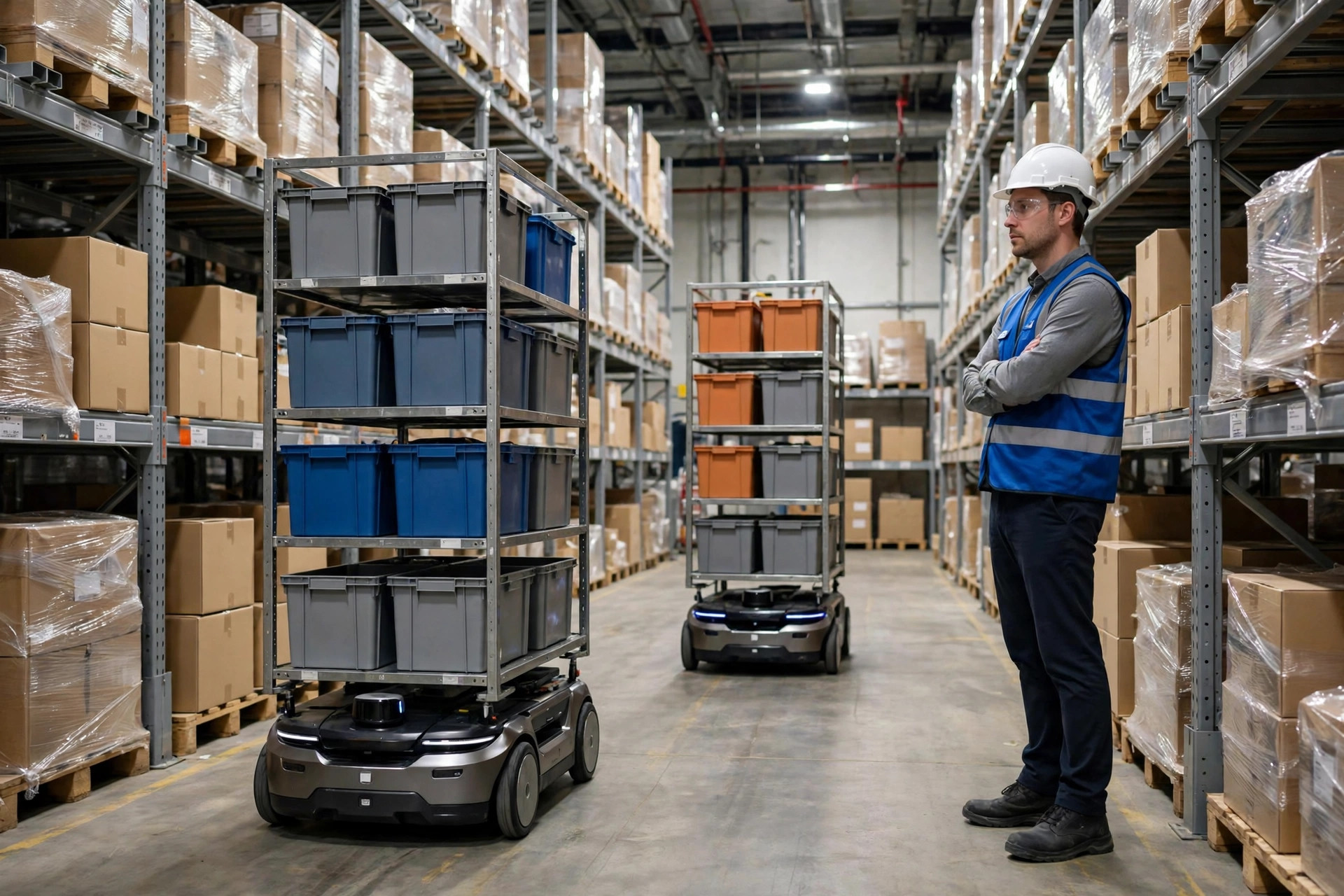
Last September I was commissioning a sortation line at a 120,000-square-foot distribution center outside Phoenix. On the AMR dispatch screen, dozens of little blue dots routed themselves and queued themselves. The warehouse manager stood next to me, watched for a long time, and finally asked: "Da Liu, is this thing going to take my job one day?"
My honest answer: it will take half of it. But not the half he's proud of — the other half.
I've worked alongside warehouse managers for ten years, back when I was a tech lead at a systems integrator and to this day. The most anxious ones I meet now are the most experienced. There's a reason: what AI is eating is exactly the most valuable part of "experience."
The Principle: What AI Actually Eats in a Warehouse
Think of AI as a calculator that never gets tired and never goes by gut feel.
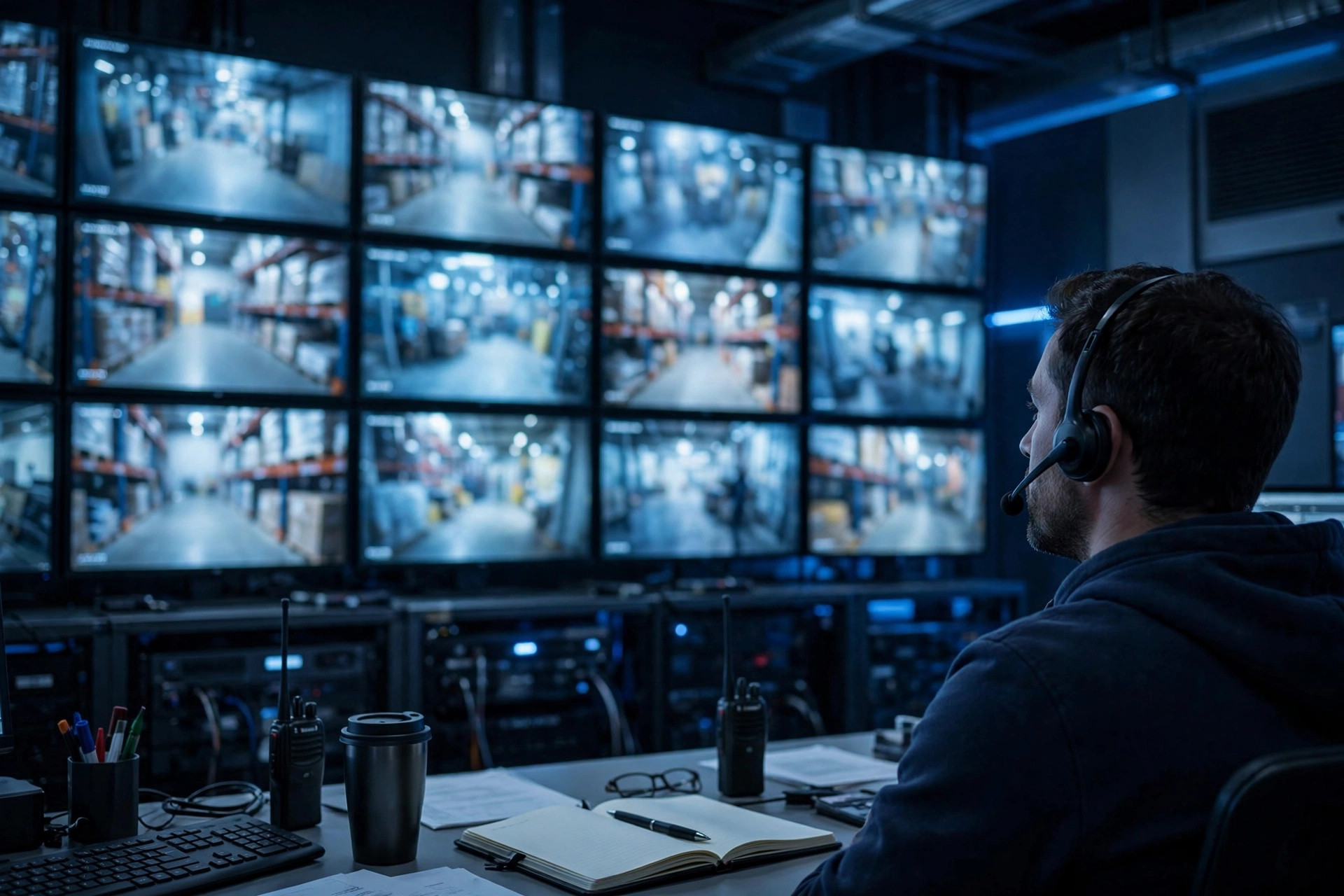
A warehouse manager's day breaks into three verbs: calculate, watch, decide. Calculate — wave planning, labor planning, safety stock, shift scheduling. Inputs fixed, outputs computable. Watch — walking the floor, reading dashboards, catching exceptions. Decide — when something breaks, who calls it; which of two plans wins; what to promise the customer.
What AI is eating right now is almost entirely the "calculate" bucket. The AI wave-planning and labor-forecasting modules shipping inside mainstream WMS products do exactly this: feed in order history, labor availability, equipment status, get a schedule out. The machine beats the human here not because it's smarter, but because it doesn't get sleepy at 3 a.m., doesn't play favorites, doesn't hold grudges.
"Watch" and "decide" are a different story. Floor exceptions are never standardized: the conveyor jams at the same moment a key customer's rush order lands, on the same night you're short two people on the night shift. That triple overlap has no textbook answer. The answer has a name: judgment.
So the skill shift for warehouse managers over the next five years comes down to one principle: whatever can be turned into an equation will depreciate; whatever requires a call will appreciate.
The Dividing Line: Warehouse Manager Skills That Appreciate vs. Depreciate
When I spec equipment, I always draw the dividing line first: left side "money well spent," right side "money down the drain." Skills deserve the same treatment:
| Depreciating | Why | Appreciating | Why |
|---|---|---|---|
| Hand-building waves from experience | AI wave optimization runs 24/7 and doesn't have off days | Defining data metrics | Whether AI computes correctly depends on what you tell it "correct" means |
| Manual labor planning in spreadsheets | Labor forecasting already lives inside the WMS | Exception triage and escalation judgment | The system throws 100 alarms a day; which 3 are worth a 2 a.m. phone call is a human decision |
| Memorizing equipment specs by heart | Looking it up beats memorizing; AR overlays exist | Cross-system process design | WMS, automation, and manual labor meet at the seams — and every breakpoint lives at a seam |
| Running the floor by shouting and hovering | Vision AI catches violations more completely than human eyes | Managing human-machine teams | Running 50 people and running "30 people plus 20 AMRs" are two different jobs |
| Writing pretty weekly decks | AI drafts them faster than you | Translating business problems into data problems | The scarcest skill of the next five years — more below |
The most counterintuitive row deserves its own paragraph: the most valuable warehouse manager of the future may be the one who best understands data definitions — not the one who best understands equipment.
I know that's an uncomfortable thing for an equipment guy to say. I'm the equipment guy. But it's true: equipment refreshes every few years, and the specs you memorized this year expire next year. What doesn't expire: how "on-time rate" is calculated, how an exception is defined, what sits in the numerator and denominator of each KPI. Those definitions decide whether everything the AI computes is right or wrong. Get the definition wrong and AI just gets you lost faster.
Two Warehouses, Same Alarm, Two Outcomes
In 2022, at a 3PL outside Columbus, Ohio — 80,000-plus square feet — the warehouse manager was a 15-year veteran. Wave planning was his signature skill: 15,000 orders on a peak day, and his hand-built waves genuinely walked pickers fewer miles than anyone else's. Then they went live on a WMS with AI wave optimization. Within a month, his signature skill had been matched by a software update. Over drinks he told me: "Fifteen years of craft, wiped out by one release."
But that's not the end of the story. He did the smart thing: he stopped competing with the machine at arithmetic and went after what the machine can't chew — SLA negotiations with key accounts, the escalation playbook for exceptions, the temp-training system for peak season. Two years later he was promoted to operations director over three sites. His words: "I used to be the best calculator in the building. Now I'm the person who defines what 'correct' means."
Second scene, early 2024, an e-commerce fulfillment center in California. The AMR fleet alarmed and stopped at 2 a.m. The shift manager had a polished résumé and zero ability to read logs — alarm codes, task queue states, WMS interface heartbeats, all Greek to him. All he could do was call the vendor. Remote diagnosis, troubleshooting, restarts — it dragged until dawn, nearly six hours of downtime, 2,000-plus orders piled up by morning.
Same year, another site, same kind of incident. That manager couldn't repair a robot either — note that, neither could he. But he could read basic error codes and check the WMS task queue. He could tell a single-unit fault from a dispatch deadlock. Forty minutes and he was back: isolate the bad unit, reassign its tasks, keep the rest of the fleet running.
See the difference? The AI era doesn't ask warehouse managers to repair equipment. It asks them to read data and set the triage level — when an alarm fires, which layer is this, do I handle it, escalate to the vendor, or trigger the contingency plan? No training course teaches that. Only the floor does.
Firing at Pseudo-Demands: Stop Learning Python
Speaking of training courses, I have a shot to fire.
There's a whole industry right now selling warehouse managers courses like "Python for the AI Era" and "Deep Learning Fundamentals or Be Obsolete." Let me be blunt: that's a pseudo-demand. It's anxiety merchandising.
What is a warehouse manager supposed to do with Python? Write a script to export a spreadsheet? The WMS reporting module and RPA tools did that years ago. Sending a manager who runs 100 people and 20 exceptions a day back to learn programming is like sending a driver to learn engine manufacturing. Wrong direction.
What managers actually need is the ability to translate a business problem into a data problem. Example: telling the data team "I want to reduce the exception rate" is business language — the AI can't hear it. You have to translate: "an exception is defined as X, measured as Y, the target is Z, constraints are A and B." That translation needs zero coding. It needs granular business understanding and an almost obsessive cleanliness about data definitions.
Another example: the AI hands you a labor plan. Dare you approve it sight unseen? You need three questions: which time window trained this model? Did peak-season data get averaged away? In its objective function, what weight sits on labor cost versus on-time rate? If you can ask those three questions, you understand AI better than most of your peers. If you can't, you're signing blind.
Worth Learning? One Test Decides
Old habit for how I end these pieces: no slogans, one judgment.
For the next five years, run every new skill you consider learning through a single filter: can AI compute this for me?
If yes — scheduling, wave planning, replenishment math, weekly reports — learn it shallowly. Learn to use it, learn to ask the right questions about it. Pour the saved hours into the three things AI can't compute: defining what counts as "correct" (data definitions), making the call when exceptions hit (escalation judgment), and rostering humans and machines together (human-machine teaming).
The Phoenix manager actually did it. He didn't learn Python. He learned his WMS data dictionary and the alarm severity model. Last month he told me the AMR vendor's field engineer came for an inspection — and his three questions left the engineer stumped. I told him: look at you, you're now the person in this building who best understands what "correct" means.
AI won't make warehouse managers obsolete. It will only obsolete the ones who insist on out-calculating the machine.
By Da Liu, Automation Engineer