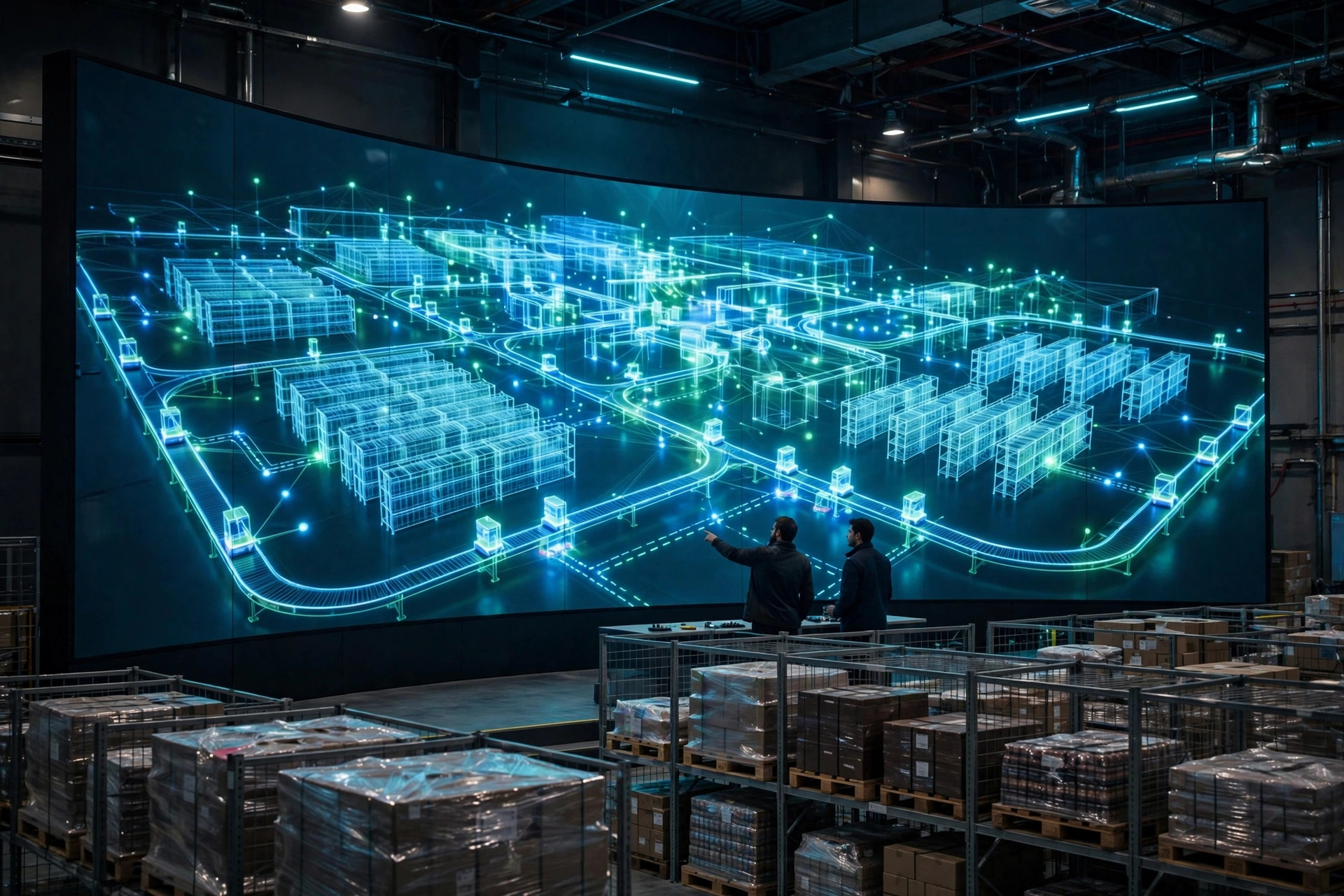
Much of the warehouse jobs AI 2027 outlook conversation stays at the headline level — "how many jobs will AI replace." This piece tries to take the question apart: by 2027, which warehouse occupations actually get eaten, which get reshaped, and which new roles get created — and what the data and timelines behind those claims look like.
Start with the phenomenon. In October 2025, Amazon announced a new round of corporate layoffs targeting roughly 30,000 positions, with "AI-driven efficiency" named explicitly as a factor. The detail that matters: the cuts hit corporate roles, not frontline warehouse roles. That sequencing previews AI's order of operations inside warehouse operations — white collar first, blue collar later. The logic is straightforward: a language model processing documents, spreadsheets, and emails costs far less than a robot physically moving a box.
On data, the World Economic Forum's Future of Jobs Report 2025 offers a widely cited frame: by 2030, roughly 92 million jobs displaced globally against roughly 170 million created. Net positive, but violently compositional. McKinsey's 2023 research estimated that up to 30% of hours worked in the US economy could be automated by 2030. Applied to warehousing, both numbers need discounting: the warehouse is the physical world, and automation penetrates it three to five years slower than purely digital work. So 2027 lands at an inflection point — displacement starting to accelerate, new roles just emerging.
The 2027 warehouse job map: four quadrants
I use a two-axis framework for this warehouse jobs AI 2027 outlook: how repetitive the work is (the more repetitive, the faster machines learn it) versus how much on-site judgment it requires (the harder to automate). Four quadrants fall out:
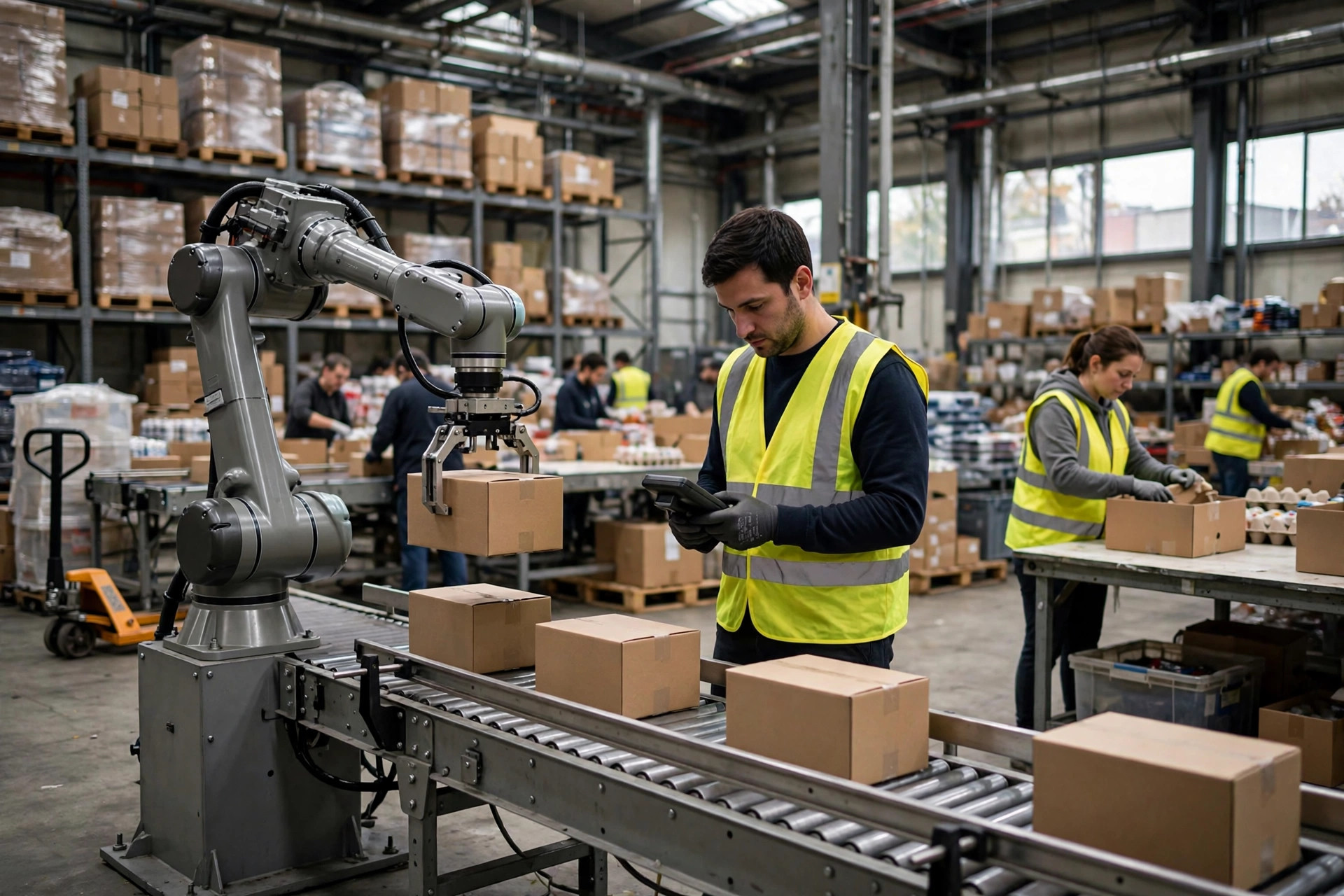
Quadrant one — high repetition, low judgment: picking, packing, data entry, labeling. This is where AI and automation bite fastest. Between 2024 and 2025, a national 3PL deployed AMRs for goods-to-person picking at a Kentucky fulfillment center: headcount in the pick zone fell from 60 to 38. Note the shape of it — those 22 positions didn't vanish overnight. They bled out over fourteen months as the robot fleet grew from 20 to 50 units. Gradual displacement is the dominant pattern through 2027.
Quadrant two — low repetition, high judgment: exception handling, equipment maintenance, labor scheduling, slotting optimization. These roles don't get eaten; they get augmented. At that same Kentucky site, six new "robot dispatcher / exception handler" roles and two data roles appeared — somebody has to decide when a robot is stuck, an order goes sideways, or a wave won't plan. The requirements changed: it used to be about stamina; now it's about reading systems and making calls.
Quadrant three — the new roles, clustering around 2027: robot dispatchers, AI QC reviewers, warehouse data analysts, automation maintenance technicians. A California returns-processing operation in 2025 is instructive: AI vision took over returns grading, and twelve QC inspectors became four "AI QC reviewers" — the machine grades first, humans only review the 15% the machine can't call. The interesting part: fewer people, but hourly pay rose from $19 to $24. Roles are concentrating; unit prices are rising.
Quadrant four — low repetition, high judgment, heavy physical interaction: forklift operators in complex yards, inbound QC (opening and inspecting), oversized and irregular freight. These are broadly safe through 2027 — humanoid robots handling irregular freight at warehouse economics isn't there yet.
The counterintuitive call: AI eats the warehouse's white collar first
Here's the counterintuitive judgment worth isolating: by 2027, the fastest-displaced group in warehouse operations won't be the people in hi-vis vests — it'll be the office staff. Schedulers, paperwork clerks, track-and-trace CSRs, report builders.
The causal chain: large language models substitute for cognitive labor — reading documents, filling forms, answering emails — which is exactly what a warehouse office does all day. A scheduler's job is fitting 80 people's shifts into Excel, handling PTO, swaps, overtime approvals; by 2026, AI scheduling tools already absorb roughly 70% of that workflow. Getting a robot to reliably pick an irregularly shaped parcel off a shelf, by contrast, remains an unsolved-at-scale engineering problem. Cognitive automation is outrunning physical automation, and that is the single most important dividing line in the 2027 job map.
The underweighted variable is demographics. US warehouse frontline turnover has run above 30% for years; hiring difficulty is structural. In many facilities, AI and automation aren't filling existing workers' jobs — they're filling gaps nobody would take. The honest 2027 picture may not be "machines stole the jobs" but "machines covered the night shifts nobody wanted."
Role concentration and wage polarization: the structure under the numbers
Put the Kentucky and California cases together and a structure emerges: headcount concentrates, wages polarize. Sixty pickers became 38 frontline plus 8 technical roles; twelve QC inspectors became four higher-paid reviewers. Total down roughly 25%, but the new roles pay 20–30% more per hour than the ones they replaced.
Economists call this the skill premium. Machines absorb the codifiable part; what remains for humans is the uncodifiable part — exception judgment, cross-system coordination, on-the-floor calls. Uncodifiable capability is scarcer in the labor market, so it costs more. Warehouses in 2027 will show a barbell: a small set of well-paid technical and judgment roles at one end, still-necessary complex physical work at the other, and the middle — medium-repetition, medium-judgment jobs — thinnest. That's a direct challenge to training systems: the old ladder ran picker → lead → supervisor in continuous steps, but under a barbell the middle rungs snap, and moving from the floor to a technical role takes a leap, not a climb.
On attribution, warehouse automation speed faces three constraints: the long tail of the physical world (SKU shapes, packaging, stacking variance make machine learning's marginal cost high), the capex cycle (AMR payback typically runs two to four years, and the decision chain is long), and labor-policy uncertainty. Together they set the tempo: 2027 is a year of accelerating displacement, not of unmanned warehouses. Any forecast claiming mass lights-out warehousing by 2027 deserves to be checked against these three constraints.
Timeline: the warehouse jobs AI outlook for 2026–2027
Based on current technology readiness and capex rhythms, my trend judgment runs in three phases: in 2026, AI scheduling, AI track-and-trace, and vision QC become standard at top 3PLs and retail DCs, and white-collar support roles start contracting. In the first half of 2027, human-machine teaming becomes the default for greenfield sites — capacity gets planned as "60% labor plus automation" from day one instead of designed for pure labor and retrofitted later. In the second half of 2027, the first formal "robot dispatcher" certification may appear — forklift-license style — turning the role from a hack into a trade.
Two preconditions attach: the cost curve for humanoids and dexterous manipulation has to fall on schedule, and state-level labor policy toward warehouse automation must not tighten sharply. If either breaks, shift the timeline twelve to eighteen months.
So which roles get eaten and which get created? My answer: 2027 doesn't bring the unmanned warehouse — it brings a changing of the blood. Repetitive physical roles and office clerical roles contract on the order of 15–25% at highly automated sites, while a cohort of human-plus-machine hybrid roles appears, paying more and demanding more. For the individual, the question was never "is AI coming." It's "how much of your skill set could a machine learn in two or three years." That's worth serious thought before 2026 ends.
By Dr. Chen, Supply Chain Researcher