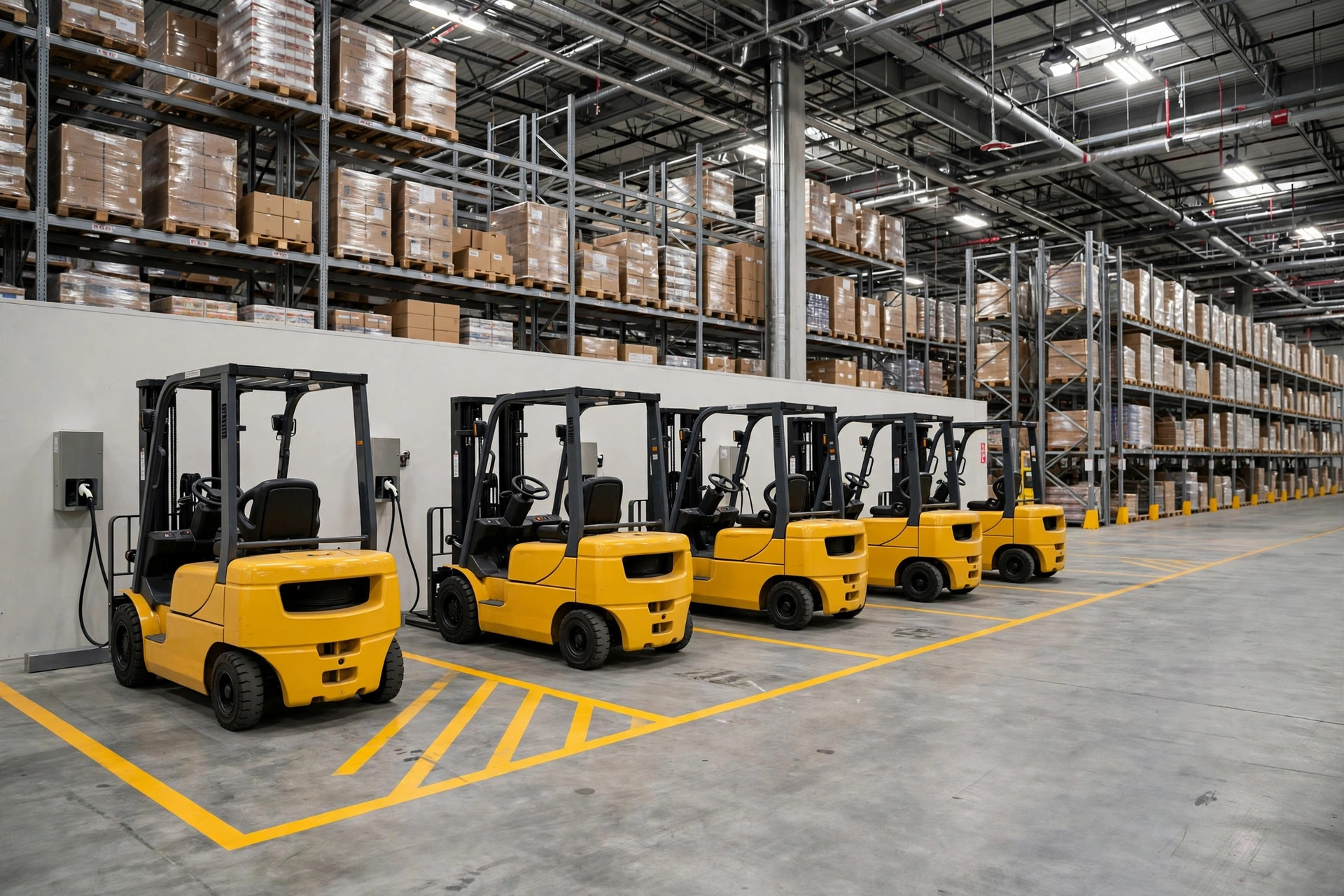
Let me open with a bill. Last year I costed a WES project for an auto-parts 3PL in Ohio: one site, 120,000 square feet, 8,000 orders a day, a conveyor loop and 20 AMRs. The full WES implementation cost timeline came to $586,000 in year one and 14 months to go live. The software subscription was $165,000 — 28% of the total. The other 72% was implementation, hardware, internal labor, and go-live losses. Anyone who talks about WES and only quotes the software hasn't finished the math; the rest of the bill just hasn't arrived yet.
Bill one: software — paying rent every year in the SaaS era
WES software is now overwhelmingly subscription-based, priced by users, sites, or order volume. Few vendors publish list prices. Manhattan Active WM lists from $2,000 per license per year (per SelectHub) — but that's the entry ticket. The WES module, robot orchestration, and labor management are frequently unbundled, and the number changes once the options are added.
Industry benchmarks help calibrate: a modular WES deployment for a mid-size warehouse starts around $150,000–$350,000; enterprise-grade rollouts with large-scale automation and multi-site licensing run $500,000–$1,000,000+, excluding ongoing maintenance and cloud hosting (2026 industry data). Note that's deployment money, not the annual software fee — don't mix the two numbers in the same conversation.
Three traps hide inside the software bill. First, the metering: named users versus concurrent users. In a three-shift warehouse, concurrency is roughly a third of registrations — get the metric wrong and you overpay by tens of thousands a year. Second, renewal escalators: if the annual uplift isn't capped in the contract, it compounds quietly year after year. Third, cloud versus on-premise: a five-year TCO model for a 50-user, two-site operation comes to roughly $1.07M for cloud versus $1.32M on-premise, with on-premise only catching up around year six or seven (ASC Software's 2026 WMS cost report). Before debating architecture with a salesperson, build the five-year TCO.
Bill two: implementation — integration is the money pit
Implementation services run $25,000–$75,000 for a single site, $100,000–$350,000 for mid-market multi-site rollouts, and $350,000–$1.5M at enterprise or 3PL scale (ASC Software, 2026). WES projects, because they touch automation, usually land in the upper half of those bands. Across the WES projects I've costed, implementation typically runs 0.8–1.5x the annual software fee. Above 1.5x, custom development has run out of control; below 0.8x, the quote is probably hiding a phase two.
The biggest line inside implementation is integration: ERP, TMS, carriers, EDI, plus PLCs and robot fleets — roughly a quarter of the total services budget (ASC). A WES earns its keep as an orchestration layer, translating WMS directives into machine execution. The more interfaces, the longer the invoice. Every "our operation is special, we need it customized" interface becomes a maintenance tax for years.
Back to that Ohio warehouse. The three bills, itemized:
| Cost item | Amount (USD) | Share |
|---|---|---|
| Software subscription (SaaS, year one) | 165,000 | 28% |
| Implementation services | 230,000 | 39% |
| Hardware & network | 80,000 | 14% |
| Internal labor (allocated) | 60,000 | 10% |
| Go-live productivity loss | 36,000 | 6% |
| Training, travel, parallel run | 15,000 | 3% |
| Year-one total | 586,000 | 100% |
Implementation at $230,000 — 1.4x the software fee — sits in the healthy band. They did three things right: piloted in one warehouse, kept every interface standard, and cleaned master data two months before go-live. Nine months to go-live, well ahead of the industry-typical 12–24 months. At roughly 6 FTEs of picking labor saved — about $330,000 a year — payback lands at 21 months.
The cautionary tale is a DTC brand's own warehouse in New Jersey, a project that started in 2023: the whole network at once, three automation systems connected simultaneously, a custom-development list forty items long. Implementation stretched from 10 months to 20; services swelled to 2.3x the software fee; the old and new systems ran in parallel for four months after go-live, adding nearly $90,000 in extra subscriptions and labor; the total overshot budget by 60%. Money spent wrongly — wrong in treating "big bang" as the thrifty option, when every custom requirement was leverage applied to the timeline.
Bill three: the timeline — time is the most expensive line item
This is the most underestimated item in the entire WES implementation cost timeline. From signature to real value, WES projects commonly take 12–24 months (2026 Warehouse Technology Decision Guide); simple WMS projects can go live in 3 months, complex networks take 18 (ASC, 2026). Timeline cost has three components, each paid in real money.
First, the parallel run: old and new systems side by side means two subscriptions and two processes — a quarter at best, half a year at worst. Second, internal labor: a project manager plus key users, full-time for 8–12 months. Never on the vendor's quote, never free. Third, the go-live dip: industry math puts a 20% productivity drop over four weeks for a 40-person team at about $35,800 in lost labor (ASC, 2026). Together, hidden costs typically add another 20–40% on top of the visible quote.
And a counterintuitive data point: 30–50% of surveyed companies cite poor data quality as the number-one barrier to WES ROI (Interact Analysis). The system goes live, the location master is a mess, SKU attributes don't match, and the optimization engine is sculpting garbage. Master-data cleanup is the cheapest insurance in the entire project — skip it and you pay double later.
Three levers that actually save money
Lever one: pilot in one warehouse, then replicate. Prove the process, the interfaces, and the data in a single site; the replication phase costs a fraction of the pilot. A pilot isn't slow — it's splitting one big bet into two smaller ones.
Lever two: kill customization, protect the standard. Nine out of ten implementation overruns die in custom development. Every "special interface" cut during requirements review saves not just the build cost but five years of maintenance. My judgment: the standard flow covers ninety percent of scenarios — don't pay multiples for the remaining ten.
Lever three: write three things into the contract — concurrent-user metering, a cap on renewal uplifts, and penalties for late delivery. A salesperson's verbal "no problem" is worth nothing; numbers in ink are worth everything.
Here's the calculable conclusion to close with — the WES implementation cost timeline formula worth memorizing: year-one total ≈ annual software fee × 3.5, and budget 12–18 months for the timeline. A $150,000 software quote means preparing $525,000 and 14 months; a $300,000 quote means $1.05M and 18 months. Any quote far below that math is hiding the implementation and timeline bills — the wool still comes off the same sheep; the invoice just arrives in two envelopes.
By Lao Zhou, Logistics Cost Analyst