Start with a number. A cross-belt sorter plus 800 meters of conveyor: the OEM quotes $85,000 a year for maintenance; three in-house technicians cost you $100,000 in loaded salary before you buy a single spare part. Which is cheaper? Don't answer yet — warehouse automation maintenance in-house vs outsourced only makes sense when you cost it down to the third layer.
The TCO Sheet Nobody Shows You
Most comparisons stop at "contract fee vs. payroll." That's half the math. True TCO has to include downtime losses and spare-parts capital. Example figures below, based on one cross-belt sorter plus 800 meters of conveyor:
| Cost item | OEM / third-party contract | 3-person in-house team |
|---|---|---|
| Annual contract fee | $85,000 | $0 |
| Labor (3 techs, fully loaded) | $0 | $100,000 |
| Spares (annualized) | $21,000 (managed spares + rush-order premiums) | $42,000 (safety-stock carrying cost) |
| Training / tooling | $0 | $11,000 |
| Annual downtime loss | $28,000 (4-hour SLA response assumed) | $7,000 (30-minute response assumed) |
| Total | $134,000 | $160,000 |
Notice what happens. On the first three rows, outsourcing wins by $26,000. Add downtime and the gap narrows — and that still assumes the vendor actually hits its 4-hour SLA. Whether that money was well spent comes down entirely to whether the response clause is honored.
The row most people get wrong is downtime loss. Don't guess it. Pull your last 12 months of unplanned stops, multiply hours by your hourly loss rate (I'll show you how to compute that below), and use the real number. In my experience, warehouses underestimate this line by 30–50% — which is exactly why the outsourced side of warehouse automation maintenance in-house vs outsourced always looks cheaper on a vendor's slide deck.
Where Outsourced Money Actually Goes
An outsourcing invoice has three layers. The first is the visible annual fee. The second is parts markup — the OEM quotes $3,900 for a drum motor you can source for $2,200; if the contract doesn't cap parts pricing, you pay whatever number they print. The third layer is the most expensive: the gray zone in the response clause. "4-hour response" — does the clock stop when the engineer leaves the depot, or when the line is running again? One word of difference, tens of thousands of dollars a year. A contract that doesn't nail this down isn't worth the paper it's printed on.
Three negotiation levers actually move the number. First, cap the parts markup — anything over 15% above list price comes out of the vendor's pocket. Second, define response as "restored to operation," with a penalty of 5% of the annual fee per breach. Third, pool safety stock with two or three nearby sites and cut your spares inventory by a third. Those three clauses leave the headline fee untouched and still take 10–15% off total cost. I've never seen a vendor walk away over them; I've seen plenty of buyers forget to ask.
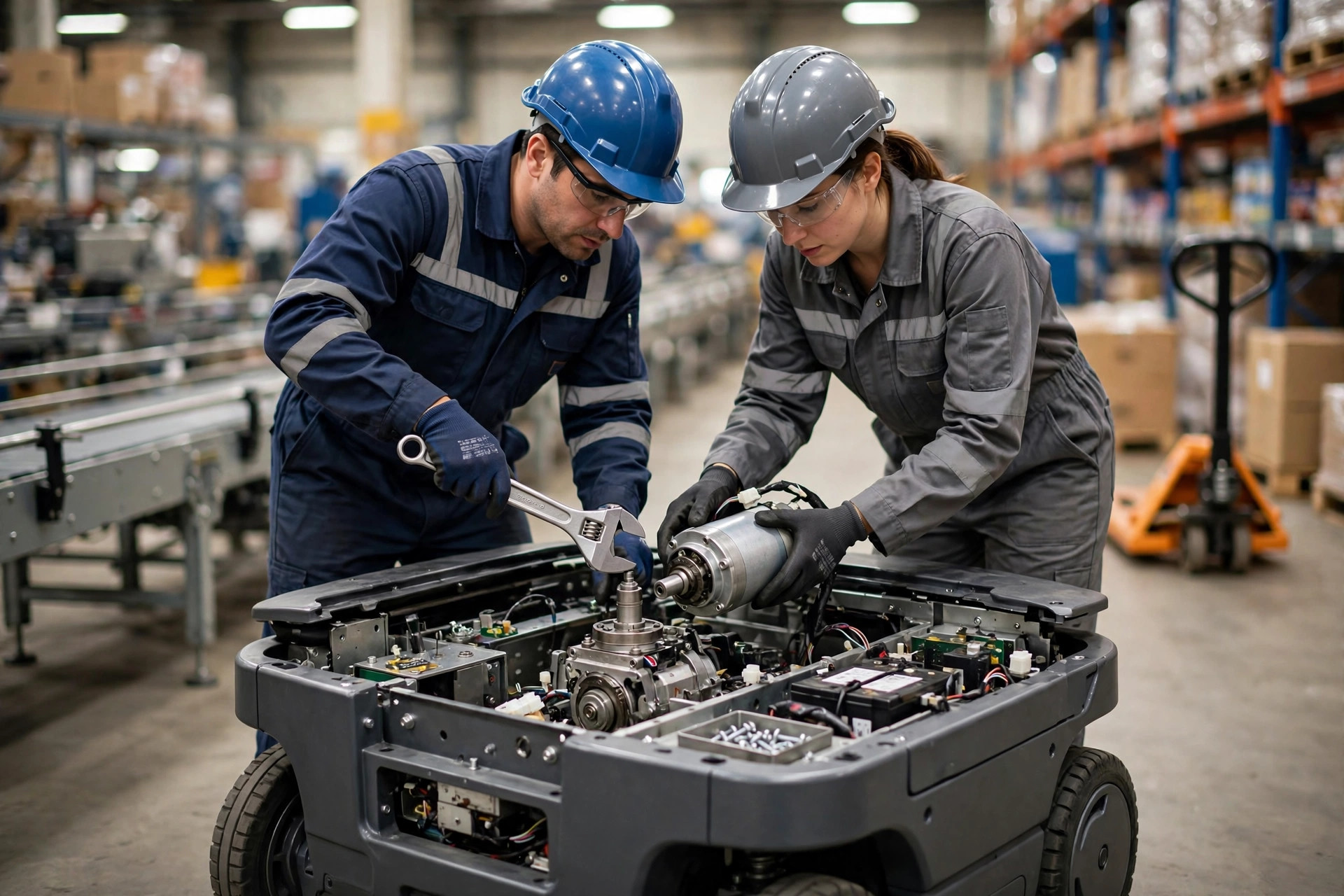
In-house costs hide on the other side. The $100,000 payroll is the visible part. The hidden three: hiring — a technician who knows both PLCs and mechanics commands a premium and can still leave for a better offer; safety stock — $42,000 of critical spares sitting on a shelf earning nothing; and knowledge concentration — one resignation and half your equipment's personality walks out the door. Those three lines never appear on a quote. They all appear on your P&L.
Two Warehouses, Two Bills
November 2023, a 3PL warehouse in eastern China. One week after the big sale, the main drive motor on the cross-belt sorter burned out. The contract promised 48-hour on-site response; the engineer arrived at hour 51 — traffic doesn't count as a breach, and the contract didn't say otherwise. Six hours fully down, 42,000 parcels backlogged, 60 temp workers pulled in for manual sorting at $53,000, plus $17,000 in customer penalties. Seventy thousand dollars gone in a day. The CFO's post-mortem was a single sentence: an SLA without a penalty clause is not an SLA.
March 2024, an e-commerce warehouse in southern China running 40 AMRs. The OEM wanted $80,000 a year. The site manager built a two-person team instead: $50,000 in annual labor, $17,000 in spares. Year one saved $13,000 — small money. The real win was mean time to repair, down from 11 hours to 2. AMR failure modes are highly standardized: swap the motor, swap the battery, clean the sensor. Two people cover all of it. His honest caveat: this only works for AMRs. Ask those two to maintain an AS/RS stacker crane and they would refuse.
The Counterintuitive Part: Small Sites Lose Money Going In-House
The most expensive mistake in the in-house vs outsourced debate is building a team "to save money." Run the numbers: one sorter, three technicians, under 1,000 wrench-hours a year — utilization below 40%. At $33,000 loaded cost per head, idle time costs exactly as much as wrench time, and your cost per repair ends up higher than the OEM's call-out fee.
My rule of thumb: if your annual outsourced maintenance quote is under roughly $110,000, an in-house team almost certainly loses money. Scale is the only moat for going in-house — enough equipment to keep five or more technicians busy, utilization above 70%, and only then does the math turn positive.
A 3-Step Framework for Warehouse Automation Maintenance In-House vs Outsourced
No gut feelings. Three numbers.
Step 1: your downtime cost. Hourly downtime loss = daily parcel volume × contribution margin per parcel ÷ daily operating hours. Example: 30,000 parcels × $0.28 ÷ 16 hours = $525 per hour.
Step 2: your in-house cost. Headcount × loaded annual salary × 1.35 (the all-in factor covering benefits, training, and tooling) + safety-stock value × 8% (cost of capital).
Step 3: compare. Contract fee + expected annual downtime loss under outsourcing, versus in-house cost + expected annual downtime loss in-house. Pick the smaller. That is the complete way to run the in-house vs outsourced comparison.
Two worked examples, same formulas:
| Site A: 1 sorter, 12 hrs downtime/yr | Site B: 3 sorters, 45 hrs downtime/yr | |
|---|---|---|
| Outsourced total | $134,000 | $390,000 |
| In-house total | $160,000 | $335,000 |
| Winner | Outsource | Build the team |
The calculable answer: if the outsourced quote exceeds 1.2× your in-house cost AND annual downtime exceeds 20 hours, build the team. Otherwise, sign the contract — but write "line running again" into the response clause and cap parts pricing in an appendix. A calculator is more honest than a feeling. Run your three numbers now.
By Lao Zhou, Logistics Cost Analyst