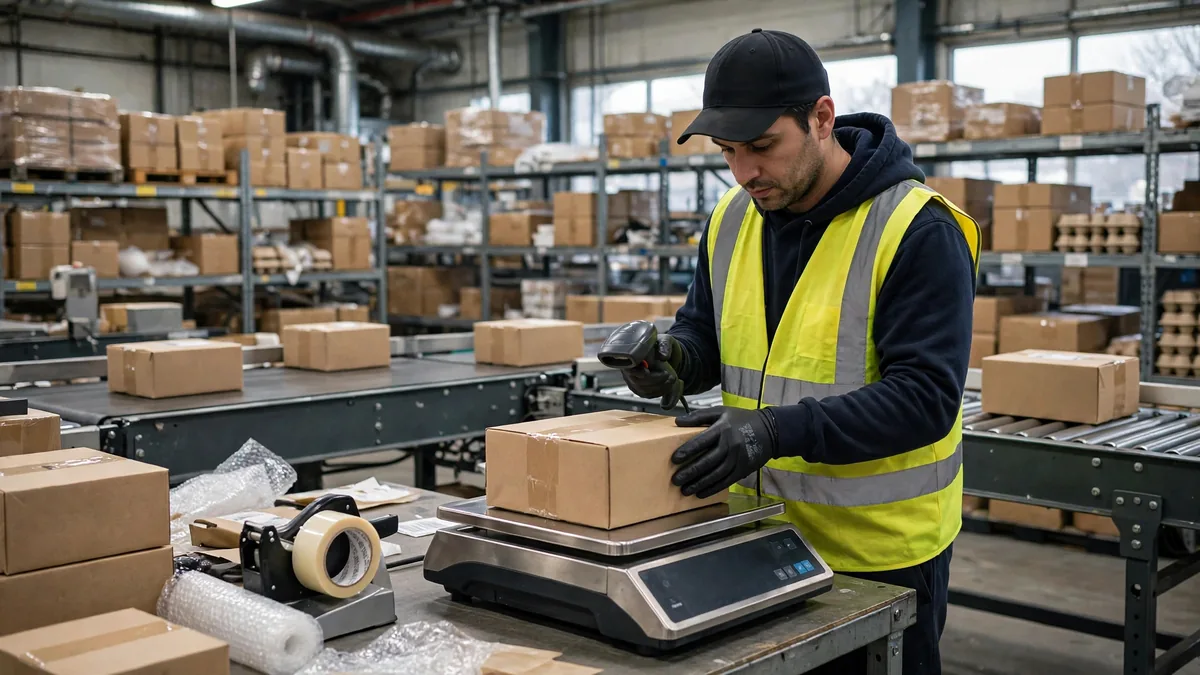
It was 2:40 in the morning on November 12 last year, one wave left on the night shift, when customer service rang. A customer of three years said his carton was short one box: twelve on the order, eleven in his hands. That call is why we now run a warehouse weight check at the end of our packing line. I wasn't thinking about the reshipment cost, but about where that box had gone missing — picking, packing, or nobody noticing at all? I've run warehouses long enough to know this is the call you dread. A customer shorted once might not yell, but his next order comes a little slower.
Next morning I pulled the record: twelve scans, system complete, packer swore he counted twelve, checker signed off. Everybody was right, and the customer still got eleven. So after the huddle I made the call: every carton goes on a scale before sealing. Measured weight doesn't match expected weight, the box doesn't leave. That's the whole job: short shipment prevention.
What a Warehouse Weight Check Actually Catches
Simple enough for a new hire to get in thirty seconds. Everything in a carton has a weight on paper; the scale tells you the weight in real life. Numbers line up, the box is probably right. They don't, something inside is wrong. The paper number comes from the master data: every item has a net weight, and the carton, filler, and tape have fixed weights. Add them up and the WMS works out the theoretical weight at order creation.
Here's what the gate catches. Short shipments: one item missing drops the weight by a chunk. Over-shipments: somebody else's item lands in the wrong carton. Wrong items: the crew grabs the heavier model instead of the lighter one. In the first month, the check stopped 47 cartons: 31 short, 11 with an extra item, 5 with the wrong model. Every one was a phone call to customer service that never happened.
The gate has its limits. It won't catch a missing item that barely weighs anything, ten or twenty grams disappearing inside the margin of error. And it won't catch a carton that's short one item but stuffed with extra filler so the weight happens to add up. The scale can tell you the weight is off. It can't tell you what's inside the box.
One Tuesday afternoon this past March, an order bound for Texas showed 4.2 kilos on paper and 4.9 on the scale. The packer didn't hit release. He opened the carton and found an extra unit of the same small appliance, pulled from the order next to it — the two picks had been sitting in one tote. Our veteran packer tells every new hire: when the scale beeps, don't hit release. Open the box. Your eyes are the final check.
Weight Check Tolerances: How Tight Is Too Tight
The first argument after the scales went in was tolerance: how far can the weight drift before the scale complains? Too tight and it screams all day. Too loose and a missing light item sails right through.
We tried three rounds: the tolerance follows the type of goods. Light small items, twenty or thirty grams a piece: roughly seventy percent of one piece, so a missing piece trips the alarm. Regular cartons, two to three kilos: about 50 grams either way. Heavy cartons over ten kilos: past 100 grams — a damp carton and extra filler can swing the weight by tens of grams. One hard rule: the tolerance must never be bigger than the lightest single item. Lightest item 60 grams, tolerance 80, and the scale will never catch it.
| Goods type | Tolerance | Why |
|---|---|---|
| Light small items (under 50 g each) | About 70% of one piece | A missing piece must trip the alarm |
| Regular cartons (2–3 kg total) | Around 50 g | Natural swing from cartons and filler |
| Heavy cartons (over 10 kg) | Over 100 g | Damp cardboard and packing variation |
Tolerance isn't set-and-forget: we review the alarm log monthly — too many false alarms, loosen a notch; things slipping through, tighten. One month false alarms on light items jumped to nearly one in ten: the supplier had changed the packaging, each piece 4 grams heavier, and nobody had updated the master data. A warehouse weight check is only as good as the master data behind it. Get the item weights wrong and the best scale in the world is blind.
We went back and forth between bench scales and an inline checkweigher. The inline unit is faster, but one costs as much as a dozen bench scales, and when it breaks you wait for the vendor. We went with bench scales: set the carton on it, weigh it, tape it shut. A dead scale gets swapped in ten minutes. Small or mid-size warehouse? Don't chase full automation on day one. And put the scale where the packer's hands already are — make people carry a carton two steps to weigh it, and come peak season, they'll start skipping it.
Three Things the Scale Will Never Catch
First, a wrong item that weighs almost the same as the right one — two models that look identical and differ by a few grams. Only barcode checks at picking catch that. Second, wrong data: the master data has the wrong weight, and the scale measures against a crooked ruler. Third, people working around the scale: in peak season somebody gets tired of the alarm and hits "release". Here, only the shift lead can release a flagged carton, and every release needs a reason written down. I read that log myself at month's end.
Now the counterintuitive part: a more sensitive scale does not mean a better catch rate. We started with one that read down to 1 gram, and the false alarms were brutal — a humid carton, one extra loop of tape, and it was yelling. We switched to 5-gram steps, false alarms dropped by more than half, and we missed no genuinely short carton. The weight check isn't a contest for the most sensitive scale. It's about whether your tolerance and your master data fit each other.
Let me run the money. After the scales went in, short-shipment complaints fell from more than 20 a month to 3 or 4. Handling one short shipment — reshipment freight, labor, customer service time — runs a little over a hundred yuan a case. One scale plus the system hookup cost under twenty thousand yuan and paid for itself in two months. But the scale adds roughly 8 seconds per order, and at 3,000 orders a day that's nearly 7 hours of labor. In peak season, those 7 hours hurt. So our trade-off: full checks daily, but on the worst days we check every high-value order and every category with a history of shorts, and spot-check the rest.
How We Run It Now
Here's the flow: items get weighed on arrival, weight goes into the master data. The WMS works out the theoretical weight at order creation. The packer fills the carton, puts it on the scale before sealing. Weight matches, the label prints and the box goes. Weight doesn't match, the red light comes on, and a person opens the carton and counts by hand. The manual check isn't a backup for the scale. It's a different gate: the scale finds something wrong; the person figures out what. One more rule: the scale gets zeroed each shift and calibrated weekly, and the record hangs right next to it.
Peak season tests all of this. During our big sale week last year, the check area backed up with more than a dozen cartons, and a driver at the dock door lost his temper with our night lead — his truck couldn't wait. The lead told him straight: the truck can leave ten minutes late, but a short carton that leaves the dock comes back as a lot more than ten minutes of trouble. We put two extra people on the check area and cleared it before midnight. On a normal day the gate looks unremarkable, but in peak season it's worth its weight in gold — that's when short shipment prevention pays most.
One warning: don't rush out and buy a scale first. Start by fixing your item weight data. Pull a hundred products, weigh them, and see how many master-data weights are wrong. If half are off, the scale will jam your packing line on day one. Get the data right first, set the tolerances by category, put a real person in charge of the check flow, and the gate actually stands. You'll never catch every short shipment — but take twenty-odd complaints a month down to three or four and the gate has earned its keep.
By Chen Feng, Warehouse Operations Manager