Pallet building has long been one of the least measured operations in the warehouse. Picking is scheduled by a system and sorting follows equipment takt, while the pallet pattern for a mixed load was for many years decided by a shift leader's experience. When carton sizes were uniform, the cost of that informality was limited. As mixed-carton orders grew and the size spread on a single pallet widened, palletizing became a combinatorial problem whose result affects utilization, transport damage, and throughput at the same time.
The phenomenon appears in two contradictory forms. Some warehouses fill pallets tightly, yet the load leans during transfer or wrapping and corners are crushed. Others take the conservative route, large cartons below and small above, and the load is stable but top space is left unused, raising unit cost. Both point to the same attribution: manual rules deliver local plausibility, while a pallet needs a global trade-off under whole-load constraints.
What Manual Pallet Pattern Rules Solve, and What They Miss
Traditional rules are not without value. Interlocking layers avoid continuous seams and let layers restrain each other. Heavy over light and large over small lower the center of gravity and give lower cartons fuller support. Alternating long and short sides disperses lateral forces. With few carton types, these rules usually produce an acceptable result in workable time, which is why they remain basic training content.
Their limit is equally clear. A rule states an ordering principle, not the best arrangement for a specific set of cartons. When one pallet contains more than ten sizes, with marked weight differences and limited crush strength, the rule cannot quantify which carton goes first, how a layer should leave gaps, or whether a void should be filled. The operator chooses by intuition under time pressure, and the same rule set produces different patterns across shifts. Manual building also rarely recalculates gravity or support coverage. A flat top is not evidence that layers below are evenly loaded.
The following is a hypothetical example for illustration only, not a measured result from any warehouse. Assume a fixed pallet footprint and 24 cartons in four sizes, with the same height limit for manual and algorithmic approaches. In the hypothetical example, the manual pattern leaves a strip-shaped void in a middle layer, and its utilization is recorded as 72%. The algorithm adjusts orientation and layer composition and records 81%. A nine-point gap, scaled to dozens of pallets a day, becomes a systematic difference in pallet count and vehicle loading. Yet the same example sets a second condition: the highest-utilization candidate places two heavy cartons away from the center, so its gravity offset is clearly larger, and it is rejected. The pattern executed is not the fullest candidate, but the next best one that passes gravity and support checks. That detail shows the objective was never maximization on a single dimension.
| Dimension | Manual rules leading | Algorithmic search leading |
|---|---|---|
| Basis | Interlocking, heavy over light, large over small | Search many arrangements under constraints and score each |
| Stability | Visual check, verified after the fact | Calculate gravity, support, and crush relations before execution |
| Space use | Varies with layer voids | Compare utilization across candidates |
| Better fit | Few carton types, stable experienced staff | Many carton types, high mixed ratio, system linkage required |
The Pallet Pattern Trade-Off Is About Gravity and Support First
Two concepts need to be settled before utilization: the center of gravity and the support surface. Gravity determines whether a load will generate an overturning moment during acceleration, braking, and turning. Support determines what share of each carton's base is carried by the layer below. A carton with insufficient support may not fall at once, but it will deform or shift under transport vibration. A pattern that looks orderly while static is therefore not necessarily sound in dynamic transport. A pattern with slightly lower utilization but a centered load and complete support may carry a lower total cost, because it reduces damage, rework, and refusal at delivery.
This leads to a counterintuitive judgment: the pattern with the highest utilization is often not the pattern that should be executed. Utilization measures only whether space has been filled, not how risk is distributed after filling. When an algorithm tucks the last small cartons into high corners, the marginal gain may be one or two points, while lateral instability rises at the same time. For short distances on smooth routes, that exchange may be acceptable. For long-haul moves with several transfers, it may not pay. The decision should be made jointly by transport distance, carton crush grade, and damage cost, not by utilization alone.
Consider a second hypothetical example for illustration only. Assume two candidates exist for the same goods. Pattern A has higher utilization, but one carton in an upper-middle layer has a clearly low support ratio. Pattern B is three points lower in utilization, but support is more complete and the center of gravity is closer to the center of the base. Ranked by utilization alone, a system would choose A. If insufficient support is treated as a hard constraint and filtered first, the system chooses B and leaves A for manual review. The order has practical meaning. Stability works better as a screening constraint applied first, and utilization as the objective compared among options that have passed. Reversing that order postpones risk handling to after dispatch, when correction is already much more expensive.
The timeline is also instructive. Early automated palletizing served uniform cartons, where patterns could be fixed in advance. Mixed-carton demand then brought offline calculation into warehouses, but order data and actual dimensions did not always agree. More recently, packing data, SKU master data, and execution have become more tightly linked, and a pattern is more often a dynamic instruction than a static drawing. Its effect still depends on data accuracy.
Pallet Robots, Manual Work, and the Pattern Library Linked to WMS
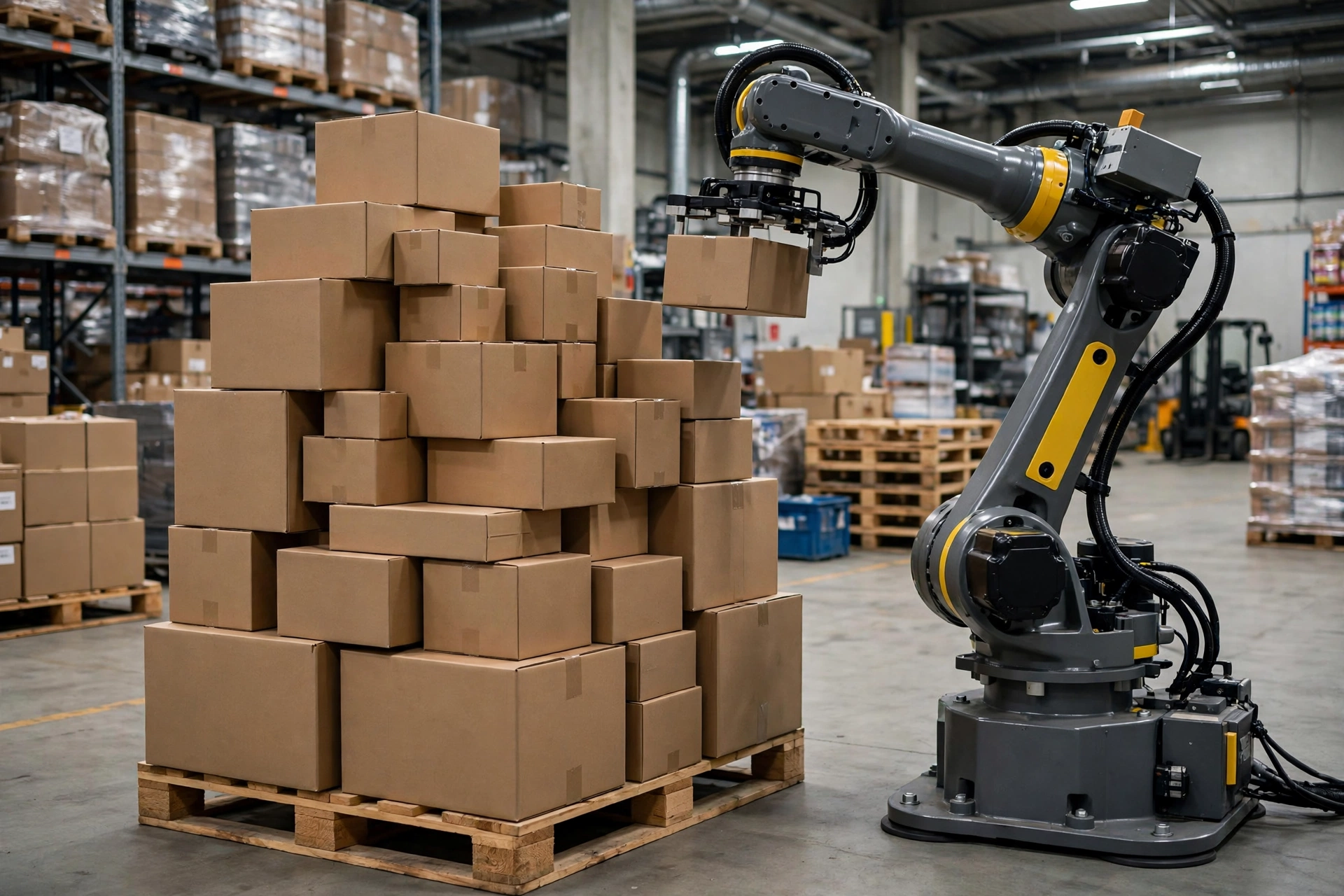
Palletizing robots and manual palletizing are not in a simple replacement relationship. The more accurate description is a division of conditions. A robot fits work with stable takt, a controllable range of carton types, a clear weight limit, and long continuous running time. Its advantage is consistency: the same pattern can be repeated and connected more easily to conveyors and wrapping equipment. Manual work retains an advantage in flexibility. Faced with irregular cartons, a promotional pack added at short notice, or a temporary packaging change, an experienced operator can adjust on site without waiting for master data or a program update.
A more robust framework looks first at order structure, then at carton standardization, and finally at takt and labor supply. If all three are stable, a robot's certainty benefit is more likely to cover investment and maintenance. If order structure fluctuates, keeping manual stations and giving operators a recommended pattern may be a lighter transitional form. In either case, the pattern needs a form the floor can verify, for example a layer-by-layer top view with a placement sequence, not only machine coordinates.
The pattern library is not a simple archive. It is a reusable asset of validated arrangements for specific carton combinations and pallet specifications. When a similar order structure appears again, the system can call a validated pattern first and reduce repeated calculation. When a new combination appears, the algorithm generates a proposal, and only after outcomes are confirmed is a decision made on whether to store it. Three data streams link to it: order and wave data in the WMS, dimension, weight, and crush information in SKU master data, and the carton types actually used in packing. If any is distorted for long, the benefit erodes. Dimension and weight data are the most basic, because an algorithm cannot correct a systematic input error.
Taken together, the significance of AI pallet pattern optimization is not that an algorithm replaces all operator experience. It is that part of the judgment once scattered across individual experience becomes computable, comparable, and reusable, so stability moves from a feeling reported after dispatch to a constraint checked before dispatch. How far that conversion should go still depends on a site's order structure, data foundation, and transport risk, and there may be no answer that holds once detached from a specific setting. What may be more worth watching is whether, once pattern data and damage data are genuinely connected, the balance point will shift from a fixed threshold toward a result adjusted dynamically by lane and by product.
By Dr. Chen, Supply Chain Researcher