Walk into almost any warehouse and you will hear the same buying question: how much is the wrapper? It is the wrong first question. In practice, warehouse stretch wrap machine maintenance cost is dominated by what happens after the purchase — whether the pre-stretch carriage actually stretches film, how often a dirty sensor stops the line, and how much extra film operators add just to feel safe. The machine is a one-time check. Film is a bill you pay on every single pallet.
warehouse stretch wrap machine maintenance cost starts with pre-stretch
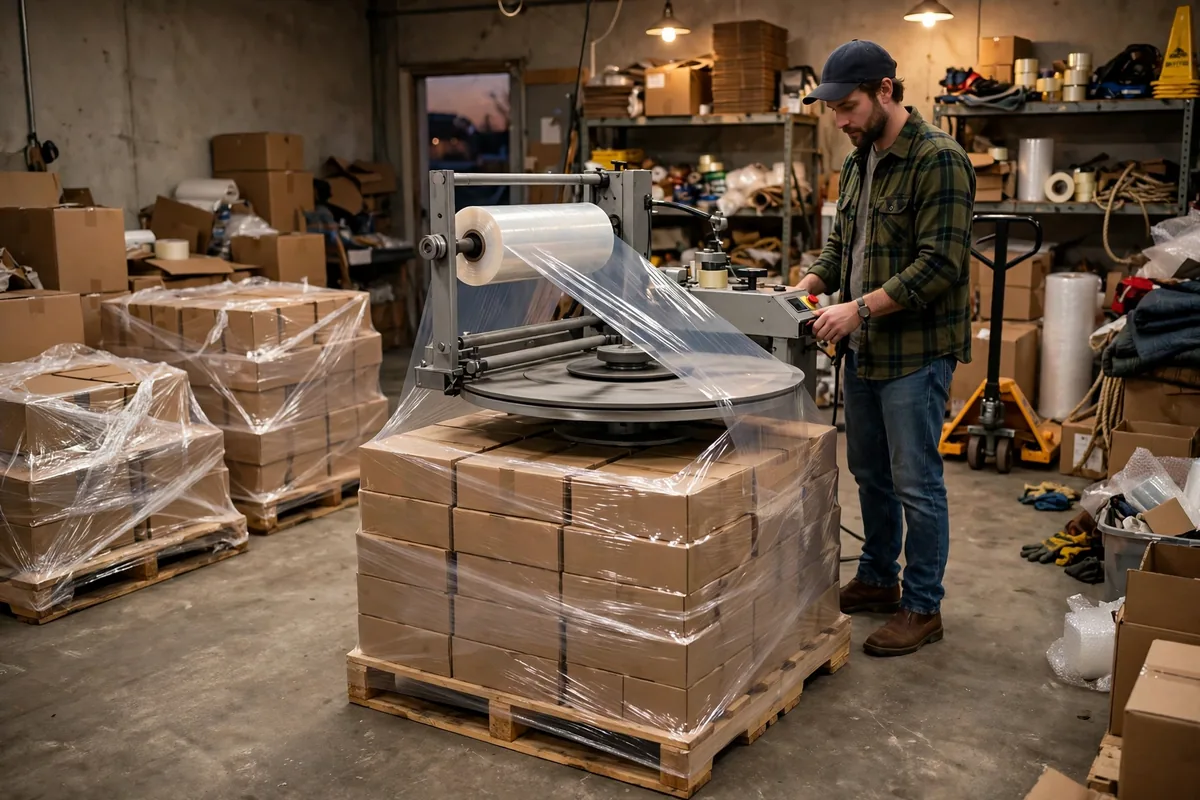
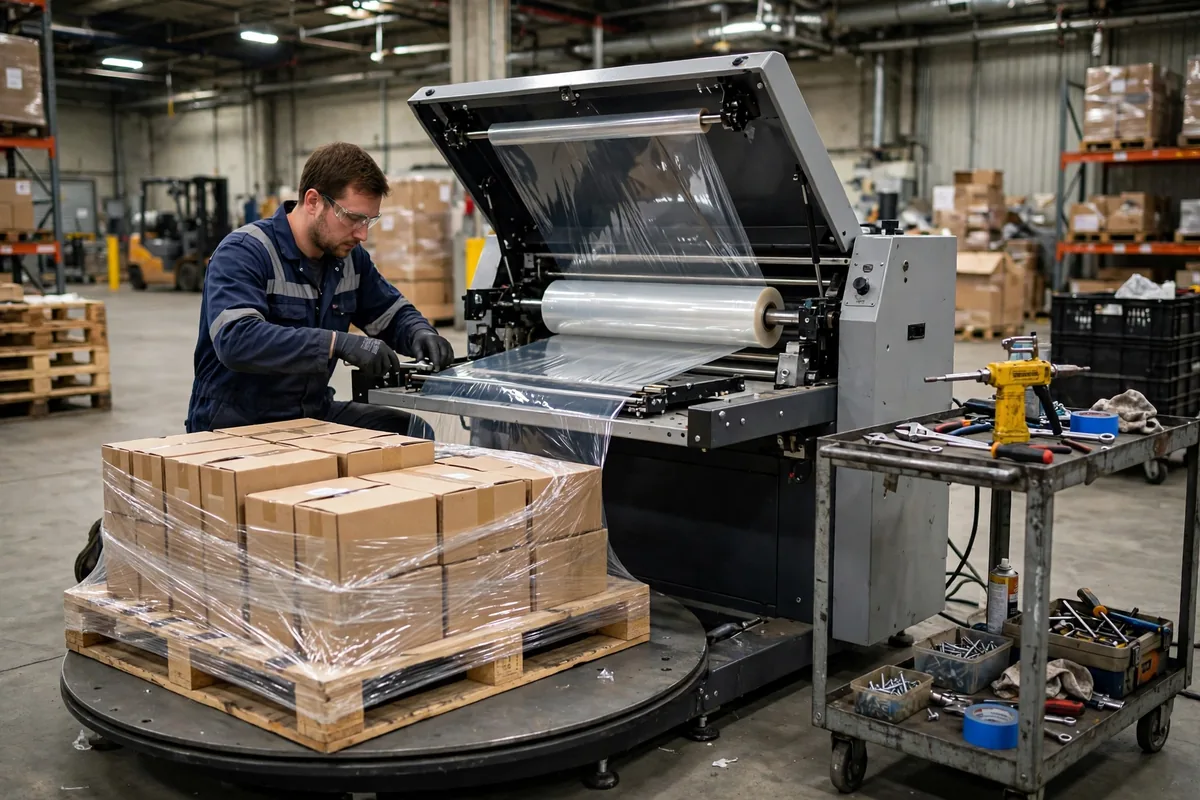
The principle is simple. On a turntable machine the pallet spins. On a rotary-arm machine the pallet stays still and the arm circles it. In both cases a carriage feeds stretch film around the load. The savings live inside that carriage. Two powered rollers turn at different speeds and stretch the film before it touches the load. Think of it like rolling dough: roll it thin first and the same amount covers far more. Skip that step and you are just pasting unstretched film onto boxes — more material, worse hold.
That is also the selection dividing line, and vendors love to blur it. A turntable fits stable, reasonably uniform pallet loads and saves floor space. A rotary arm fits light, tall, or tippy loads that would wobble or topple if you spun them. Neither is simply the premium version of the other. They solve different physics. I am blunt about fake requirements here: if you wrap a few dozen pallets a day, you do not need the fastest cycle time on the brochure. You will never use that speed, but you will pay for its parts and service for years.
Illustrative example one: a consumer-goods warehouse in 2024, illustrative example with invented figures. Operators complained about frequent film breaks and started adding extra wraps before releasing pallets. Inspection found fine grooves worn into the pre-stretch rollers. The film was being stressed unevenly, so the real stretch fell away and the crew compensated with more wraps. No single pallet looked alarming. Across hundreds of pallets a day, the extra film quietly became the largest waste line in the packing area. The lesson is not a magic savings percentage — distrust anyone who quotes one without your data. Pull your own film issue records and divide by pallets wrapped. That ratio tells the truth.
warehouse stretch wrap machine maintenance cost hides in breaks and downtime
The second account is downtime, and wrapping sits in the worst possible place: the end of outbound. Picking is done, checking is done, the truck is at the dock, and everything queues behind one wrapper. A photo-eye coated in dust and film scraps misses the pallet and stops the cycle. A turntable bearing develops play, the rotation gets rough, operators slow the machine down because it sounds wrong, and throughput bleeds away without ever fully breaking. None of this looks like a major failure on a work order. All of it taxes every shift.
Illustrative example two: an e-commerce warehouse during a peak-week warm-up, illustrative example. A rotary-arm machine kept reporting film breaks on the night shift. A fresh roll would behave for a while, then the fault returned. The film was fine. The break detection and tension settings had drifted, and a small burr on a guide roller was nicking the film edge, so the web tore as soon as tension rose. Cleaning the detection area, removing the burr, and resetting tension to the manual ended the pattern. Intermittent faults like this are the most expensive kind: maintenance keeps calling the machine usable, while operations pays in waiting, re-wrapping, and extra film every night.
Use this illustrative calculation framework before you argue about service prices. All figures below are an illustrative example, not vendor pricing:
| Cost lens (illustrative example) | Healthy carriage | Worn rollers, extra wraps as cover |
|---|---|---|
| Wraps per pallet | As set in the wrap pattern | Routinely added by operators |
| Film breaks | Rare, quick recovery | Frequent, worst on night shift |
| Film use trend | Tracks the issue plan | Creeps up monthly, no single leak |
| Real loss | Planned care time | Film waste plus waiting plus rework |
The counter-intuitive point follows directly: over the life of the machine, film will cost far more than the machine. Shaving a little off the purchase price means nothing if the carriage holds stretch poorly, the rollers wear fast, or break recovery is fiddly. You will repay that saving in film and dock congestion, with interest. Judge a wrapper by stretch stability, how easily wear parts can be swapped, and how fast a normal operator can recover from a film break at 2 a.m. without calling anyone.
Preventive care is mostly small, frequent attention, not heroic overhauls. Common practice includes cleaning pre-stretch and guide rollers and checking them for grooves and burrs, keeping sensor lenses and reflectors clean, and checking turntable or arm bearings, chains, and belts for play, noise, and tension. Intervals vary by site — some warehouses do weekly checks and monthly deep checks, others trigger by pallet count — and the correct intervals, lubrication, and replacement limits always follow the equipment manufacturer's manual, not another plant's habit. A service contract deserves the same unsentimental math. Keep it in-house if you have electricians, stocked wear parts, and slack in the shipping window. Buy the contract if you run multiple shifts, wrapping is your outbound bottleneck, and one peak-season jam costs more than a year of coverage.
Two buying details deserve more attention than they usually get. First, film-break recovery. On a well-designed machine, an operator should be able to re-thread the film, reset, and resume wrapping within a couple of minutes, not crouch by the carriage reverse-engineering the film path. During selection, let an actual operator — not the salesperson — simulate a break and recover from it. Second, respect the load limits and guarding. Turntable machines suffer quietly from chronic off-center and overweight loads, plus the odd forklift nudge to the table edge. Rotary-arm machines need their fencing and light curtains taken seriously, because the arm moves and people must not step inside its sweep. Even the floor matters: a pitted, uneven pad means pallets sit crooked, wrap tension lands unevenly, and everyone blames the film again. Machine, floor, and pallet quality are one system. Costing only the machine will never balance the books, and neither will a parts cupboard that was never stocked before the first peak.
So here is the close I use on site. Whether the money was well spent comes down to one number: average film use per pallet. Track it weekly for the same machine and similar loads. If it holds steady, your carriage and your care routine are healthy. If it creeps up, do not blame the film first and do not blame the operators first. Feel the rollers, clean the sensors, listen to the bearing. The machine will not explain itself. Film use will.
By Da Liu, Automation Engineer