Here is the short version: a warehouse dimensioner dim weight carrier dispute is never really an argument about a box. It is an argument about evidence. The carrier re-measures your parcel at its hub, decides the dimensional weight is higher than what you declared, and bills you the difference. If all you can produce is the number printed on your shipping label, you are asking the carrier to take your word for it. Carriers do not run on trust. They run on records, and in a dispute the side with the better record usually keeps the money.
The mechanics are simple enough. A parcel is billed on the greater of its actual weight and its dimensional weight, which is calculated from length, width, and height using a divisor that varies by carrier and service, so always check the carrier's current published terms rather than relying on any number in an article, including this one. The trouble starts at re-measurement. A soft poly mailer that left your dock fairly flat can puff up in transit. A carton can swell in humidity. A strap or a loose tape flap can add a centimetre where it hurts most. None of this is fraud, on either side. It is physics meeting two different measuring moments, and the gap between those two moments is where the chargebacks live.
What a warehouse dimensioner dim weight carrier dispute is actually about
Strip away the paperwork and most disputes fall into three buckets. The first is a size dispute: the re-measured dimensions are larger than the declared ones, usually because of soft packaging, deformation, or something protruding that your process did not count. The second is a weight dispute: your scale and the carrier's scale disagree, or the parcel changed weight in transit through moisture or repacking after damage. The third is a rules dispute, about rounding, irregular-shape handling, or which service terms apply. That third bucket is slow and contractual. The first two are winnable or losable on data, which is why they deserve your attention first.
Two illustrative examples show the difference data makes. Both are hypothetical, and the figures are illustrative examples only, not any carrier's actual rates. In the first, imagine an apparel warehouse in the US Midwest shipping about 8,000 parcels a day during the 2024 peak season. For three months it absorbed re-measurement adjustments on roughly 1,200 parcels a month. When the team finally investigated, the cause was mundane: staff measured flattened cartons with tape measures, while the carrier's system measured the same cartons after the soft contents had pushed the sides out, adding around two centimetres on one side. The warehouse had no stored measurement records and no photos, so its first round of appeals argued from shipping manifests and mostly failed. In the second example, picture a third-party warehouse in South China in 2025 fulfilling small appliances for several clients. Its outbound station used a dimensioner that photographed every parcel and stored length, width, height, weight, and a timestamp against the order number. When about ninety re-measurement charges arrived in one month, the team exported the stored record for each parcel and appealed parcel by parcel. Most of those charges were reversed on review. The remainder taught them something useful: loose tape ends were being read as part of the parcel, so they changed the packing standard, and the same category of dispute dropped sharply the following month. Same industry, same carriers, opposite outcomes. The variable was not luck. It was whether measurement evidence existed at the moment the parcel left the building.
Selection lines: what a warehouse dimensioner dim weight carrier dispute demands from the machine
Forget the brochure speed for a minute. Four specifications decide whether a dimensioner protects you. First, accuracy and repeatability: measure the same parcel ten times and the readings should stay inside the stated tolerance, and that tolerance should be backed by a calibration certificate, not a sales conversation. Second, metrological certification: if the measurement will be used for billing defence, choose equipment with recognised legal-for-trade certification where your market requires it, with a certificate number and expiry date you can actually produce. Third, evidence capture: every measurement should bind automatically to the parcel ID and store dimensions, weight, time, and ideally top and side images, exportable in seconds when a charge lands. Fourth, throughput matched to your peak hour, not your average day. A machine that cannot keep up at peak will be bypassed by your own team, and every bypass is a hole in your evidence chain.
| Question | Weak position | Strong position |
|---|---|---|
| What do you keep? | Declared values on the label | Raw dimensions, weight, timestamp, and photos per parcel |
| How do you appeal? | General explanations in bulk | Parcel-by-parcel export matched to each charge |
| Calibration status | Nobody remembers the last one | Certificate current, daily checks logged |
| What do you learn? | Only the total deducted | Which packing station, category, or shift causes disputes |
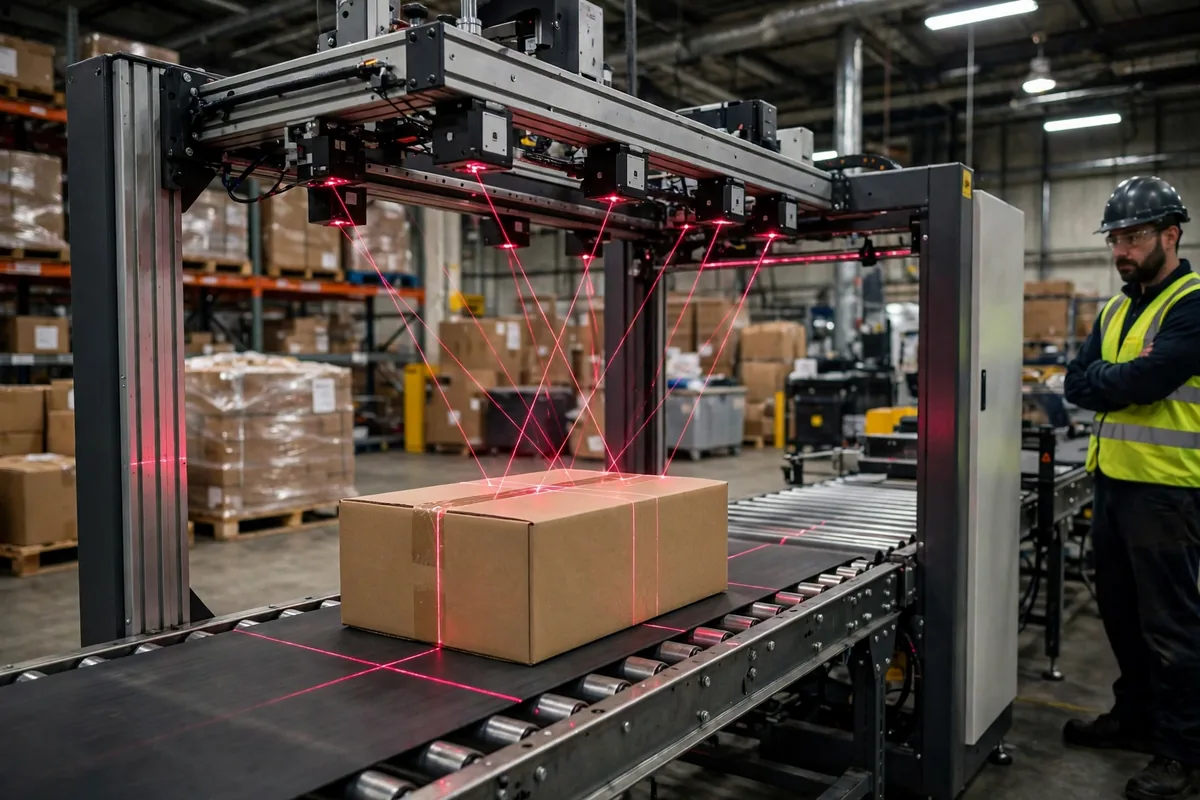
Form factor follows volume. Static units, where the parcel sits still for a second or two, are accurate, affordable, and perfectly sensible for lower volumes and mixed freight. Dynamic in-motion systems measure on the belt at full line speed and suit high-volume docks, but they are less forgiving of parcel spacing, orientation, floor vibration, and belt condition. Think of it like tyres on a race car: the best tyre in the world will not save a bad track surface. I also push back on one common overspec: bolting on automatic rejection and labelling because the demo looked impressive, when your volume never justifies the cycle time. Measure accurately and keep the record first. That is the whole game.
Calibration: why certified numbers end arguments
Dimensioners drift. Belts wear, sensors collect dust, floors vibrate, and readings wander slowly enough that nobody notices until the adjustments pile up. Three habits keep the data defensible. Calibrate on the manufacturer's schedule through a qualified provider, and file the certificate where your dispute handler can find it in one minute, because data captured while a certificate was lapsed invites an argument you do not need. Run a start-of-shift check with a fixed reference object and a known test weight, and log the result; a thirty-second check is what turns a machine reading into a maintained measurement system. Finally, flag outliers automatically: when a reading sits far outside that product's measurement history, hold the parcel for a re-measure instead of letting a bad record flow into your evidence file. Contradictory evidence is worse than no evidence.
Packing standards belong in the same conversation. Tape flaps, protruding tags, and uncompressed soft packs all count as parcel size at re-measurement, whether or not they counted at your bench. Align the packing standard, the daily equipment check, and the dispute export into one routine, and dispute handling stops being a monthly fire drill. When a warehouse dimensioner dim weight carrier dispute lands on your desk after that, it becomes a lookup exercise instead of an investigation. The money question answers itself the same way. Spread over a year of parcels, the machine is rarely the expensive part; the silent adjustments and the staff hours spent arguing without data are. So here is my closing test, the one I give every operator who asks whether the spend is justified. This money is worth it or not depending on one number: can you pull the timestamped raw measurement for any parcel you shipped, within thirty seconds? If yes, you hold the evidence. If no, you are funding the other side's version of your parcels.
By Da Liu, Automation Engineer