Let me start with a confession about warehouse shrink wrap machine cost small warehouse math. Our place is a little over three thousand square meters with four and a half people — one guy works three days a week, so he counts as half. Two peak seasons ago I was on my knees hand-wrapping pallets, and somewhere around pallet thirty-seven my lower back filed a formal resignation. That night I went home and priced wrapping machines. Then I quietly closed the browser tab. We small warehouses cannot afford to burn money like that. But I kept redoing the math for months, and today I will hand you the method instead of a price, because the method is what actually travels.
First, the math: what warehouse shrink wrap machine cost really includes
The beginner mistake is treating the machine price as the whole cost. The real warehouse shrink wrap machine cost small warehouse version has at least four parts: the machine, the film, the labor, and the rework. Hand wrapping looks like zero equipment spend, while labor and film quietly burn money in the background.
Film is where the key concept lives: pre-stretch. Hand wrapping has essentially none — the film stretches however hard you pull, and your shoulders decide the tension. A machine with a powered pre-stretch carriage stretches the film before it goes on the load, so the same pallet takes noticeably less film. How much less depends on film quality and load shape, so I will give you the measurement, not a borrowed percentage. Weigh a roll, wrap one pallet, weigh it again. Do ten pallets, average the difference, multiply by your daily pallet count. That number is your real film consumption. Trust your scale, not anyone's brochure.
Here is a labeled hypothetical, built from my own warehouse's experience purely to demonstrate the arithmetic — it is not a market quote. Say hand wrapping uses roughly 0.35 kg of film per pallet and about six minutes of labor, while a semi-automatic turntable uses roughly 0.2 kg and about two minutes, since the operator only attaches the film, presses a button, and cuts. At twenty pallets a day, twenty-six days a month:
| Item | Hand wrapping (hypothetical) | Semi-auto turntable (hypothetical) |
|---|---|---|
| Film per month | ~180 kg | ~105 kg |
| Wrapping labor per month | ~52 hours | ~17 hours |
| Equipment | Zero | One machine, spread over 36 months |
| Rework (collapsed loads re-wrapped) | A few pallets every peak month | Far fewer; tension is consistent |
Now plug in your local film price and your local wage. When the machine's monthly amortized cost drops below the monthly saving, you have crossed the line. In our building the break-even landed around fifteen pallets a day: below that, payback crawls; above it, hand-wrapping labor eats you first. Your line will differ. Use the table, not my numbers.
Three routes: hands, semi-automatic, and the used machine
Route one: keep hand wrapping. Do not laugh — at low volume this is genuinely the right answer. Buy a decent hand dispenser, fix your pallet positions, and standardize the wrap pattern, with extra revolutions at the base to lock the load to the pallet. That base lock is the single step that cuts collapsed loads the most, and it costs nothing.
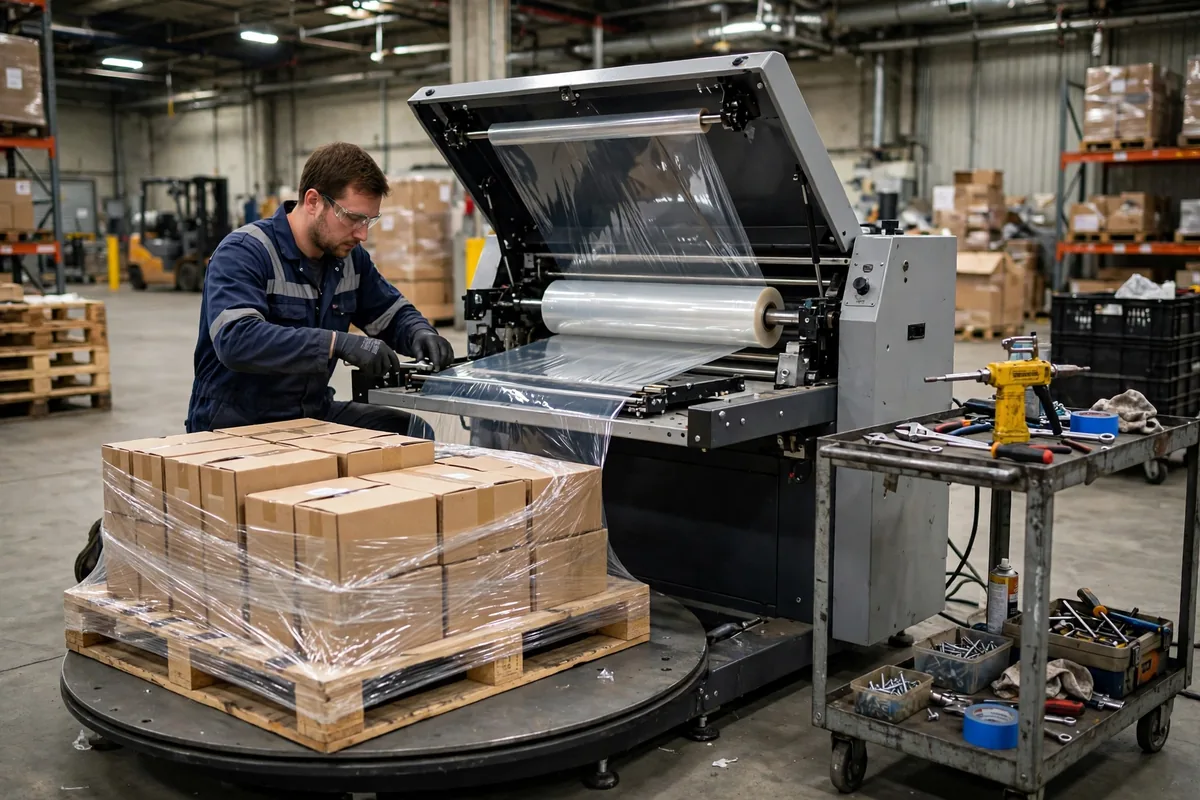
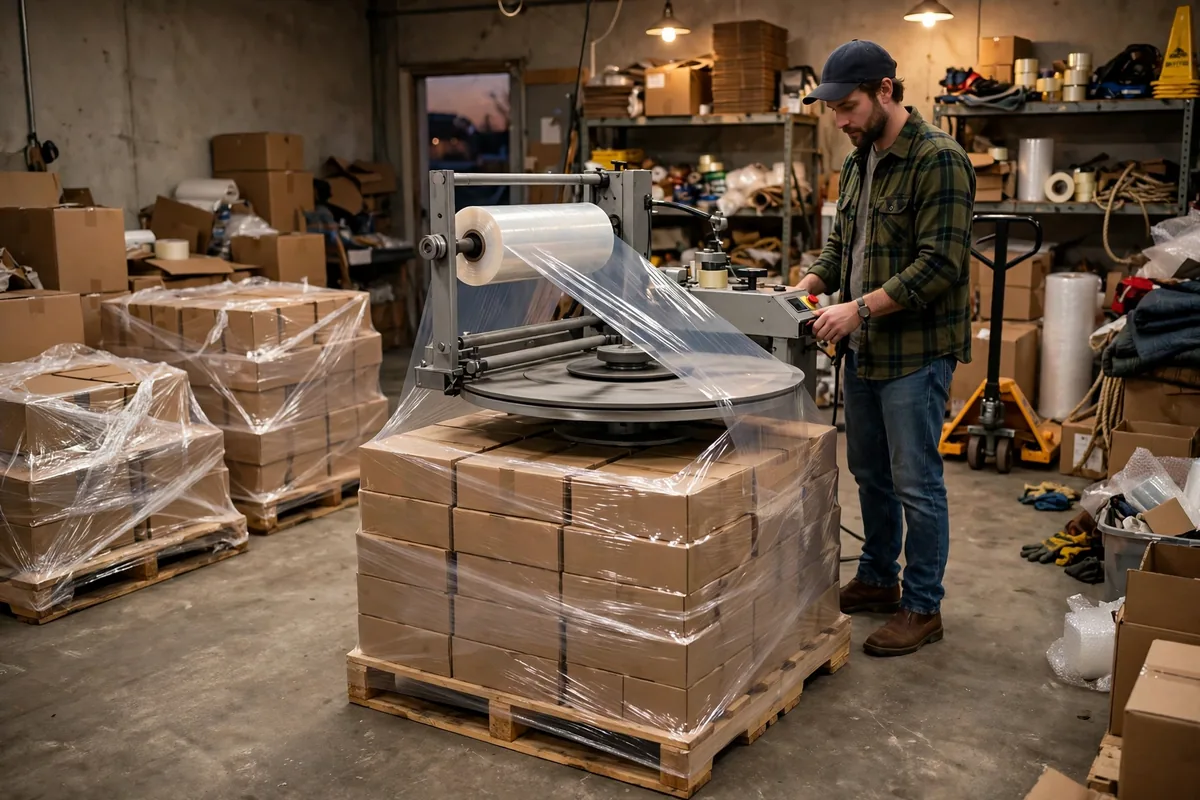
Route two: a semi-automatic turntable. This is where most small warehouses end up, and it is where I landed. Judge it by one number only: your steady daily pallet count in the slow season. Buying for peak volume is the classic small-warehouse impulse purchase. Peaks pass; payments do not.
Route three: used machines. Here is the counter-intuitive part. A used wrapper is not a bad idea, but the trap is rarely that it breaks. The trap is that you cannot get the parts. Worn pre-stretch rollers, a turntable bearing whose model was discontinued, a control board that was some small factory's custom job — the machine is thirty percent cheaper, then it sits dead for two weeks in peak season waiting on a part, and those two weeks hand back every cent you saved, with interest.
My own story: I first fell for a used turntable at a very attractive price. At the seller's yard I found the pre-stretch carriage was dead, and the seller waved it off — just pull the film by hand, same thing. Same thing, my foot. With pre-stretch gone, that machine is a spinning iron plate. Film use equals hand wrapping, and it eats floor space doing it. I bought an entry-level new machine instead. It cost more, but the carriage, bearings, and board are all common parts my local industrial supplier stocks.
A checklist before you buy anything, new or used
- Bring a real loaded pallet for the test. An empty spin tells you nothing; bearings and carriages only confess under load.
- Inspect the pre-stretch carriage. Check rollers for scratches and dents, confirm the stretch setting adjusts, and test it with actual film.
- List the wear parts and confirm local availability, item by item: bearing, belt, photo-eye sensor, control board. Anything you cannot confirm, price into the deal as future downtime.
- Measure the footprint honestly. A turntable needs forklift swing room and operator space. In a small warehouse, floor space is money — do not let the machine eat a travel aisle.
- Check floor and power. An uneven old slab makes the turntable wobble, and a wobbling machine wraps one side tight and one side loose. Level first, negotiate second.
One more frugal hack for anyone hovering near the break-even line: share. A small auto-parts warehouse on our street ended up splitting a machine with the warehouse next door — his pallets in the morning, mine in the afternoon, film bought separately, machine cost halved. No selection guide will ever print that advice, but that is how small-warehouse math actually works. Surviving beats looking professional.
So the honest answer on warehouse shrink wrap machine cost small warehouse questions is not in any price list. It is in your daily pallet count, your local wage, and the actual grams of film on your scale. Count them, weigh them, write them down, and the buy-or-not decision makes itself. Small warehouses have their own way of living: live first, polish later.
By Xiao Ma, Small Warehouse Owner