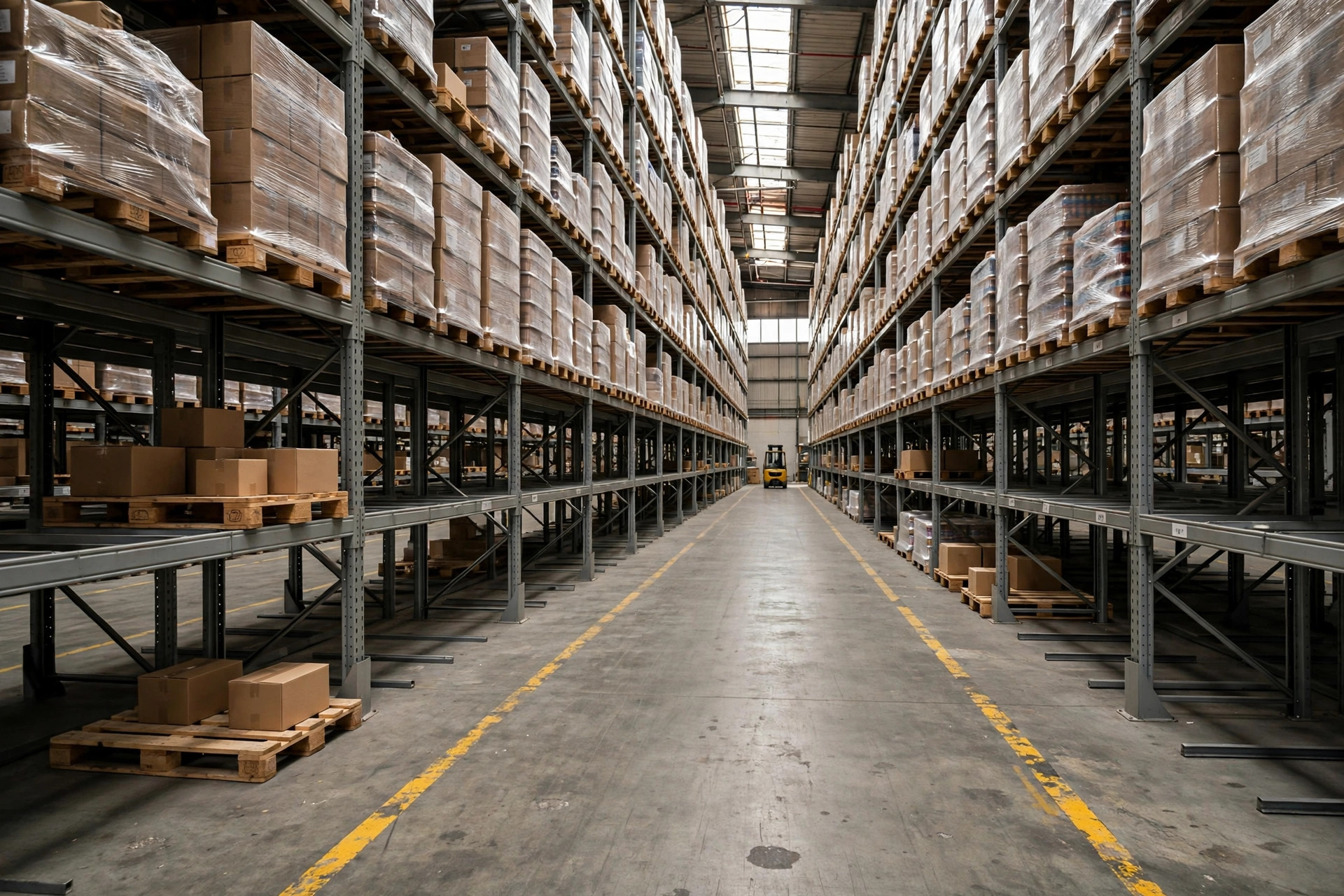
Start with the arithmetic of warehouse storage capacity utilization: a 430,000-square-foot warehouse paying about $82,000 a month in rent, with the manager reporting 92% full and asking for a second building. A comparable second building would run close to $980,000 a year. I told him not to sign anything until we had walked the floor. One afternoon of counting gave us three different answers: floor space 88% used, cubic space 61% used, pallet positions 79% occupied. Same building, a 30-point spread. Whether to lease or not depends entirely on which number you believe.
Most warehouses carry a single utilization number, often whichever one the system happens to report. Floor, cube, and slot occupancy answer three different questions, and mixing them up produces expensive decisions. When warehouse storage capacity utilization goes to the boss, all three numbers should go with it. Reporting only one is reporting the most convenient one.
Capacity utilization is three numbers, not one
| Measure | How to calculate it | What it actually tells you | | Floor utilization | Occupied floor area / usable floor area | Whether the ground is crowded | | Cube utilization | Occupied cubic volume / usable cubic volume | Whether the height is wasted | | Slot occupancy | Occupied pallet positions / total pallet positions | Whether you can still put freight away |
High floor utilization means aisles and work areas are squeezed. Low cube utilization means the top beams sit empty while you pay rent on the full clear height. High slot occupancy means the system is running out of assignable locations and putaway is about to queue. An appliance warehouse I worked with last year was a cube problem disguised as a space problem: big appliances stacked only two high per pallet, the top two beam levels empty year-round, the floor looking packed while the air above it was doing nothing. The fix cost almost nothing: light, bulky goods went up high, heavy goods stayed low, and cube utilization moved from 61% to 74%. That is 13% of capacity recovered without a dollar of extra rent.
You do not need fancy software to audit the three numbers. Measure floor area off the layout drawing, calculate cube from beam heights and actual pallet stack heights, and pull slot occupancy straight out of the system. The part most people skip is auditing zone by zone: receiving, storage, picking, and returns each get their own numbers. I have seen a warehouse averaging 80% overall with picking at 98% and storage at 65%. The average hid the real bottleneck. There is also the gap between system and reality: locations the system shows as occupied where the freight shipped weeks ago. Sample 100 locations shown as occupied; if more than 8 are physically empty, the slot data cannot support a leasing decision until it is cleaned up. Audit one zone a week, two people, half a day, and clear the ghost locations as you go. Four weeks later the three numbers are measurements, not estimates, and the next time someone walks in quoting 92%, you can point at exactly which zone is full and which one is not.
Half-empty pallets are the cheapest capacity you already own
An e-commerce warehouse I audited before peak season had 1,400 pallet positions, and 380 of them held half a pallet or less. A half pallet is worse than it sounds: it occupies a full position, ships half a pallet of goods, and still costs a full position in rent and in picking travel. Consolidating the ones that could be combined freed nearly 190 positions, about 13% of capacity, and the peak overflow fit inside the existing building. No temporary space was rented at all. Before consolidating, pull the dead stock out separately: pallets that have not moved in 90 days, listed on their own sheet, positions multiplied by the monthly rent per position. That is what they cost every month. Clearing 60 dead pallets frees real positions, and the arithmetic tells you whether clearing them is worth the effort, without anyone having to argue from gut feel.
Consolidation has a cost, and it has to be counted. Labor to combine, new labels, and updating locations in the system: if that total exceeds one month of rent for the freed position, consolidating that pallet loses money. The counterintuitive part is that the fastest-moving goods are the worst candidates. Leave a half pallet of an A-class fast mover where the picker can reach it in one motion, and consolidating it into a full pallet saves a location but adds a layer of handling to every pick. Across thousands of orders in peak season, the extra labor eats the rent saving. Run the math per item, not per warehouse. Consolidate slow movers first, medium movers next, and touch fast movers last, only after costing the added pick time.
What to do at 85% capacity utilization, and what changes at 95%
| Slot occupancy | Move first | | Below 80% | Normal operations, audit the three numbers monthly | | 80% to 85% | Re-slot: slow movers up high and far away | | 85% to 95% | Consolidate, clear dead stock, negotiate overflow space | | Above 95% | Putaway queues up; expansion or outsourcing is cheaper |
85% is the dividing line. Below it, the problem is usually layout and half pallets, and internal fixes are enough. That is the discipline behind tracking warehouse storage capacity utilization as three numbers instead of one: each number triggers a different action, and the action, not the average, is what saves the money. Past it, putaway staff spend visibly longer hunting for open locations, receiving starts to back up, and talking only about tidying up is stalling. Past 95%, no calculation rescues the floor: the hours spent hunting locations, trucks waiting at the door, and mis-shipments eat whatever rent you saved, and expansion becomes the cheaper option. Temporary overflow space can bridge a gap, but price the round-trip transport and double handling honestly. Overflow below about 10% of total inventory usually pays; above that, the shuttling often costs more than leasing directly.
Run the total on the warehouse from the opening paragraph: a new building at $980,000 a year against an internal reorganization costing under $30,000 in labor and labels, recovering 13% of capacity and pushing the leasing decision out by at least a year. Tidying is not free, but it is an order of magnitude cheaper. Flip the case around: if all three numbers sit above 95% and the recovered space will not survive one peak season, the $980,000 is money well spent, because holding out costs more in waiting trucks and wrong shipments. Audit the three numbers monthly, zone by zone. If half pallets exceed 25% of positions, consolidate before you lease. If slot occupancy stays above 92% for two straight weeks, then go negotiate the expansion. Capacity decisions made in that order rarely waste money.
By Lao Zhou, Logistics Cost Analyst