In a fastener warehouse storage operation, how much does one lost screw cost you in a year? That is the first question I ask every time I walk into a small fastener warehouse. The owner usually laughs: it is just a few screws, how much could it cost? Run the numbers, and the laugh tends to stop.
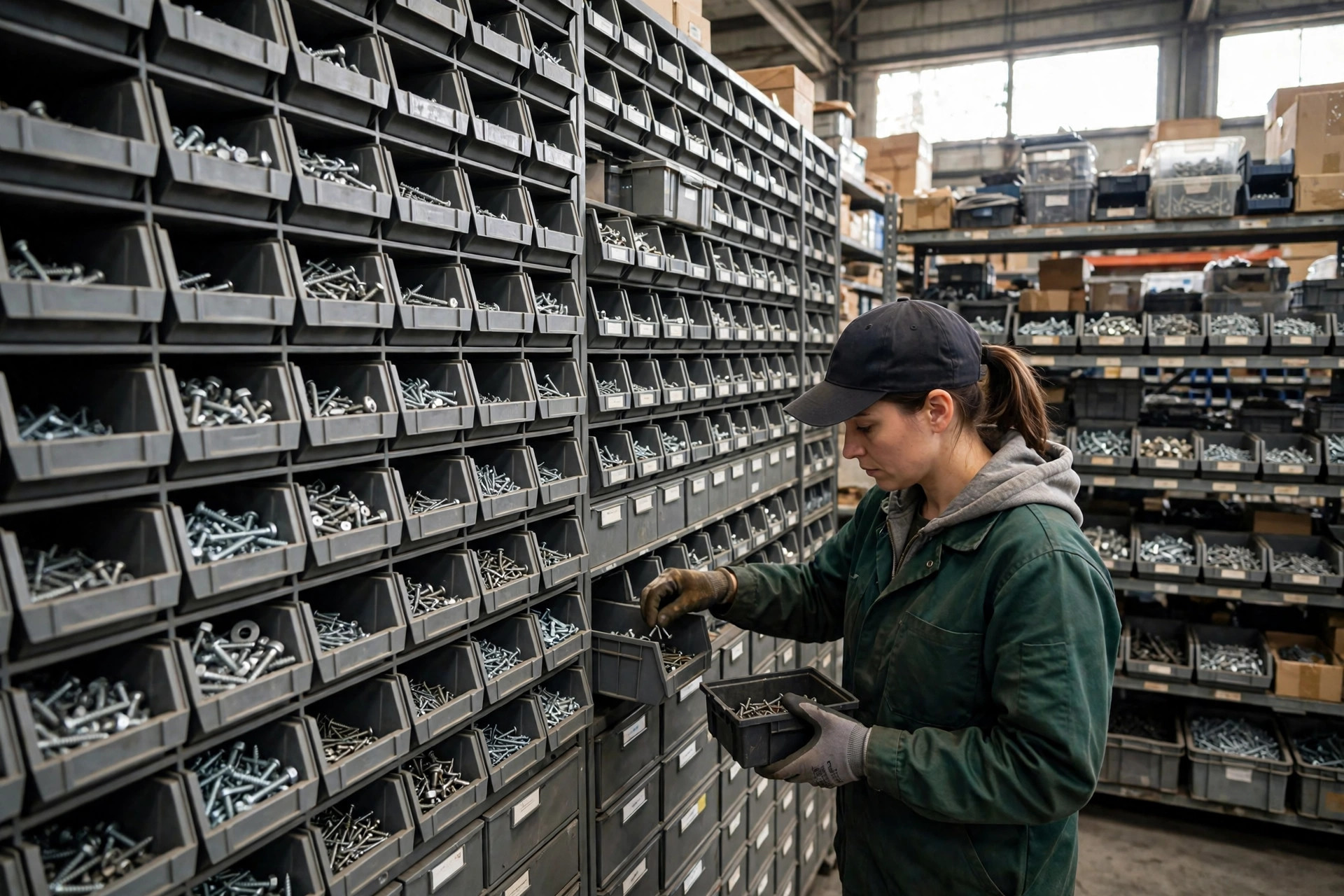
Last fall I visited a small auto-parts fastener warehouse in Zhejiang. The place was not big: two rows of racking and one wall of parts bins. Lao Chen, a picker with six years on the job, could find the common sizes blindfolded. I followed him on one order: 12 lines, bolts, nuts, and washers in combinations from M6 to M12. The first nine lines went smoothly. The last one stuck — M6 nuts had been mixed into the M8 nut bin, and Lao Chen checked three times before he was sure. That single line cost an extra ten-plus minutes. The order still shipped on time, but Lao Chen told me this happens two or three times a week.
This is not slow picking. Small fasteners are the worst combination in warehousing: tiny, look-alike, and numerous. A bolt off by one thread pitch looks identical to the eye and only reveals itself when it will not thread — and the rework is never just one order. Worse, a mix-up is rarely a one-off mistake. When labels and compartments never separated the sizes properly in the first place, today it is M6, tomorrow it is M10.
The First Ledger of Fastener Warehouse Storage: Where Picking Time Goes
Let me put a clearly labeled hypothetical on the table, using figures I worked through with the owner on site. Suppose one picker loses 40 extra minutes a day to searching and double-checking. Over 22 working days a month, that is 880 minutes, roughly 15 hours. With six pickers, the warehouse burns about 90 hours a month — the equivalent of half an extra headcount — before counting a single rework or reshipment. In other words, slow picking is not an efficiency problem. It is money leaking straight out of payroll.
Mix-ups cost more. Pick the wrong size and the mild version is a return and reship: freight, labor, and packaging all lost. The bad version is a batch that reaches the customer's line before anyone notices, and then the whole lot comes back for re-inspection. That warehouse had one last year: M12 bolts mixed into M10 stock stopped a customer's production line for half a day, and the compensation plus the lost orders cost more than two new cabinet walls. The owner told me he used to treat mix-ups as occasional bad luck. After that incident he understood: in a warehouse where sizes are not separated, a mix-up is not a question of if, but when.
Labels are where this gets fixed, and the method that works is three elements: the full spec on the label (diameter, length, thread pitch), the mating combination (which nut and washer go with this bolt), and a compartment number big enough to read from a step away. Color can separate broad categories, but the category is only a helper — one compartment holds exactly one size, always. Relabeling takes less than a day. The picking time it saves comes back every single day.
There is also a ledger most owners forget: stock counting. In a warehouse where sizes are blurred, counting means counting everything by hand, and nobody trusts the result. Where compartments and labels are clean, counting becomes spot-checking by compartment, and any variance points straight at one compartment. Half a day, and the books reconcile.
Three Routes for Fastener Warehouse Storage: Drawer Cabinets, Bins, and Kitting
In practice there are three routes, and none of them cures everything. The right choice depends on your order profile and your size count.
| Route | Best for | Strength | Weakness |
|---|---|---|---|
| Drawer cabinets | Many sizes, small orders, mixed variety | Dense compartments, intuitive labels, fast picking | Takes floor space, cannot hold large items, higher upfront cost |
| Bin and tote systems | Fast turnover, large batches | Flexible, stackable, hangable, low cost | Sizes blur together fast without label discipline |
| Kitting | Fixed combinations shipped as sets | Pre-picked per order, low mispick rate, fast outbound | Needs demand forecasting, recompose when a combination changes |
Here is the counter-intuitive part: the most expensive cabinet is not always the cheapest answer. I have seen a small warehouse buy a full wall of premium drawer cabinets and then label them by broad category anyway — bolts in one drawer, nuts in another, M6 and M8 sharing a compartment. A good cabinet with a wrong label still makes pickers dig. Put differently, sort the sizes correctly first and talk equipment second. Get the order backwards and the money is wasted.
A hardware distributor in Ningbo did it the other way around. No new cabinets at first. Instead, they spent two weeks rebuilding the label system: one size per compartment, labels showing length, pitch, and the mating washer-and-nut combination, and pick lists sorted by compartment number. Two weeks later, pickers no longer dug through bins to verify, and mispicks dropped. Only then did the owner gradually convert high-frequency compartments to drawers, leaving low-frequency ones in bins. The total spend came in well below a rip-and-replace cabinet purchase, and every step paid for itself visibly.
Replenishment is another leak people miss. A compartment runs empty, nobody notices, and the picker walks over, finds nothing, and walks back to raise a replenishment order. The fix that works is a minimum line per compartment: drop below the line and replenishment triggers, with replenishment lists sorted by compartment number so one trip covers a whole row. Set the line from roughly two weeks of usage data for that size. It costs nothing — it just turns replenishment from "when someone remembers" into "when the line is crossed."
The Cheapest Combination: Sort Specs First, Buy Equipment Second
Here is a decision framework you can apply directly. Step one, count your sizes and study your order mix: over 200 sizes with small, mixed orders points to drawer cabinets; few sizes in large batches means bins are enough; a high share of set shipments justifies kitting. Step two, get labels and compartment numbers right before deciding on any equipment change. Step three, put drawers on high-frequency compartments and leave bins on low-frequency ones — the mix is the cheapest option. Before buying anything, run one more check: review a month of pick lists and rank which compartments get touched most and which sizes get mispicked most. That ranking is your cabinet priority list, not gut feel.
Run the earlier hypothetical once more with labels and compartment numbers in place. If daily searching time falls from 40 extra minutes to 10, six pickers save 66 hours a month. Equipment can wait; labels can go up today. That is why I keep saying: sort the specs first, talk equipment second.
At the end of the day, small-parts fastener storage is not won by the most expensive cabinet. It is won by sizes separated cleanly and labels you can trust. Run the numbers yourself when you get back: picking time first, mix-up cost second, and only then decide whether the equipment needs changing.
By Lao Zhou, Logistics Cost Analyst