We're a small warehouse, and let me be honest up front: we can't afford to burn money on this. In our first year, whenever a pallet broke a board, we dragged it out to the trash. Old stuff wasn't worth the floor space, or so I thought. Then I did the year-end math and realized what we'd thrown away, what we'd panic-bought to replace it, and what we'd paid out when a bad pallet dropped a load added up to a scary chunk of money. That's when I made a rule: no pallet goes straight to the dumpster. It goes through our warehouse pallet repair reuse management routine first — fix it, downgrade it, or scrap it. This is how a small team runs that routine without any big-company system.
Our Small-Warehouse Pallet Problem: We Can't Afford to Trash Them or Replace Them
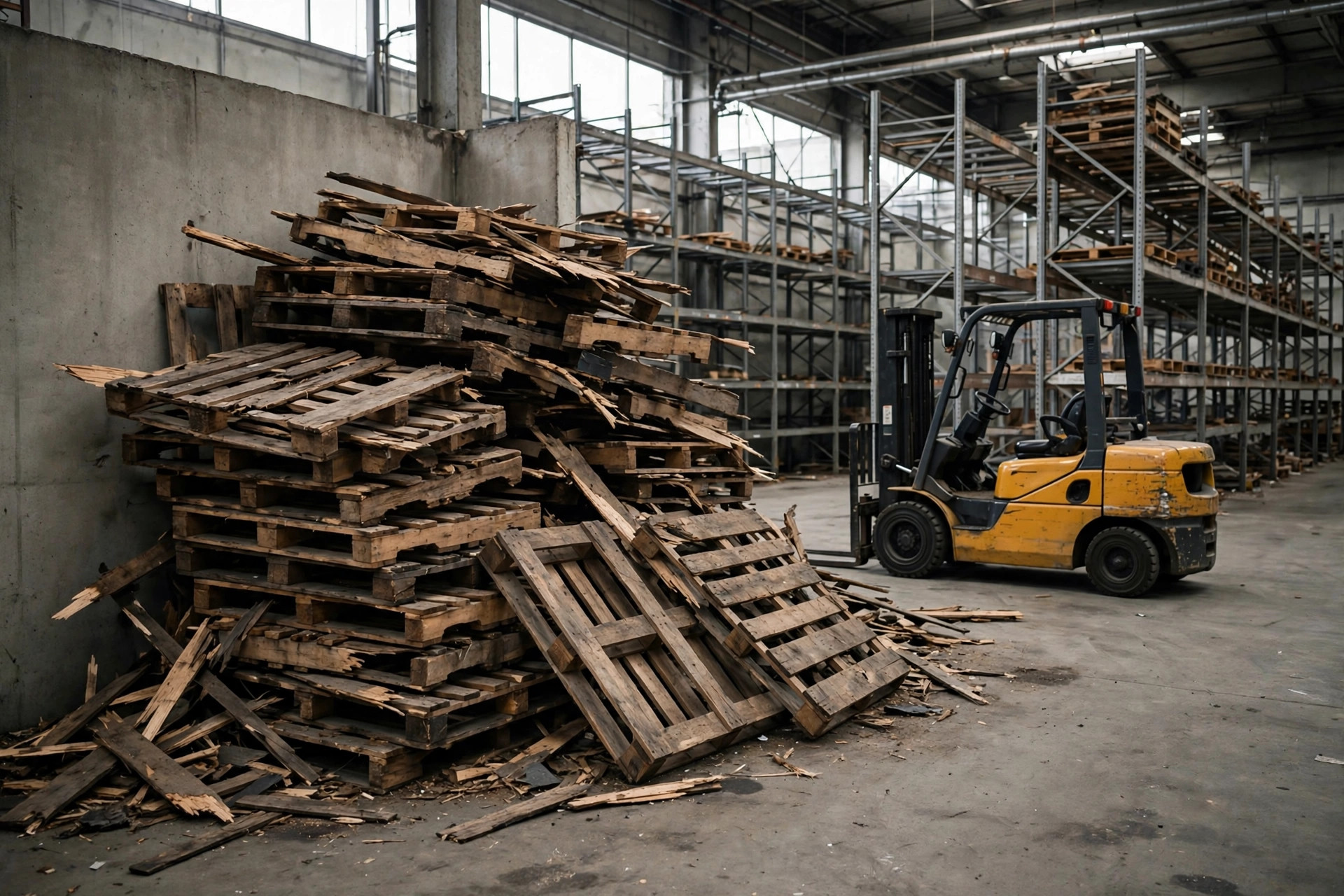
We run a small floor with a few dozen pallets in circulation, and peak season stretches every one of them. The first lesson arrived one autumn afternoon. A container came in, and while unloading we found that several of the pallets that arrived with the goods had a broken bottom board or a nail sticking up. In a hurry, the crew stacked the broken ones to one side, planning to "deal with them later." Later never came. The broken pile grew until it blocked half an aisle. Worse, a new hire grabbed a broken-board pallet for a heavy load without noticing, the board gave way halfway across the floor, and a corner of the load went over. We paid the customer for the damage and lost half a day of outbound work.
The second lesson was more typical. One year, just before peak season, our count showed we didn't have enough good pallets. We rushed to buy new ones, the supplier needed several days to deliver, and in the meantime we pressed half-broken pallets into service. The forklift drivers grumbled the whole week: a crooked pallet makes a crooked stack, and a crooked stack makes everyone nervous. After peak season I sat down and figured out the real problem. It wasn't that we didn't have enough pallets. It was that good, bad, and half-broken pallets were all mixed together with nobody telling them apart, so the good ones were buried. For a small warehouse, the pallet problem is almost never "not enough pallets." It's "nobody is managing the pallets."
Pallet Repair and Reuse Grading: Fixable, Downgraded, or Scrapped
Our method of warehouse pallet repair reuse management is low-tech, but it works: every pallet gets graded into one of three buckets before anyone decides its fate.
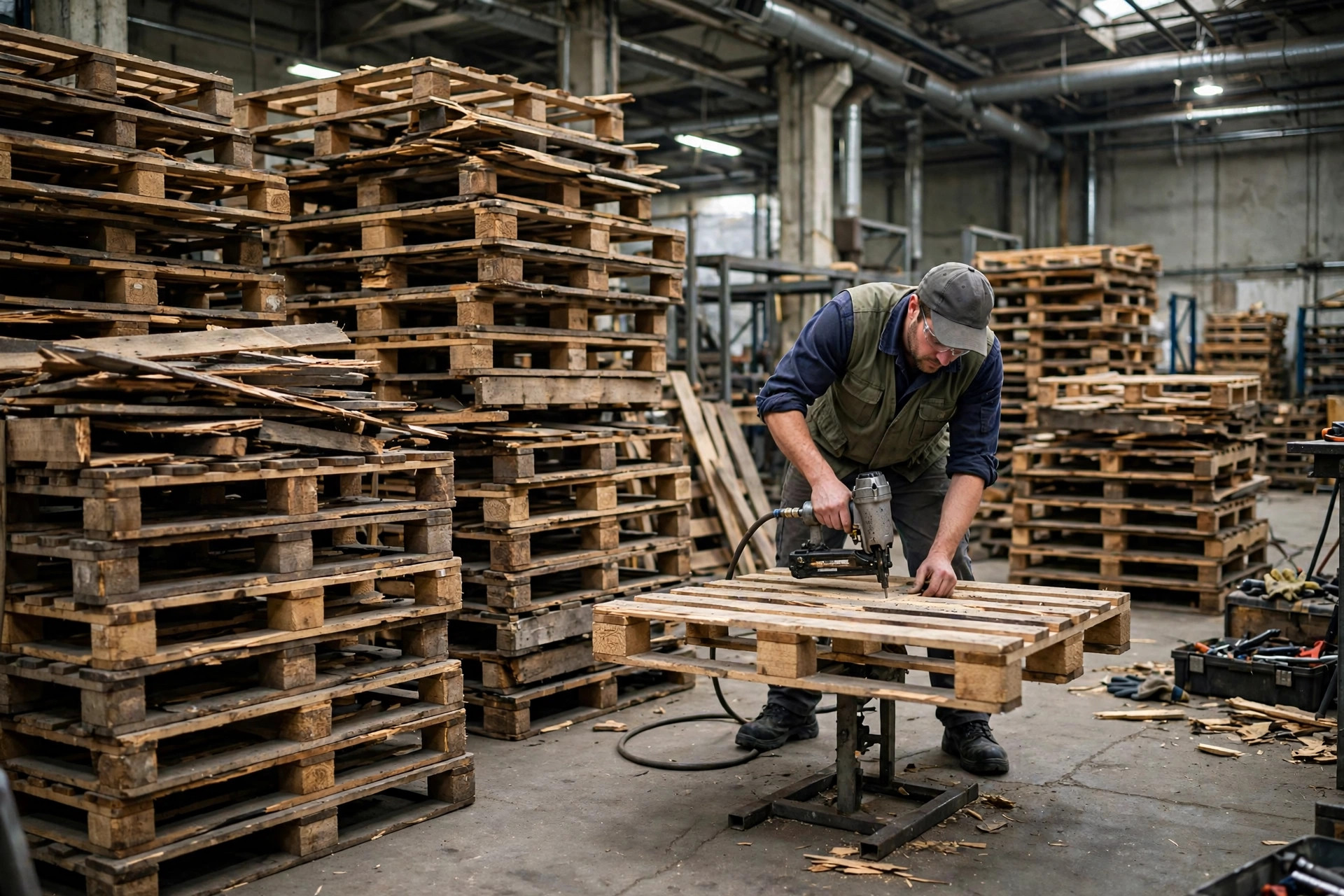
Bucket one is "fixable." A pallet with one or two broken boards, a loose nail, or a lightly scuffed corner — damage that doesn't hurt its strength once repaired — goes to the repair corner. After repair it carries loads and goes on racking like any other pallet, except we keep it off the heaviest loads for a while, a sort of probation period.
Bucket two is "downgraded." These pallets have too many broken boards, or repairs that leave them weaker than before. They never go on racking again and never carry heavy loads. They do ground-level work only: moving goods around inside the building, temporary staging, or sitting under stock as a moisture barrier. We mark them with a bright splash of paint so any worker can see at a glance that this pallet stays on the ground. Downgrading isn't writing a pallet off. It's giving it a job it can actually do.
Bucket three is "scrapped." A broken main stringer, a twisted frame, serious mold, or nails sticking out beyond repair — those come apart. Boards that are still good get saved as spare parts, and the rest goes out as waste. We log how many we scrap and why, not to blame anyone, but so we can see each month's real loss rate. Without that number, the next purchase order is just a guess.
Once grading became a habit, inbound inspection got a standard too. Pallets arriving with goods get a quick look first. Broken or warped ones are separated on the spot and never mixed into the good stack. That check takes a few minutes and saves a pile of trouble later. At the end of each month we spend half an hour counting how many pallets sit in each bucket, whether the repair corner is backed up again, and whether any downgraded pallet got mistakenly sent to racking. The counts go on a small whiteboard on the repair-corner wall — our pallet ledger.
Pallet Repair and Reuse in Practice: The Corner, the Spares, and the Responsibility Ledger
Grading is only step one. Making warehouse pallet repair reuse management actually run day to day comes down to three small things.
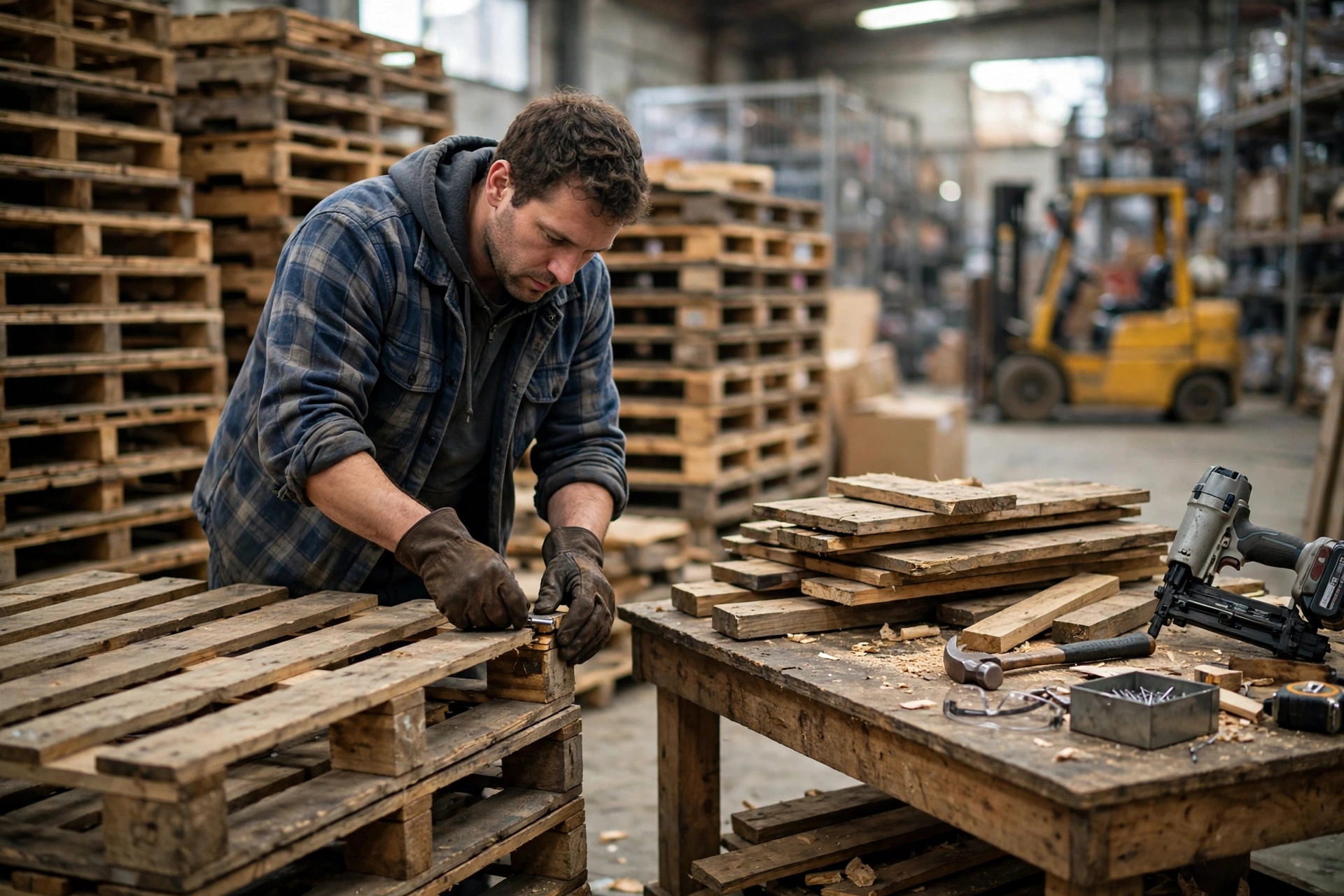
First, a repair corner. This sounds trivial, but before we had one, tools were scattered everywhere and pallet repair depended entirely on somebody feeling motivated. Now a small corner holds a nail gun, a box of nails, a few spare boards, and a saw, with the grading standard posted on the wall. In the last half hour before closing, whoever has a free moment clears a few pallets from the repair corner. The week before peak season, we spend a full day clearing the corner out so the good-pallet stock is topped up. A tiny corner turns "fix the pallets" from a chore nobody owns into a job with a place, tools, and time.
Second, spare parts. Nothing kills pallet repair faster than running out of boards or nails mid-job. Our fix is simple: good boards stripped from scrapped pallets become the spare stock, kept in one pile, and nails are kept by the box and restocked before they run out. Spares cost almost nothing. The point is never running dry.
Third, the responsibility ledger, which is where arguments usually start. If a pallet goes missing or gets wrecked, whose fault is it? Our split is this: normal wear and tear belongs to the warehouse, no questions asked, and nobody gets blamed. Rough handling — a forklift ramming a pallet, deliberate overloading — gets pointed out on the spot and noted, but there's no fine, just a reminder. For customer-owned pallets, we photograph damage at receiving and check the pallet against that photo when it leaves. Once the rules are clear, people stop hiding broken pallets to dodge blame, and the real loss numbers finally show up.
Here's the comparison table we use internally. No vendor prices here, just our own judgment from running the place:
| Option | Cost | Time | Best for | | Repair and keep using | Low | A little | Minor damage, board and nail problems | | Downgrade to ground use | Very low | Almost none | Weakened pallets that can't go on racking | | Scrap and buy new | High | Delivery lead time | Broken stringers, twisted frames | | Rent from a pallet pool | Pay per use | Saves management effort | Temporary peak-season gaps, volatile volume |
The table gives us a rule of thumb: light damage gets repaired, heavy damage gets downgraded, dead pallets get scrapped, and a seasonal gap gets covered by renting for a few days instead of panic-buying a big batch. The rental-versus-own choice comes down to how steady your volume is. If volume is steady and you can manage your own fleet, own it. If volume spikes and only spikes, renting for the peak is cheaper. Check the supplier's latest quote for actual rental terms, since rates vary — never treat someone else's quoted price as your cost.
Now for the counter-intuitive bit: the most expensive pallet in the building is usually not the new one you paid for. It's the broken one somebody gave you for free. Free pallets invite carelessness. Nobody inspects them, nobody grades them, nobody repairs them. They slip into the good stack, and one collapsed load or one damage claim costs far more than a new pallet ever would. Meanwhile, an old pallet that went through inspection, grading, and repair — a pallet we spent a little money fixing — is the one I trust most, because three pairs of eyes have already been over it. So don't judge a pallet program by "how much money did we save." Judge it by whether any out-of-control pallet is still wandering around the warehouse — that is what warehouse pallet repair reuse management is really about.
My advice to other small warehouses is three lines long: inspect pallets at receiving, and never let broken ones mix into the good stack. Grade them clearly — fixable, downgraded, scrapped — each in its own place. Keep a repair corner stocked with parts so fixing a pallet has a place, materials, and a person. Big-company pallet systems aren't for us, but these homegrown habits are enough to keep the pallet ledger honest. Small warehouses have their own way of surviving, and this is one of them.
By Xiao Ma, Small Warehouse Owner