Let me tell you straight: steel coil warehouse storage handling looks like the simplest job in the yard. You take a big roll of steel off the truck, you put it down somewhere, done. Anyone who has actually done it knows better. After fifteen years on the road, I have hauled hundreds of coils from mills to warehouses and from warehouses to processors, and I can tell you the warehouse is where the real test begins. A single coil can weigh twenty tonnes or more, and its surface is far more delicate than it looks. One crooked lift, one wrong orientation, one bad piece of dunnage, and the customer is looking at a downgraded coil and the warehouse is looking at a claim nobody wants to own.
Steel coil warehouse storage handling starts with orientation: eye up or eye to the side
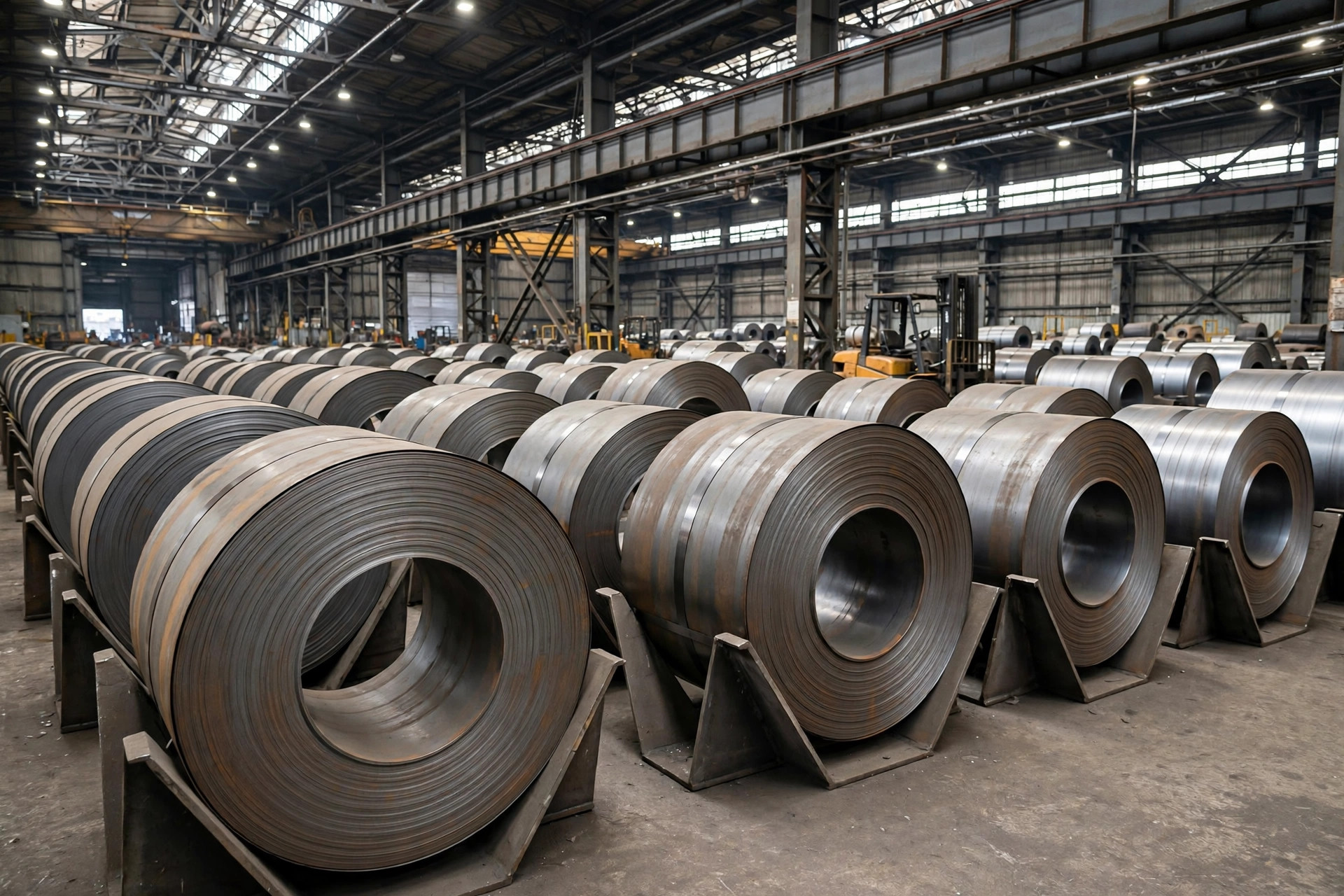
The argument I hear most often in coil yards is about orientation. The "eye" is the hole through the middle of the coil. Eye up means the coil stands upright with the hole pointing at the ceiling. Eye to the side means it lies on its side like a giant tire, resting in saddles, with the hole facing sideways.
In the autumn of 2019, I delivered to a steel warehouse near Duisburg in Germany and watched a costly mistake unfold. The yard had just taken on new forklift drivers, and in a hurry, they stood a coil of cold-rolled steel weighing over twenty tonnes eye-up directly on the concrete floor, without a single timber underneath. It looked stable enough, and nobody gave it a second thought. Three days later, when the customer came to collect, the bottom ring of the coil was covered in pressure marks and rust spots where it had touched the damp floor. The coil had to be downgraded, and the warehouse spent more than a week arguing with the customer before accepting most of the loss. Eye up looks steady, but the whole weight sits on one ring at the bottom. The heavier the coil, the deeper the mark, and once floor moisture gets in, rust creeps upward from the base.
Lying a coil on its side is not as simple as rolling it over either. A coil on its side has to sit in saddles, and the curve of the saddle has to match the outside of the coil. The two saddles also have to be spaced right, or the coil sits crooked and picks up two lines of pressure marks over time. The best yards I have seen put a rubber pad on the saddle, set the coil down, and then walk all the way around it before releasing the hook, checking that it is level and fully supported. That extra minute saves a lot of arguments later.
| Orientation | Advantages | Risks | Best for | | Eye up | Small footprint, easy to stack, easy to count at a glance | Pressure marks on the bottom ring, moisture and rust from the floor, sway during lifting | Short-term turnaround, dry and level floors, when proper pallets are used | | Eye to the side | Weight spread across the saddles, better surface protection | Takes more floor space, wrong saddles leave marks | Longer storage, cold-rolled and coated coils with strict surface requirements |
That table is not a rulebook on its own. You still have to look at the coil's width, its weight, and the condition of your floor. But one rule never changes: a coil must never sit directly on bare concrete. Timber, a saddle, a pallet — something has to stand between the steel and the ground. Think of it as the coil's shoes. No shoes, no standing on the floor.
Steel coil warehouse storage handling lives or dies on saddles and lifting gear
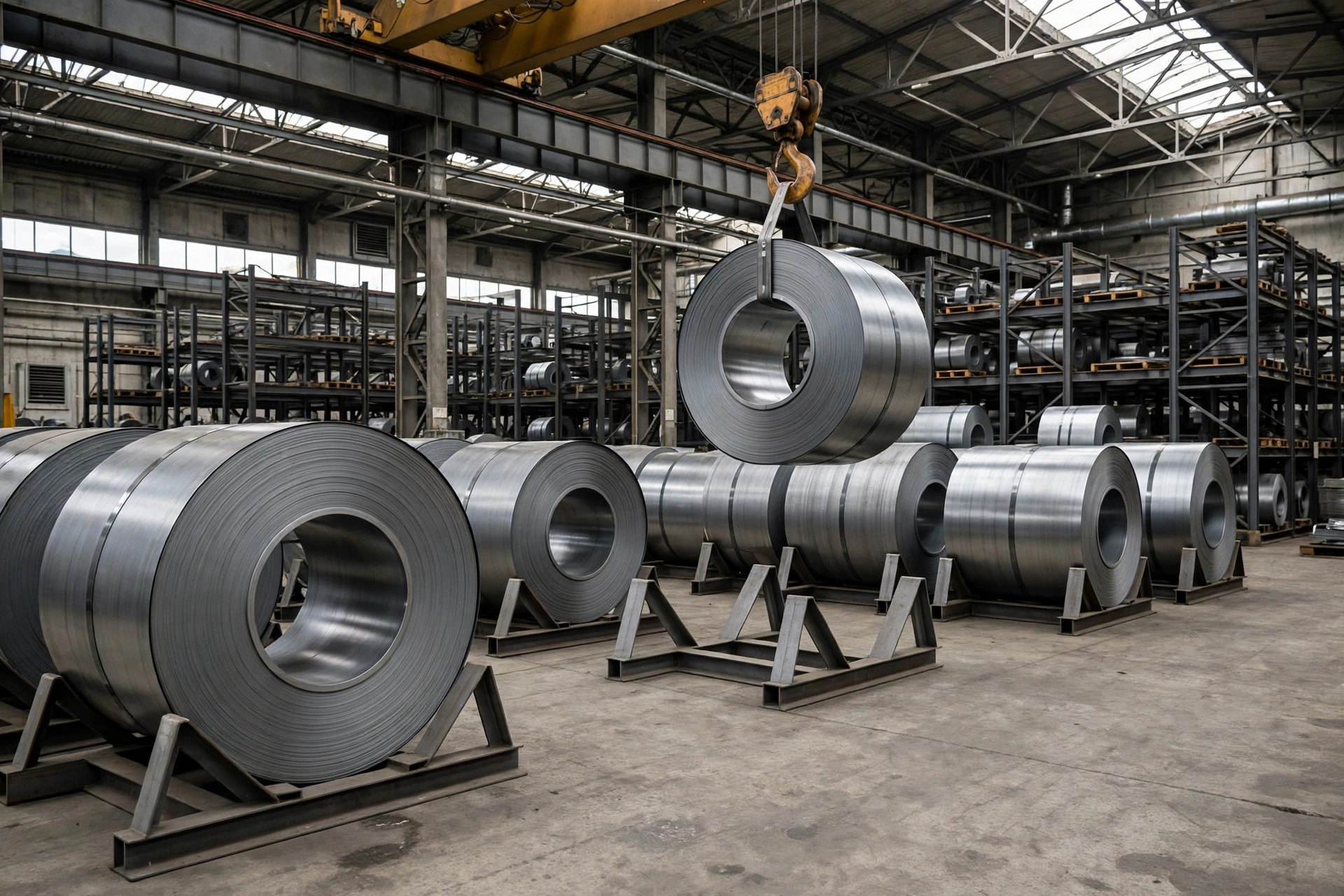
Lifting gear is something I have argued about with warehouse crews more than once. The most common tool for coils is the C-hook, which passes through the eye and grips the inner ring. It looks simple, and it still goes wrong. A hook that is too small will not hold the inner ring properly and the coil can slide sideways as it rises. A hook that is too big has to be forced into the eye and deforms the inner wraps before the lift even starts. Slings looped under the coil suit loads with very strict surface requirements, but slings hate sharp edges and oil, and if nobody inspects them regularly, a worn sling is an accident waiting for a date.
In the spring of 2023, I was waiting to unload at a processor in northern Italy when I saw a near miss on the next lane. A crane was lowering a hot-rolled coil onto its saddles, and the operator, trying to save time, released the hook while the coil was still about half a metre above the saddle. The coil bounced, shifted a good fifteen centimetres sideways, and chipped its outer edge. Nobody was standing close enough to get hurt, thank goodness, but the coil had to go back for rework. After that, the crew made a rule: the last part of every set-down is done slowly, the banksman keeps his eyes on the coil, and nobody releases the hook until the coil is fully settled. After all these years on the road, my view is simple. Going slow for half a minute costs you nothing. Rushing for half a minute can cost you everything.
Here is a judgment that surprises people: packing coils as tightly and firmly as possible often causes more damage, not less. Some yards wedge coils together with no gaps at all, afraid they might roll. Come the rainy season, moisture gets trapped between the coils with nowhere to go, and the faces pressed against each other rust first. A little gap, a little lift off the floor, and room for air to move is actually the cheapest rust protection you can buy. Rust-preventive oil matters, but before you spray anything, fix the leaking roof and the damp floor. Otherwise you are just putting a blanket over the rust.
Rust prevention is not just a coat of oil
I learned that lesson the hard way myself. Years ago, I hauled a load of cold-rolled coils for export, and the warehouse wrapped them in just two layers with the corners left poorly sealed. The coils sat there for over two months, and a stretch of rain found a small leak in the roof right above one of them. By collection day, the exposed face was stained, and the customer refused the coil on the spot. Ever since, the first thing I do when I deliver to a warehouse is look up at the roof for water stains and down at the floor to see if it is dry. When a customer hands you their steel, they are trusting you with the condition it leaves in, not just its weight.
The coil area deserves its own layout too. Keep it separate from general pallet freight, mark the crane path and the floor load limits on the ground, and hang the coil numbers facing outward so the crane and forklift crews can match numbers at a glance. I have seen yards where coils shared space with pallet freight, with a twenty-tonne coil swinging over racking while people walked underneath. It looked dangerous because it was dangerous. Separation costs a little floor space, but it keeps the heaviest work away from everyday foot traffic, makes tracing a problem much easier, and speeds up stock counts. Number plates, location plates, and load-limit signs: hang all three, and even a new hand on the crew makes fewer mistakes.
So here is my advice to owners and warehouse managers, three practical points. First, inspect on arrival: coil number, weight, outer packaging, and any edge damage, photographed and logged before the coil goes into stock, so any later dispute has evidence. Second, get the gear right before you lift: the C-hook sized to the eye, the saddle curved to the coil, and a layer of dunnage between steel and floor. If any of those three does not match, slow down and change the setup rather than forcing it. Third, treat rust as an environment problem first: a roof that does not leak, a floor that stays dry, and gaps between coils for air to move. Oil and wrapping are the last line of defence, not the first.
Steel looks tough, but a coil is a fussy piece of cargo. Treat it rough and it pays you back in dents and rust. Treat it with care and it leaves your yard looking as good as the day it arrived. There is an old saying among drivers that fits this trade perfectly: slow is smooth, and smooth is fast.
By Shifu Zhao, Trucking Veteran (15 yrs)