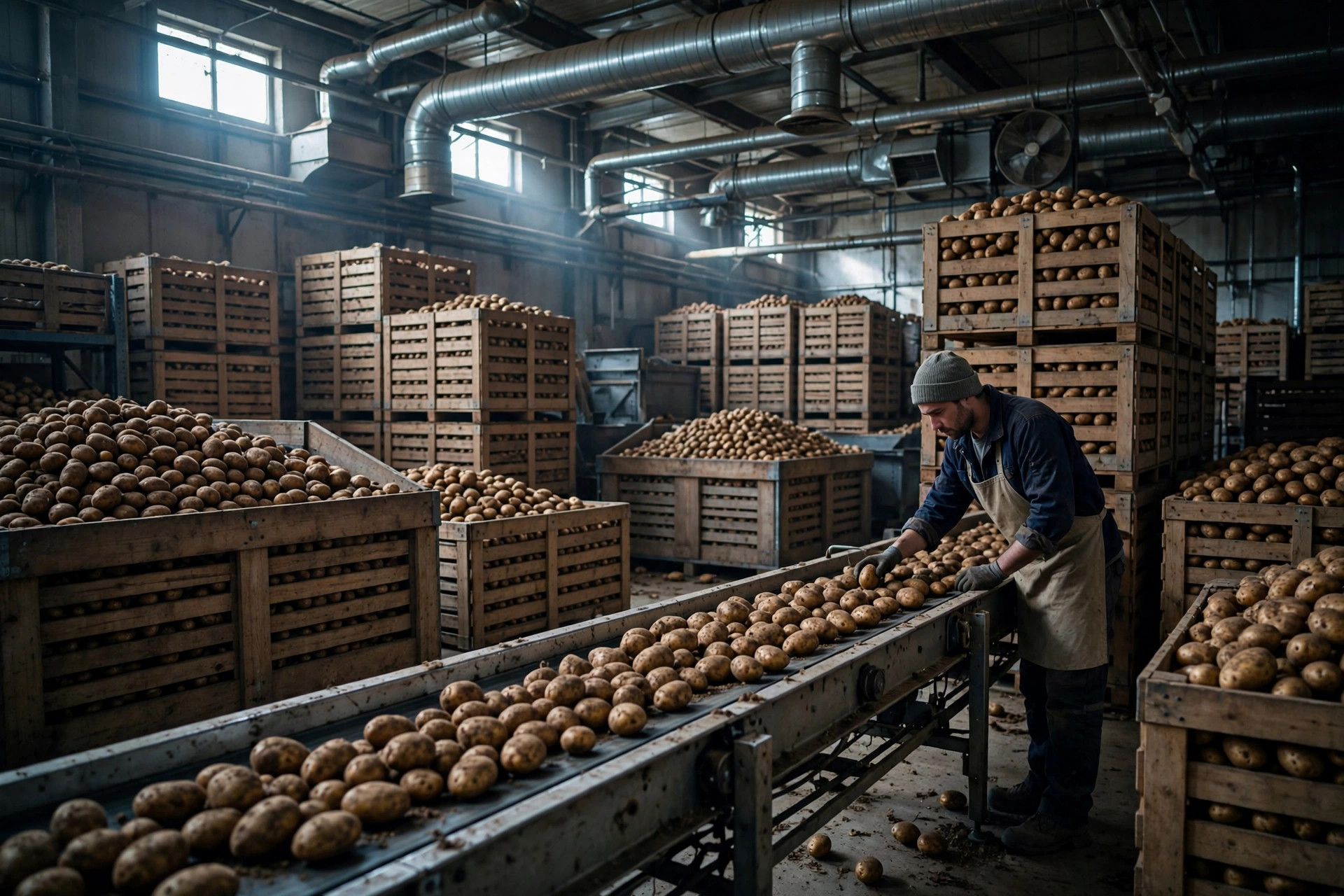
We have a client in the potato warehouse storage business who wholesales fresh potatoes. Last autumn he bought a beautiful crop up in Inner Mongolia, rolled it into a cold store he had just leased, and set the temperature himself: colder is safer, so he pushed it down close to freezing. Three weeks later he called me, still relaxed, saying the potatoes had sprouted a little and couldn't he just snap the sprouts off? I told him not to touch them yet. Snapping sprouts costs labor, it breaks the skin, and the greenish ring around each sprout eye is the first thing a supermarket inspector notices. The load was never rejected, but it was downgraded, and by the time the price was renegotiated he understood something about potato warehouse storage: the bill doesn't start when you pay rent. It starts the day the potatoes go in.
A potato in storage is not a dead object. It is still breathing, still burning through itself, still looking for a chance to sprout. Every condition you give it, temperature, humidity, airflow, is a term in a negotiation, and the potato answers back with sprouts, shrink, frost damage, or rot.
Potato Warehouse Storage Lesson One: Colder Is Not Always Better
We have another client in Shandong who processes potatoes for frozen fries, so he should have known better. One year, to keep things simple, he put processing potatoes and fresh-market potatoes into the same store at the fresh-market temperature. The fries came out unevenly colored, batch after batch, and his buyer complained they looked burnt. The oil wasn't the problem and neither was the cut. The cold was. When storage runs too cold, starch in the potato converts to sugar, and sugar darkens fast in hot oil. Fresh-market potatoes are comfortable at 4–7°C, processing potatoes want 7–10°C, and seed potatoes are a different animal again at 2–4°C. One store, one temperature, three kinds of potato: that is three problems wearing one coat.
Here is the counterintuitive part of potato warehouse storage, and the part most newcomers get wrong: the enemy of a cold store is not only heat. It is also too much cold. People hear frost damage and picture ice, but long before anything freezes, low temperature has already quietly stolen quality. Heat is no kinder. Warm it up and the sprouts start moving, the potato burns through its reserves faster, the skin softens, and shelf life shortens in front of your eyes. So when you talk to a warehouse operator, don't just ask what temperature the store can reach. Ask who that temperature was set for. Fresh, processing, or seed: three uses, three regimes. If the contract doesn't say which one applies to your load, the operator will manage to a generic standard, and when something goes wrong you will have nowhere to stand.
| Use | Temperature | Relative humidity | What goes wrong if you miss |
|---|---|---|---|
| Fresh-market potatoes | 4–7°C | 90–95% | Heat forces sprouting; cold hurts quality |
| Processing potatoes | 7–10°C | 90–95% | Too cold turns starch to sugar; fries darken |
| Seed potatoes | 2–4°C | 90–95% | Wrong temperature wrecks sprouting rhythm |
Humidity deserves its own paragraph, because 90–95% relative humidity sounds like a sauna and most people's first instinct is to fear mold. Dry is the quieter thief: too little moisture and the potato loses weight and wrinkles, so you lose kilos before you lose the sale, and the appearance goes with it. Too much moisture without airflow invites mold and rot. The real killer, though, is unevenness. A stack by the wall and a stack by the vent can live in two different climates in the same building, and the paperwork will swear they didn't.
Receiving is where a lot of this starts, and it gets skipped more than anyone admits. A bruised or cut potato that goes into the stack unexamined is rot with a head start. No temperature regime fixes a wound that was stored instead of rejected. The half day you save by waving a load through, you pay back later in a full day of sorting.
The Second Ledger of Potato Storage: What Sprouts, Shrink, and Rot Actually Cost
That Inner Mongolia client eventually added it up: the labor to handle sprouts, the downgrade discount, and the few cases a supermarket refused over green sprout eyes. The total dwarfed the electricity he thought he had saved by running the store colder. This is the line I give every buyer: storage cost is never just rent and power. Shrink is the biggest line item, and it never appears on a quotation.
Sprouting is the most underestimated cost of the lot. The sprout itself is worthless, but removing it costs money, the nutrients and moisture it consumed cost money, and the tissue around the eye that goes off costs more. Shrink is a slower bleed: a wrinkled potato loses looks first, weight second, and processing yield third, and the buyer may never complain out loud while quietly marking you down. Rot is the most brutal. One rotten potato can spoil a whole case, and a poorly ventilated stack core can hide the problem until it is too late. I once opened a stack that looked perfect from the outside, caught a faint smell on inspection, and found the core already soft. The sorting labor and the discarded stock cost more than a month of storage on the whole lot. Frost damage is the most unfair, because it is usually not bad luck at all. It is a load that was never separated by use, or a temperature log nobody looked at until the curve had already drifted.
So my advice to clients is never "find the cheapest store." It is "find a store willing to put its conditions in writing." Temperature bands by use, in writing. Humidity range, in writing. Ventilation and inspection frequency, in writing. And a loss-adjustment standard for downgrades, refusals, and rot, in writing. A verbal promise that "our store has always been stable" is worth exactly nothing on the day you file a claim.
Negotiating Advice: Questions to Ask Before You Sign
Start with separation by use. Are your potatoes fresh, processing, or seed, and can the operator actually manage them separately? If not, don't force them into one store. Then ask about temperature and humidity records: are they kept daily, and can you see the history, not just today's dial? Ask who inspects, how often, what happens when sprouts or rot are found, and whose account the handling is charged to. Ask how losses are measured: downgrade, refusal, and rot each need a percentage or a formula, attached to the contract, not left in a chat thread.
And here is the honest seller-side truth: don't go hunting for storage in peak season. A store found in a hurry comes with vague terms and no room to negotiate, and when something goes wrong the operator's answer will be that your potatoes arrived that way. Negotiate in the quiet season, and you walk into peak season able to promise your own customers delivery dates and quality. Potatoes will not wait for you to finish negotiating before they sprout. Your contract has to be faster than they are.
Next time you negotiate a contract, ask these three questions: Is this temperature set for my kind of potato? Can I see the temperature and humidity records any time? Are the loss-adjustment rules for sprouting and rot written into the contract? If all three get a straight answer, the store is probably solid. If any one of them gets a shrug, think hard about whether the rent you saved covers a whole stack of potatoes.
By Susan, 3PL Sales Director