A warehouse smoke detector false alarm at 2 a.m. wakes the whole building. The night guard walks the floor, smells no smoke, sees no flame, resets the panel, goes back to sleep, and an hour later it sounds again. By the second day nobody takes it seriously, and by the third sounding someone has put earplugs in. Run the bill first, because the fine on the invoice is the smallest line on it. One false alarm carries four costs, and only one of them arrives as a bill.
A warehouse smoke detector false alarm bills you four times
The first cost is the fine, and it gets more expensive the more often you ring. The City of Los Angeles fee schedule for fiscal year 2024-25 lists $219 per false alarm response; every jurisdiction sets its own figure, so check the current local schedule before budgeting around it. In New South Wales, Australia, the fire service answered roughly 58,000 automatic alarm activations in 2025, about 98 percent of them unwanted, and charges A$1,656 per chargeable false alarm callout under the local schedule. The fine is the visible cost. The big money sits behind it.
The second cost is the shutdown. The table below is an illustrative example: in a warehouse with 80 people on site, one alarm means a full evacuation, 40 minutes of stopped work per person on average, plus another 20 minutes to reset, account for everyone, and restart operations — 80 working hours gone on a single warehouse smoke detector false alarm. Multiply by your own loaded labor cost and the number dwarfs the fine. Every site's figure differs, so run it with your own labor cost and do not guess.
| Cost item | Illustrative example (one false alarm) | Note |
|---|---|---|
| Response fine | $219 | Per current local fee schedule |
| Shutdown, 80 working hours | At your own loaded labor cost | Illustrative example |
| Reset and inspection | 4 working hours, guard plus engineering | Illustrative example |
| The boy-who-cried-wolf effect | Not quantifiable | Slower evacuation at a real fire |
The third cost is the labor of resetting and investigating: the guard walking the floor at night, engineering checking detectors by day, the fire protection contractor coming out to test. The fourth is the most expensive and the hardest to put a number on. After three false alarms, the crew's first reaction to the fourth is "another false one," and evacuation runs half a step slow. That half step costs nothing on a spreadsheet and everything if the fourth alarm is real. One warehouse I know had cutting smoke trip the same zone four times in a month, and each time someone just hit reset. The fifth time, a carton was genuinely smoldering, and the shift lead took ten extra minutes to believe it. The fire stayed small and the loss stayed small, but those ten minutes scared everyone in the building.
Why the warehouse smoke detector false alarm rate stays high
Here is the counterintuitive part: the warehouses with the lowest false alarm rates usually do not have the most expensive detectors. They have the most rigid response routines. Dust, steam, forklift exhaust, and cutting smoke are the usual suspects in a warehouse, and a pricier detector trips on them just the same. What actually drives the rate down is three things: the response routine, the maintenance rhythm, and the log. A warehouse smoke detector false alarm is rarely a device problem. The detector only sounds. Everything after that is people.
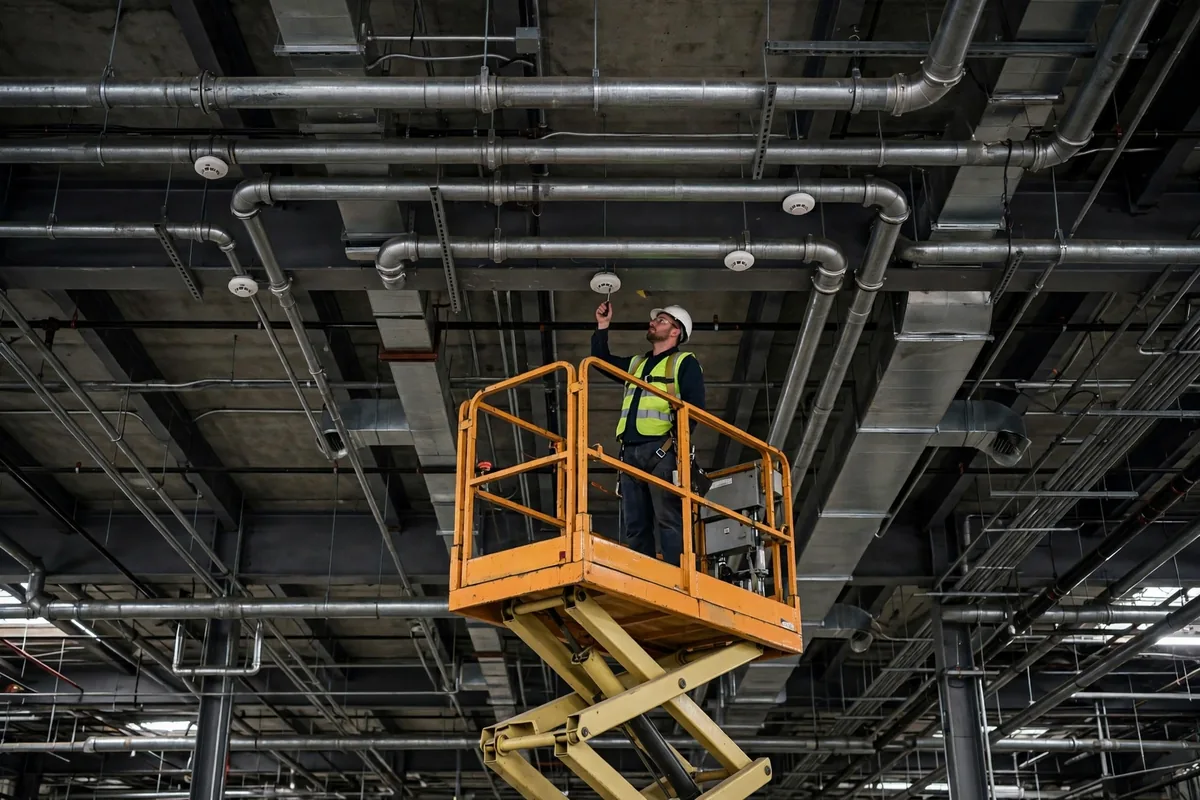
The maintenance rhythm has hard rules behind it. The fire alarm code calls for smoke detectors to be functionally tested at least annually, with sensitivity testing within the first year after installation and then every 2 years; confirm the current edition against the official source for your jurisdiction. Service life is generally 10 years from the date of manufacture, so replace detectors on schedule instead of waiting for sensitivity to drift out of range. In many warehouses the false alarm bill traces back to detectors past their service life with sensing chambers clogged by dust — a clean and a test would have fixed it months before it became a monthly event.
On the response side, the code provides a positive alarm sequence: trained on-site staff may investigate a single-zone alarm at the panel for up to 3 minutes before the system transmits the signal and starts occupant notification. It requires approval from the local authority having jurisdiction, it does not suit every occupancy, and the current rules should be confirmed against the official source. Those 3 minutes are not for silencing the alarm. They are for walking to the zone with a radio and confirming — and if you cannot confirm, you let the signal go and evacuate. A warehouse without that routine leaves the guard two bad choices: treat every trip as real and evacuate everyone, or reset on instinct. Both are expensive.
One line must never be crossed: never turn the sensitivity down on your own. It buys two fewer soundings and puts the entire missed-detection risk on you. When the investigation report lands, an undocumented sensitivity change has nowhere to hide. The savings lever is not on the sensitivity dial. It is in the maintenance rhythm and the response routine.
The warehouse smoke detector false alarm checklist
Confirm: read the panel, note the zone and detector number, walk the floor in pairs with a radio and a flashlight, and check by smell, sight, and touch for smoke, flame, or hot equipment. Reset: reset only after confirming there is no hazard, and log the reset time and the person who reset it. Any detector that trips twice in a month gets reported for service the same day — do not wait for a third trip. Record: log every warehouse smoke detector false alarm with time, zone, detector number, likely cause, and minutes of stopped work, then total it monthly, because the count and the lost hours are your hardest numbers at the next budget discussion. Review: clean a repeat-tripping detector and test its sensitivity, replace it if sensitivity falls outside its listed range, and swap out detectors past 10 years on a planned rolling schedule instead of waiting for a batch failure.
Take your last 12 months of false alarms, the average stopped minutes per event, and the headcount on site, and run them through the table above. The annual figure that comes out is the strongest card you will hold in next year's fire protection budget negotiation. Work it out and you will find that one fewer false alarm a year pays for a full round of sensitivity testing across the warehouse, with money left over.
By Lao Zhou, Logistics Cost Analyst