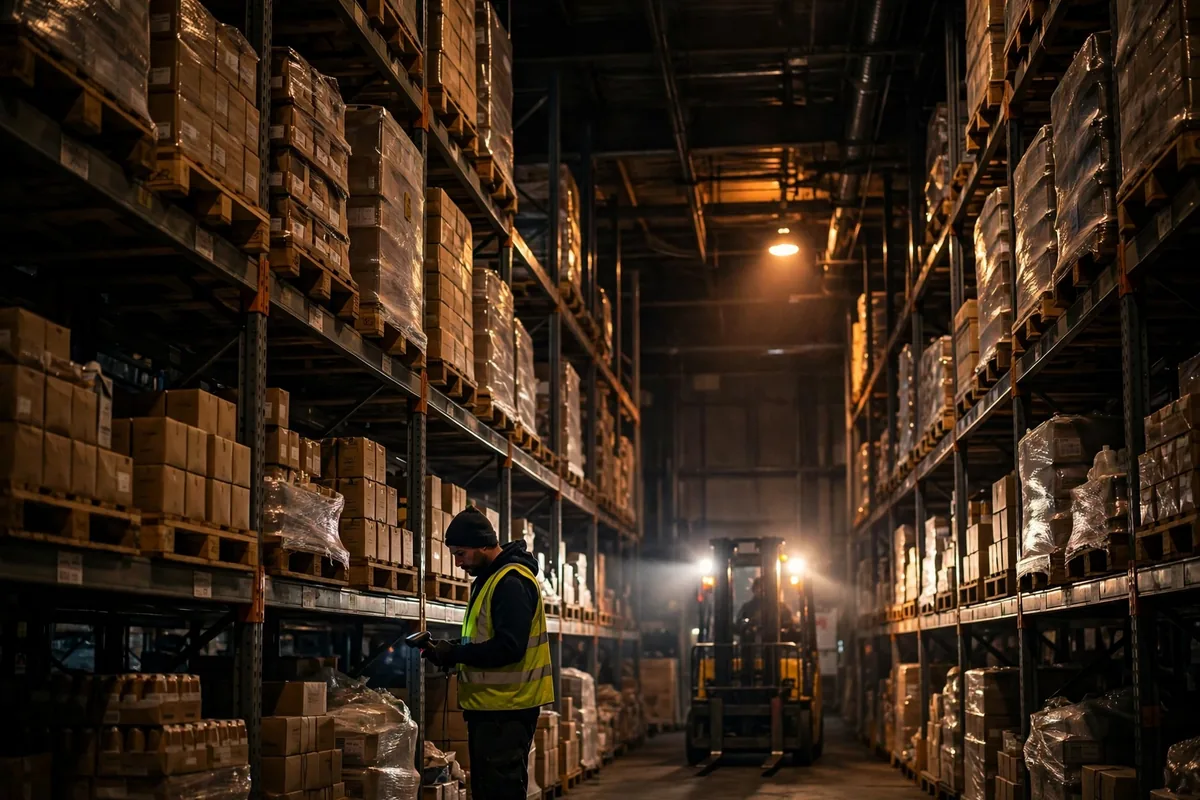
Start with one number: a warehouse shipping 8,000 orders a day runs a night shift from 10 p.m. to 6 a.m. with 40 people, and in eight hours they pick 2,400 orders. How much extra does that shift cost in night premiums? How much slower is it than the day shift? And what do fatigue-driven accidents and errors add on top? Add those three numbers together and many warehouses are losing money on the night shift. They just lose it quietly, because nobody has ever costed it separately. Every figure in this article is an illustrative assumption, used to make the structure visible. Swap in your own warehouse's real numbers before acting on any of it.
Where the night shift money goes
A night shift costs more than a day shift in three places, and the first one is the visible one. First, the premium: night allowances, meal money, transport subsidies. A few dozen currency units per person per night adds up to two or three thousand per shift for a 40-person crew, sixty to eighty thousand a month, seven to eight hundred thousand a year. Second, energy and supervision: lighting, air conditioning, forklift charging, security, and a supervisor who either works the night or leaves the floor unmanaged the next day. The lights are on all night whether the crew is complete or not. Third, and easiest to miss, is the cost of managing nights at all: rosters get more complicated, cover is harder to find, and handovers eat management time.
Add the three together and the direct cost of a night shift usually runs well above a day shift producing the same output. The problem is that most warehouses only count the first item. The premium is visible on the payroll; the other two hide inside the electricity bill and the management overhead. By year-end, labour cost as a share of revenue has crept up, nobody can say which part grew, and the night shift rolls on for another year.
How much slower is the night shift, really?
The biggest cost of a night shift is not the premium. It is the productivity discount. Take picking: a day-shift picker manages 60 lines an hour; at night, walking the aisles under artificial light, fighting drowsiness, the same person drops to 45 lines or fewer. That is a 25 percent discount. Forty people over eight hours should theoretically produce 3,200 orders; in practice they produce 2,400. The missing 800 orders are not work that nobody did. They are work the night could not do. Converted to cost per order, that shortfall is the equivalent of paying for ten extra people and getting nothing from them.
The productivity loss has a knock-on effect. One wrong pick at night takes three times as long to fix in daylight: check the camera footage, find the goods, reship, apologise. Worse, night-shift errors are usually discovered the next morning, after the goods have already left on the truck, when intercepting them costs far more than correcting them inside the building. Any honest costing of a night shift has to fold the productivity discount and the error cost into the cost per order. Counting only the premium is self-deception.
A 3PL warehouse handling apparel once ran this calculation, again on illustrative-assumption numbers: six weeks of peak-season night shifts lifted volume, but the error rate climbed from 0.3 percent in the day to 0.8 percent at night, and returns and reshipping ate the extra margin the night shift had earned. The warehouse switched the night shift to a day shift starting two hours early. Volume fell by less than 5 percent, the error rate returned to 0.3 percent, and monthly labour cost actually dropped. A night shift can produce volume, but some of that volume carries error costs with it, and the margin has to be discounted accordingly.
Fatigue costs more than the premium
The hours between 3 a.m. and 5 a.m. are when the human body is at its lowest ebb, and they are also the peak window for warehouse accidents. A forklift turning between racks, a picker walking under high-bay storage, a reaction slowed by half a second: half a second in a warehouse is one collision, one falling carton, one injury. The direct cost of even a minor injury covers medical treatment, lost days, cover staff, and higher insurance. The indirect cost covers morale, safety inspections, and a roster thrown out of shape. Together they often exceed a whole crew's monthly night premium.
Controlling fatigue is a rostering problem, not a motivational one: no more than three consecutive night shifts, light work rather than high-bay work in the dead hours, forced rest rotation for forklift drivers, and a night supervisor walking the floor every hour instead of sitting in an office. One more hard rule: night-shift accidents and errors must be counted separately, never blended into the day-shift figures, or management will never see the true risk level of the night. Rotation itself can be costed: one extra person on rotation costs a few thousand a month, and buys the avoidance of one injury whose direct and indirect costs are often ten times that amount. On the numbers, that exchange pays.
Is the night shift worth it? One table decides
Whether a night shift is worth it comes down to a simple comparison: does the extra money buy something the day shift cannot buy at any price? The most common reason is the carrier cut-off. If parcels must be collected by 2 a.m., a warehouse that does not work nights misses the truck and breaks its next-day delivery promise. That reason only holds if the orders picked at night genuinely need that truck. If half of the 2,400 orders picked overnight could have waited until morning, the night shift is paying for an urgency that does not exist.
Before deciding, fill in this table. The figures are illustrative assumptions:
| Option | Labour cost per order | Cut-off met | Error rate | When it fits |
|---|---|---|---|---|
| Run a night shift | About 30% higher | High | High | Cut-off is in the early hours and orders truly cannot wait |
| Extend the day shift by 2 hours | About 12% higher | Medium | Low | The volume gap is small |
| Stagger receiving and pre-pick | Unchanged | Medium | Low | The cut-off can be negotiated and customers will accept it |
Once the table is filled in, the conclusion usually draws itself. When the volume gap is small, two extra hours on the day shift is the cheapest fix. When the cut-off can be negotiated, staggering the work beats staying up all night. Only when the cut-off is fixed and the volume genuinely cannot be done in daylight is the night shift the right answer. A night shift is not forbidden. It just has to be costed down to the cost-per-order level before it is approved: how many nights, how many people, and what time it ends.
By Lao Zhou, Logistics Cost Analyst