Here's the verdict up front: for a mid-size warehouse running 40 truck trips a day, sitting 5 minutes closer to the highway exit saves roughly $100,000 a year in fuel and driver hours alone. When people pick a site, they haggle over rent down to the dime per square foot — but almost nobody runs the math on those 5 minutes of road.
In 2019 I was helping a client look at warehouses in the Inland Empire. Two finalists: Site A sat right off the highway — three minutes from the off-ramp to the gate, slightly higher rent. Site B was cheaper, saving $60,000 a year in rent, but 12 minutes from the exit with two traffic lights in between. The boss leaned toward B: "Sixty grand a year, that's $300,000 over five years." I told him to hold on and run the fleet numbers first.
How the math actually works
It's not complicated. Four inputs: daily truck trips, extra miles per one-way trip, fuel economy and diesel price, driver hourly cost.
Start with mileage. Five minutes at 60 mph is about 5 extra miles each way — 10 miles round trip. That's the extra portion, not the total trip. Forty trips a day, 250 working days a year: 40 × 10 × 250 = 100,000 miles.
Now fuel. Heavy trucks average around 6.5 miles per gallon (typical for US long-haul fleets; worse trucks do worse), diesel at $4 a gallon (California runs higher): 100,000 ÷ 6.5 × 4 ≈ $61,500. That's $61,500 a year just in extra diesel burned.
Then driver time. Ten extra minutes round trip, 40 trips — that's 400 minutes, about 6.7 hours a day. At a fully loaded driver cost of $28 an hour (wages, payroll tax, benefits): 6.7 × 28 × 250 ≈ $46,900.
Add them up: $108,400 a year. Site B saved $60,000 in rent and burned nearly $110,000 in extra transport cost — a net loss of $50,000. And that excludes the tire wear and maintenance from 100,000 extra miles. The boss looked at the spreadsheet and signed Site A on the spot.
A note on the assumptions, so you don't misapply the formula. The 6.5 mpg figure assumes a decent fleet; older trucks, heavy loads, and lots of surface streets can drag it to 5.5, which pushes the fuel line up another 18%. The $28-an-hour loaded driver cost reflects the Inland Empire market around 2024–2025 — the Bay Area and the Northeast run higher. And 250 working days assumes Monday-to-Friday minus holidays; an e-commerce warehouse running peak season year-round should use 300. Plug in your own fleet's numbers and the dollar figure will move, but the direction of the conclusion rarely does. The point of the exercise was never a precise-to-the-dollar answer — it's getting rent and transport on the same spreadsheet.
Three add-ons people always forget
First, on-time performance. A warehouse far from the exit pushes drivers through surface streets, traffic lights, and congestion — one late pickup appointment can mean an extra hour in the dock queue. Late penalties written into 3PL contracts are common, a few hundred dollars a pop, and they add up.
Second, driver turnover. Veteran drivers keep score. A route that adds 20 minutes of city driving every day and always misses lunch is the hardest route to staff. Replacing one driver — recruiting, training, the ramp-up productivity loss — is widely estimated at $5,000 to $8,000 in this industry. An awkward route design quietly pushes your turnover above everyone else's.
Third, rush-order responsiveness. When a customer drops an emergency order needing shipment within two hours, a dispatcher with a warehouse three minutes from the exit says yes with confidence. Twelve minutes away, they hesitate. Over time, that decides whether you can take rush business and charge rush fees.
How to evaluate those 5 minutes during site selection
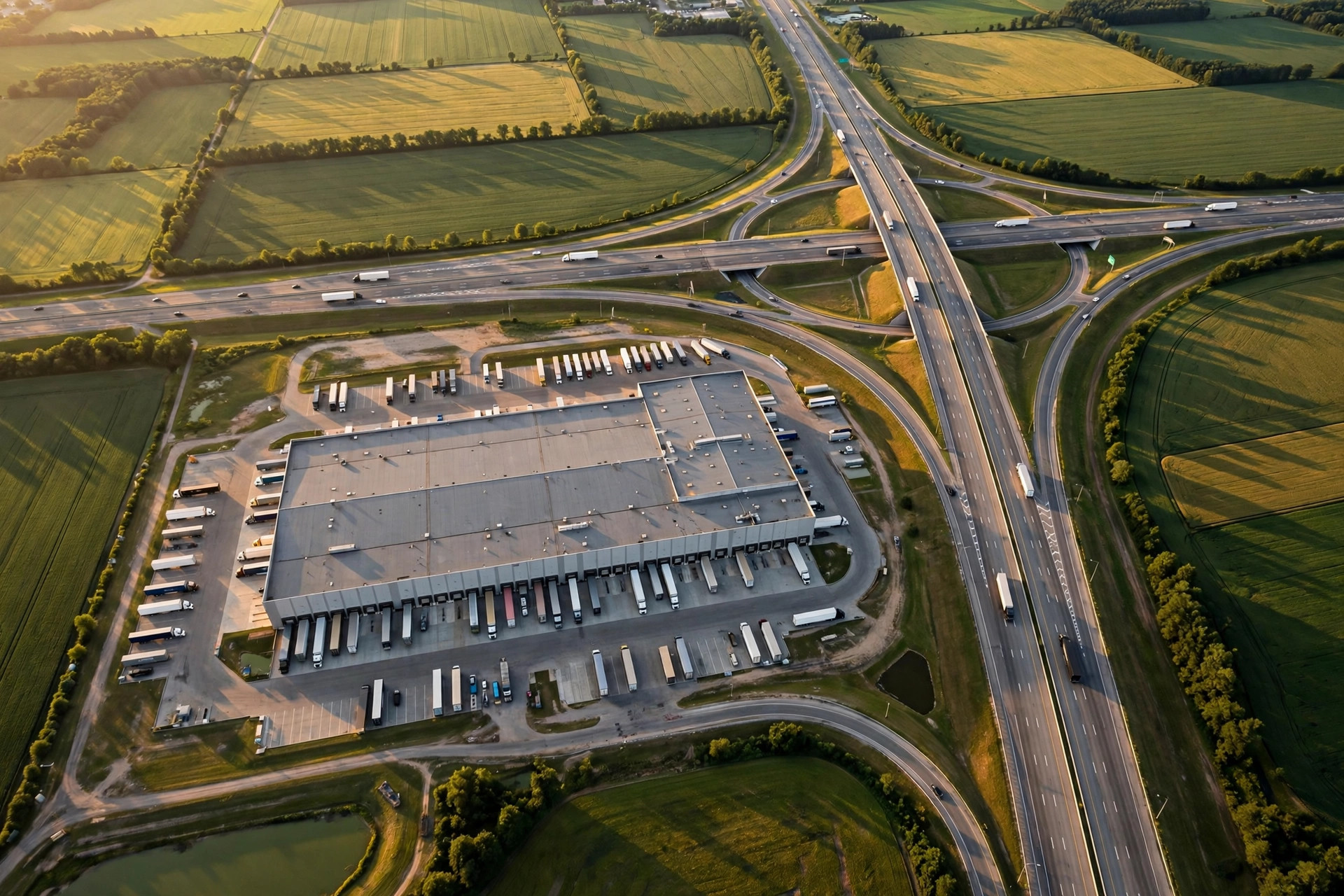
Check the real ramp distance — drive it on a map during morning and evening rush, don't trust "2 miles as the crow flies." Some warehouses look close to the highway but require a big loop, or the ramp is in perpetual construction.
Check the last mile in and out. A 12-foot country lane where two trucks can barely pass, plus ice in winter — that's a few days of semi-paralysis every year. Road width, turning radius, height and weight limits: drive it yourself before signing the lease.
Check the direction. Which side of the exit the warehouse sits on decides whether your main freight flow runs with the grain. If 80% of your freight heads toward the ports of LA and the warehouse is on the wrong side of the interchange, every truck starts the day with a U-turn — add that to the 5-minute math.
Check the three-year road outlook. Is the city planning new logistics parks near that exit? A three-minute drive today can become fifteen minutes in three years. That's on the city planning department's website, or ask the broker for a traffic study.
When you can stop caring about the 5 minutes
Fair is fair — three cases where it matters less:
Pure storage plays with slow inventory turns — a handful of trucks a week. Transport is a rounding error; cheap rent wins outright.
Small private fleets shipping mostly LTL and parcel — the linehaul cost isn't on your books, so exit proximity barely moves your numbers.
And rent gaps so wide they swallow the math. Core Inland Empire versus the outskirts can differ $3–4 per square foot per year — $300,000 to $400,000 a year on a 100,000-square-foot building, which covers the $100,000 transport cost. But even then, run the numbers before deciding. Never go on gut feel.
One last line for anyone touring warehouses right now: rent is the visible number in the contract; those 5 minutes on the road are the hidden number in your operations. Everyone can read the visible one. The people who can price the hidden one are the ones who actually know how to pick a site. Next time a broker shows you a building, don't ask about rent first — open the map and find the highway exit.
Here's the quick site-visit checklist I keep on my phone — ten minutes on site: 1) drive the exit-to-gate route in both rush hours and log the minutes; 2) photograph the last-mile road width, turning radius, and height limits; 3) check whether your main freight direction runs with the grain of the interchange; 4) look up the city's three-year plan for new logistics parks nearby; 5) multiply daily trips × extra one-way miles × 250 days for annual extra mileage, convert to fuel dollars, and add driver hours. Fill in all five, put Site A and Site B side by side, and the answer writes itself.