Taking over a secondhand warehouse? Before you sign, stop calculating how much rent you're saving. Start calculating how much the previous tenant's mess will cost you to fix.
Here's the most common math I see: a 6,000 sqm secondhand warehouse rents for RMB 5/sqm/month less than a new one nearby. That's RMB 360,000 a year, over a million across a three-year lease. Sounds like a steal. Then the bills arrive. The previous tenant stored paper products — low fire-risk goods — so the sprinkler system was built to that standard. You move in auto parts (a higher fire-risk category), and the sprinklers, alarms, and fire compartments no longer comply. Partial retrofit: over RMB 300,000. The floor spent a decade under the previous tenant's forklifts — dusting, cracking, uneven. Grinding it down and re-coating: RMB 200,000, easily. The racking they "left for free"? A third of it fails inspection — rusted uprights, bent beams — and replacing it costs another RMB 200,000+. Add it up: RMB 700,000+, plus six weeks of downtime. That million you "saved" on rent just shrank by two-thirds. Whether that money was well spent depends entirely on what you inspected before signing.
Secondhand warehouse takeover: the three hidden bills
Ninety percent of the traps sit in the building itself, not the equipment. Forklifts, AMRs, and pallets are a separate calculation — today is about the property: fire protection, flooring, and racking.
| Risk area | Typical problems | Retrofit cost (market estimate; get written quotes) | Schedule impact |
|---|---|---|---|
| Fire protection | System no longer matches your goods' fire-risk category after change of use: sprinkler density, alarm linkage, fire compartments | Partial sprinkler + alarm retrofit: tens of RMB/sqm; full rebuild: 100+/sqm | 30–60 days incl. re-inspection |
| Flooring | Dusting, cracking, unevenness from years of heavy forklift traffic | Patch + re-coat (hardener/epoxy): tens of RMB/sqm | 15–30 days incl. curing |
| Racking | Rusted uprights, deformed beams, no inspection report | Third-party inspection: a few thousand RMB/warehouse; replacement priced per bay; 20–40% scrap rate is common | 10–20 days |
(Treat the table as directional: recent market ranges from the Yangtze River Delta and Pearl River Delta. Anything without a written quote goes into your budget at the top of the range.)
Bill one: fire protection — the most expensive, and the only one that's legally non-negotiable
Fire systems are approved for a specific use. The previous tenant's fire acceptance was granted for whatever they stored. Paper and apparel are low fire-risk categories; auto parts, e-commerce general merchandise, anything with lithium batteries sit higher. Change the goods, and the old sprinkler layout, alarm linkage, and compartment design stop complying. Since the 2019 revision of China's Fire Protection Law moved fire acceptance to the housing and urban-rural development authorities, re-filing after a change of use is mandatory. Ignore any broker who tells you "it worked for them, it'll work for you."
A case from early 2024: an auto-parts trader in Kunshan took over a 6,000 sqm secondhand warehouse previously used for paper products. No fire engineer walked the site before signing. After signing, the inspection firm found sprinkler coverage inadequate for the higher risk category and alarm linkage missing. The partial retrofit cost over RMB 300,000, and re-inspection took 45 days — 45 days of rent paid with zero goods moving in, which quietly added another six figures in hidden losses.
Pre-signing checklist:
- Ask the landlord for the last fire acceptance document — check what "intended use" it was approved for.
- Match your goods against the fire-risk categories (A, B, C, D, E — from flammable down to non-combustible) and pay a fire contractor for a written condition survey.
- That survey is your negotiating weapon: delivering a fire-compliant building is the landlord's basic obligation. The retrofit bill belongs mostly to them.
A few thousand RMB on a survey before signing, versus hundreds of thousands on a retrofit after. The difference is one word: before.
Bill two: flooring — the best liar in the building
Floors lie. Walk the warehouse and it looks "fine"; put a forklift on it and the truth comes out: dusting that eats tires, cracks that rattle pallet jacks, unevenness that loads racking uprights unevenly.
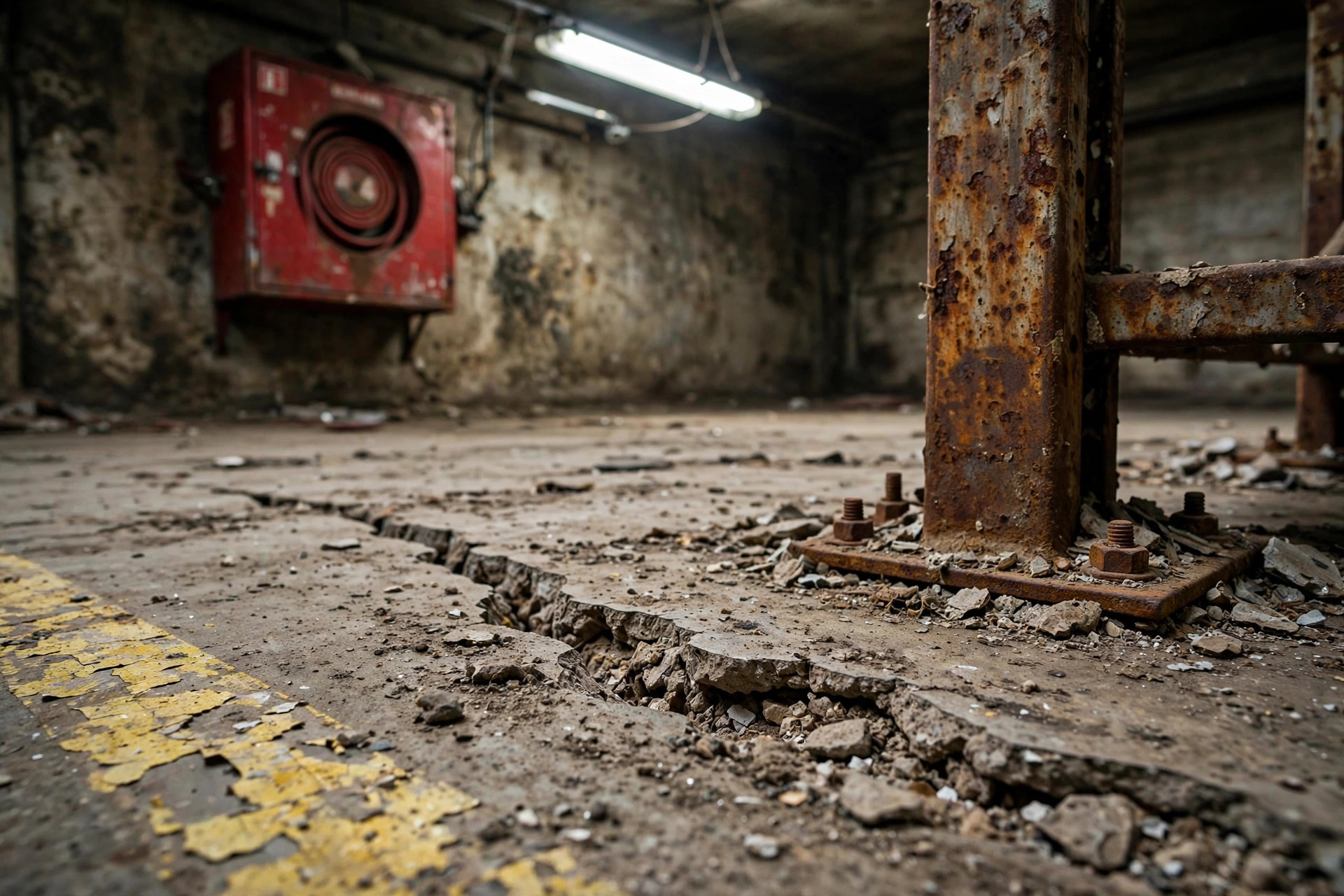
A 2023 case in Dongguan: an e-commerce company took over a 4,000 sqm warehouse with a decade-old plain concrete slab. The previous tenant's forklifts had run it hard for years — severe dusting, cracks everywhere. Within two months, tire wear was running at more than double the normal rate, and a pallet jack tipped goods twice crossing a cracked strip. They ended up shutting down for two weeks to grind and re-coat the floor: about RMB 200,000. Had they surveyed the floor before signing, that money could have been negotiated into the landlord's handover standard.
Checklist:
- Run a 3-meter straightedge over the slab. Cracks wider than 3 mm or dusting across more than 10% of the area — budget for a full re-coat.
- Ask what the previous tenant did. Heavy machinery, cold chain (ripping out insulated panels wrecks floors), chemicals — assume the floor needs redoing.
- Re-coating needs curing time (7–15 days for hardener or epoxy systems). Build it into your go-live plan.
Bill three: racking — the "free gift" that might be a liability
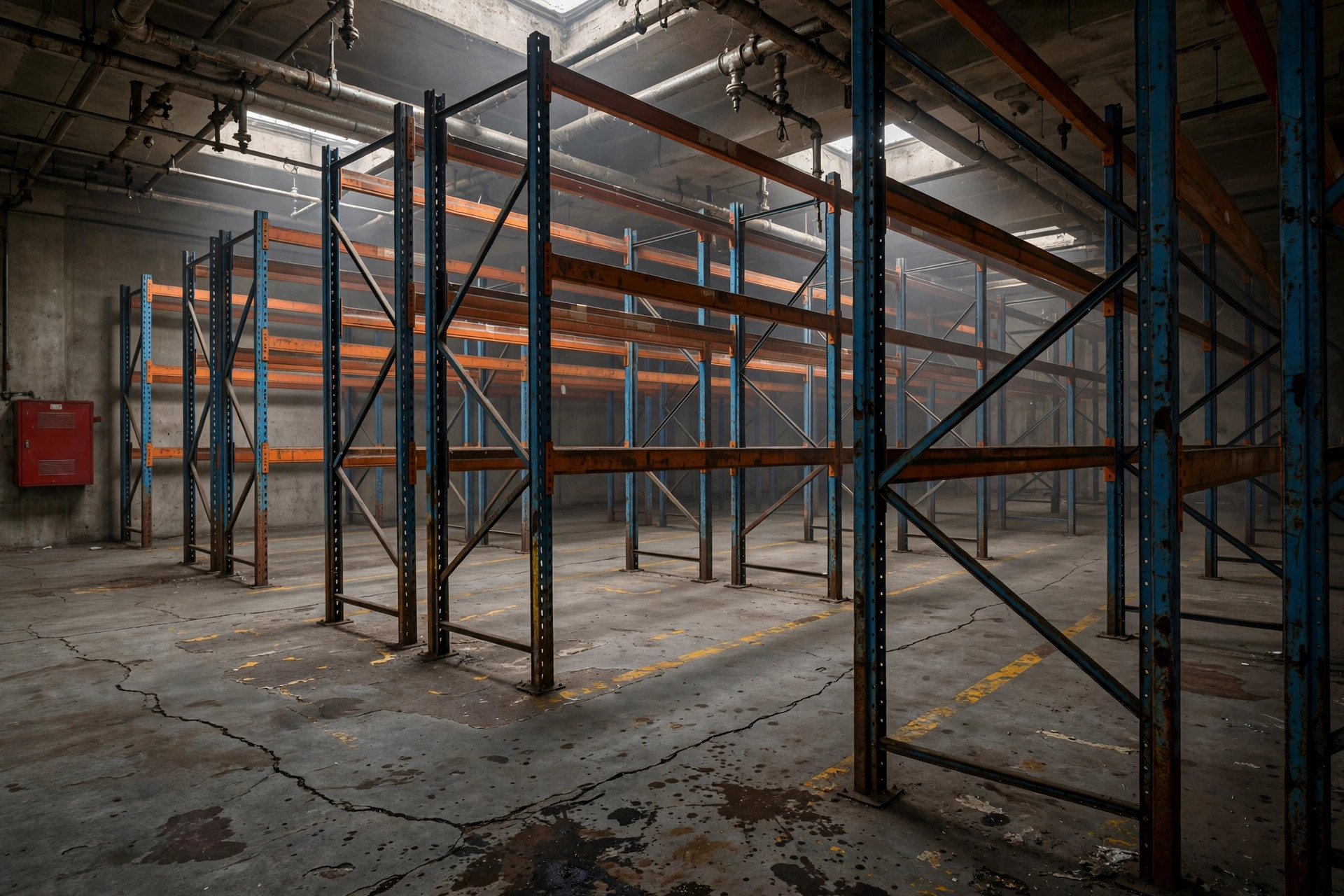
Landlords love to say the old racking comes "free." Hold the applause: rusted uprights, bent beams, missing inspection reports — any one of those means that bay can't go straight back into service.
Do the math this way: a third-party racking inspection costs a few thousand RMB and covers the whole warehouse. After inspection, expect a 20–40% scrap rate on old racking. Replacement selective racking is priced per bay, from a few hundred to over a thousand RMB each. For a 6,000 sqm site, RMB 200,000+ in racking replacement is unremarkable.
Here's the counter-intuitive call: treat inherited racking as a liability by default, not an asset. Budget as if all of it needs replacing; whatever the inspection clears is found money. Budget the other way — assuming it's all usable — and a failed inspection blows up your cash flow. People who work in costs always budget pessimistic.
Three levers to cut the retrofit bill
Bills calculated; now the savings. Three levers:
- Make the right party pay. Fire compliance is a handover obligation of the property. Walk into negotiation with the survey report and push the bulk of the fire retrofit onto the landlord — or convert it into rent-free months. If they won't move, walk away: a warehouse needing RMB 500,000 in fire work is expensive at any rent.
- Survey reports are bargaining evidence, not costs. A few thousand RMB on fire, floor, and racking surveys before signing routinely negotiates ten times that in rent concessions and cost-sharing. The highest-ROI spend in the whole deal.
- Phase it: compliance first, cosmetics later. Fire and structural safety get done in one shot. Wall paint, lighting upgrades, office fit-out can wait until after move-in. Cash flow dies by the month — don't fire all your bullets at once.
The computable conclusion: is this secondhand warehouse actually cheaper?
The takeover decision is one line of arithmetic:
True monthly cost = quoted rent + total retrofit cost ÷ lease months + downtime losses ÷ lease months
Run that number against the rent of a comparable new warehouse nearby. If the secondhand unit still wins, sign. If it's close — or worse — walk away without a second thought.
One rule to remember: every yuan you save on a secondhand warehouse's rent has to be re-counted against the fire, floor, and racking bills. What survives the math is a bargain. What doesn't was never cheap — it was just priced to look that way.
By Lao Zhou, Logistics Cost Analyst