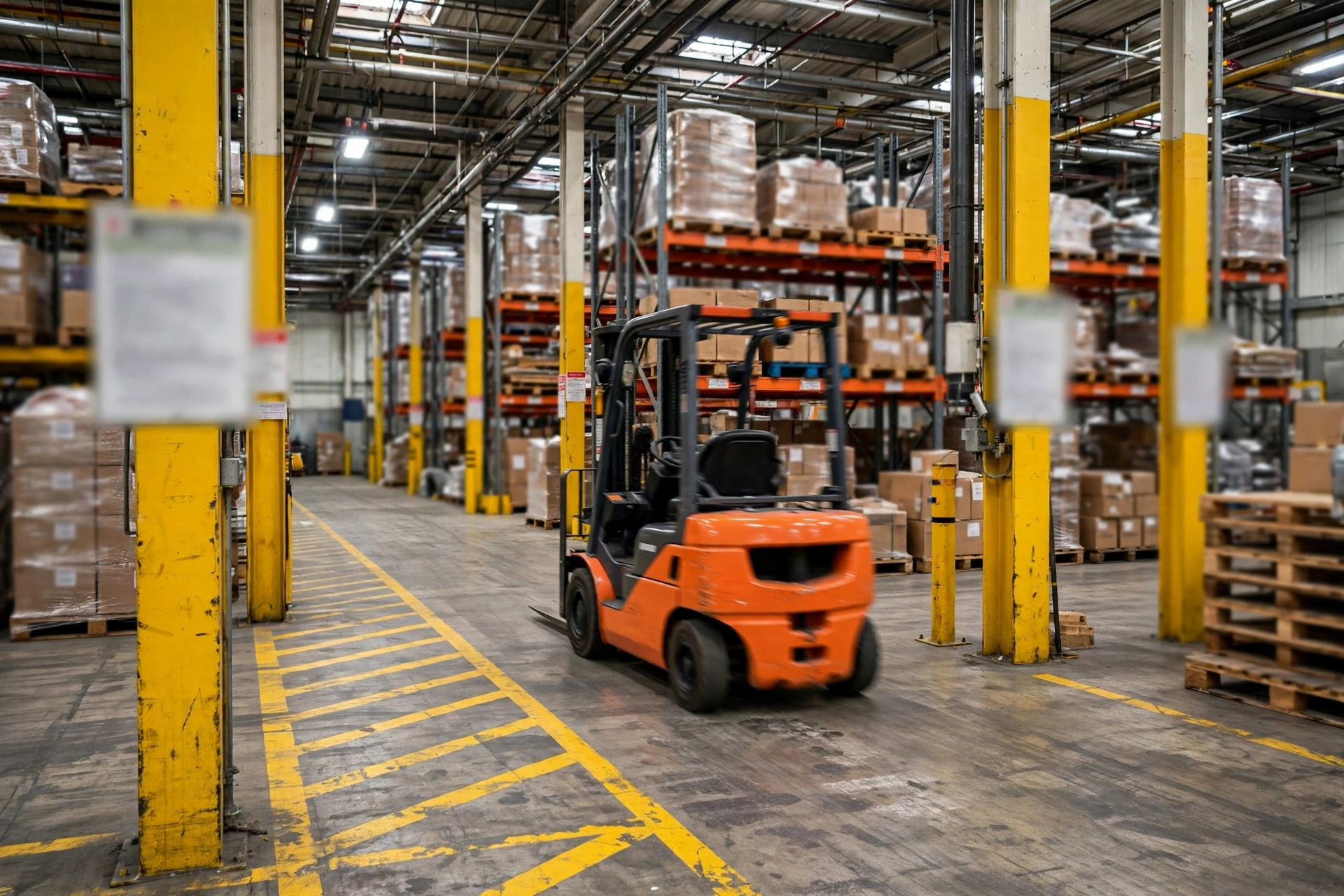
Here's the uncomfortable truth for anyone Googling what signs are required in a warehouse under OSHA: the master list doesn't exist. 29 CFR 1910.145 never hands you a checklist of signs to hang. It tells you what the signs must look like — the colors, the formats, the signal words. What you actually need to hang is scattered across other standards: exits live in 1910.37, extinguishers in 1910.157, color coding in 1910.144. So the question splits in two: which areas need marking, and what the markings must look like.
Frankly, what most people really want to know is simpler: when the inspector walks in, which missing sign gets me fined?
I've watched too many warehouses learn this the expensive way. Fall of 2023, I was doing an operations review at a 3PL apparel warehouse in Fontana — 120,000 square feet, close to 200 temps on the floor for peak season. Walking in, the first thing I noticed: a bright red Danger sign on the forklift battery charging room. Ventilation was fine, no real hydrogen risk — an ordinary charging area wearing the highest-level warning in the book. The yellow-black edge striping at the dock doors was buried under pallets that had sat there for weeks. And the wall-mounted fire extinguisher? Half-hidden behind a stack of cartons. Three months later the place got inspected — triggered by an employee complaint. Two citations were signage items: an exit sign blocked from view by staged freight, and zero documented training on Danger vs. Caution. Five figures total. The owner told me, "But we hung the signs." The inspector's answer was pure OSHA: hung where nobody can see them is the same as not hung.
Since then I've had a habit: every warehouse I walk into, I look at the signs before I look at the freight.
The Three Colors: A Red Sign Is Not for Scaring People
1910.145 sorts signs into three classes, and the colors are non-negotiable:
- Danger — red, black, white. Red oval, white "Danger" lettering, black border. This is the top tier: immediate danger, as in death or serious injury if you don't stay clear. Electrical panels, confined-space entries, battery rooms with genuine hydrogen accumulation risk. The standard adds an explicit duty: every employee must be instructed that Danger signs mean immediate danger. Not "able to read" — instructed. Inspectors really do ask how you trained people on the three classes.
- Caution — yellow background, black lettering. Potential hazard, avoidable with care. Forklift aisles, dock edges, low overhead beams, wet floors. Yellow-on-black is one of the most visible combinations in low light, and that's human-factors engineering, not decoration.
- Safety Instruction — white background, green panel, white letters. Instructions, not warnings: extinguisher here, first-aid kit there, eyewash station ahead, muster point in the parking lot.
Here's a counterintuitive detail: those orange Warning signs you see everywhere aren't native to OSHA 1910.145 — they come from the ANSI Z535 system. OSHA's own classes have no orange tier. In practice inspectors widely accept Z535-style orange Warning signs — nobody gets fined for hanging one. But putting an orange sign where Danger belongs changes the meaning: Danger says "this will kill you," Warning says "this could go badly." Downgrading dilutes the warning.
So rule number one: don't overuse Danger. I once walked a warehouse where even "wet floor" got the red treatment — an entire wall glowing red. By the time workers reach the actual electrical room, they glance and keep walking. Red everywhere means red nowhere. That's sign blindness: the more signs you hang, the less each one warns. A misused Danger sign is worse than no sign.
What Signs Are Actually Required in a Warehouse?
This is the working checklist I use on compliance walkthroughs. Left column is the zone, right column is the sign and its basis:
| Zone | What to hang | Color / basis |
|---|---|---|
| Every exit | EXIT sign, letters at least 6 inches high, lit by a reliable light source | 1910.37; doors that look like exits but aren't get "Not an Exit" |
| Egress paths | Directional arrows; line of sight must never be blocked | 1910.37: line-of-sight clearly visible at all times |
| Forklift areas | Caution: forklift traffic, pedestrian separation | Yellow |
| Dock edges | Caution plus yellow-black floor striping | Yellow; the floor line beats the wall sign (see below) |
| Extinguishers / hose stations | Safety Instruction: location marking; extinguishers must be readily accessible | Green/white; 1910.157: visual check monthly, professional service yearly |
| First aid / eyewash | Safety Instruction: location marking | Green |
| Battery / charging rooms | Danger (if real hydrogen risk) or Caution | Red/yellow, matched to actual risk |
| Electrical panels / confined spaces | Danger | Red — immediate hazards only |
| Rack aisles | Load-capacity plaques per beam level | Not spelled out by OSHA, but inspectors and insurers both ask |
Extinguishers deserve a word, since this is where warehouses fail most: 1910.157 requires a monthly visual check — gauge, seal, cylinder, and whether anything blocks access — plus annual professional service with records kept at least a year. In ordinary combustible areas, nothing should sit more than about 75 feet of travel from an extinguisher. On walkthroughs I always check what's stacked in front of them. Six or seven out of ten warehouses fail that check.
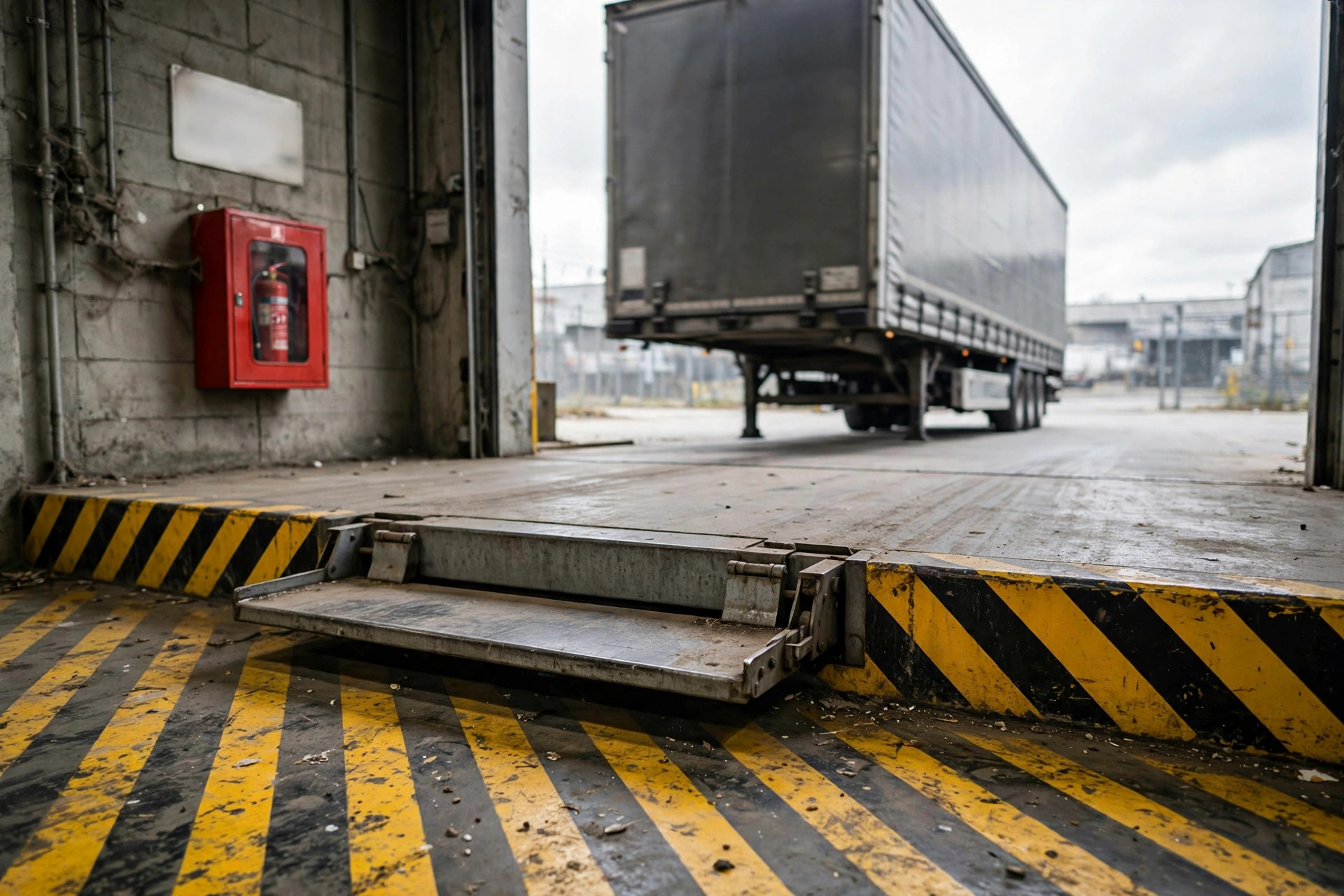
My eight-item walkthrough list: exit signs big enough and lit; egress sightlines clear of pallets; "Not an Exit" on look-alike doors; forklift aisle lines legible; dock edges striped; extinguishers unblocked with monthly tags punched; Danger signs only where danger is real; and ask two random employees what Danger vs. Caution means — if they can't answer, your training requirement is hanging by a thread.
Where Warehouses Go Wrong on OSHA Signage
The Fontana citation that stuck with me wasn't about a missing sign — it was a blocked one. OSHA's exit-marking rule has a hard line: the line-of-sight to an exit sign must be clearly visible at all times. Their sign was compliant — 6-inch letters, lit — but peak-season staging had narrowed the aisle, and from the main walkway you could only see half of it. The inspector's logic: a sign your people can't see in an emergency is not a sign.
Another one: a 50,000-square-foot operation in Ontario hung a Caution sign about the dock edge nearly 10 feet up, above the door. Good intention — but a driver backing up watches the ground and the mirrors. Nobody looks 10 feet up. We moved the sign to the door column at eye level and painted yellow-black chevrons on the floor. The driver: "The floor line works better. I catch it in my peripheral vision."
The point: signage compliance has three layers. Layer one, the colors and formats are right. Layer two, the placement is right — in people's natural line of sight, never blocked. Layer three, people actually know what the signs mean. Most warehouses pass layer one and fail layers two and three.
The Math: A Full Signage Package Costs Less Than One Citation
The honest arithmetic: a compliant aluminum sign runs fifteen to twenty bucks. A full signage package for an 80,000-square-foot warehouse, installed, tops out at two or three thousand dollars. For 2026, OSHA's maximum penalty for a serious violation is $16,550 per violation (adjusted annually for inflation — that's the 2026 figure on osha.gov), and willful or repeated violations start at $165,514.
| Item | Cost |
|---|---|
| One compliant sign | $15–20 |
| Full warehouse signage + install | $2,000–3,000 |
| One serious citation, maximum | $16,550 |
| No documented training on the three sign classes | An easy extra citation |
You don't need a spreadsheet: signage is the cheapest safety investment in the entire building, and it's not close. The Fontana owner later spent a couple thousand redoing every sign in the building. His words: "If I'd known two grand would have saved me five figures in fines, I'd have done it five years ago."
So if you're still asking what signs are required in a warehouse, here's the short answer: fewer than you think, placed better than most, and understood by everyone on the floor.
One piece of advice, and one homework assignment: before you leave tonight, walk your own warehouse and count three things — how many signs are blocked from view, how many Danger signs only deserve a Caution, and how many extinguishers have freight stacked in front of them. When you're done counting, you'll know exactly how far you are from a citation.
By Lao Mi, Supply Chain Veteran (20 yrs)