Our warehouse is 3,000 square meters with twelve people on the floor, and until last year our returns never had a real home — a textbook warehouse returns area layout mistakes story, except we were living it. Whatever a customer sent back, we opened it, checked it, and shoved it into the nearest empty slot. It was all inventory, right? Why would a small warehouse waste floor space on a dedicated returns area — that felt like a big-company luxury, and we are not a big company. We cannot afford big-company habits.
Then month-end inventory came around, and the bill showed up anyway.
A friend of mine runs a small home-appliance warehouse in Los Angeles, smaller than ours. Last November, during peak season, he was getting more than 40 returns a day. His returns sat on two pallets right next to the pick face, separated from new stock by a single aisle. In the middle of the rush, a new picker grabbed an air fryer off the returns pallet and shipped it as new — except that unit had been used for two weeks and had scratches inside the basket. The buyer complained, the marketplace docked his service score, and by the time he paid return shipping and sent a replacement, he was out nearly $200 on a $70 appliance. He told me he moved the returns pallets to the back of the warehouse that same night and taped a yellow box on the floor. Funny how fast a lesson lands once you have paid for it.
Our own numbers were not much better. In our March count, Zone B showed 17 variances, and 11 of them were returns: refurbished units sitting in the "to process" pile while the system showed them as sellable, and scrapped units still showing as available stock, so pickers walked over, found nothing, and walked back to ask. Four of us spent a whole afternoon untangling those 11 units. At our labor cost, that afternoon alone ran close to $400. That does not count the mispick risk during peak season.
Warehouse Returns Area Layout Mistakes: Where Mixing Actually Costs You
Most people think a returns area is just a place to put things, and that mixing saves floor space. It does not. The cost is not the floor. It is these three bills:
| Hidden cost | Rough monthly scale | How it happens |
|---|---|---|
| Mispicks and complaints | 2–5 orders a month in peak | A return looks identical to a new unit, and a busy picker cannot tell them apart |
| Recounting and hunting | 10–20 hours a month | Variances, searching, reconciling the system — one return can eat half an hour |
| Dead stock hogging good slots | 5–10 slots tied up permanently | Units never refurbished, never scrapped, sitting on slots that should hold sellers |
The first one hurts the most, because a mispick is never just one order. A bad review and a marketplace penalty chain into the next orders, and a small seller cannot absorb many of those. The second one is the most grinding: it never looks like a big expense, it just steals half an hour a day until you add it up at month-end. The third one is the most invisible: you start thinking you need a bigger warehouse, when really you gave your best slots to stock that will never sell again.
The Returns Area Deserves a Good Spot, Not a Leftover Corner
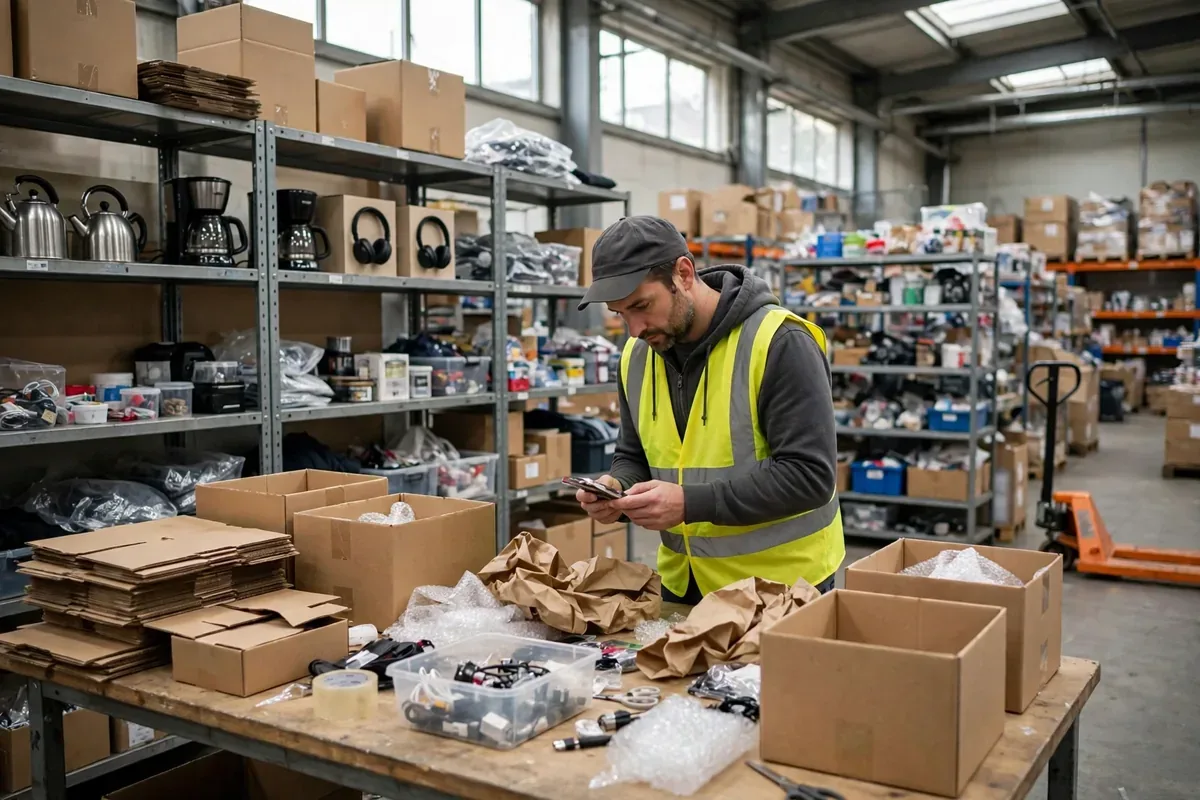
Here is the counterintuitive part, and the heart of most warehouse returns area layout mistakes: the returns area is not the leftover corner of the warehouse. It deserves one of the better spots. Why? Because returns get handled more than almost anything else — receive, open, inspect, sort, refurbish, restock, scrap. One unit passes through seven or eight touches. Shove that work into the dead far corner and you are paying your team to walk extra trips every single day. A good returns area sits close to receiving, with a clear boundary from the pick face. It does not need to be big. Ours is three pallet positions and one workbench, under 30 square meters, less than 1% of the floor. That is enough.
We fixed it in three steps, and anyone can copy this:
Step one, tape out a fixed zone. Yellow floor tape, a clear boundary, and a handwritten sign that says "Returns." Do not laugh at the sign. Without a sign there is no boundary, and without a boundary someone will stash new stock in there again by habit. Once the boundary exists, mixing stops being a habit and becomes a mistake you can see at a glance. New hires do not even need training — they see the yellow line and know this spot is different.
Step two, tag every return with one of three colors before anything else happens. Green means inspected and sellable, straight into the resale flow. Yellow means needs refurbishment or a replacement part, onto the refurb shelf. Red means scrap or return to supplier, off in its own corner. Update the system status when you stick the tag on. We used to resist this because tagging felt like an extra step. Then we realized that skipping it just moved the guessing to every later step, and the time we saved came back doubled.
Step three, clear returns on a fixed day every week. We picked Thursday afternoon: greens go back to stock, yellows get refurbished in one batch, reds go through the scrap process. A fixed rhythm keeps returns from quietly growing into a mountain. Before we had a rhythm, we cleared returns at month-end, and by then the season had moved on — units that could have sold at full price had to be cleared at a discount. A fixed day turns returns from an accumulating headache into a routine.
Three months in, the results are more solid than I expected: return-related variances fell from around 10 a month to 1 or 2, and we have not shipped a returned unit as new since. The best part is that Thursday afternoon has just become a habit for the team. Nobody treats it as extra work anymore.
Small warehouses have their own way of surviving — the returns area does not need to be big or expensive, but it needs a name, a boundary, and a rhythm. Floor space is fixed, but the bill is not. Whatever you save by mixing returns with good stock, month-end inventory will collect it back, with interest.
By Xiao Ma, Small Warehouse Owner