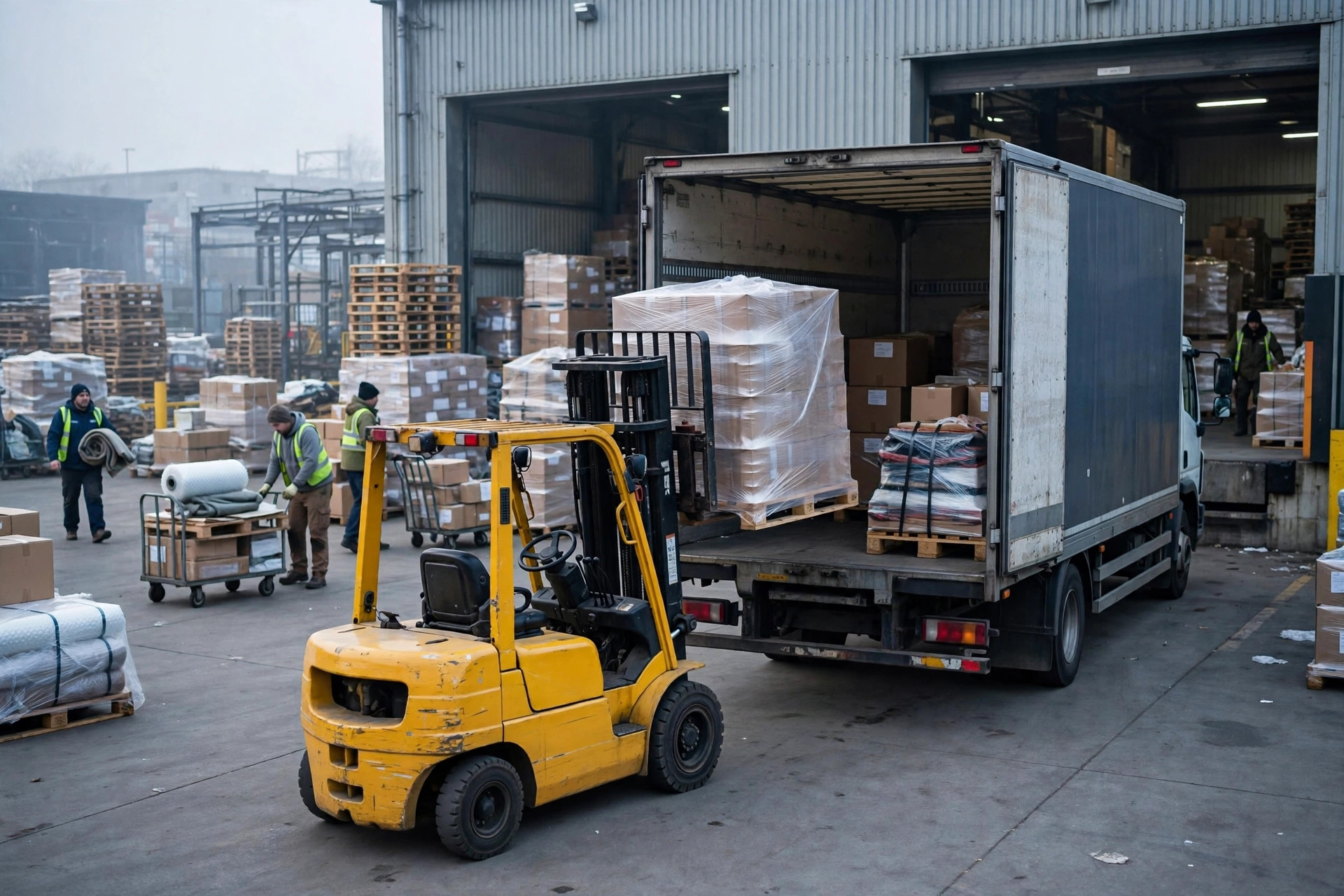
How to relocate a warehouse without downtime — keep every order flowing while the building changes underneath you. I've watched too many operators try to save money the wrong way here: skipping two months of parallel rent on the old and new buildings, then moving in the final week before the old lease expires. Let me put the numbers on the table. For a 50,000 sq ft facility, two months of overlap costs under $78,000. Two days of shutdown — backlogged orders, SLA penalties, overtime catch-up — starts at $120,000. This piece runs both calculations: (1) parallel rent versus downtime losses, and (2) a big-bang weekend move versus a phased move. My conclusion up front: everyone who tries to save the rent money pays it back double in downtime.
Where the Money Actually Goes: The Four Buckets of Relocation Cost
When people say "relocation budget," they usually mean the mover's quote. In my years of cost analysis, that is the budget line with the biggest gap between estimate and reality. A warehouse move has four buckets:
- Direct moving cost: the mover, racking teardown and reassembly, IT equipment, WMS cutover. For a 50,000 sq ft facility moving within 20 miles, expect $30,000–$50,000.
- Parallel-run cost: rent on the new building from day one of the lease, rent on the old one until you hand back the keys, plus double staffing, forklifts, utilities, and system licenses. National in-place industrial rent averaged about $9.31 per sq ft per year as of August 2025 (Yardi Matrix data), so a 50,000 sq ft building runs under $39,000 a month — roughly $78,000 for two months of overlap.
- Downtime losses: margin on orders you can't ship, customer SLA penalties, overtime to clear the backlog, customers you lose outright. Industry research puts warehouse downtime at $5,000–$100,000 per hour for operators (cited by FreightWaves) — the order of magnitude is what matters.
- Reconciliation cost: cycle-count labor to fix inventory mismatches, reshipment and refunds for mispicks, writing off phantom inventory in the system. This line never appears in any budget, yet nine out of ten moves I've analyzed paid it.
Bucket 4 is the nasty one. It shows up on no quote, so nobody defends against it — and it's usually the most expensive line on the final bill.
Run the full math on a 50,000 sq ft 3PL doing 3,000 orders a day. Mover's quote: $40,000. Parallel rent: $78,000. On paper that's $118,000, and it stings. Now skip the overlap and move in the last week of the lease: two days of shutdown at $8 margin per order means $24,000 a day in lost margin — $48,000 for two days; $20,000 in overtime to clear the backlog; $30,000 in SLA penalties from two big customers; $20,000 in recount and reconciliation labor when the books go sideways. That's $118,000 minimum, comfortably past $150,000 in practice. The $78,000 you "saved" turns into $40,000 extra on the settlement. That's the normal shape of a relocation budget: the visible money is small money, the invisible money is big money.
Downtime Math: Pricing the Risk of a Big-Bang Cutover
| Big-bang (one weekend) | Phased move (2–3 weeks) | |
|---|---|---|
| Method | Everything moves in 48 hours | Batches by SKU velocity over weeks |
| Mover's quote | High (weekend premium, extra crews and trucks) | Low (normal scheduling, 20–30% cheaper) |
| Parallel rent | ~1 month | ~2 months |
| Downtime | 0–1 day (timed to the weekend trough) | Theoretically zero |
| Inventory accuracy risk | Low (freeze once, reopen once) | High (two live books, easy to cross) |
| Reconciliation cost | Low | High — and unknowable in advance |
| Best for | Concentrated SKUs, strong execution team | 10,000+ SKUs, 10,000+ orders/day |
The phased move's total cost is systematically underestimated, for one reason: nobody budgets for the cost of untangling the books. It wins the quote by 20% and loses the settlement by 2x.
Same 50,000 sq ft facility, settlement-basis comparison. Big-bang: $45,000 move (weekend premium) + $39,000 parallel rent (one month) + $12,000 for half a day of downtime = $96,000, with one inventory freeze and reconciliation near zero. Phased: $32,000 move (30% cheaper) + $78,000 parallel rent (two months) + a conservative $50,000 in reconciliation (recount labor, mispick refunds, oversell penalties) = $160,000. It won the quote by $13,000 and lost the settlement by $64,000. Finance reads quotes; owners read settlements. On a warehouse move, always decide on the settlement.
How to Relocate a Warehouse Without Downtime: The 60-Day, Four-Phase Plan
T-60 to T-46: Freeze the books. Full physical count first — get the books clean. Then ABC-classify every SKU by velocity: slow C-movers relocate first, fast A-movers last. "Freeze" means the old building goes receive-restricted from T-46: all inbound appointments reroute to the new building, so inventory stops growing under you.
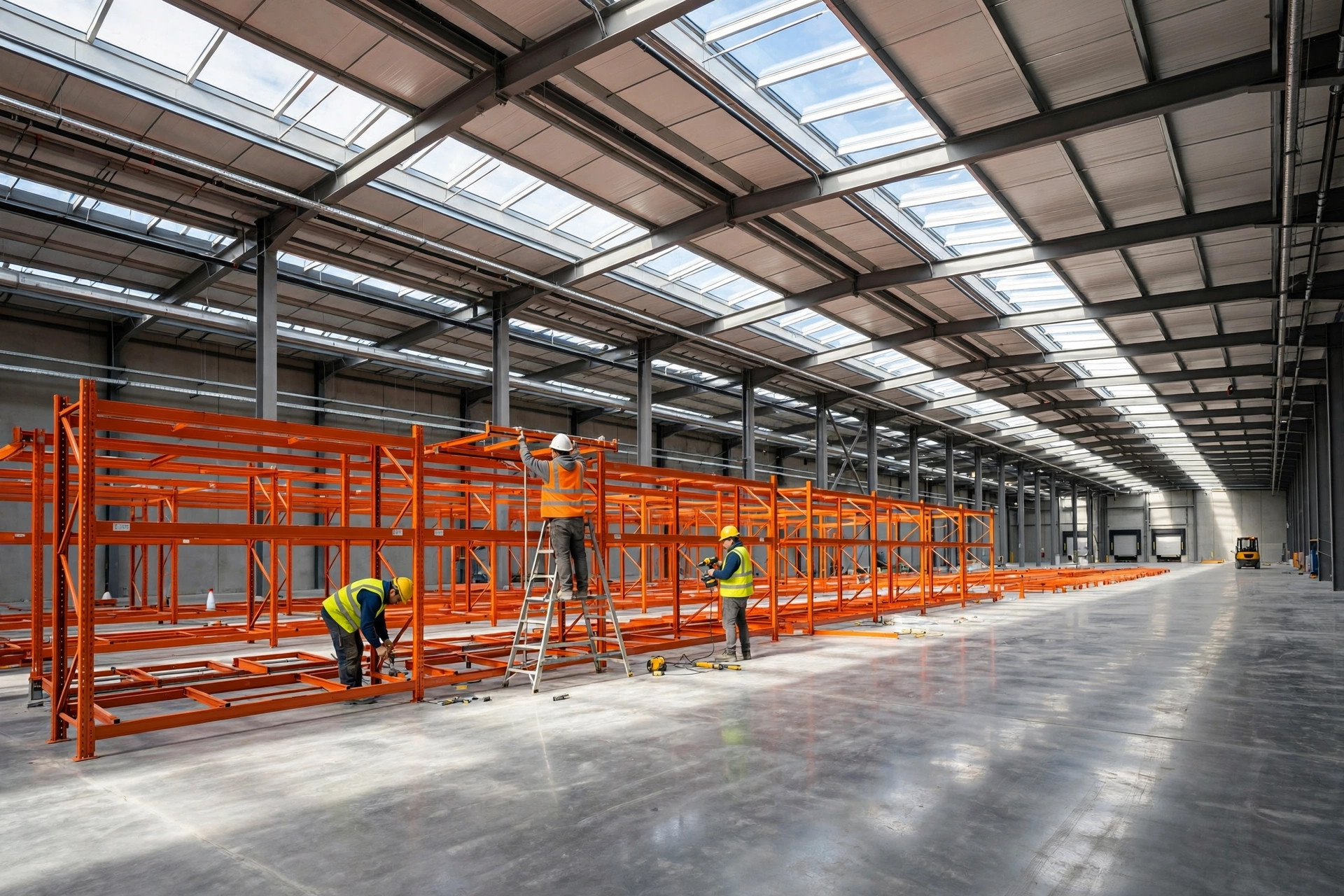
T-45 to T-16: Pre-stage the new building. Racking installed, location labels up, WMS configured, network and scanners tested — then a pilot run with C-class SKUs through the full receive, putaway, pick, and ship cycle. At this point the new building can ship; it just has no volume yet. The better the pre-staging, the less praying on cutover night. Two non-negotiables: lock the location-coding scheme during pre-staging (changing it mid-move is self-sabotage), and configure the new building's org structure, user permissions, and label templates in the WMS early — not at 2 a.m. on cutover night when you discover labels won't print.
T-15 to T-3: Move in batches. C, then B, then A. Each batch gets received and put away at the new building the same day it leaves the old one; the books balance daily. Run trucks on a fixed cadence — say six round trips a day — so nothing sits in an "in-transit black hole." One manifest per truck, signed by the driver, the loader, and the unloader; shrinkage responsibility gets locked the same day.
T-2 to T+14: Cutover and tail cleanup. Pick your lowest-volume weekend for the system cutover: Friday 8 p.m. the old building stops taking orders (storefront switches to pre-order or delayed-ship mode), and by early Sunday the new building ships its first order. The 14 days after are the dual-watch period: two people stay at the old building for tail inventory and returns while the whole team watches exception orders at the new one. At T+14 the books are clean and the old keys go back.
Two Moves, Two Outcomes
The win: November 2024, Dallas, Texas — a 50,000 sq ft 3PL. Order intake stopped Friday at 8 p.m.; the first order shipped from the new building Sunday at 4 a.m. Forty-eight hours, zero downtime. The bill: $76,000 for two months of parallel rent, $42,000 for the weekend-premium move — $118,000 total, zero penalties, zero customer complaints. The owner's words: "The least painful $118,000 I've spent all year."
The loss: April 2025, Ontario, California — a self-operated home-goods e-commerce DC. About 9,000 SKUs, 4,000 orders a day. To save parallel rent, they moved over three weeks with two live WMS books. Week three blew up: the same SKU had stock in both buildings, 400+ orders oversold, and it took 16 days to reconcile. Direct damage: $31,000 in refunds, $17,000 in marketplace penalties, $24,000 in overtime catch-up — plus one major customer worth 30% of revenue, gone. The $78,000 of rent they saved became a $200,000+ bill.
The difference between the two? Respect for the books. Big-bang bets on 48 hours of execution. Phased bets on three weeks of never breaking the books — an order of magnitude harder.
The Counterintuitive Take: Parallel Rent Is the Cheapest Line Item
On a relocation budget, parallel rent looks like the most offensive line: $39,000 a month, $78,000 for two, pure "waste." But it buys the only certain thing in the entire move — optionality. With overlap, you can pilot, correct, and cut over calmly. Without it, every step has to be right the first time.
The formula: parallel cost X = 2 × monthly rent; downtime loss Y = daily order margin × downtime days + penalties + reconciliation. Whenever Y > X, overlap wins — and in every real facility I've modeled, Y > X always holds, usually by 1.5x or more.
Here's your computable rule: take your "average daily order margin × 3" and compare it to "one month's rent on the new building." If the first number is bigger, run the two-month overlap without hesitation. If it's negligible — a dead-storage building that barely moves — you didn't need this article anyway. The biggest cost of a warehouse move was never the mover's quote. It's downtime. Money spent on certainty is never money wasted.
By Lao Zhou, Logistics Cost Analyst